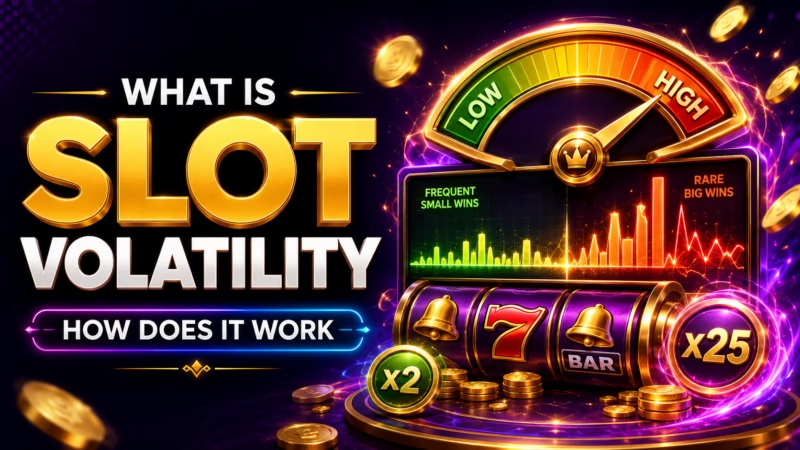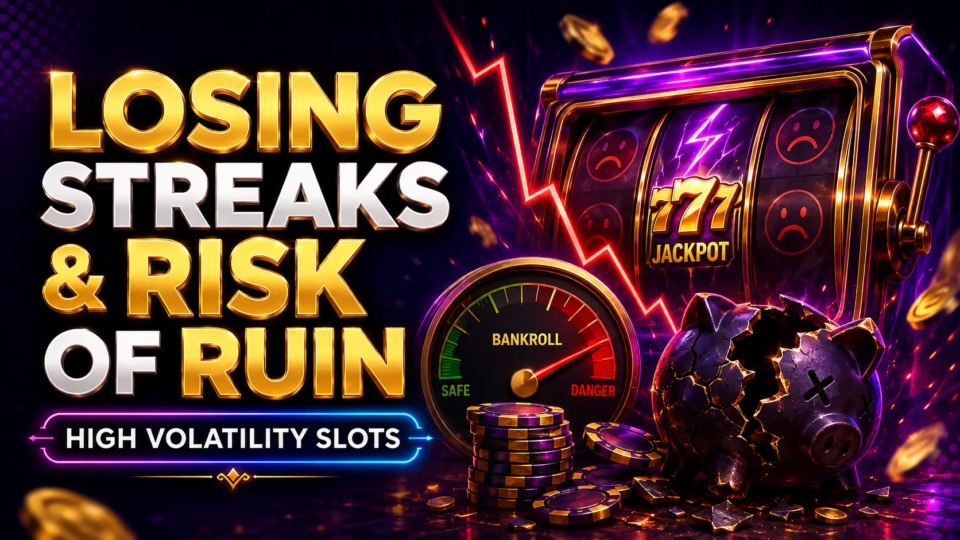
High volatility slots can produce long stretches of weak results because their payout distribution is usually more uneven than that of lower-volatility games. A player may see several small wins, many losing spins, or a long period without a meaningful payout before a larger result appears. None of these patterns means that a large win is becoming more likely.
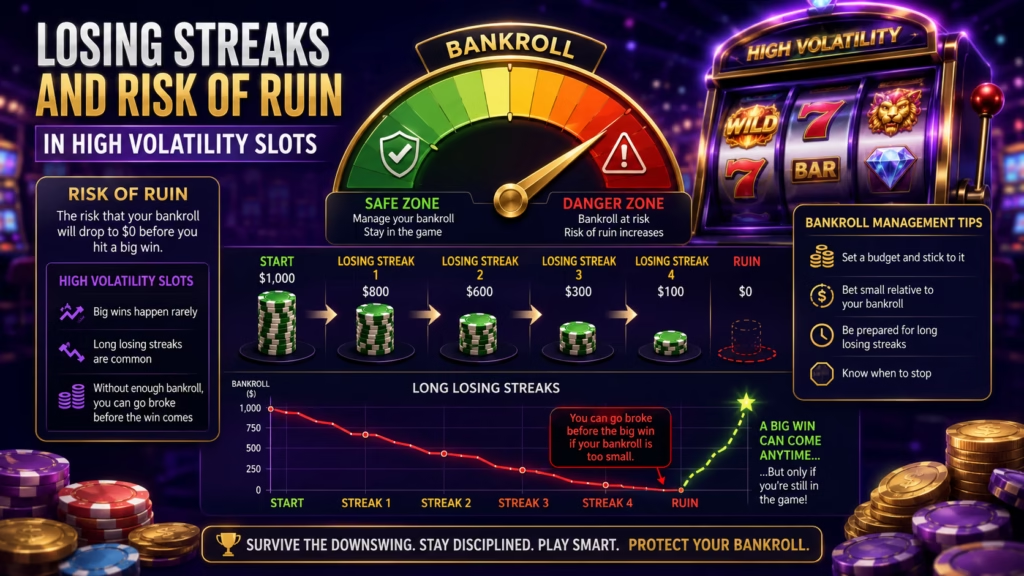
The risk of ruin in slots is the risk of using the entire bankroll before the session ends or before a meaningful payout occurs. In high-volatility slots, that risk can rise quickly when the bet is large relative to the available bankroll.
Quick takeaways
- High volatility means results can vary widely over a relatively small number of spins.
- Losing streaks do not make the next spin more likely to win.
- Volatility and hit frequency are related concepts, but they are not the same metric.
- Bet size relative to bankroll is one of the biggest practical factors affecting risk of ruin.
- RTP describes long-term theoretical return and does not predict the result of an individual session.
- High-volatility slots are generally more suitable for players who accept uneven results and set strict spending limits.
Players with small budgets or anyone uncomfortable with extended losing periods should be particularly cautious with high-volatility slots. The combination of large bets, fast play and uneven payouts can exhaust a bankroll faster than expected.
What Is a Losing Streak in a High Volatility Slot?
A losing streak in a slot is a sequence of spins that produces no win or, in practical bankroll terms, fails to return enough money to offset the amount being wagered.
The distinction matters because a slot may register a technical “win” that pays less than the original bet. For example, a $1 spin returning $0.40 may trigger winning animations, but the bankroll has still decreased by $0.60.
For bankroll management, players should therefore look at net results, not only the number of winning spins displayed by the game.
High volatility can make these negative stretches feel more extreme because a larger share of the game’s theoretical return may be concentrated in less frequent or higher-value outcomes. However, volatility alone does not tell you exactly how many consecutive losses to expect.
Why High Volatility Slots Can Feel So Unforgiving
High-volatility slots are designed around a wider range of possible outcomes. The difference between an ordinary spin and one of the game’s strongest payouts can be substantial.
This creates an uneven playing experience. A session might contain many low-value outcomes while a relatively small number of spins account for much of the money returned.
That does not mean every high-volatility slot has an extremely low hit frequency. Volatility measures the distribution and variation of payouts, while hit frequency measures how often a defined winning combination occurs.
Two games can therefore both be classified as highly volatile while behaving differently during ordinary play.
One might produce regular small returns mixed with rare large wins. Another might have longer periods without any significant return.
The game’s paytable, mathematical model and published information should be checked when available instead of assuming that every high-volatility slot behaves the same way.
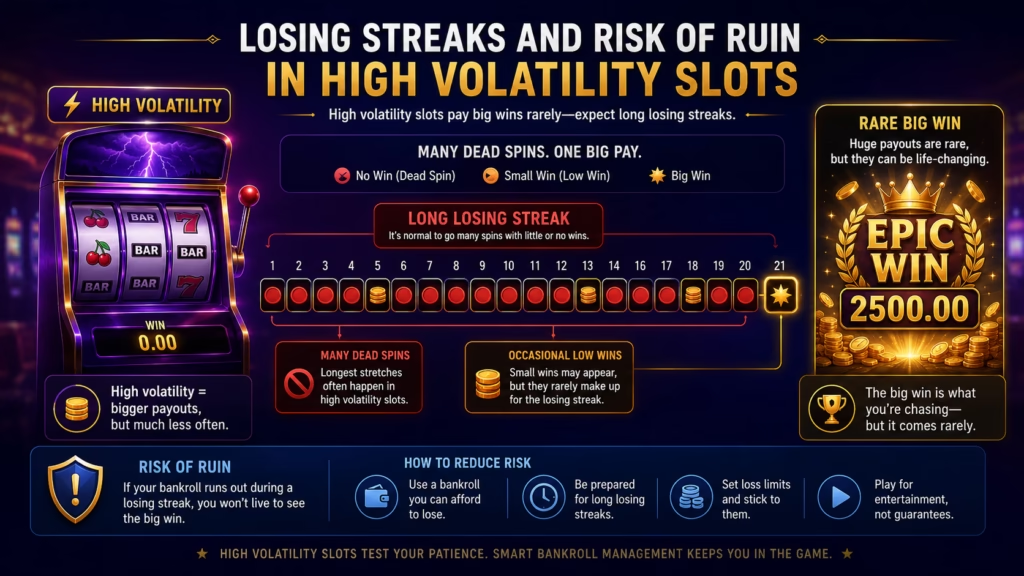
Losing Streaks Are Not Evidence That a Win Is Due
A long losing streak does not make the next spin more likely to produce a large payout.
Modern slot outcomes are generally determined independently by the game’s random number generation system according to its programmed rules. Previous losses do not create a debt that the slot needs to repay to one specific player.
This makes the idea that a slot is “due” one of the most dangerous misunderstandings during a losing session.
Consider a simple hypothetical situation where an independent event has a fixed probability of producing a particular result. If that result has not appeared for many attempts, the probability on the next independent attempt does not automatically increase because of the previous failures.
Slots are considerably more complex than a simple coin toss, but the same principle matters: past losing spins are not a reliable signal for predicting the next spin.
What Is Risk of Ruin in Slots?
Risk of ruin is the probability or practical danger that a player’s allocated bankroll will be exhausted before they decide to stop playing.
For slots, risk of ruin depends on several factors rather than volatility alone:
- starting bankroll;
- bet size;
- number of spins;
- payout distribution;
- game volatility;
- hit frequency and win values;
- bonus mechanics;
- session length;
- decisions to increase or decrease the wager.
A bankroll of $100 behaves very differently when wagering $0.20 per spin than when wagering $5 per spin.
At $0.20 per spin, the bankroll initially represents 500 bets. At $5 per spin, the same bankroll represents only 20 bets.
That does not mean the player receives exactly 500 or 20 spins, because wins may extend the session. It simply shows how strongly bet size changes the amount of short-term variance a bankroll can absorb.
Why Bet Size Matters So Much
The ratio between bankroll and bet size is one of the simplest ways to understand short-term risk.
| Bankroll | Bet per Spin | Bankroll in Starting Bets |
| $100 | $0.20 | 500 |
| $100 | $0.50 | 200 |
| $100 | $1 | 100 |
| $100 | $2 | 50 |
| $100 | $5 | 20 |
These numbers are not predictions of session length. They are a way of comparing exposure.
A player starting with only 20 bets has much less room to absorb normal negative variance than a player starting with several hundred bets.
This difference becomes particularly important in high-volatility slots because meaningful payouts may be separated by substantial stretches of weak results.
How Long Can Losing Streaks Last?
There is no universal maximum losing streak for high-volatility slots.
The exact distribution depends on the mathematics of the individual game. A volatility label such as “high” does not reveal enough information to calculate a precise maximum or typical losing sequence.
If the probability of a particular type of win were known and each trial could be treated independently, the probability of missing that event repeatedly could be modeled mathematically.
For a simplified event with probability p, the probability of failing to hit that event on n independent attempts would be:
(1 – p)^n
Real slot analysis is more complicated because games can contain many payout sizes, different symbol combinations, bonus features and returns smaller than the original wager.
This is why a published hit frequency, when available, should not automatically be interpreted as the probability of finishing a spin with a net profit.
RTP Does Not Protect a Short Session
RTP, or return to player, is a theoretical long-term percentage built into the game’s mathematical model. RTP does not guarantee that a player will recover approximately that percentage during a single session.
A slot with a theoretical RTP of 96%, for example, is not promising that every $100 deposited will produce $96 back.
Individual results can fall far above or below the theoretical percentage.
This short-term variation can be particularly noticeable in high-volatility games because the theoretical return may depend partly on relatively uncommon higher-value outcomes.
The exact RTP can also vary between versions of the same game or between operators, so players should check the paytable or game information before playing.
RTP vs Volatility vs Hit Frequency
RTP, volatility and hit frequency describe different parts of a slot’s mathematical behavior.
RTP
RTP estimates the proportion of wagers theoretically returned to players across a very large number of game rounds under the game’s mathematical model.
It does not show how smoothly that return is distributed.
Volatility
Volatility describes how variable payouts can be.
Higher volatility generally means greater short-term variation between weak and strong results.
Hit frequency
Hit frequency describes how often a game produces a result that meets the developer’s definition of a win or hit.
A high hit frequency does not necessarily mean a profitable session because many winning combinations can return less than the original stake.
Looking at all three concepts provides a more useful picture than relying on RTP alone.
How Bonus Features Affect Losing Streaks
Bonus rounds can make high-volatility slots feel even more uneven when an important part of the payout potential is concentrated inside free spins, multipliers or other features.
A player might spend a substantial number of spins waiting for a bonus trigger. Even when the feature appears, its payout is not guaranteed to be large.
This is an important distinction. Triggering free spins is not equivalent to winning a jackpot, recovering previous losses or receiving the advertised maximum win.
Maximum win figures describe an upper possible payout under the game’s rules. They should not be interpreted as realistic session targets.
Bonus rules, RTP configurations and feature availability can vary, so the official paytable and operator terms should be checked.
Bonus Buys Can Increase Bankroll Exposure
A bonus buy can dramatically increase the amount placed at risk in a single game round.
Instead of paying for ordinary spins until a feature appears naturally, the player pays a multiple of the normal stake to access the feature immediately.
Buying the feature does not guarantee that its payout will exceed its purchase price.
This can produce large bankroll swings because several expensive bonus purchases with weak returns can consume funds much faster than low-stake base-game play.
Players considering bonus buys should check the purchase cost, applicable RTP information, possible payout range and casino rules before using the feature.
Why Chasing Losses Increases Risk of Ruin
Increasing the wager after a losing streak does not change the random nature of the next spin.
It does increase the amount of bankroll exposed to that spin.
For example, a player who starts at $0.50 per spin and begins wagering $2 after losing money has reduced the number of additional bets their remaining bankroll can support by 75%.
The slot has not become more favorable because the stake increased.
Loss chasing can therefore turn an uncomfortable losing session into bankroll exhaustion very quickly, especially in a high-volatility game.
A predetermined spending limit is more useful than attempting to recover losses through progressively larger wagers.
Practical Ways to Control Risk
Risk cannot be removed from slot play, but the amount of money exposed can be controlled.
Keep the wager small relative to the bankroll
Smaller bets allow the bankroll to withstand more short-term variation.
This does not improve RTP or make winning more likely. It simply reduces how quickly a fixed bankroll can be exhausted.
Set a loss limit before starting
A session limit works best when it is decided before any wins or losses occur.
Changing the limit because a large win feels “close” defeats its purpose.
Avoid increasing bets to recover losses
Higher wagers increase exposure but do not make the next result more predictable.
Separate entertainment money from essential money
Money required for rent, bills, debt payments, food or other financial commitments should not be used for gambling.
Check the game’s information
Where available, review:
- RTP;
- volatility;
- minimum and maximum stake;
- paytable;
- bonus rules;
- feature-buy cost;
- jackpot conditions;
- maximum win conditions.
These details help explain the game’s structure, although none can predict a specific session.
High Volatility vs Low Volatility During Losing Sessions
High and low volatility slots can feel very different even when their RTP values are similar.
| Factor | Lower Volatility | Higher Volatility |
| Short-term fluctuations | Usually smaller | Usually larger |
| Payout distribution | Often more even | Often more uneven |
| Bankroll swings | Typically milder | Can be substantial |
| Large payouts | Usually less central | May represent more of the game’s appeal |
| Suitability for small bankrolls | Often easier to manage | Requires greater caution |
These are general characteristics rather than guarantees for every game.
Players should not assume that a low-volatility slot cannot produce losing streaks or that every high-volatility slot will eventually produce a large win.
Both remain games of chance.
Common Myths About Losing Streaks
“The slot has taken enough money and must pay soon”
A slot does not need to compensate one player for previous losses. Previous spins do not create a guaranteed future payout.
“A long losing streak means the jackpot is getting closer”
A losing streak does not reveal when a random jackpot or major payout will occur unless the game uses a specifically defined mechanic that says otherwise.
“Higher bets improve the chance of recovering losses”
Higher bets increase the amount won when an applicable payout occurs, but they also increase the amount lost on unsuccessful spins. They do not automatically improve the underlying probability of a favorable outcome.
“High RTP prevents bankroll ruin”
High RTP does not eliminate short-term variance. A high-RTP game can still produce a severely negative individual session.
“The maximum win tells me what I can realistically expect”
Maximum win is an upper payout limit or maximum possible outcome under specific game rules. It does not indicate the typical payout from a session.
Who May Prefer High Volatility Slots?
High-volatility slots may appeal to players who understand that results can be uneven and who prefer games built around stronger but less predictable payout potential.
They are usually less comfortable for players who want frequent feedback, dislike extended losing periods or have a bankroll that cannot absorb large swings.
Anyone choosing a high-volatility game should treat the stake as entertainment spending rather than money expected to produce a financial return.
If losing streaks cause frustration, repeated deposits, larger wagers or attempts to recover previous losses, stopping the session is more sensible than changing strategy.
How to Compare High Volatility Slots Before Playing
When comparing high-volatility games, do not select a slot only because it advertises an unusually large maximum win.
A more useful comparison includes:
- RTP configuration.
- Volatility classification.
- Minimum stake.
- Paytable structure.
- Bonus frequency information, if disclosed.
- Bonus-buy price, if available.
- Maximum payout conditions.
- Jackpot structure.
- Operator-specific game configuration.
The paytable and official game information are the most appropriate places to verify these details.
The goal is not to find a slot that guarantees better results. The goal is to understand how much variance and bankroll exposure a particular game may involve.
How This Information Was Reviewed
The guidance in this article is based on the relationship between slot volatility, payout distribution, bankroll size, bet size, RTP and short-term variance.
Exact risk of ruin cannot be determined from a generic “high volatility” label alone. Calculating it accurately would require detailed information about the individual game’s mathematical distribution and the player’s betting rules.
Players should verify RTP, volatility information, paytable rules, feature costs and operator-specific conditions before playing.
RTP, volatility, bonus features and previous results cannot guarantee the outcome of future spins. Slots should be treated as paid entertainment rather than a way to generate income.
If gambling stops being enjoyable, spending limits are repeatedly exceeded, or losses are being chased, the appropriate action is to stop playing.
FAQ
Can high volatility slots have long losing streaks?
Yes. High-volatility slots can produce substantial short-term swings, including long periods with little meaningful return. The exact frequency and duration of losing streaks depend on the mathematical model of the individual game, so a volatility label alone cannot predict how many losing spins will occur.
What is risk of ruin in slots?
Risk of ruin is the risk that a player’s allocated bankroll will be exhausted during play. It is influenced by bankroll size, bet size, volatility, payout distribution, session length and betting behavior. Increasing the wager relative to the remaining bankroll generally increases short-term exposure.
Does a losing streak mean a slot is about to pay?
No. Previous losing spins do not make a future win guaranteed or create an obligation for the slot to compensate the player. Each outcome remains governed by the game’s programmed random process and rules.
How many losing spins can happen in a row?
There is no universal maximum that applies to all slots. The answer depends on the game’s probability distribution and on what is defined as a loss. Volatility alone is not sufficient to calculate a precise losing-streak limit.
Does RTP reduce the chance of losing my bankroll?
A higher RTP can indicate a lower theoretical long-term house advantage, but it does not protect an individual bankroll from short-term losses. A player can still lose an entire session bankroll in a high-RTP slot because individual results vary widely.
Is hit frequency the same as volatility?
No. Hit frequency describes how often qualifying wins occur, while volatility describes the size and variability of payouts. A game can register frequent small wins and still have significant volatility if much of its payout potential depends on uncommon larger outcomes.
Does lowering the bet improve my odds?
Lowering the bet normally does not change the underlying probability of the spin unless the game’s rules specifically say otherwise. It can, however, reduce the amount of bankroll exposed per spin and allow the same bankroll to withstand more losing rounds.
Should I increase my bet after several losses?
No mathematical advantage is created simply by increasing the bet after losses. A larger wager exposes more money to the next random outcome and can increase the risk of exhausting the remaining bankroll.
Can bonus buys reduce losing streaks?
A bonus buy can provide immediate access to a feature, but it does not guarantee a profitable result or recovery of previous losses. Because bonus purchases can cost many times the normal stake, repeated purchases may increase bankroll volatility and risk of ruin.
Are high volatility slots suitable for small bankrolls?
They require particular caution with small bankrolls because larger short-term swings can exhaust limited funds quickly. Players who still choose them should keep stakes small relative to the amount they are prepared to lose and avoid chasing losses.
In short
High volatility slots losing streaks are a normal consequence of uneven short-term results, not evidence that a large win is becoming due. Risk of ruin rises when the wager is large relative to the bankroll, especially during extended sessions or when losses are chased.
RTP, volatility and hit frequency help describe how a slot behaves, but none predicts the next spin or guarantees a particular session result. The practical way to control exposure is to use fixed spending limits, keep bet sizes proportionate to the bankroll and treat slot play strictly as entertainment.