Slot volatility affects how sharply a bankroll can rise or fall during a playing session. Low-volatility slots generally produce smaller, more frequent payouts, while high-volatility slots tend to concentrate more of their payout potential into less frequent wins. As a result, two slots with similar RTP figures can create very different bankroll swings and session lengths.
The practical relationship between slot volatility and bankroll is simple: higher volatility usually requires greater tolerance for losing streaks and larger balance fluctuations. Lower volatility can make a fixed bankroll last through more spins, although no volatility level guarantees a particular session length or result.
Key points:
- Low-volatility slots usually create smaller bankroll fluctuations.
- High-volatility slots can produce longer periods without meaningful wins.
- A larger bankroll does not change the mathematical odds of an individual spin.
- Bet size can affect session length as much as volatility.
- RTP and volatility describe different characteristics and cannot predict a specific session.
Players with a limited entertainment budget or those who prefer longer sessions may find lower-volatility games easier to manage. High-volatility slots may appeal more to players comfortable with uneven results and shorter sessions when their predetermined loss limit is reached.
What Is Slot Volatility?
Slot volatility describes how a game’s payouts are distributed rather than how much the game theoretically returns overall.
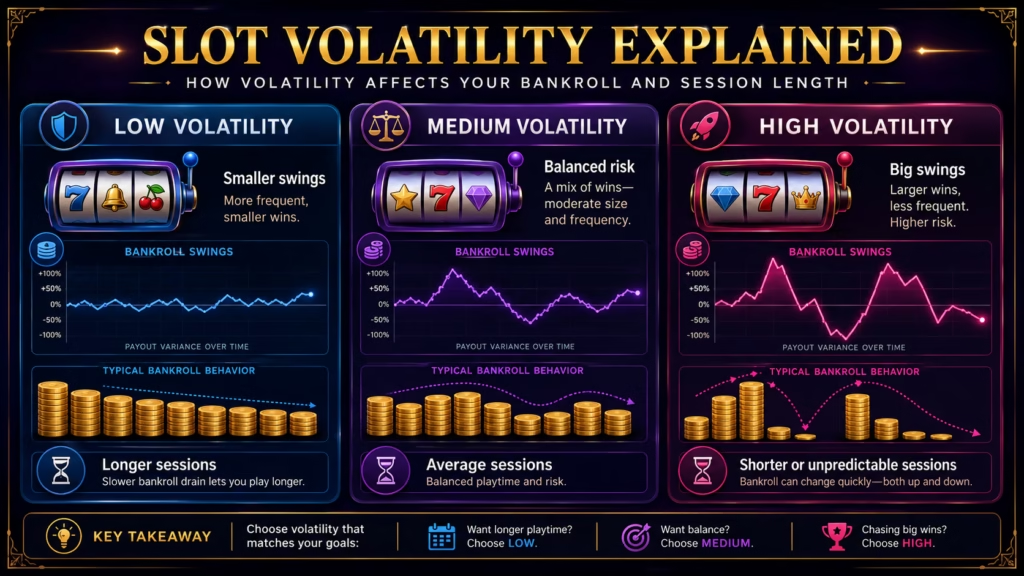
A low-volatility slot typically distributes more of its winning combinations through relatively frequent but smaller payouts. A high-volatility slot generally concentrates more payout potential into less frequent wins, sometimes including much larger individual prizes.
Medium-volatility slots sit between these two patterns.
Volatility should not be confused with RTP. Return to Player represents the theoretical proportion of wagers a game is designed to return over a very large number of plays. Volatility describes the variation around that theoretical return.
A 96% RTP slot can therefore be low, medium, or high volatility. The RTP figure alone does not show whether a player’s balance is likely to experience frequent small changes or larger short-term swings.
How Slot Volatility Affects Your Bankroll
Slot volatility affects bankroll primarily through the size and frequency of short-term fluctuations.
On a low-volatility game, frequent small payouts may repeatedly return part of a stake to the player’s balance. These payouts do not necessarily represent profit, but they can slow the rate at which a bankroll is consumed.
High-volatility slots behave differently. Because meaningful payouts may be more widely spaced, a player can experience a sequence of losing or low-return spins before encountering a significant win.
This means a bankroll that feels adequate for a low-volatility slot may disappear much faster on a high-volatility game when both are played at the same stake.
Example of Bankroll Fluctuation
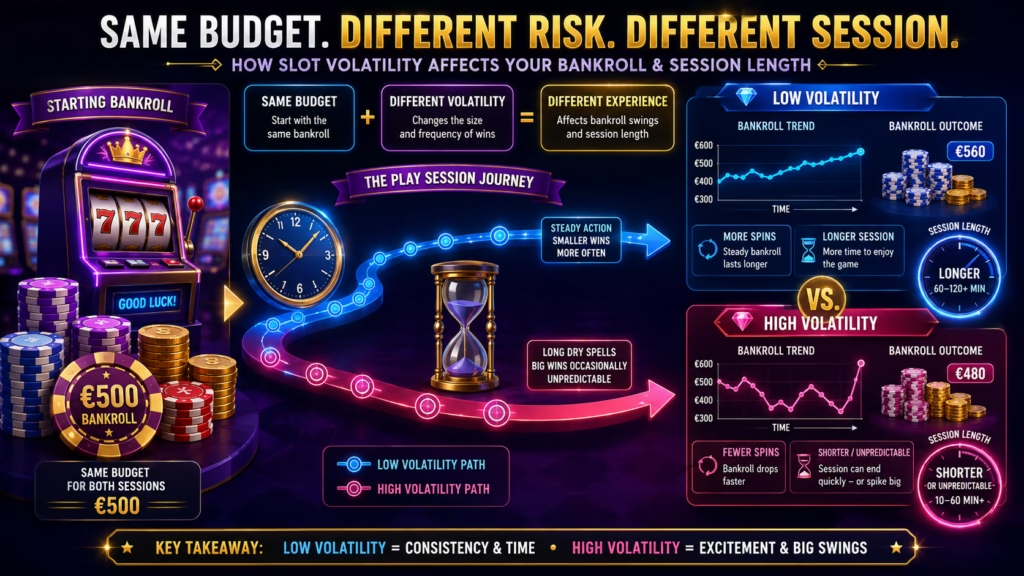
Consider two players who each start with a $100 entertainment budget and wager $1 per spin.
The first chooses a lower-volatility slot. Small wins occur relatively frequently, so the balance may move from $100 to $94, back to $101, then down to $90 and continue fluctuating.
The second chooses a high-volatility slot. The balance might fall from $100 to $70 relatively quickly before a meaningful payout occurs. It could also reach the player’s predetermined loss limit before such a payout appears.
Neither sequence can be predicted in advance. The example only illustrates how different payout distributions can affect bankroll behavior.
How Slot Volatility Affects Session Length
Slot volatility and session length are connected because payout frequency influences how quickly a bankroll may fluctuate, but volatility is not the only factor that determines how long a session lasts.
Lower-volatility slots may support longer sessions because smaller payouts can repeatedly replenish part of the balance. Higher-volatility slots can shorten a session when losing sequences consume the available bankroll before a larger payout occurs.
However, bet size is equally important.
A player wagering $5 per spin on a low-volatility game may exhaust a $100 bankroll faster than someone wagering $0.50 on a high-volatility game. Spin speed, bonus purchases, additional bets and voluntary stopping points can also change session length substantially.
The safest way to think about volatility is therefore as one component of bankroll planning rather than a session timer.
Bankroll, Bet Size and Volatility
The relationship between bankroll and volatility becomes clearer when bet size is measured as a percentage of the available balance.
| Bankroll | Bet per Spin | Stake as % of Bankroll | Spins if Every Spin Lost |
| $100 | $0.20 | 0.2% | 500 |
| $100 | $0.50 | 0.5% | 200 |
| $100 | $1.00 | 1% | 100 |
| $100 | $2.00 | 2% | 50 |
The final column is only a mathematical illustration. Real sessions contain wins and losses, so actual session length will differ.
The useful lesson is that smaller stakes provide more individual betting opportunities before a bankroll is exhausted. This can be particularly relevant on high-volatility slots, where a player may encounter longer periods without a substantial payout.
Reducing the stake does not increase RTP, improve the probability of a future win, or make the slot less volatile. It simply reduces the amount of bankroll exposed on each spin.
Low vs Medium vs High Volatility for Different Bankrolls
Low Volatility
Low-volatility slots may be more suitable for players who prioritize playing time and prefer relatively modest balance fluctuations.
They can appeal to:
- players using smaller entertainment budgets;
- beginners learning how slots behave;
- players who dislike prolonged dry periods;
- players who value frequent small wins more than occasional large payouts.
Low volatility does not mean low risk. A player can still lose an entire bankroll because every spin remains random.
Medium Volatility
Medium-volatility slots attempt to provide a middle ground between payout frequency and payout size.
They may suit players who want more payout variation than low-volatility games without deliberately choosing the more extreme bankroll swings associated with high-volatility slots.
Actual volatility classifications can differ between providers, so labels such as “medium” should be treated as general guidance rather than precise standardized measurements.
High Volatility
High-volatility slots are usually more appealing to players willing to accept greater short-term bankroll swings in exchange for the possibility of less frequent but potentially larger payouts.
The important issue is not simply having a large bankroll. A player also needs to accept the possibility that the predetermined session budget could be exhausted without triggering a major payout or bonus result.
A larger bankroll cannot force a high-volatility slot to produce a win.
Does High Volatility Mean You Need a Bigger Bankroll?
High volatility does not create an official minimum bankroll requirement, but a larger number of affordable bets can provide more room for short-term fluctuations.
The more important figure is often the relationship between bankroll and stake size.
A $500 bankroll with $10 spins provides only 50 full stakes if every spin loses. A $100 bankroll with $0.20 spins theoretically provides 500 full stakes under the same simplified assumption.
For players who want longer sessions, reducing the amount wagered per spin is usually a more direct method of controlling bankroll consumption than simply looking for a larger starting balance.
This remains budget management, not a strategy for beating the game.
RTP vs Volatility for Bankroll Management
RTP and volatility answer two different questions.
RTP asks: What percentage of total wagers is the game theoretically designed to return over a very large sample?
Volatility asks: How unevenly might those payouts be distributed?
For bankroll planning, both can be useful, but neither predicts what will happen during a single session.
A high-RTP, high-volatility slot can still consume a bankroll quickly during an unfavorable sequence. A lower-volatility game can still produce a losing session despite frequent small payouts.
Players should therefore avoid interpreting a 96% RTP as meaning they will personally receive $96 back from every $100 wagered. RTP is a long-run theoretical measure, not a promise for an individual player.
Bonus Features Can Increase Bankroll Swings
Bonus mechanics can make bankroll behavior more complicated, particularly in high-volatility slots.
Some games concentrate a significant portion of their payout potential in free spins, multipliers, jackpots, hold-and-win features or other bonus rounds. When this happens, base-game payouts may feel relatively limited while the player waits for a more valuable feature.
Bonus Buy options can create even larger immediate bankroll changes because the player pays a substantial multiple of the base stake to access a feature directly.
Buying a bonus does not guarantee that the feature will return its purchase price. Rules, RTP configurations and feature costs can vary by game and operator, so the official paytable should be checked before playing.
Common Bankroll Mistakes With High-Volatility Slots
Increasing Bets After Losses
Increasing stake size because several spins have lost does not make the next spin more likely to win.
Random slot outcomes do not compensate a player simply because the previous sequence was unfavorable. Chasing previous losses can instead expose a larger portion of the remaining bankroll.
Assuming a Bonus Is “Due”
A long period without free spins does not prove that a bonus round must appear soon.
The triggering conditions are determined by the game’s mechanics and random outcome generation. Previous unsuccessful spins do not provide a reliable prediction of the next result.
Choosing Stakes Based on Maximum Win
A slot advertising a large maximum payout can encourage players to focus on what is theoretically possible rather than how often such outcomes occur.
Maximum win potential should not determine how much money a player can afford to risk.
Treating RTP as a Session Guarantee
RTP operates over a very large statistical sample. A short session can finish far above or below the theoretical percentage.
Bankroll decisions should therefore be based on affordable losses rather than expected short-term RTP.
How to Choose Volatility Based on Your Playing Style
Choose volatility according to the experience you want and the amount you are prepared to lose, not according to an expectation of profit.
Lower volatility may make more sense when:
- extending playing time matters more than pursuing large individual payouts;
- your entertainment budget is relatively limited;
- sharp bankroll swings make the game less enjoyable;
- you prefer frequent smaller winning events.
Higher volatility may make more sense when:
- you understand that losing sequences can be substantial;
- you are comfortable ending a session when your preset limit is reached;
- occasional larger payout potential is more appealing than frequent small wins;
- your chosen stake represents only a manageable part of your entertainment budget.
No volatility category is mathematically “best” for every player.
Practical Ways to Control Session Length
The most reliable way to control session length is to set limits that do not depend on whether the slot is currently winning or losing.
Before playing, decide:
- Maximum loss: the amount you are prepared to spend entirely as entertainment.
- Maximum stake: a bet size that does not expose too much of the session budget on individual spins.
- Time limit: a predetermined point at which the session ends regardless of the balance.
- Feature spending: whether Bonus Buys, ante bets or additional wagers are included in the same budget.
- Stopping rule: do not increase the budget simply because the original amount has been lost.
These limits cannot improve the mathematical outcome of a slot. Their purpose is to control spending and prevent a short losing sequence from turning into unplanned additional gambling.
Volatility Does Not Predict Your Next Spin
Slot volatility describes a game’s overall payout pattern, not the timing of the next win.
A high-volatility slot does not become more likely to produce a large payout after a series of losses. A low-volatility slot does not guarantee that small wins will arrive at regular intervals.
Short-term results can vary dramatically from theoretical expectations because individual spins are random.
This distinction is especially important when managing bankroll. Volatility can help a player select a game that better matches their tolerance for balance fluctuations, but it cannot be used to predict or control outcomes.
How This Information Was Reviewed
The relationship between slot volatility, bankroll and session length should be evaluated using several separate factors: payout variance, wager size, available entertainment budget, game mechanics and theoretical RTP.
Exact RTP values, volatility classifications, maximum wins and bonus rules should be checked in the game’s official paytable because configurations may differ between games or operators.
RTP and volatility describe mathematical characteristics of a slot but do not guarantee results in an individual session. Slots should be treated as paid entertainment rather than a way to generate income.
If gambling stops being enjoyable, exceeds the budget you originally planned, or encourages attempts to recover losses, ending the session is the appropriate decision.
FAQ
Does High Slot Volatility Drain a Bankroll Faster?
High volatility can cause a bankroll to decline faster during an unfavorable sequence because meaningful payouts may occur less frequently. However, the actual result depends on random outcomes, stake size and game mechanics, so a high-volatility slot does not automatically produce a shorter session every time.
Are Low-Volatility Slots Better for Small Bankrolls?
Low-volatility slots may be easier to manage with smaller bankrolls because frequent small payouts can reduce short-term balance swings. Bet size is still critical, and even a low-volatility slot can exhaust a small bankroll if the stake is too large.
What Is a Good Bankroll for a High-Volatility Slot?
There is no universal bankroll amount for high-volatility slots. The important consideration is whether each wager represents a manageable proportion of money already designated for entertainment. A larger bankroll does not guarantee that a significant payout will occur.
Does Lowering My Bet Reduce Slot Volatility?
Lowering the bet normally reduces the amount of money exposed per spin, but it does not necessarily change the mathematical volatility of the game. Some slots may have mechanics affected by bet settings, so the official game rules should be checked.
Does Higher RTP Make My Bankroll Last Longer?
A higher RTP can indicate a lower theoretical house advantage over a very large number of wagers, but it does not guarantee a longer individual session. Volatility, stake size and random short-term results can have a much greater visible effect during a limited number of spins.
Can Slot Volatility Tell Me When a Big Win Is Coming?
No. Slot volatility cannot predict when a large payout will occur. It describes the general distribution of payouts across gameplay, while individual outcomes remain random.
Are High-Volatility Slots More Profitable?
No volatility level makes slots a reliable source of profit. High-volatility games may offer larger potential individual payouts, but those payouts can be less frequent. Casino slots should be treated as entertainment rather than an investment or income strategy.
Can Bonus Buys Shorten a Session?
Yes. A Bonus Buy can consume a significant portion of a bankroll immediately because the feature may cost many times the normal base-game stake. The purchased bonus is not guaranteed to return its cost, so feature prices and rules should be checked before use.
Should I Change Slots After a Losing Streak?
Changing games does not recover previous losses or improve the mathematical probability of winning them back. If a predetermined spending or time limit has been reached, stopping is more appropriate than switching games to continue chasing losses.
Short Conclusion
Slot volatility affects bankroll mainly by changing how unevenly payouts may occur. Low-volatility slots generally create smaller short-term swings, while high-volatility games can produce longer losing periods and more dramatic balance changes.
For players concerned about session length, bet size and predetermined spending limits matter at least as much as volatility. RTP and volatility can help explain how a game is designed, but neither predicts a specific session or guarantees a win. Set limits before playing and treat slot play strictly as entertainment.