
Crash game volatility describes how sharply results can change depending on when a player chooses to cash out. Unlike a slot with a fixed spin result shown immediately, a crash game displays a rising multiplier that can stop, or “crash,” at an unpredictable point. Cashing out earlier usually means smaller potential payouts with less exposure to the crash, while targeting higher multipliers increases potential payout but also increases the chance that the round ends before the cash-out point is reached.
The key points are simple:
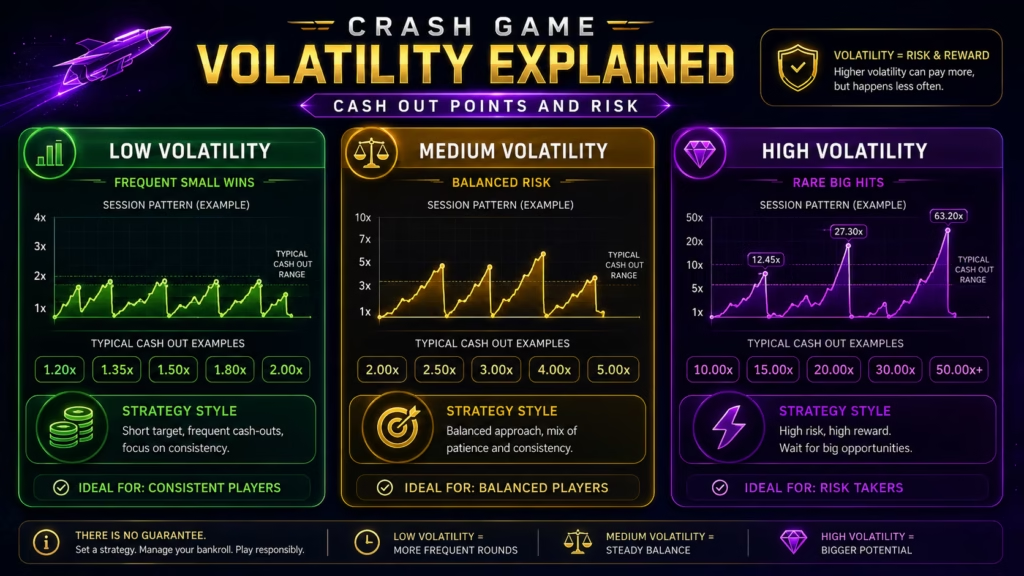
- Lower cash-out targets generally produce smaller potential returns per successful round but are reached more often.
- Higher cash-out targets offer larger potential returns but expose the bet to greater crash game risk.
- A previous crash multiplier does not reliably predict the next one.
- Changing cash-out points changes the distribution of wins and losses, not the underlying house advantage.
- Crash games should be treated as entertainment because no cash-out strategy can guarantee profit.
Crash games usually appeal to players who prefer fast rounds, simple mechanics and direct control over when to end their participation in a round. They require extra caution from players who are tempted to chase high multipliers or increase bets after losses.
What Is Crash Game Volatility?
Crash game volatility is the degree to which short-term results can fluctuate because of the combination of random crash points, bet size and the multiplier selected for cashing out.
The multiplier normally starts near 1x and rises until the round crashes. A player must cash out before that point to receive the displayed multiplier. If the crash occurs first, the active bet is lost.
For example, consider two players using the same bet size:
- Player A attempts to cash out at 1.50x.
- Player B attempts to cash out at 10x.
Player A needs the game to survive only to 1.50x. Player B needs the multiplier to continue much further. Player B therefore accepts substantially more round-level risk in exchange for a larger payout if the target is reached.
This relationship is the core of crash game volatility.
How Cash-Out Points Affect Risk
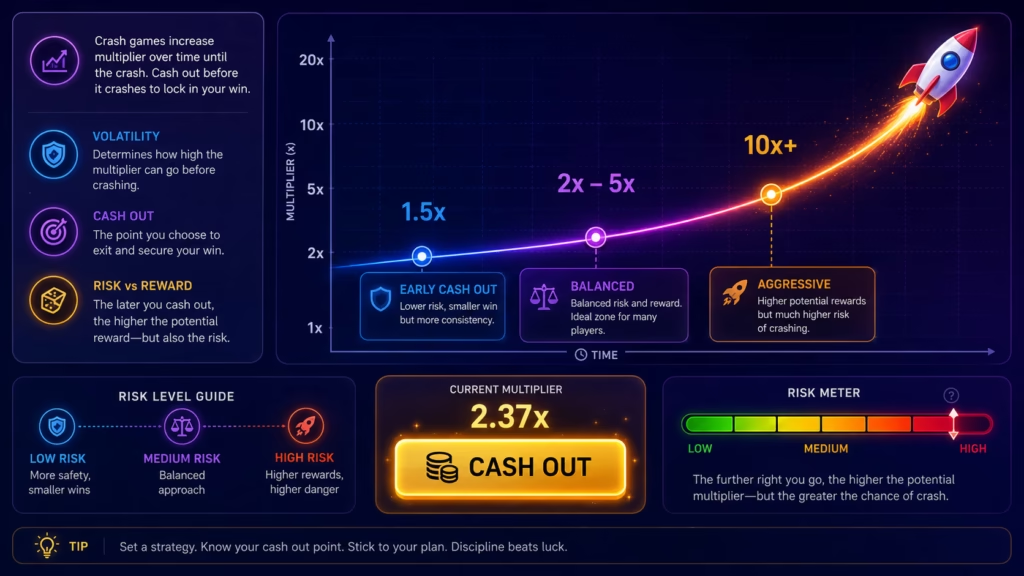
The cash-out point determines how long a bet remains exposed to the possibility of a crash.
A low target such as 1.20x or 1.50x requires only a relatively small increase before the player exits. A higher target such as 5x, 10x or 50x requires the round to survive much longer.
| Cash-out approach | Potential payout per successful round | Frequency of reaching target | Typical short-term volatility |
| Very low target | Low | Higher | Lower |
| Moderate target | Moderate | Moderate | Moderate |
| High target | High | Lower | High |
| Extreme target | Very high | Much lower | Very high |
The table describes the general risk relationship rather than guaranteed probabilities. Exact multiplier distributions depend on the rules and mathematical model of the individual crash game.
A lower cash-out point is therefore not automatically a “better” strategy. It simply exchanges payout size for a greater likelihood of reaching the target. A high cash-out point makes the opposite tradeoff.
Why Higher Multipliers Carry More Crash Game Risk
Higher multiplier targets carry more crash game risk because every additional increase in the multiplier requires the round to continue without crashing.
Suppose a player wants to exit at 2x. Any round that crashes at 1.99x or lower loses the bet. A player targeting 10x loses not only those rounds, but also every round that crashes anywhere between 2x and 9.99x.
The possible reward becomes larger as the target increases, but the number of crash points capable of defeating the target also increases.
This is why a spectacular 50x or 100x multiplier should not be interpreted as evidence that targeting those levels is profitable. Large multipliers can occur, but their existence does not remove the much greater probability of a round ending earlier.
Low Cash-Out Strategy Versus High Cash-Out Strategy
Low and high cash-out strategies mainly change the pattern of results.
Low cash-out targets
Players choosing low targets often prefer more frequent successful exits and smaller multiplier gains. A target such as 1.20x to 2x creates relatively limited exposure to each individual round compared with waiting for much larger multipliers.
However, frequent successful cash-outs can create a misleading sense of safety. One losing round can erase several small gains, particularly when the chosen multiplier is close to 1x.
A low target therefore reduces volatility but does not remove the house edge or guarantee a profitable session.
High cash-out targets
High targets produce a very different experience. A player may experience several or many losing rounds while waiting for a multiplier large enough to reach the chosen target.
When the target is reached, the payout can compensate for multiple previous losses depending on the target, bet sizes and game mathematics. The problem is that there is no guarantee the required multiplier will arrive before the player exhausts the amount allocated to play.
High multiplier chasing is therefore more suitable only for players who understand the possibility of long losing sequences and are prepared to accept them as part of the game’s risk profile.
Does a Low Cash-Out Point Reduce the House Edge?
Choosing a lower cash-out multiplier usually changes volatility rather than eliminating the game’s mathematical advantage.
In many crash game models, the relationship between potential payout and probability is designed so that different target multipliers retain a built-in operator advantage over a sufficiently large number of rounds. The exact formula can vary between games, so the official game rules should be checked before drawing conclusions about a specific title.
For example, moving from a 5x target to a 1.50x target may make successful cash-outs more frequent. It does not mean the player has discovered a way to overcome the mathematical design of the game.
Cash-out timing should therefore be viewed as a risk preference, not as a method for creating guaranteed positive expected returns.
Automatic Cash Out Versus Manual Cash Out
Automatic cash out allows a player to specify a multiplier before the round begins. If the game reaches that multiplier, the bet is automatically settled according to the game’s rules.
Manual cash out requires the player to decide during the round.
Auto cash out can be useful because it removes hesitation at the target point. A player who decided beforehand to exit at 2x does not have to reconsider when the multiplier reaches 1.95x and continues climbing.
Manual cash out provides more flexibility, but that flexibility can encourage emotional decisions. A player may originally plan to exit at 2x, then wait for 3x, 5x or higher because the multiplier is still rising.
Neither method predicts the crash point. Auto cash out is mainly a tool for executing a predefined decision consistently.
Why Previous Crash Results Do Not Predict the Next Round
A sequence of low or high crash multipliers does not by itself prove that the next multiplier is “due” to behave differently.
Players sometimes see several early crashes and assume a large multiplier must follow. The opposite mistake occurs after a very high multiplier, when a player assumes another large result cannot happen soon.
These beliefs resemble the gambler’s fallacy. In a properly implemented random or provably fair crash game, historical display patterns should not be treated as a reliable prediction system for future independent results.
The practical conclusion is important: changing a bet because the chart “looks ready” for a high multiplier adds speculation rather than dependable information.
The Risk of Martingale and Loss-Chasing Strategies
Increasing bets after losses can dramatically increase crash game risk.
A common approach is to double or otherwise increase the next wager after a failed cash-out attempt. The idea is that a later successful round will recover earlier losses.
The weakness is that consecutive losses remain possible. As the bet grows, the amount required to continue the sequence can rise quickly. Casino betting limits and the player’s own bankroll also create hard limits on how long such a progression can continue.
A betting progression changes how losses are distributed. It does not make an unpredictable crash point predictable.
Players should avoid treating Martingale-style systems as a way to guarantee recovery.
How Bankroll Size Changes the Experience
Bankroll size affects how much short-term volatility a player can absorb, but it does not change the probability of an individual crash result.
A player making $1 bets from a $100 entertainment budget has much more room for losing rounds than someone making $20 bets from the same amount. The underlying game has not changed. Only the amount of money exposed per round has changed.
A useful way to think about bet sizing is to decide the maximum amount that can be lost during the session first, then choose a wager small enough that normal losing sequences do not immediately consume that amount.
This is a risk-control decision rather than a strategy for increasing expected profit.
Choosing a Cash-Out Point Based on Risk Preference
There is no universal cash-out multiplier that is best for every player.
A sensible choice depends mainly on the type of experience a player accepts:
- Players uncomfortable with long losing streaks may prefer relatively low cash-out targets.
- Players willing to accept fewer successful rounds in exchange for larger potential payouts may prefer higher targets.
- Players who repeatedly abandon their planned target while watching the multiplier rise may benefit from automatic cash out.
- Players who feel pressure to recover losses should stop rather than raise the multiplier target or bet size.
The most important decision should happen before the round starts. Decide the bet, target and maximum session loss while there is no rapidly rising multiplier encouraging an emotional change.
Common Crash Game Volatility Myths
“Several low crashes mean a high one is coming”
Previous results do not create a dependable countdown to a high multiplier. Historical streaks can look meaningful even when they provide no predictive advantage.
“Cashing out at 1.10x is almost risk-free”
A very low target reduces exposure compared with a high target, but the bet can still lose if the game crashes before that multiplier. “Low risk” and “risk-free” are not the same thing.
“Waiting longer improves the value of the bet”
Waiting increases the multiplier available if the cash out succeeds. It simultaneously increases the chance of losing the entire active bet before reaching the target.
“A betting system can compensate for volatility”
Bet sizing can change the severity of winning and losing sequences, but it cannot guarantee that the next crash point will reach the required multiplier.
“A large bankroll makes high multipliers safer”
A larger bankroll may allow someone to withstand more losing rounds. It does not make a 10x, 50x or 100x target more likely to occur.
Practical Ways to Control Crash Game Risk
Crash game risk is best controlled by limiting financial exposure rather than trying to predict multiplier movement.
Before playing, consider these rules:
- Set a fixed session budget. Use only money allocated to entertainment and assume the full amount could be lost.
- Choose the cash-out target in advance. Avoid repeatedly moving the target higher because a round looks promising.
- Keep bet sizes proportionate to the session budget. Large wagers make ordinary losing streaks more damaging.
- Do not increase bets simply to recover losses. Loss chasing can accelerate bankroll depletion.
- Use available responsible gambling tools. Deposit limits, loss limits, time limits and self-exclusion options may be available depending on the operator.
- Stop when playing stops being entertainment. Frustration, urgency and attempts to recover money are reasons to end the session rather than change strategy.
Crash games remain games of chance regardless of the cash-out target selected.
How This Information Was Reviewed
This explanation evaluates crash game volatility through four practical factors: cash-out target, probability exposure, bet sizing and the effect of losing sequences.
The exact probability distribution, house edge, maximum multiplier, auto cash-out rules and other parameters can differ between crash games. Players should therefore check the official rules, game information and operator terms for the specific title they are considering.
RTP, volatility and previous multiplier history do not predict the result of an individual round. A crash game should be treated as paid entertainment rather than a method of generating income. Anyone finding it difficult to maintain predetermined spending or time limits should stop playing and consider the responsible gambling controls available to them.
FAQ
What does volatility mean in a crash game?
Crash game volatility describes how widely short-term results can fluctuate. Higher cash-out targets normally create greater volatility because successful exits occur less frequently but produce larger multiplier payouts when reached.
Is a lower cash-out multiplier safer?
A lower cash-out multiplier generally reduces round-level risk because the game needs to survive for less time before the target is reached. It does not eliminate the possibility of losing or remove the house advantage.
What is the best cash-out point in a crash game?
There is no universally best cash-out point. Lower targets generally favor more frequent smaller cash-outs, while higher targets favor less frequent larger potential payouts. The appropriate choice depends on risk tolerance, and neither approach guarantees profit.
Does cashing out at 2x give a 50% chance of winning?
Not necessarily. Exact probabilities depend on the mathematical model and house edge of the specific crash game. The game’s official rules should be checked rather than assuming that a displayed multiplier translates directly into a particular probability.
Can crash game history predict the next multiplier?
Past crash multipliers should not be treated as a reliable predictor of the next independent result. A streak of low multipliers does not guarantee that a high multiplier is due next.
Is auto cash out better than manual cash out?
Auto cash out can be better for enforcing a predetermined target because the player does not need to make a decision while the multiplier is moving. It does not improve the randomness of the result or guarantee that the chosen multiplier will be reached.
Does changing the cash-out target change RTP?
Changing the target can change the pattern and volatility of results, but it does not necessarily improve the game’s theoretical return. Exact RTP and house-edge mechanics depend on the specific crash game and should be verified in its rules.
Can Martingale work in crash games?
Martingale cannot guarantee profit in crash games. Consecutive losses can force wager sizes to increase rapidly, while bankroll and casino betting limits eventually restrict the progression.
Are high multipliers worth targeting?
High multipliers provide larger potential payouts but come with a lower chance of being reached. They are therefore associated with greater volatility and potentially long losing sequences. They should not be treated as a shortcut to profit.
How can players reduce crash game risk?
Players can reduce financial exposure by using smaller bets, setting a fixed session budget, choosing cash-out targets before each round and refusing to chase losses. These measures control spending but cannot remove the underlying randomness of the game.
Brief Conclusion
Crash game volatility is primarily a tradeoff between cash-out frequency and potential payout size. Lower targets generally create more frequent smaller exits, while higher targets expose the bet to greater risk in pursuit of larger multipliers.
No cash-out point predicts or controls the crash. Bet size, automatic cash out and bankroll limits can change how volatility affects a session, but they cannot guarantee a positive result. Crash games are best approached with predetermined spending limits and treated strictly as entertainment.