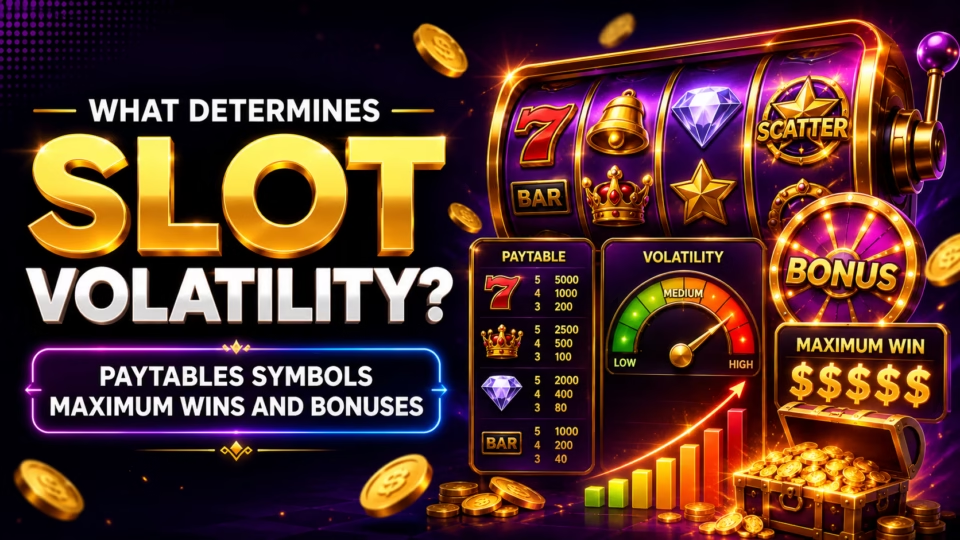
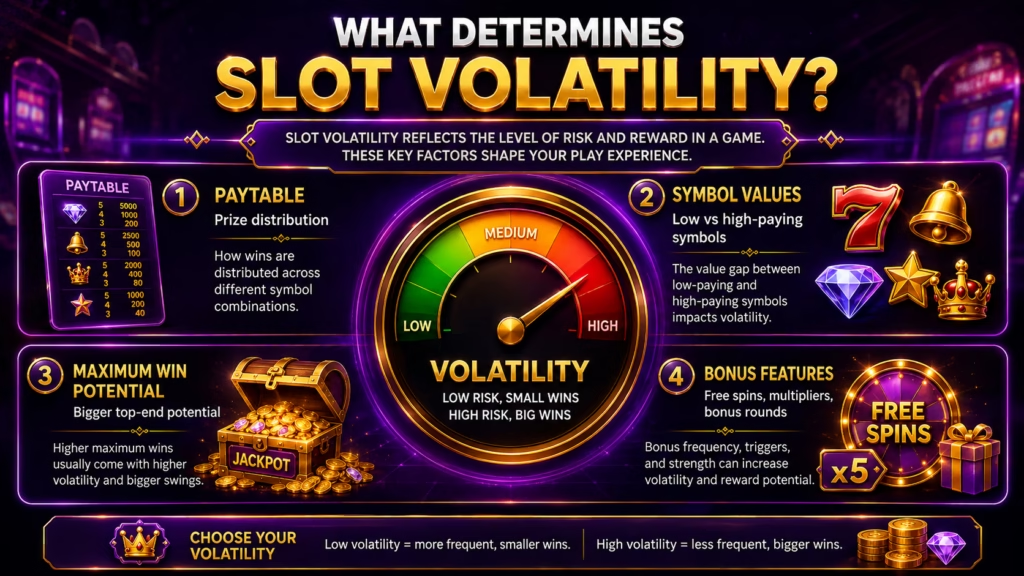
Slot volatility is determined by the mathematical distribution of a slot’s possible payouts, including how often winning combinations occur, how much those combinations pay, how symbols are weighted, and how much value is concentrated in bonus features or rare maximum wins. A high-volatility slot usually concentrates more of its payout potential into less frequent, larger wins, while a low-volatility slot generally distributes more value across frequent, smaller payouts.
The main factors that affect slot volatility are:
- paytable structure and payout distribution
- symbol frequency and weighting
- hit frequency and win frequency
- maximum win potential
- bonus round frequency and payout potential
- wilds, multipliers and other modifiers
- jackpot or top-prize probability
- the underlying mathematical model
Volatility does not tell you whether a slot will pay on your next spin. It describes the statistical shape of the game over a very large number of outcomes, while every individual spin remains random.
High-volatility slots may appeal to players who prefer the possibility of larger payouts and accept longer periods without significant wins. Low-volatility games are usually more suitable for players who prefer smaller but more regular winning combinations. Neither type provides a better chance of making money, and slots should be treated as entertainment rather than a source of income.
What Does Slot Volatility Actually Measure?
Slot volatility, also called slot variance, describes how widely a game’s payouts can vary around its expected long-term return.
A low-volatility slot tends to produce a narrower range of outcomes. Wins may occur relatively often, but many of them are small compared with the player’s stake. A high-volatility slot can produce a much wider range of outcomes, including long sequences of losing or low-paying spins combined with occasional much larger wins.
The important distinction is that volatility measures payout distribution, not simply win frequency.
Two slots can theoretically have similar hit frequencies but very different volatility. One game might award many low-value wins and occasionally a moderate bonus, while another may use similarly frequent winning combinations but place much more payout value behind rare multipliers or bonus events.
How the Paytable Determines Slot Volatility
A slot paytable is one of the clearest indicators of how the game distributes prize values, but the visible payout amounts do not reveal the complete volatility model.
A paytable that contains a very wide gap between ordinary symbol payouts and top-paying combinations can contribute to higher volatility. If most combinations pay modest amounts while a few rare combinations offer exceptionally large prizes, more of the game’s payout potential may be concentrated in uncommon outcomes.
For example, consider two hypothetical slots.
Slot A
- frequent low-symbol wins
- modest premium-symbol payouts
- maximum win of 500x
- limited multiplier potential
Slot B
- relatively weak base-game payouts
- highly valuable premium combinations
- multipliers that can increase dramatically
- maximum win of 10,000x
Slot B is more likely to use a higher-volatility mathematical structure, although maximum win and paytable values alone are not enough to prove its volatility.
The missing information is probability. A 1,000x prize that occurs comparatively often affects the mathematical model very differently from a 1,000x prize designed to occur extremely rarely.
Symbol Frequency and Weighting
Symbol weighting is one of the most important factors that determine slot volatility because the probability of forming winning combinations depends on how frequently each symbol can appear.
Modern slots do not necessarily give every symbol an equal probability of landing. A low-paying symbol may effectively occur much more frequently than a premium symbol, scatter or special bonus symbol.
This means that two symbols displayed on the same reel can have very different mathematical probabilities.
If high-value symbols are heavily restricted while low-value symbols appear frequently, large combinations become harder to form. This can increase the concentration of value in rare outcomes and contribute to higher volatility.
Symbol weighting also explains why simply looking at the number of symbols on the screen cannot reveal the true probability of a particular combination.
The exact probabilities usually depend on the game’s internal mathematical configuration and may not be fully disclosed to players.
Does Hit Frequency Determine Slot Volatility?
Hit frequency affects volatility, but the two measurements are not the same thing.
Hit frequency describes how often a spin produces a winning result according to the game’s rules. Volatility describes how winnings are distributed by both frequency and size.
Consider a simplified example:
| Slot | Approximate Win Pattern | Typical Volatility |
| Game A | Many small wins | Lower |
| Game B | Moderate mix of small and medium wins | Medium |
| Game C | Fewer wins with occasional large payouts | Higher |
This relationship is useful as a general model, but real slot mathematics can be more complicated.
A high hit frequency does not automatically mean low volatility. Some games generate frequent payouts below or close to the original stake while reserving meaningful profits for rare features. Those small payouts can increase the reported hit frequency without making the game genuinely low variance.
How Maximum Win Affects Slot Volatility
A large maximum win can indicate that a slot has high-volatility characteristics, but maximum win alone does not determine volatility.
A slot offering a maximum payout of 20,000x the stake requires some mechanism for producing that amount. The top payout might depend on an extremely rare symbol combination, a chain of multipliers, a jackpot event or an unusually successful bonus round.
If a meaningful share of the game’s theoretical payout is concentrated in those rare outcomes, volatility can become high.
However, two games with the same 10,000x maximum win can have completely different volatility profiles. One could distribute substantial value through the base game and bonuses while making its 10,000x result exceptionally rare. Another could concentrate far more of its payout distribution around large bonus outcomes.
For this reason, max win should be treated as one volatility clue rather than a complete measurement.
How Bonus Rounds Affect Slot Volatility
Bonus rounds can significantly increase slot volatility when a substantial part of the game’s theoretical payout is concentrated inside the bonus feature.
A slot may have a relatively quiet base game because its most valuable mechanics only become active during free spins. These mechanics can include:
- increasing multipliers
- additional wild symbols
- expanding wilds
- sticky wilds
- symbol upgrades
- extra reels or rows
- retriggers
- collected modifiers
- enhanced paylines or ways to win
When bonus rounds are difficult to trigger but can produce payouts far larger than normal base-game wins, they can create a high-volatility payout structure.
By contrast, a slot that triggers features relatively frequently and awards moderate bonus payouts may have lower or medium volatility.
Bonus frequency alone is not enough to determine the answer. The combination of feature probability and potential payout is what matters.
Multipliers Can Increase Payout Variance
Multipliers often increase slot volatility because they expand the difference between ordinary and exceptional outcomes.
A game where winning combinations normally pay 2x to 20x but occasionally combine with a 100x multiplier has a much wider potential payout range than a game without such modifiers.
Multiplier systems become especially important when they can accumulate.
For example, some slots increase multipliers after consecutive wins or during free spins. Most sessions may never reach the strongest multiplier levels, while a small number of unusually successful sequences can produce disproportionately large payouts.
This creates the uneven payout distribution associated with higher volatility.
A multiplier does not guarantee a large win. The required symbols, feature conditions and multiplier level still have to occur according to the game’s random mechanics.
Wilds Scatters and Special Symbols
Wilds and scatters affect volatility according to how frequently they appear and how much payout value depends on them.
A frequently appearing wild that regularly completes small combinations may reduce payout variance by creating more consistent wins. A rare wild carrying a multiplier or appearing only during a powerful bonus feature may have the opposite effect.
Scatter symbols can have an even larger effect when they control access to free spins or another major bonus.
If much of a slot’s payout potential requires landing three, four or five rare scatter symbols, the bonus trigger probability becomes an important part of its volatility profile.
The symbol itself does not make a slot high or low volatility. Its probability, payout and interaction with other mechanics determine its mathematical importance.
RTP and Volatility Are Not the Same
RTP does not determine slot volatility.
Return to Player, or RTP, represents the theoretical percentage of wagered money returned to players across a very large number of game rounds under the specified mathematical configuration.
Volatility describes how unevenly that theoretical return is distributed.
For example, two hypothetical games could both have 96% RTP:
- one could return much of that value through frequent small payouts;
- another could allocate considerably more value to rare bonuses and large wins.
The theoretical return can therefore be similar while the playing experience feels completely different.
RTP and volatility also cannot predict the outcome of an individual session. A theoretical RTP is a long-term mathematical property rather than a promise that a player will personally receive that percentage back.
Does the Number of Paylines or Ways to Win Affect Volatility?
More paylines or ways to win do not automatically make a slot more or less volatile.
A game with thousands of ways to win may generate combinations frequently, but its paytable can compensate with smaller average payouts or different symbol probabilities. A traditional fixed-payline slot could still have either low or high volatility depending on its mathematical design.
Systems such as Megaways, cluster pays and all-ways mechanics can produce highly variable outcomes because the number or size of winning combinations may change significantly from one spin to another.
However, the mechanic’s name cannot establish volatility by itself. The complete payout model remains more important than the number of paylines or winning ways.
What Affects Slot Volatility Most?
When estimating slot volatility, the most useful approach is to examine several characteristics together rather than relying on one number.
Signs that may indicate higher volatility
A slot may lean toward higher volatility when it combines several of these characteristics:
- very large maximum win potential
- powerful but relatively rare bonus rounds
- escalating or persistent multipliers
- strong dependence on premium symbols
- large difference between ordinary and top payouts
- jackpots or rare top-prize events
- substantial payout potential concentrated in free spins
Signs that may indicate lower volatility
A slot may lean toward lower volatility when it features:
- frequent small winning combinations
- narrower differences between common and top payouts
- fewer extreme multipliers
- relatively modest maximum wins
- bonus features producing more moderate payout ranges
These are indicators rather than universal rules. The provider’s stated volatility rating, official game information and paytable should be checked whenever available.
Common Myths About Slot Volatility
High volatility means a slot pays less often
High-volatility games often produce less consistent meaningful payouts, but win frequency and volatility are separate measurements. A game can record frequent small wins while still reserving most substantial payouts for rare events.
A huge maximum win always means high volatility
A large maximum win is a useful clue, not proof. The probability of reaching that win and the rest of the payout distribution matter just as much.
High RTP means low volatility
RTP and volatility measure different characteristics. High-RTP slots can still be highly volatile.
A losing streak means a big win is due
Previous spins do not make a future win due. Slot outcomes are generated according to the game’s random mechanics, and volatility should not be used to predict when a payout will occur.
How to Choose a Slot Based on Volatility
Choose volatility according to the type of playing experience you prefer rather than treating it as a way to improve your chances of winning.
Players who prefer longer sessions with more frequent small results may find low or medium-volatility games easier to manage. Players comfortable with larger swings may prefer higher-volatility slots, provided they understand that significant payouts can be irregular.
Before playing, check:
- the provider’s volatility rating if available
- the official paytable
- RTP and whether different RTP configurations exist
- maximum win
- bonus mechanics
- multiplier limits
- minimum bet
- free-spin and bonus rules
Set spending and time limits before playing. A high maximum win should never be treated as an expected outcome, and increasing the stake does not make a rare result become due.

How This Information Was Reviewed
The factors used to evaluate slot volatility include payout distribution, paytable structure, symbol probability, hit frequency, maximum payout, bonus mechanics and multiplier systems.
Exact volatility cannot always be calculated from information visible to players because the complete mathematical model and symbol probabilities may not be publicly disclosed. When available, the game’s official rules, provider information and paytable provide the most appropriate sources for game-specific figures.
RTP, volatility, bonuses and maximum wins describe mathematical characteristics of a slot, but none can predict an individual spin or guarantee a profitable session. Casino games should be treated as entertainment, and players should stop if gambling begins to exceed their planned money or time limits.
FAQ
What determines slot volatility?
Slot volatility is determined by how the game’s mathematical model distributes payouts across possible outcomes. Symbol probabilities, paytable values, bonus frequency, multipliers, maximum wins and the probability of rare high-value combinations can all affect the final volatility profile.
What affects slot volatility the most?
The distribution of payout probability has the greatest overall importance. A slot becomes more volatile when a larger share of its theoretical payout is concentrated in uncommon high-value outcomes rather than frequent smaller wins.
Does a high maximum win mean high volatility?
Not necessarily. A very large maximum win often appears in high-volatility slots, but the top prize cannot establish volatility by itself. Its probability and the distribution of all other payouts must also be considered.
Do bonus rounds increase volatility?
Bonus rounds may increase volatility when they are relatively difficult to trigger and contain a large share of the game’s payout potential. More frequent features with moderate payouts can produce a very different volatility profile.
Is hit frequency the same as volatility?
No. Hit frequency measures how frequently winning spins occur, while volatility considers both the frequency and size of payouts. A slot can produce many small wins while still having significant payout variance.
Does RTP affect slot volatility?
RTP and volatility are separate mathematical properties. Two slots can have similar theoretical RTP percentages while distributing their payouts very differently. RTP also does not predict how much a player will receive during an individual session.
Do more paylines make a slot less volatile?
Not automatically. More paylines or ways to win can create more winning combinations, but symbol probabilities and payout values can be adjusted accordingly. The entire mathematical model determines volatility.
Can you calculate slot volatility from the paytable?
A paytable can provide useful clues, but it usually cannot reveal exact volatility on its own. Precise calculation would require information about probabilities, symbol weighting, feature frequency and the complete payout distribution.
Can slot volatility predict when a big win will happen?
No. Volatility describes the statistical distribution of payouts over many outcomes and cannot predict the next spin. A sequence of losing spins does not mean a large win is due.
In short
Slot volatility is primarily determined by how payout value is distributed, not by a single feature such as RTP, hit frequency or maximum win. Paytables, symbol weighting, bonus probabilities, multipliers and rare top prizes all contribute to the game’s variance.
High-volatility slots generally place more payout potential behind uncommon large outcomes, while lower-volatility games distribute more value through frequent smaller wins. The most reliable assessment comes from considering several characteristics together and checking the provider’s official game information when available.
Volatility describes risk and payout behavior, not what will happen next. Every spin remains random, and slots should be played for entertainment with predetermined spending and time limits.