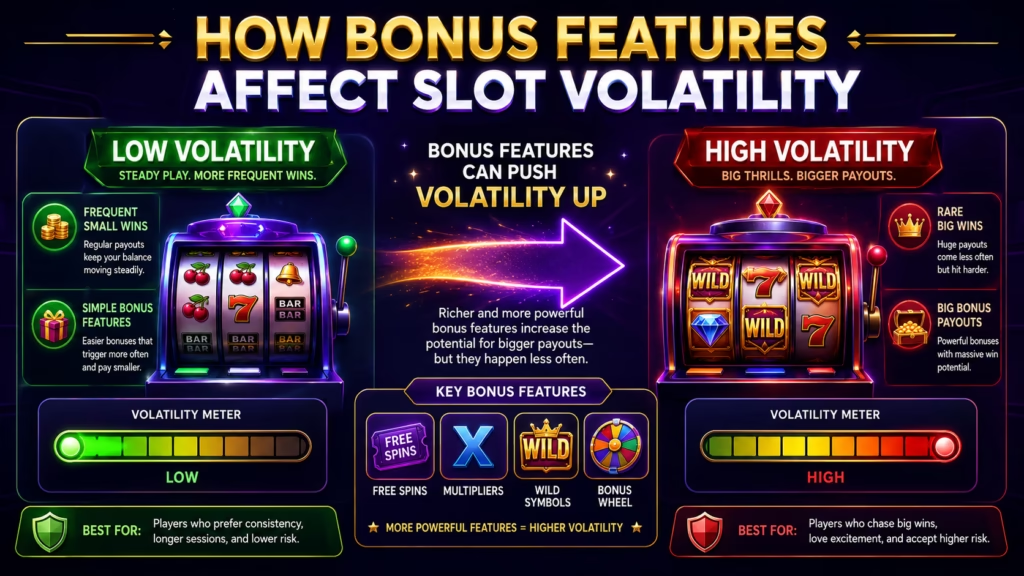
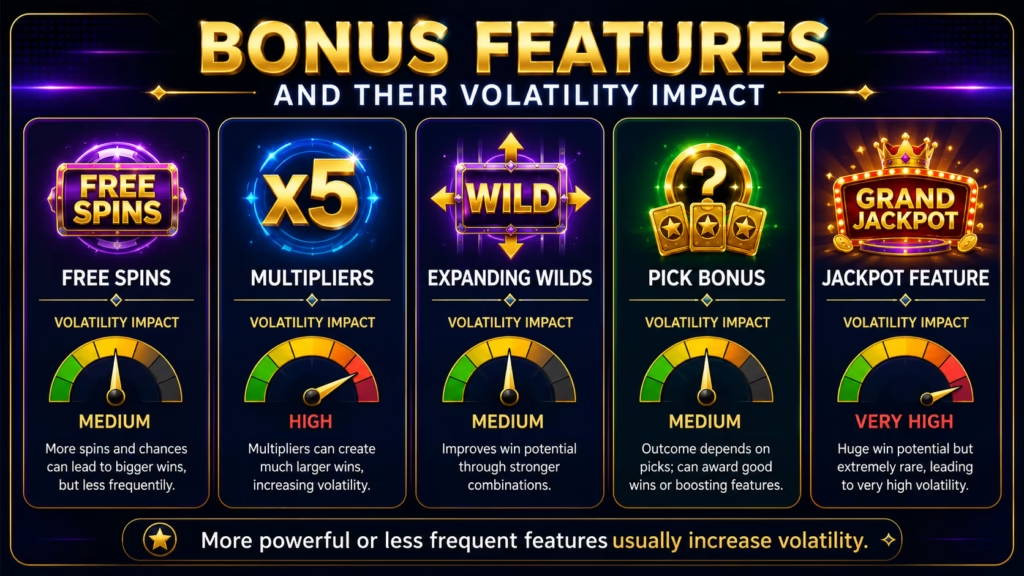
Bonus features can significantly affect slot volatility because they change how often meaningful payouts occur and how much of a game’s potential return is concentrated inside special rounds. A slot with free spins, multipliers, expanding wilds, jackpots or bonus buys may feel more volatile when a large share of its payout potential depends on triggering those features rather than receiving regular base-game wins.
The important point is that bonus features do not automatically make a slot high volatility. Their effect depends on how frequently they trigger, how much they can pay, how much variance exists inside the feature and how the provider distributes payouts between the base game and bonus rounds.
- Rare but potentially valuable bonus rounds usually increase perceived volatility.
- Frequent small bonus features can make gameplay feel less volatile.
- Multipliers and progressive mechanics can widen the range between ordinary and exceptional outcomes.
- Bonus buys may provide faster access to a feature, but they do not remove volatility or guarantee a favorable result.
- RTP and volatility describe long-term game characteristics, not what will happen during an individual session.
Understanding how bonus features affect slot volatility is particularly useful for players comparing games with similar RTP figures but very different gameplay. A player who prefers regular activity may favor frequent lower-value features, while someone comfortable with longer periods without significant payouts may prefer games where more potential is concentrated in rare bonus rounds.
What Does Slot Volatility Mean?
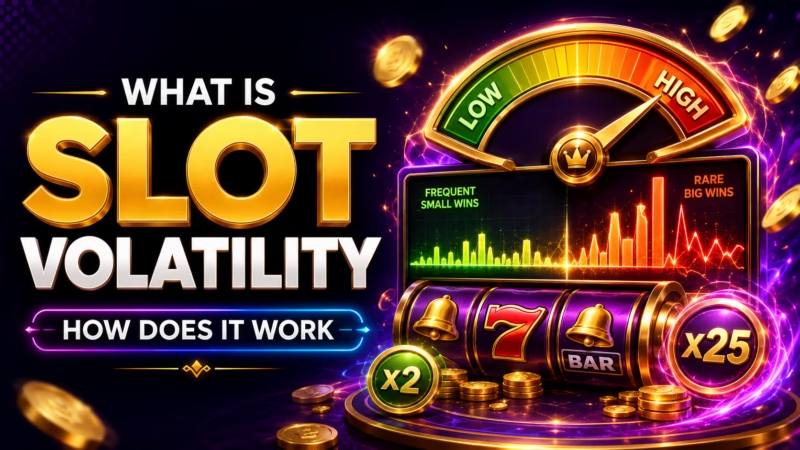
Slot volatility describes how widely payouts can vary and how the game’s payout pattern is distributed over time. Low-volatility slots generally emphasize smaller and more frequent wins, while high-volatility slots may produce longer stretches of limited returns followed by less frequent but potentially larger payouts.
Volatility should not be confused with RTP. RTP represents the theoretical percentage of wagered money a game is designed to return over a very large number of plays. Volatility describes the distribution of those returns.
Two slots could theoretically have the same RTP but provide completely different experiences. One may return much of its theoretical payout through frequent base-game wins, while another may concentrate more value inside free spins or another difficult-to-trigger feature.
Neither RTP nor volatility predicts the result of a particular spin or session. Slot outcomes remain random according to the game’s underlying rules and random number generation.
How Bonus Features Change Slot Volatility
Bonus features affect volatility mainly by changing where payouts come from and how unevenly those payouts are distributed.
Consider two simplified slot designs.
The first game offers relatively frequent line wins and occasional free spins that usually produce modest payouts. The second game offers smaller base-game returns but includes a rare bonus round containing powerful multipliers and a much higher potential payout.
Even if both games have similar theoretical RTP values, the second game can feel considerably more volatile because more of its potential is locked behind an infrequent event.
A useful way to evaluate a bonus feature is to consider four factors:
- How often the feature can trigger.
- How much its payouts can vary.
- How much of the game’s potential return depends on it.
- Whether additional mechanics can increase payouts dramatically during the feature.
The more extreme these factors become, the more strongly the bonus system may contribute to volatility.
Free Spins and Volatility
Free spins can increase slot volatility when significant payout potential is concentrated inside the free spins round.
A basic free spins feature that triggers regularly and simply provides ten spins with unchanged game mechanics may have a relatively limited effect on volatility. A feature that adds escalating multipliers, sticky wilds or expanding symbols can produce a much wider range of results.
For example, two free spins rounds could both award ten spins. In one slot, every free spin behaves almost like a normal spin. In another, multipliers increase after every win and remain active until the bonus finishes.
The second design creates greater variance because the difference between a weak bonus and a strong bonus can become much larger.
Players should therefore look beyond the number of free spins. The mechanics active during those spins often matter more when judging how the feature contributes to volatility.
Multipliers Can Increase Payout Variance
Multipliers often increase volatility because they can create much larger differences between ordinary and exceptional outcomes.
A fixed 2x multiplier has a relatively predictable effect. A multiplier that can increase repeatedly or combine with other multipliers creates a much broader range of potential payouts.
Multiplier mechanics can become particularly volatile when they:
- increase after consecutive wins;
- remain active throughout a bonus round;
- stack or combine with other multipliers;
- apply to already valuable symbol combinations;
- have very high maximum values but appear infrequently.
A slot advertising large multiplier potential should not be interpreted as being more likely to generate a large win. High multiplier values can be difficult to reach, and their exact behavior should be checked in the game’s official rules or paytable.
Wild Features and Their Effect on Volatility
Wild symbols can either reduce or increase perceived volatility depending on how they are implemented.
Frequent standard wilds may help create winning combinations more regularly, potentially smoothing the base-game experience. More powerful versions such as expanding wilds, sticky wilds, walking wilds or multiplier wilds may instead concentrate greater payout potential into specific situations.
Sticky wilds during free spins are a good example. A bonus can begin with almost no wild coverage and end with several wilds remaining on the reels. That creates a wide gap between weaker and stronger bonus rounds.
The name of the mechanic alone does not determine volatility. Frequency, positioning rules and interactions with other features are what matter.
Hold and Win Features
Hold and Win or similar respin features can contribute strongly to volatility when large prizes depend on collecting rare symbols or reaching difficult conditions.
These bonuses often begin by locking specific symbols in place while the remaining reel positions respin. Additional special symbols may reset the number of remaining respins and potentially increase the final prize.
The volatility depends on the feature’s exact structure. A game that triggers Hold and Win frequently with relatively narrow prize ranges may behave very differently from one where the feature is rare but contains large jackpot or multiplier potential.
Players interested in these mechanics should check the rules for trigger requirements, prize values and whether advertised jackpots are fixed, progressive or subject to additional conditions.
Bonus Buys Do Not Remove Volatility
A bonus buy allows a player to pay a specified amount to enter a bonus feature directly instead of waiting for it to trigger naturally. This changes access to the bonus, but it does not make the underlying feature predictable.
A purchased bonus can still produce a result worth substantially less than its cost, while another activation may produce a larger payout. The range between those outcomes is part of the feature’s volatility.
Bonus buys may make volatility more noticeable because larger amounts are committed to individual feature activations rather than spread across many regular spins.
The cost, availability and RTP configuration of bonus buys can vary between games and operators. Players should check the official game information before using the feature and should not treat purchasing a bonus as a shortcut to a profit.
Progressive Jackpots and Rare Bonus Events
Progressive jackpots and other extremely rare high-value events can increase the upper end of a game’s payout distribution.
When part of a game’s potential is connected to a jackpot that is unlikely to occur during a typical session, ordinary gameplay may not reflect the highest advertised payout possibilities.
A large jackpot does not necessarily mean that every part of the game is highly volatile. Some jackpot slots still provide frequent smaller wins. However, rare jackpot events create a much wider possible range of outcomes.
Players comparing jackpot games should distinguish between the regular game’s payout structure and the separate jackpot component.
Frequent Bonuses Do Not Always Mean Low Volatility
Bonus frequency alone is not enough to determine slot volatility.
A game could activate a feature frequently but still be volatile if most activations pay relatively little while a small percentage produce very large results. Another game could trigger bonuses less frequently but provide a narrower range of possible bonus payouts.
The better question is not simply “How often does the bonus trigger?”
Instead, consider both frequency and payout distribution. These factors together provide a clearer picture of how the bonus feature affects the playing experience.
Base Game vs Bonus-Heavy Slots
One useful way to compare slot volatility is to examine whether the game is base-game driven or bonus driven.
| Game structure | Typical gameplay characteristic | Possible volatility effect |
| Base-game focused | More payout potential occurs during normal spins | Can create a steadier experience |
| Frequent small bonuses | Features appear regularly but have limited range | May reduce perceived volatility |
| Rare powerful bonuses | Significant potential depends on bonus triggers | Often feels more volatile |
| Progressive features | Feature strength can build dramatically | Can widen payout variation |
| High multipliers | A small number of outcomes may become very valuable | Can increase variance |
| Jackpot mechanics | Rare events account for extreme potential payouts | Can increase the upper payout range |
These are general patterns rather than universal rules. The actual mathematical model of each slot determines its volatility.
How to Evaluate Bonus Feature Volatility
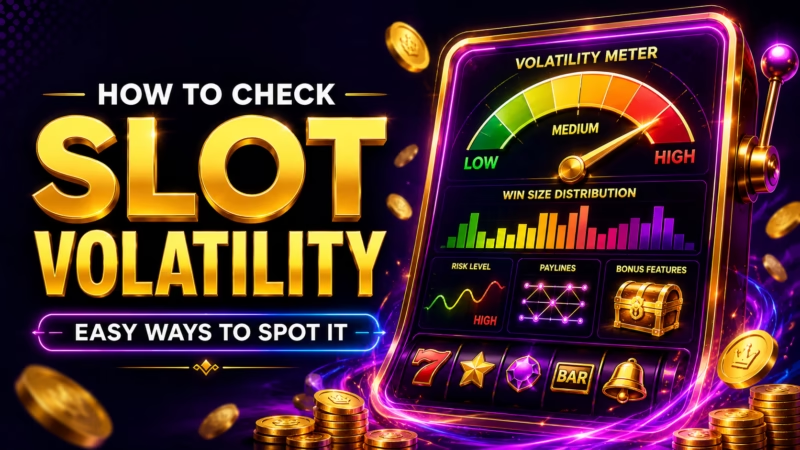
Players cannot calculate a slot’s exact volatility simply by looking at its graphics or feature list, but several indicators can help explain its design.
Check the Published Volatility
Some providers classify games as low, medium or high volatility. This is the most straightforward starting point when the information is available.
Definitions can differ between providers, so the rating is most useful for comparing games from the same developer rather than treating every “high volatility” label as mathematically identical.
Read the Paytable and Game Rules
The paytable can reveal how free spins trigger, what wilds do, whether multipliers accumulate and which conditions unlock the largest prizes.
A feature with several stages, persistent modifiers or escalating multipliers may create a broader range of possible outcomes than a simple bonus round.
Compare the Maximum Win Carefully
A very high maximum win can indicate that extreme outcomes are possible, but the maximum win alone does not establish overall volatility.
The relevant question is how the game’s entire payout distribution is structured, not only its theoretical maximum.
Look at Feature Complexity
Multiple interacting mechanics can increase variance when they must align to create the game’s strongest outcomes.
For example, a bonus might require free spins, multiplier symbols and premium symbols to combine simultaneously before the highest payout potential becomes relevant.
Complexity does not automatically equal higher volatility, but it can help explain why bonus results vary substantially.
Which Bonus Structure May Suit Different Players?
Players who prefer frequent activity may find slots with regular base-game wins and straightforward, frequently triggered bonuses easier to tolerate. Players with smaller entertainment budgets may also prefer avoiding games where much of the experience depends on waiting for a rare feature.
Players who enjoy high-volatility slots may prefer mechanics such as escalating multipliers, persistent wilds, bonus progression or rare feature combinations. These games can involve longer periods without meaningful returns, so strict spending limits become particularly important.
Neither style is objectively better. The appropriate choice depends on the type of gameplay a person finds entertaining and the level of variance they are comfortable accepting.
Common Myths About Bonus Features and Volatility
“A bonus is due after a long losing streak”
A bonus is not necessarily more likely to appear simply because it has not triggered recently. Previous spins do not provide a reliable way to predict the next random outcome.
“Buying the bonus improves the chance of winning”
A bonus buy provides direct access to the specified feature. It does not guarantee that the feature will return more than its purchase price.
“More features mean better RTP”
The number of features does not determine RTP. A visually complex slot can have a lower, similar or higher RTP than a simple slot depending on its mathematical configuration.
“High volatility means higher RTP”
Volatility and RTP measure different characteristics. High volatility describes a broader or less frequent payout distribution, while RTP represents theoretical long-term return.
“A huge maximum win makes a slot better”
Maximum win describes potential, not probability. A large theoretical maximum can be extremely difficult to reach and should not be treated as a likely outcome.
How This Information Was Reviewed
The relationship between slot bonus features and volatility should be evaluated through feature frequency, payout variation, base-game distribution, multiplier behavior, jackpot mechanics and the conditions required to reach higher-value outcomes.
Exact RTP, volatility ratings, feature probabilities and bonus rules depend on the individual game configuration. Players should verify those details in the official paytable, game information screen or provider documentation because versions offered by different operators may not always use identical settings.
RTP, volatility and bonus features cannot predict the result of a specific session. Every wager involves risk, and slot games should be treated as paid entertainment rather than a way to generate income. Set spending and time limits before playing, and stop when gambling is no longer enjoyable or no longer remains within your planned budget.
FAQ
Do bonus features increase slot volatility?
Bonus features can increase slot volatility when a large share of the game’s payout potential is concentrated in rare or highly variable bonus rounds. Frequent bonuses with relatively small and consistent payouts may have much less effect.
Do free spins make a slot high volatility?
Free spins do not automatically make a slot high volatility. Their impact depends on how frequently they trigger, what mechanics operate during the feature and how widely the possible bonus payouts vary.
Why can two bonuses in the same slot pay very differently?
Two bonus rounds can produce very different results because each spin remains random and mechanics such as multipliers, wilds or symbol combinations can develop differently during each activation. A wide range of bonus results is common in more volatile feature designs.
Do multipliers increase volatility?
Multipliers can increase volatility when large multiplier values are rare or can accumulate during a bonus. Fixed and frequently applied small multipliers may have a much smaller effect on overall payout variation.
Is a bonus buy less volatile than waiting for free spins?
A bonus buy does not necessarily reduce volatility. It only changes how the player enters the bonus. The purchased feature can still produce a broad range of outcomes, including a payout below the purchase cost.
Does a high maximum win mean high volatility?
A high maximum win can be associated with a wider payout range, but it does not prove that a slot is high volatility. Feature frequency, hit distribution and the game’s overall mathematical structure also matter.
Can RTP tell me how volatile a bonus feature is?
RTP alone cannot tell you how volatile a bonus feature is. RTP describes theoretical long-term return, while volatility describes how that return is distributed between smaller, larger, frequent and infrequent payouts.
Are frequent bonus rounds better than rare bonuses?
Frequent bonus rounds are not inherently better. They may appeal more to players who prefer regular feature activity, while rare bonuses with larger potential ranges may appeal to players comfortable with higher variance. Neither format guarantees better results.
Can I predict when a slot bonus will trigger?
No reliable method can predict when a random slot bonus will trigger. Previous spins, recent losses and the time since the last bonus do not provide a dependable prediction of the next outcome.
Brief Conclusion
Bonus features affect slot volatility by changing how frequently important payouts occur and how much potential value is concentrated inside special rounds. Rare bonuses, escalating multipliers, persistent wilds, jackpots and highly variable free spins can make a slot feel more volatile, while frequent modest features may produce a steadier experience.
The feature name alone is not enough to judge volatility. Check the game’s volatility rating, paytable, bonus mechanics, RTP configuration and payout rules before playing. Most importantly, volatility describes risk and payout distribution, not a way to predict or control random slot results.