
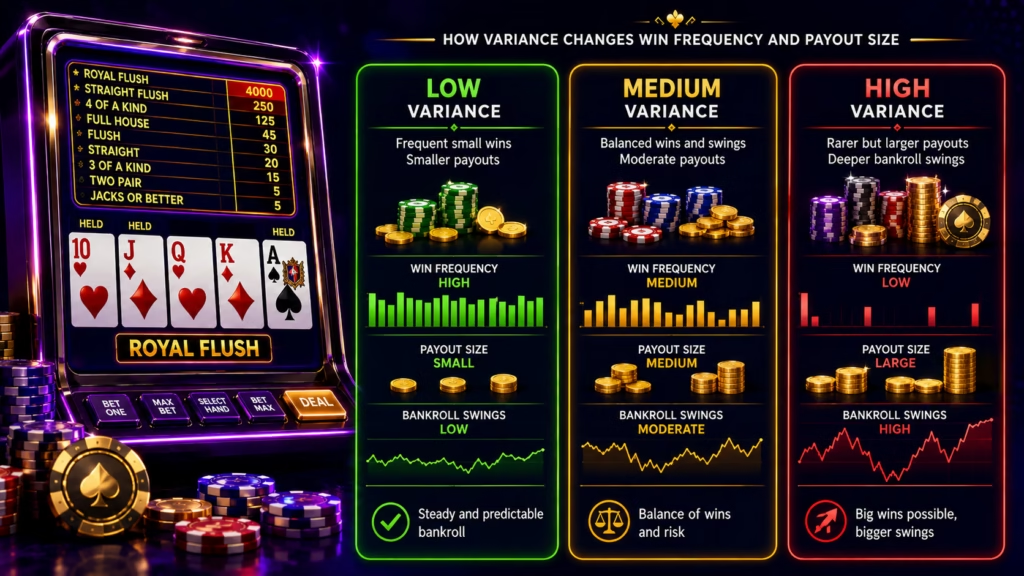
Video poker variance describes how widely short-term results can move around a game’s theoretical return. Two video poker games can have similar RTP figures but feel completely different because one pays a larger share of its return through frequent smaller wins, while another concentrates more value in rare four-of-a-kind hands, premium quads or royal flushes.
The practical point is simple: RTP tells you the theoretical long-term return, while variance tells you how uneven the path toward that return can be. Higher-variance video poker generally produces larger bankroll swings and longer losing stretches, while lower-variance games tend to distribute their payouts more evenly. Neither measure predicts what will happen in a specific session.
Key points to understand:
- Video poker variance measures the spread of possible results, not whether a game is “good” or “bad.”
- Paytables can change both RTP and variance, even within the same video poker game.
- Bonus-style games usually place more value on premium hands, which can increase volatility.
- A higher-variance game generally requires a larger bankroll for the same amount of play.
- RTP and variance calculations normally assume a defined playing strategy, often optimal strategy.
Video poker variance matters most to players choosing between different paytables, game families and bankroll sizes. Players who dislike sharp balance swings may prefer relatively stable games, while players comfortable with less frequent but larger premium payouts may accept higher volatility. In either case, video poker remains gambling, and mathematical characteristics do not guarantee a particular result.
What Is Video Poker Variance?
Video poker variance measures how far individual results can deviate from the game’s expected average return. A game with higher variance can generate much larger differences between winning and losing sessions than a lower-variance game, even when their theoretical RTP percentages are close.
In mathematical terms, variance describes the dispersion of possible returns around an expected value. Standard deviation is closely related and is often easier to interpret because it expresses the size of fluctuations on the same general scale as the underlying results.
For a player, the important interpretation is not the formula itself. Higher video poker variance usually means:
- larger bankroll fluctuations;
- greater dependence on relatively rare premium hands;
- potentially longer periods without significant wins;
- a greater chance that a short session looks very different from the theoretical RTP.
Lower variance usually means more of the game’s theoretical return comes from comparatively common hands, reducing the importance of a few rare payouts.
Variance should never be interpreted as a prediction. A low-variance game can still produce a severe losing session, and a high-variance game can produce a large early win. Random outcomes remain uncertain.

Video Poker Variance vs Volatility
Video poker variance and video poker volatility describe closely related ideas, although variance has a more precise mathematical meaning. In everyday casino terminology, players often use “volatility” to describe how aggressively a game’s bankroll can rise and fall.
Variance can be mathematically calculated from the probabilities and payouts of possible outcomes. Volatility is often used as a more general label such as low, medium or high.
For practical game selection:
| Characteristic | Lower Variance | Higher Variance |
| Bankroll movement | Usually smoother | Usually more dramatic |
| Dependence on rare hands | Lower | Higher |
| Premium hand payouts | Usually less concentrated | Often more important |
| Losing stretches | Can occur | Can be more severe |
| Bankroll requirement | Generally lower | Generally higher |
| Short-term predictability | Still unpredictable | Still unpredictable |
Neither column means better odds of winning a particular session. The difference concerns how payouts are distributed.
How Paytables Affect Video Poker Variance
A video poker paytable can change variance because changing the payout for one or more hands changes the distribution of the game’s possible returns. This is why players should not judge a machine only by the game name.
Consider two versions of the same basic video poker game. One version might pay relatively more for common winning hands, while another shifts additional value toward rare four-of-a-kind combinations. The second structure can create larger occasional payouts while making those uncommon hands more important to the game’s overall return.
Paytables also affect RTP. A seemingly small reduction to the payout for a common hand can materially affect theoretical return because that hand occurs far more frequently than a royal flush.
Before playing, check:
1. the exact payout for each winning hand;
2. whether the displayed payouts assume the maximum number of coins or credits;
3. whether the royal flush payout changes with bet size;
4. the theoretical RTP associated with that exact paytable;
5. the strategy assumptions behind the published return.
The game title alone is not enough. Two machines labeled Jacks or Better, for example, can use different paytables and therefore have different mathematical characteristics.
How Video Poker Game Types Affect Variance
Different video poker families distribute their payouts differently. That payout structure is one of the main reasons variance changes from one game type to another.
Jacks or Better
Jacks or Better is commonly considered one of the more straightforward video poker formats because its payout structure is less dependent on specialized bonus payouts.
Winning hands begin with a pair of jacks or better, and the game provides a useful baseline for understanding video poker strategy and paytables. Specific RTP and variance still depend on the exact paytable and playing strategy.
Players who want to understand video poker mechanics before dealing with specialized quad bonuses often start by studying Jacks or Better.
Bonus Poker
Bonus Poker increases the importance of certain four-of-a-kind hands compared with a basic Jacks or Better structure. This changes how value is distributed through the paytable and can increase bankroll fluctuations depending on the specific version.
The important detail is the exact bonus schedule. “Bonus Poker” is a family name rather than a guarantee that every available paytable behaves identically.
Double Bonus Poker
Double Bonus Poker generally places more value on four-of-a-kind payouts, which makes premium quad hands more important to overall results.
Because more return may be concentrated in less frequent outcomes, a Double Bonus structure can feel substantially less stable than a simpler video poker game. Players should therefore compare both theoretical return and variance instead of choosing based only on a high advertised RTP.
Double Double Bonus Poker
Double Double Bonus Poker further emphasizes specific four-of-a-kind combinations and kicker cards, creating greater dependence on comparatively rare premium outcomes.
The attraction is obvious: certain qualifying hands can produce much larger payouts. The tradeoff is that a greater share of the game’s value may depend on hitting those hands.
For bankroll planning, this distinction matters. A player using the same session budget and denomination may experience much more pronounced fluctuations than in a lower-variance format.
Deuces Wild
Deuces Wild changes both hand probabilities and strategy because every deuce acts as a wild card. Its variance cannot be judged simply by comparing the paytable with a non-wild game.
Different Deuces Wild paytables can have significantly different theoretical returns and payout distributions. Players should identify the exact version before using an RTP figure, strategy chart or variance estimate.
Does Higher RTP Mean Lower Variance?
No. Higher RTP does not automatically mean lower variance. RTP and variance measure different properties of a video poker game.
RTP measures expected long-term return under specified assumptions. Variance measures how widely individual outcomes are distributed around that expectation.
A higher-RTP game can have high variance if much of its theoretical return comes from rare premium hands. A slightly lower-RTP game can provide a smoother payout distribution.
This distinction is especially important when comparing video poker games. Selecting only the highest RTP without considering volatility can lead to a game whose bankroll requirements do not match the player’s intended session.
Why the Royal Flush Has Such a Large Effect
The royal flush contributes a meaningful part of the theoretical return in many video poker games despite being a rare hand. That combination of low frequency and high payout contributes to variance.
This is also why maximum-coin payout rules deserve attention. Some video poker machines offer a disproportionately larger royal flush payout when the required maximum wager is used. If the paytable changes the royal payout according to wager size, the theoretical RTP can also change.
That does not mean a player should increase a wager beyond a comfortable budget. If the required bet size is too high, choosing a lower denomination or another game is more sensible than risking more money solely to qualify for a particular payout schedule.
How Variance Affects Video Poker Bankroll
Higher video poker variance generally requires a larger bankroll if the goal is to maintain the same amount of play while tolerating normal fluctuations. The reason is not that a larger bankroll improves the game’s odds. It simply provides more room for losing sequences before the session budget is exhausted.
Suppose two players make the same number of wagers at the same denomination. One chooses a relatively stable paytable, while the other chooses a bonus-heavy game in which rare quads contribute much more to expected return. The second player may need to tolerate deeper swings before those premium hands appear.
A practical bankroll decision should consider:
- wager per hand;
- number of hands expected to be played;
- game variance;
- exact paytable;
- personal loss limit;
- whether several hands are being played simultaneously.
Bankroll size does not change the underlying probability of the next hand.
Single-Hand vs Multi-Hand Video Poker
Multi-hand video poker can increase the amount of money exposed per decision because several hands are played from the same initial draw. The shared starting cards also mean the hands are not equivalent to completely independent single-hand rounds.
For example, playing ten hands at five credits per hand creates far more total wager exposure than playing one five-credit hand. Even when the game and paytable are identical, bankroll consumption can therefore accelerate dramatically.
Players comparing volatility should distinguish between the mathematical variance of the underlying game and the practical bankroll swings created by playing several hands at once.
Common Mistakes When Evaluating Video Poker Variance
One common mistake is choosing a game only because its RTP is high. A mathematically attractive theoretical return does not tell you how severe short-term swings may be.
Another mistake is assuming a large bankroll improves the probability of winning. Bankroll affects how much variance a player can financially tolerate, not the probabilities encoded in the game.
A third mistake is using strategy information from the wrong paytable. Optimal decisions can change when payouts change. Strategy charts should therefore match the exact game and paytable being played.
Players also sometimes assume that a machine is “due” for a royal flush or four of a kind after a long dry period. Previous hands do not create a reliable schedule for future premium hands in a properly functioning random game.
How to Choose a Video Poker Game Based on Variance
Choose video poker based on paytable quality, variance, bet size and the type of session you are prepared to tolerate, rather than focusing on a single statistic.
A useful process is:
1. Identify the exact game variant.
2. Read the complete paytable.
3. Check the RTP for that specific paytable.
4. Determine whether the game emphasizes rare premium payouts.
5. Use the correct strategy for that version.
6. Calculate the total amount wagered per round.
7. Set a loss limit before starting.
8. Avoid increasing stakes to recover losses.
Lower-variance games may appeal more to players who prefer smaller fluctuations. Higher-variance bonus games may appeal to players who specifically enjoy premium hand structures and accept greater bankroll swings.
Neither choice removes gambling risk.
How This Information Was Reviewed
This explanation evaluates video poker variance through the relationship between paytables, payout probabilities, game variants, strategy assumptions and bankroll exposure. Exact RTP and variance figures should always be checked for the specific game version because casinos and software providers may offer different paytables under similar game names.
Published theoretical returns can also depend on using the appropriate playing strategy. A player’s actual results can differ substantially, especially over short samples.
RTP, variance and strategy do not guarantee winning sessions. Video poker should be treated as paid entertainment rather than a reliable way to earn money. Set spending limits before playing, avoid chasing losses and stop if gambling stops being recreational.
FAQ
What is variance in video poker?
Video poker variance measures how widely results can fluctuate around the game’s theoretical expected return. Higher variance means larger potential swings, while lower variance generally produces a more even payout pattern. Variance does not predict the outcome of an individual hand or session.
Is video poker volatility the same as variance?
Video poker volatility is commonly used to describe the practical intensity of bankroll swings, while variance is a specific statistical measurement of outcome dispersion. The terms are often used similarly when comparing games, but variance has a precise mathematical definition.
Which video poker games have higher variance?
Games that concentrate more of their theoretical return in rare premium hands generally have higher variance. Bonus-oriented variants such as Double Bonus or Double Double Bonus can therefore be more volatile than simpler structures, although the exact comparison depends on the specific paytables.
Does the paytable change video poker variance?
Yes. A paytable can change video poker variance because increasing or decreasing payouts alters the distribution of possible returns. The same named video poker game can therefore have different RTP and variance characteristics under different paytables.
Is high-variance video poker better?
High-variance video poker is not inherently better. It may suit players comfortable with larger fluctuations and greater dependence on premium hands, while lower-variance games may suit players who prefer a smoother distribution of payouts. Neither format guarantees winning.
Does a bigger bankroll reduce video poker variance?
No. A bigger bankroll does not change the mathematical variance of the game. It only gives a player more financial capacity to absorb fluctuations before reaching a predetermined session limit.
Can a video poker game have high RTP and high variance?
Yes. A video poker game can combine a high theoretical RTP with high variance if a meaningful share of its expected return comes from rare, highly paid hands. RTP measures average theoretical return, while variance measures the spread of possible outcomes.
Does strategy affect video poker RTP and variance?
Strategy can affect the distribution of final hands and therefore the player’s expected results. Published RTP figures generally assume a particular strategy, often optimal play. Players should use strategy information designed for the exact game and paytable rather than assuming one chart applies to every version.
How much bankroll do I need for video poker?
There is no universal bankroll amount because the answer depends on denomination, wager size, number of hands, intended playing time, paytable and variance. A higher-variance game generally requires more financial tolerance for fluctuations, but increasing bankroll does not improve the odds of the next hand.
Can video poker variance predict when a big win will happen?
No. Video poker variance describes the statistical distribution of outcomes, not the timing of individual winning hands. A long period without a premium hand does not mean that a royal flush or four of a kind is guaranteed to appear soon.
In short
Video poker variance explains how unevenly a game’s returns can appear in real play. Paytables and game types determine how much theoretical value is concentrated in common hands versus rare premium payouts, while RTP describes the long-term expected return under specified strategy assumptions.
When comparing video poker games, examine RTP and variance together. Lower variance generally means smaller bankroll swings, while higher variance can produce more dramatic fluctuations and greater dependence on rare hands. Neither statistic predicts a specific session, so choose stakes that fit a fixed budget and treat video poker as entertainment rather than a source of income.