
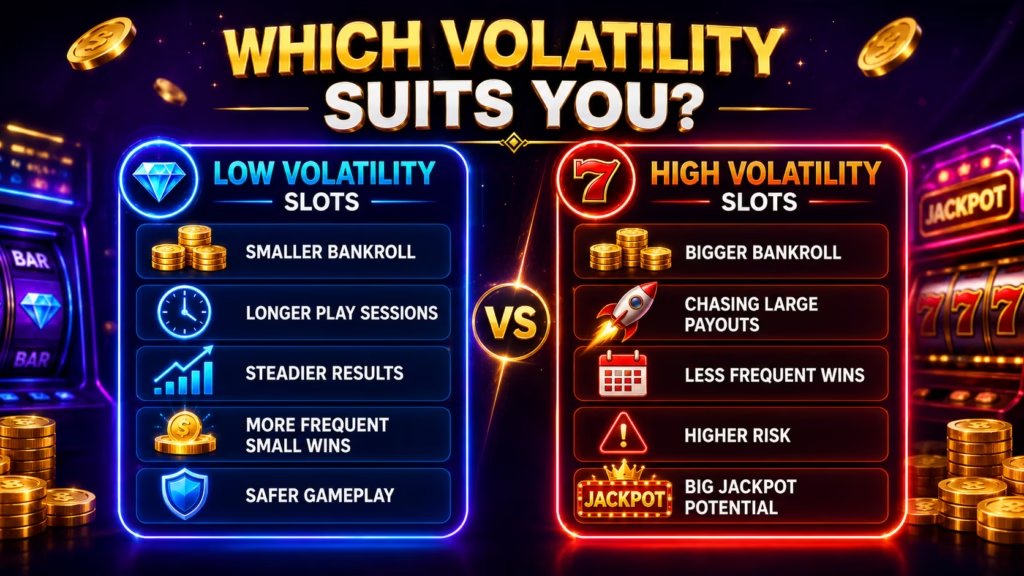
High vs low volatility slots differ mainly in how unevenly wins are distributed. Low-volatility slots generally produce a steadier playing experience with smaller payouts, while high-volatility slots concentrate more of their payout potential into larger but less predictable wins. Neither volatility level is objectively better. The better choice depends on your bankroll, preferred session length and tolerance for swings.
Quick takeaways:
- Low volatility usually suits players who prefer smaller fluctuations and longer sessions.
- High volatility may appeal to players willing to accept stronger bankroll swings for the possibility of larger individual payouts.
- Volatility is not the same as RTP or hit frequency.
- A high-volatility slot does not guarantee large wins, and a low-volatility slot does not guarantee frequent wins on every session.
- Every spin remains random, so volatility describes the statistical character of a game rather than predicting what will happen next.
Players with a limited entertainment budget or those learning how slots work may find lower-volatility games easier to manage. High-volatility slots require more caution because an unlucky sequence can consume a bankroll quickly even when the game’s theoretical RTP appears competitive.
What Is Slot Volatility?
Slot volatility measures how much the size and distribution of payouts can vary over time. It is sometimes called variance, although the technical meaning of variance can be more precise in mathematical game analysis.
A low-volatility slot generally distributes more of its payout potential across smaller wins. A high-volatility slot generally concentrates more value into larger outcomes that may occur less consistently.
Consider two hypothetical slots with similar long-term RTP:
- Slot A frequently returns small portions of the wager.
- Slot B has more uneven results and occasionally produces a much larger payout.
Slot A would typically feel less volatile, while Slot B would feel more volatile.
The important point is that volatility describes how payouts are distributed, not whether the slot is more profitable for the player.
High Volatility vs Low Volatility Slots at a Glance
| Factor | Low Volatility Slots | High Volatility Slots |
| Typical payout pattern | More stable | More uneven |
| Individual win size | Often smaller | Can be larger |
| Bankroll swings | Usually lower | Usually higher |
| Dry periods | Often less severe | Can be substantial |
| Session stability | Generally higher | Generally lower |
| Suitable bankroll approach | Smaller, controlled stakes | More conservative stake sizing |
| Player profile | Prefers steadier gameplay | Accepts greater variance |
| Guaranteed outcome | None | None |
These characteristics are general patterns rather than universal rules. Game developers can design unusual mathematical models, so the official game information should always take priority over assumptions based on labels such as low, medium or high volatility.

What Are Low Volatility Slots?
Low-volatility slots are designed to produce a relatively stable distribution of payouts compared with higher-volatility games. Wins tend to be concentrated around smaller values rather than depending heavily on rare large outcomes.
Low-volatility slots may suit players who:
- prefer longer sessions;
- dislike rapid bankroll fluctuations;
- use relatively small entertainment budgets;
- enjoy frequent interaction with base-game features;
- prefer consistency over chasing large potential multipliers.
For example, imagine a player starting with a $50 entertainment budget and betting $0.50 per spin. A lower-volatility mathematical model may generally allow the bankroll to move up and down more gradually than a highly volatile model.
That does not mean the $50 will last for a specific number of spins. Random sequences can still produce long losing periods.
Advantages of Low Volatility Slots
The main advantage of low volatility is reduced payout variance.
Smaller bankroll movements can make the gameplay feel more predictable from one group of spins to another. Players may also experience more regular small returns, depending on the game’s separate hit-frequency characteristics.
Low-volatility slots can therefore be easier to understand for beginners who want to observe paylines, ways-to-win systems, wilds, scatters and bonus mechanics without deliberately selecting one of the most aggressive mathematical models available.
Disadvantages of Low Volatility Slots
The tradeoff is that individual payouts are often less dramatic.
A low-volatility slot can still have jackpots, multipliers or bonus rounds, but the mathematical model may allocate less of the game’s theoretical payout toward extremely large outcomes.
Players specifically attracted to very high maximum-win potential may therefore find some low-volatility games less appealing.
What Are High Volatility Slots?
High-volatility slots use a more uneven payout distribution, creating larger swings between losing and winning sequences. A greater portion of the game’s theoretical return may be tied to comparatively valuable outcomes.
These games may suit players who:
- accept significant short-term fluctuations;
- are comfortable with losing sequences;
- value larger potential payouts over session stability;
- understand that advertised maximum wins can be extremely rare;
- can reduce stake size to accommodate higher variance.
High volatility should not be interpreted as a signal that a large win is approaching. Random outcomes do not become more favorable simply because previous spins lost.
Advantages of High Volatility Slots
The main attraction of high volatility is greater payout potential in individual winning events.
Many games built around large multipliers, elaborate bonus rounds or highly valuable combinations use relatively volatile mathematical models because substantial prizes must be balanced against less rewarding outcomes elsewhere in the game.
This structure can create a more dramatic experience for players who specifically enjoy strong swings.
Disadvantages of High Volatility Slots
The biggest disadvantage is bankroll pressure.
A highly volatile slot can produce sequences where relatively little value returns to the player before a significant payout appears. The significant payout may never appear during an individual session.
Players who use the same stake size on a very high-volatility game that they use on a low-volatility game can therefore expose their entertainment budget to much stronger short-term swings.
Does High Volatility Mean Lower Hit Frequency?
No. Volatility and hit frequency are related concepts, but they measure different things.
Hit frequency describes how often a spin produces a winning result according to the game’s rules. Volatility describes the distribution and magnitude of payouts.
A developer could theoretically design:
- a high-volatility slot with many tiny wins and a small number of extremely valuable wins;
- a low-volatility slot with a moderate hit frequency but relatively consistent payout sizes.
For this reason, assuming that every high-volatility slot pays less frequently is an oversimplification.
When a provider publishes both volatility and hit-frequency information, evaluate them separately.
Does Volatility Affect RTP?
Volatility does not determine RTP. A high-volatility slot and a low-volatility slot can have the same theoretical RTP while distributing that return very differently.
RTP, or return to player, represents the theoretical percentage of wagered money returned across a very large number of game rounds under defined conditions.
For example, two hypothetical games might both have an RTP of 96%.
One could return much of that theoretical value through numerous smaller payouts. The other could depend more heavily on rare high-value results.
Their long-term theoretical RTP could therefore be identical while the experience of playing them feels completely different.
RTP also does not predict what will happen during a short session. A player can finish far above or below the theoretical percentage.
Which Is Better for a Small Bankroll?
Low volatility is generally easier to manage with a small bankroll because fluctuations tend to be less extreme.
Suppose two players each set aside $30 for entertainment. One chooses a relatively low-volatility slot and the other chooses a highly volatile game.
The high-volatility player may need to reduce the stake per spin significantly if the goal is to avoid exposing a large percentage of the budget to each wager.
The practical principle is simple: as volatility increases, conservative stake sizing becomes more important.
No stake size can guarantee a particular session length because random results can differ substantially from statistical expectations.
Which Is Better for Longer Sessions?
Lower-volatility slots are generally more compatible with players who value session stability rather than maximum payout potential.
The reason is mathematical rather than strategic. Less volatile payout distributions usually create smaller short-term fluctuations.
A high-volatility game may consume a bankroll rapidly during an unfavorable sequence, particularly when the bet represents a large percentage of the player’s total budget.
Players interested primarily in exploring a game’s theme, mechanics or bonus features may therefore prefer lower or medium volatility.
Are High Volatility Slots Better for Big Wins?
High-volatility slots are often designed with greater individual payout potential, but high volatility does not mean a big win is likely.
This distinction matters.
A slot advertising a maximum win of thousands of times the stake may make that outcome possible within its rules, but the maximum payout can be extremely rare. The displayed maximum win should never be interpreted as an expected session result.
Check the official paytable or game information for:
- maximum-win information;
- RTP;
- volatility;
- bonus rules;
- multiplier limits;
- bet requirements;
- special feature conditions.
The exact configuration can sometimes vary between operators.
How to Choose Between High and Low Volatility Slots
The most useful way to choose volatility is to match the game to your preferred experience rather than trying to identify which type will produce better results.
Choose Lower Volatility If You Prefer
- smaller bankroll swings;
- longer entertainment sessions;
- lower emotional pressure from losing streaks;
- more consistent payout distribution;
- simpler bankroll management.
Consider Higher Volatility If You Prefer
- stronger swings between outcomes;
- larger potential individual payouts;
- bonus mechanics built around substantial multipliers;
- shorter or more unpredictable sessions;
- accepting the possibility that little may return during a session.
Neither approach changes the random nature of the game.
Medium Volatility Can Be a Middle Ground
Medium-volatility slots attempt to balance payout size and payout consistency.
They may be useful for players who find low-volatility games too conservative but do not want the bankroll swings associated with highly volatile titles.
Volatility classifications are not completely standardized across every provider, however. One developer’s “medium-high” game may behave differently from another developer’s game carrying the same description.
When possible, use the provider’s official volatility rating together with RTP, paytable information and maximum-win data.
Common Myths About Slot Volatility
Myth 1: High Volatility Means Better RTP
False. RTP and volatility describe different characteristics of a slot.
A high-volatility game can have a lower, equal or higher RTP than a low-volatility game.
Myth 2: A High-Volatility Slot Is Due to Pay After a Losing Streak
False. Previous losing spins do not establish that a large payout must occur soon.
Each result is determined according to the game’s random system and mathematical rules.
Myth 3: Low Volatility Means You Cannot Lose Quickly
False. Low volatility reduces expected variance, but random losing sequences are still possible.
No volatility rating guarantees that a bankroll will last for a particular period.
Myth 4: Maximum Win Shows What You Can Realistically Expect
False. Maximum win describes an allowed payout under the game’s rules, not the payout a typical player should expect to receive.
Maximum outcomes can be extremely uncommon.
Practical Tips Before Choosing a Slot
Check volatility together with RTP and game rules rather than evaluating any single statistic in isolation.
A useful pre-play checklist includes:
- Check the stated volatility level.
- Check the RTP shown in the game information.
- Review the maximum-win figure if one is provided.
- Read how free spins, multipliers and bonus rounds work.
- Check whether alternative RTP configurations exist.
- Set a fixed entertainment budget.
- Choose a stake that does not put a large percentage of that budget at risk on each spin.
- Stop when the predetermined spending or time limit is reached.
Volatility can help you select a style of game. It cannot turn a random casino game into a predictable one.
How This Information Was Reviewed
This comparison evaluates high vs low volatility slots using payout distribution, bankroll fluctuation, potential payout size, session stability, RTP and hit frequency as separate criteria.
Individual games may behave differently from general volatility categories, so players should verify the official paytable, RTP configuration, volatility rating, maximum payout and bonus rules before playing. Casino configurations and bonus terms may also vary between operators.
RTP, volatility and bonus features describe aspects of a game’s mathematics but cannot predict the outcome of a particular spin or session. Slots should be treated as paid entertainment rather than a way to generate income. Set spending and time limits before playing, and stop if gambling stops being enjoyable or affordable.
FAQ
Are high or low volatility slots better?
Neither is universally better. Low-volatility slots generally suit players who prefer smaller bankroll swings and steadier gameplay, while high-volatility slots may suit players willing to accept greater variance for larger potential individual payouts.
What is the main difference between high and low volatility slots?
The main difference is payout distribution. Low-volatility slots generally distribute returns more evenly, while high-volatility slots concentrate more payout value into less consistent outcomes.
Do high volatility slots pay bigger wins?
High-volatility slots can allocate more of their payout potential to larger individual wins, but those wins are not guaranteed. A high volatility rating describes variance rather than the likelihood that a particular player will receive a large payout.
Do low volatility slots pay more often?
Low-volatility slots often feel more consistent, but volatility does not directly equal hit frequency. A game’s actual winning-spin frequency depends on its separate mathematical design, so check official game information when available.
Can a high-volatility slot have a high RTP?
Yes. RTP and volatility are separate metrics. A high-volatility slot can have a high or low RTP, just as a low-volatility slot can. RTP describes theoretical long-term return, while volatility describes how unevenly payouts are distributed.
Are low volatility slots better for beginners?
Low-volatility slots may be easier for beginners to understand because bankroll changes are generally less extreme. Beginners should still check the paytable, understand the bet amount and set fixed spending limits before playing.
What volatility is best for a small bankroll?
Lower volatility is generally easier to manage with a limited bankroll because expected short-term fluctuations tend to be smaller. However, no volatility level guarantees that a bankroll will last for a particular number of spins.
Can slot volatility predict when a big win will happen?
No. Volatility cannot predict the timing of a win. It describes the statistical distribution of payouts over many game rounds, while individual spin outcomes remain random.
Is medium volatility better than high or low volatility?
Medium volatility can provide a compromise between payout potential and session stability. It may suit players who want more variation than a low-volatility game without accepting the strongest swings found in highly volatile slots.
Should I choose a slot based only on volatility?
No. Consider volatility alongside RTP, bet range, maximum payout, bonus mechanics and the official paytable. These characteristics explain different parts of the game’s mathematical model, but none guarantees a winning result.
In short
High vs low volatility slots is primarily a choice between payout stability and payout variance. Low volatility generally offers smaller fluctuations and may suit longer, more controlled sessions. High volatility creates stronger swings and can offer larger individual payout potential, but it also exposes the bankroll to more severe losing periods.
Neither type improves your ability to predict or control random results. Choose volatility according to your entertainment budget and preferred gameplay style, verify the game’s official rules and RTP, and never treat slots as a source of income.