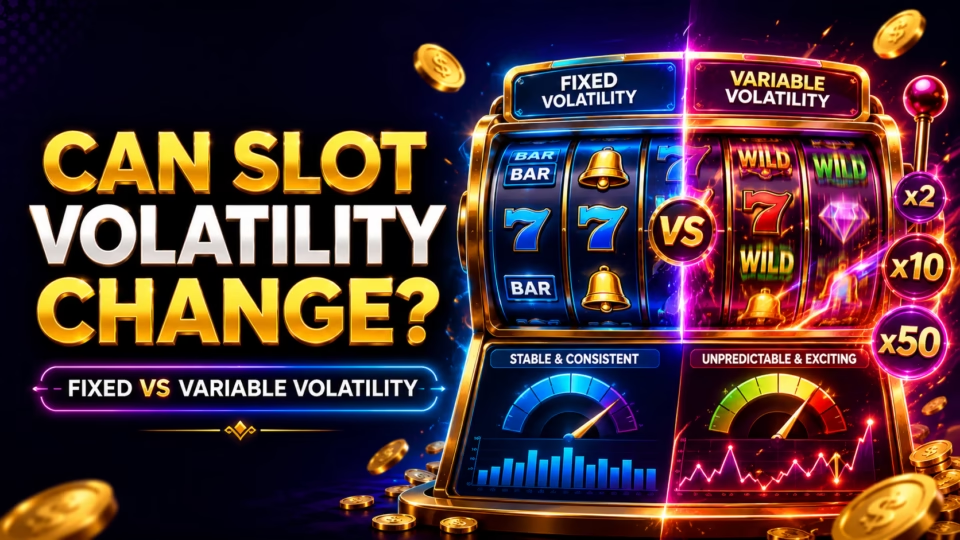
Yes, slot volatility can change in some games, but only when the slot’s mathematical design includes different volatility modes, features, or game configurations. Most slots use fixed volatility, meaning their underlying payout distribution does not change simply because a player raises the bet, wins several times, loses several times, or continues playing.
Variable volatility slots are different. They may let players choose between modes that favor more frequent smaller wins or less frequent but potentially larger wins. Some slots apply this choice only inside bonus rounds, while others use selectable game modes with different probability and payout structures.
Quick answers
- Most slots have fixed volatility determined by their mathematical model.
- Some slots have variable or player-selectable volatility through game modes, bonus options, or feature choices.
- Increasing the normal bet does not automatically increase volatility if the probabilities and payout multipliers remain unchanged.
- RTP and volatility are different measurements. A slot can have the same RTP while distributing payouts very differently.
- Volatility cannot predict the next spin. Random slot outcomes remain unpredictable, and short sessions can behave very differently from the theoretical volatility profile.
Players who care about bankroll swings, bonus frequency, and the balance between smaller and larger wins may find volatility particularly useful when comparing slots. However, volatility should never be interpreted as a method for predicting wins or improving the expected outcome of a session.
What Does Slot Volatility Mean?
Slot volatility describes how the game’s payouts are distributed, particularly the relationship between how often meaningful wins occur and how large those wins can be.
A lower-volatility slot generally concentrates more of its payout potential in smaller or medium wins. A higher-volatility slot usually allocates more of its mathematical potential toward less frequent, larger outcomes. This does not mean that every high-volatility game must have a low hit frequency, because hit frequency and volatility measure different characteristics of the payout distribution.
Volatility is part of a slot’s mathematical design together with factors such as RTP, hit frequency, symbol probabilities, bonus frequency, prize distribution, multipliers, and maximum payout potential.
Most importantly, volatility describes a long-term mathematical characteristic, not what must happen during a particular sequence of spins.
Can Slot Volatility Actually Change?
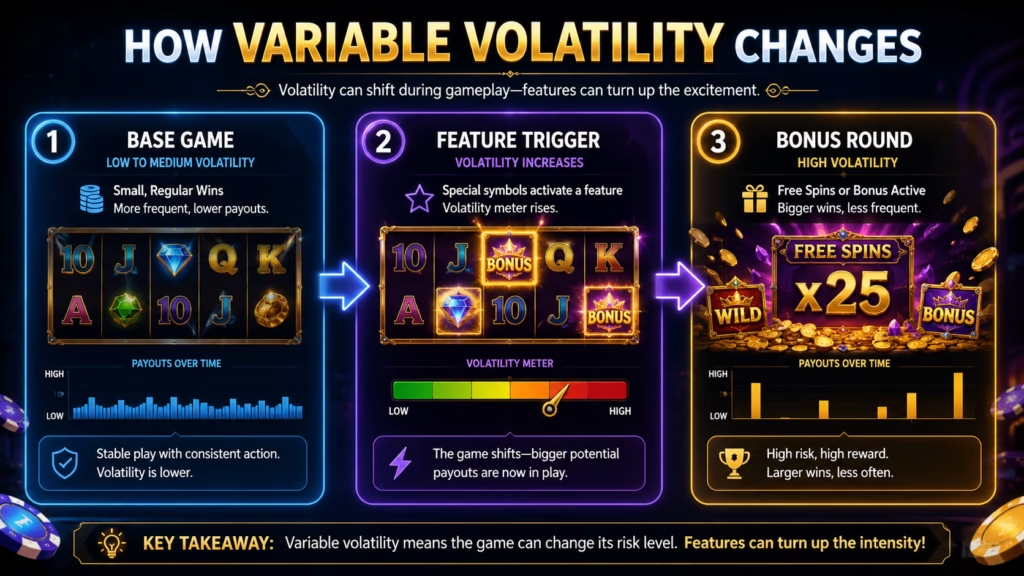
Slot volatility can change only when the game’s rules or mathematical model provide a mechanism for changing it.
There are several different situations that players sometimes group together as changing volatility:
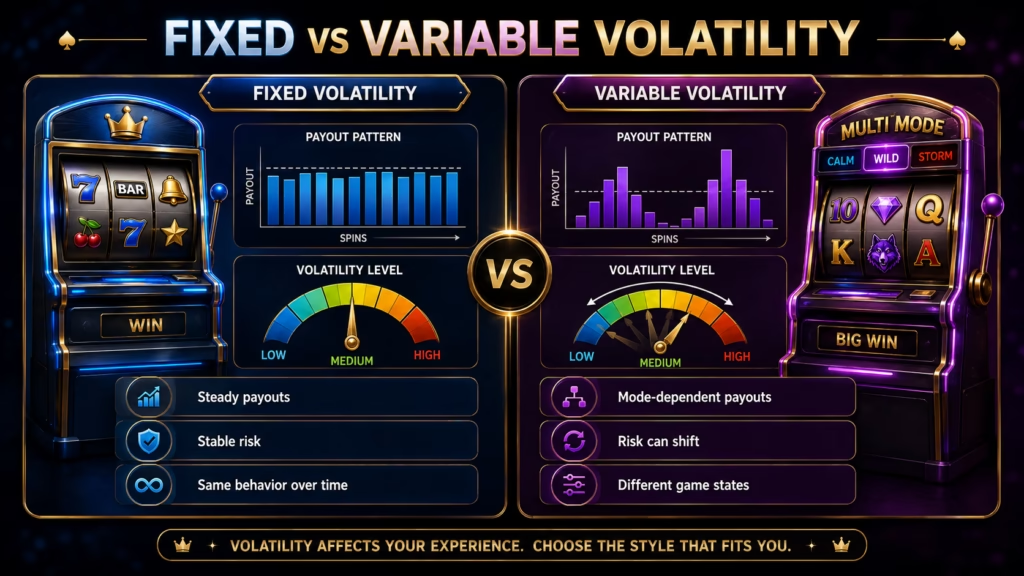
- A slot has one fixed mathematical model.
- A slot allows the player to select different volatility modes.
- A bonus round offers alternative risk profiles.
- A special bet or feature changes the game’s payout distribution.
- A provider offers different versions or configurations of a game.
These situations should not be confused with random short-term swings. A fixed high-volatility slot can suddenly produce several wins close together, while a low-volatility slot can produce a long losing sequence. Neither event proves that the underlying volatility changed.
Fixed Volatility Slots
A fixed-volatility slot uses essentially the same volatility profile while the same game configuration is being played. The player cannot move a volatility slider or deliberately switch the mathematical distribution from low to high.
If the slot is designed as high volatility, the game remains high volatility regardless of whether the player has recently won or lost.
Changing a normal stake from, for example, $0.50 to $1 does not by itself make the slot mathematically more volatile when the same probabilities and payout multipliers apply. The monetary swings become larger because more money is being wagered, but the proportional payout structure may remain unchanged.
Higher financial exposure is not necessarily higher game volatility.
A player betting five times more can experience five times larger monetary swings while still playing the same underlying math model.
What Are Variable Volatility Slots?
Variable volatility slots allow the payout profile to change through a deliberate game mechanic, mode, feature, or player decision.
The exact implementation varies by provider. A game might allow players to choose between:
- more frequent bonuses with lower average bonus payouts;
- less frequent bonuses with greater payout potential;
- different free-spins mechanics;
- alternative wild features;
- different risk settings;
- optional special bets;
- separate game modes using different probability distributions.
Variable volatility therefore does not mean that the slot secretly adjusts itself. It means that alternative mathematical experiences are intentionally built into the game.
Some modern slots explicitly allow players to choose the volatility or risk profile of a bonus round by selecting different Free Spins mechanics or feature configurations.
Player-Selectable Volatility Explained
Player-selectable volatility gives the player some control over which predefined mathematical mode is used, not control over the random outcome itself.
Consider a slot offering several bonus paths:
| Mode | Typical Design Goal | Possible Experience |
| Lower-volatility option | More frequent or more evenly distributed wins | Smaller swings |
| Higher-volatility option | More payout potential concentrated in stronger outcomes | Larger swings |
| Balanced option | Middle ground between frequency and payout size | Moderate swings |
The game developer determines the probabilities and payout structure behind each option. Selecting a high-volatility mode does not improve the player’s ability to predict when a large win will occur.
Some games use this concept by offering one side or mode with more frequent bonus triggers and lower average bonus wins, while another side offers rarer bonuses with higher average payout potential.
Can Volatility Change During Free Spins?
Yes, some slots allow volatility to change specifically during Free Spins or another bonus feature.
A base game might retain one volatility profile while the bonus round gives the player alternative mechanics.
One option could provide more opportunities to land winning combinations. Another could introduce sticky multipliers or persistent wilds that create greater payout concentration but less predictable results.
Players should therefore distinguish between overall slot volatility and feature-specific volatility. A provider may classify the complete slot as medium or high volatility even though individual game modes behave differently.
Do Bonus Buys Change Slot Volatility?
A Bonus Buy can significantly change the way volatility is experienced, but it should not automatically be assumed that every Bonus Buy changes the official volatility rating.
A Bonus Buy replaces repeated base-game spins with a much larger upfront wager that directly activates a feature. That concentrates more money into fewer game events, which can create much larger session-level swings.
Some modern games also provide several bonus purchase options with different mechanics, starting conditions, multiplier levels, or feature structures.
Whether the mathematical volatility or RTP changes between those options depends on the specific game. Players should check the game information and paytable instead of assuming that all Bonus Buy modes use identical mathematics.
Bonus purchases are also considerably more expensive per event than ordinary spins, so limits should be established before using them.
Does Increasing the Bet Change Volatility?
Increasing a standard slot bet usually changes the amount of money at risk rather than the underlying volatility, provided that all game probabilities and features remain the same.
Suppose the same outcome pays 20x the stake:
- A $0.50 bet pays $10.
- A $1 bet pays $20.
- A $5 bet pays $100.
The monetary variance becomes larger because the wager is larger, but the payout is still 20 times the stake.
The situation changes when a higher bet activates additional paylines, an ante feature, jackpot eligibility, enhanced bonus probabilities, or another mathematical modification. In that case, the game configuration may genuinely be different.
The correct approach is therefore to check what the increased bet actually changes, rather than assuming that a larger stake automatically means higher volatility.
RTP vs Volatility: Why They Are Not the Same
RTP describes the theoretical proportion of stakes returned over a very large number of game rounds, while volatility describes how those returns are distributed.
Two slots can theoretically have similar RTP values but completely different playing characteristics.
Imagine two simplified games with the same theoretical return:
- Game A distributes much of its return through frequent small payouts.
- Game B concentrates more return into rare large payouts.
Their RTP could be similar, while Game B has substantially greater volatility.
This is why selecting a higher-volatility mode should not be interpreted as selecting a higher RTP mode. Likewise, choosing lower volatility does not automatically improve the theoretical return.
The exact RTP should always be checked in the game’s information screen because the value can depend on the specific game configuration or operator version.
Hit Frequency vs Variable Volatility
Hit frequency measures how often a game produces a defined winning result, while volatility considers the wider distribution and size of payouts.
A slot can theoretically generate many small winning combinations while reserving a substantial proportion of payout potential for rare bonus outcomes. Such a game might have a reasonable hit frequency while still producing a volatile overall experience.
For that reason, a volatility decision should not be based on hit frequency alone.
Useful information includes:
- volatility rating;
- RTP;
- hit frequency, if disclosed;
- bonus frequency, if disclosed;
- payout distribution;
- maximum win;
- bonus mechanics;
- special bet rules.
Not every provider publishes all of these values.
Can a Slot Change Volatility Because You Are Winning?
A legitimate random slot should not become more or less volatile simply because an individual player has recently won or lost.
Random slot results are generated independently according to the game’s approved mathematical model. A previous win or loss does not create a reliable signal that the next spin must be better or worse.
This matters because streaks are easy to misinterpret. Ten poor spins followed by a large win do not demonstrate that the game opened up. Several wins followed by a dry period do not show that the slot deliberately reduced its volatility.
Random sequences naturally contain clusters, streaks, and unusual-looking patterns.
Can Casinos Secretly Change Slot Volatility?
Players should not assume that an operator can dynamically change a regulated slot’s math whenever it wants.
In regulated markets, game software, RNG behavior, and material changes that affect fairness are generally subject to technical standards, testing, and approval requirements.
A provider can potentially develop different approved configurations or update a game, but that is fundamentally different from a slot secretly reacting to an individual player’s current balance or recent results.
Rules depend on jurisdiction, so players should use licensed operators where required and consult the applicable regulator when they need jurisdiction-specific information.
How to Tell Whether a Slot Has Variable Volatility
The safest method is to check the actual game rules instead of judging volatility from a short playing session.
Look for:
- a volatility or variance rating;
- multiple game modes;
- selectable Free Spins;
- alternative bonus configurations;
- special bet or ante options;
- Bonus Buy variations;
- explanations of how each option changes probabilities or prizes;
- separate RTP figures for different modes, if supplied.
Some slot series are specifically designed with variants offering different volatility levels, paylines, RTP values, or maximum wins.
If the rules never state that the mathematical configuration changes, do not infer variable volatility merely from experiencing a lucky or unlucky session.
Which Volatility Type May Suit Different Players?
Lower or moderate volatility is generally easier to understand for players who prefer smaller bankroll swings, while higher volatility is more relevant to players who accept longer periods without significant payouts.
Variable volatility can be useful for players who want to choose between those experiences without switching to a completely different slot.
Fixed lower or medium volatility may suit players who:
- prefer relatively steadier gameplay;
- dislike large bankroll swings;
- want a simpler game without risk-mode decisions;
- mainly play for entertainment with a limited session budget.
High volatility may appeal to players who:
- accept irregular payouts;
- understand that strong results may be rare;
- are comfortable setting strict loss and spending limits;
- prefer games where more payout potential is concentrated in larger outcomes.
Variable volatility may appeal to players who:
- like changing gameplay styles;
- want a choice between bonus structures;
- understand what each mode changes;
- are willing to read the rules before selecting a risk level.
No volatility category improves the ability to predict results.
Common Myths About Changing Slot Volatility
“A slot becomes more volatile after a big win”
There is no basis for treating a normal random winning streak as evidence that the mathematical volatility has changed. Random outcomes can naturally produce unusual sequences.
“Raising the stake unlocks bigger volatility”
A larger monetary stake increases the amount won or lost when the same multiplier structure applies. It changes financial exposure, not automatically the mathematical payout distribution.
“High volatility means better RTP”
High volatility and high RTP are separate concepts. Either one can exist without the other.
“Low volatility means you cannot lose quickly”
Low volatility describes long-term payout distribution. A short random session can still produce substantial losses.
“Variable volatility lets players control wins”
Selectable volatility only allows players to choose among predefined game models or feature configurations. It does not let them control the RNG or predict the next result.
Practical Rules for Choosing a Volatility Setting
Before selecting a volatility mode, identify exactly what changes.
First, check whether the option affects frequency, prize size, bonus probability, multipliers, feature mechanics, RTP, or several variables at once.
Second, compare the cost of each option. A feature requiring a much larger wager can produce a very different bankroll experience even when its theoretical RTP is similar.
Third, avoid selecting maximum volatility solely because the advertised maximum win is larger. Maximum win represents an upper payout limit or potential outcome, not the probability of reaching it.
Finally, set a spending limit before playing. Volatility describes statistical behavior, but it does not eliminate randomness or make a particular session predictable.
How This Information Was Reviewed
This explanation separates volatility from RTP, hit frequency, bet size, and random short-term results because these measurements describe different aspects of a slot.
The practical examples are based on common slot design patterns, game-rule terminology, and regulatory principles for random game outcomes. Exact volatility, RTP, feature probabilities, and bonus rules can vary between games and configurations.
The game’s paytable and rules should therefore be checked before playing.
Slots should be treated as paid entertainment, not as a way to earn money. RTP and volatility are long-term mathematical characteristics and cannot guarantee the result of an individual session.
FAQ
Can slot volatility change?
Yes. Slot volatility can change when the game includes different mathematical modes, feature configurations, or player-selectable volatility options. A conventional fixed-volatility slot does not change volatility simply because the player wins, loses, increases the normal stake, or continues playing.
What are variable volatility slots?
Variable volatility slots are games that provide more than one payout or risk profile within the same game structure. Players may be able to select modes with different bonus frequencies, average payout sizes, wild mechanics, multipliers, or other mathematical characteristics.
Can players choose slot volatility?
Some slots allow players to choose volatility directly or indirectly through selectable Free Spins, bonus mechanics, or alternative game modes. Many other slots have only one fixed volatility profile.
Does betting more increase slot volatility?
Not necessarily. Raising a normal stake increases the amount of money exposed to each spin, but it does not automatically change volatility when the underlying probabilities and payout multipliers stay the same. If a higher bet activates different mechanics or probabilities, the game configuration may change.
Can RTP change when volatility changes?
It can, but it does not have to. RTP and volatility are separate mathematical properties. A provider can design two modes with different volatility but similar RTP, or modes where both values differ. Check the paytable or game information for the exact configuration.
Are Bonus Buy slots more volatile?
Bonus Buys often create larger bankroll swings because a substantial stake is concentrated into a single bonus event, but this does not prove that every Bonus Buy has a different official volatility rating. The mathematical model and RTP of each purchase option should be checked individually.
Does a slot lower its volatility after paying a big win?
A random slot should not be assumed to alter its mathematical behavior because one player recently received a large payout. Winning and losing streaks can occur naturally within random sequences.
Is high volatility better than low volatility?
Neither is inherently better. High volatility concentrates more risk around irregular outcomes, while lower volatility generally aims for a more even payout distribution. The appropriate choice depends on the type of gameplay an adult player prefers and the spending limits they are prepared to follow.
Can volatility predict when a slot will pay?
No. Volatility describes the statistical distribution of payouts and cannot identify when the next winning spin or bonus will occur. Random outcomes remain unpredictable, and previous spins do not provide a reliable method for forecasting the next result.
Short Conclusion
Slot volatility can change, but only when the game’s mathematical design provides different modes, features, or configurations. Most traditional slots use fixed volatility, while variable volatility slots can let players choose between different payout distributions or bonus structures.
Changing the normal bet or experiencing a winning or losing streak does not automatically change volatility. Check the game’s rules, paytable, RTP, feature options, and volatility information before playing. Most importantly, volatility describes long-term statistical behavior and cannot predict individual spins or guarantee better results.