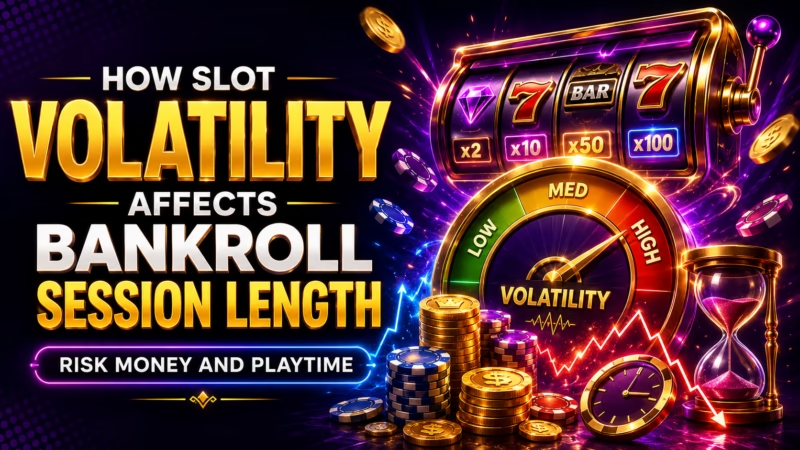
Casino game variance describes how widely short-term results can move around a game’s expected mathematical return. A higher-variance game can produce larger swings, longer losing stretches and occasional larger wins, while a lower-variance game usually produces more stable results with smaller changes between individual bets.
Variance does not tell you whether a casino game is profitable, when a win will occur or whether the next session will be better than the last. It describes the distribution of possible outcomes, not a prediction of future results.
Quick takeaways:
- High variance means results can fluctuate sharply over a relatively small number of bets.
- Low variance usually means smaller, more frequent changes in the bankroll.
- Slots often have wider payout distributions than simple table-game bets because one spin can include many different prize levels and bonus outcomes.
- Table-game variance depends heavily on the game and the specific wager. A roulette straight-up bet behaves very differently from an even-money roulette bet.
- Variance, RTP, house edge and hit frequency measure different things and should not be treated as interchangeable.
Casino game variance matters most to players deciding how much short-term fluctuation they are comfortable with. Players using smaller entertainment budgets may prefer games or bets with less dramatic swings, while players who deliberately choose high-volatility slots should understand that substantial losing periods can occur even when the theoretical RTP appears competitive.
What Is Variance in Casino Games?
Variance in casino games is a statistical measure of how far individual outcomes can spread from the average expected outcome. In simple terms, variance helps describe whether a game tends to deliver many relatively similar results or a mixture of small results and occasional extreme outcomes.
The statistical concept can be expressed as:
Variance = E[(X − μ)²]
where X represents a possible result and μ represents the expected value. Players do not need to calculate this formula to use the concept. The practical question is whether the game produces relatively smooth bankroll movement or large short-term swings.
A casino game can therefore have a predictable long-run mathematical expectation while still producing highly unpredictable short-term sessions. Random outcomes do not need to follow the theoretical average over dozens, hundreds or even thousands of individual bets.
Variance vs Volatility
Variance and volatility are closely related terms, but they are not always used in exactly the same way.
Variance has a precise statistical meaning. It measures the dispersion of possible results around the expected value.
Volatility is commonly used by slot developers, casinos and players as a practical description of how aggressively a game’s payouts may fluctuate. A slot described as high volatility generally has the potential for larger but less consistent payout events, although the exact mathematical model may not be publicly disclosed.
For everyday slot comparison, volatility is usually easier to understand. For mathematical analysis of casino games, variance is the more precise concept.
Neither term predicts the next outcome. A high-volatility slot is not “due” to pay after a losing streak, and a low-volatility game cannot guarantee frequent profitable sessions.
How Casino Game Variance Affects Your Bankroll
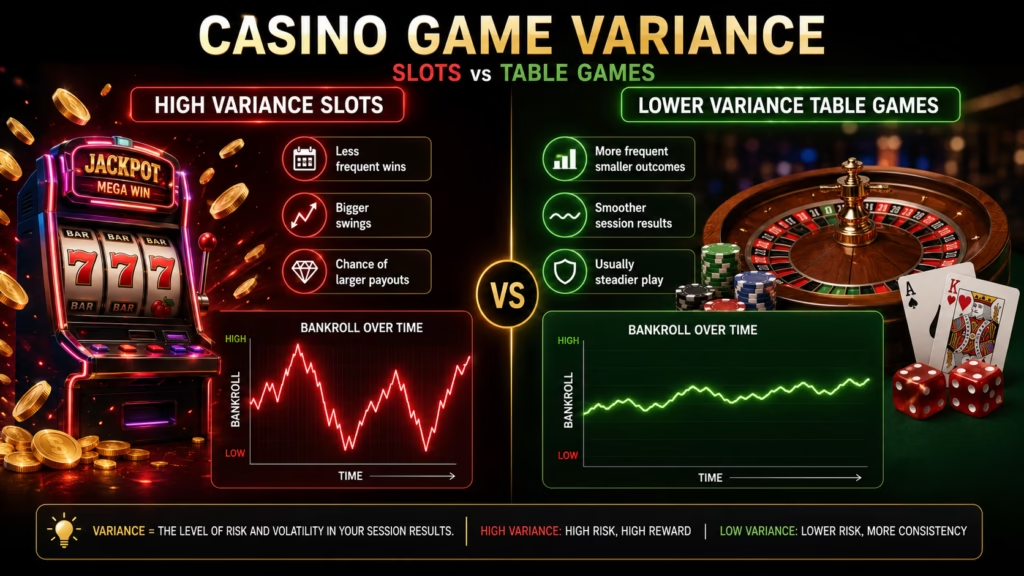
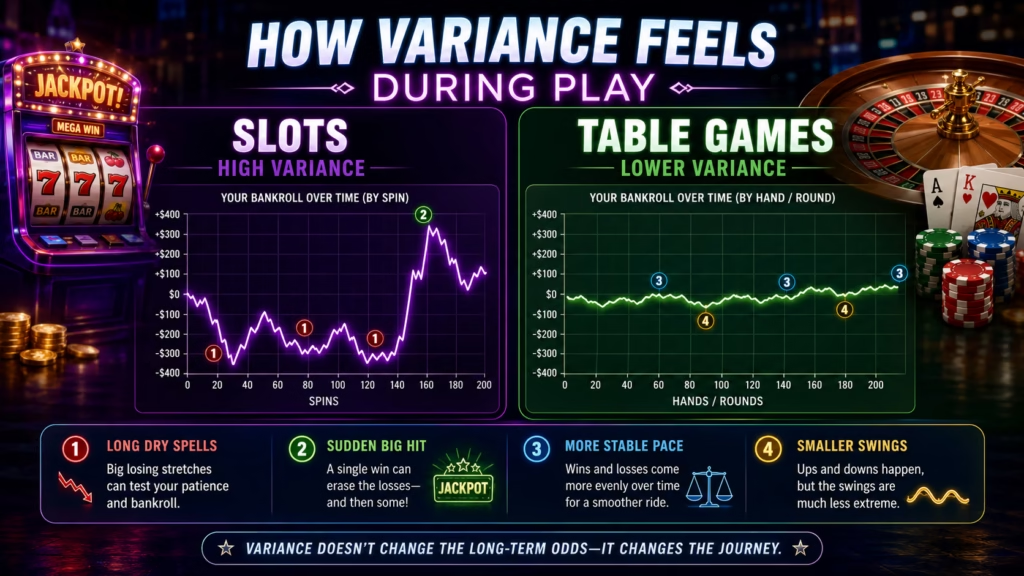
Casino game variance affects how quickly a bankroll may rise or fall during a session. Higher variance generally requires greater tolerance for short-term fluctuations because the distance between ordinary results and unusually large outcomes can be much wider.
Imagine two games with broadly similar theoretical returns. Game A produces many modest payouts and relatively few extreme outcomes. Game B produces numerous losing results but includes occasional much larger payouts. Game B has the more aggressive short-term profile even though their long-run return percentages could be similar.
This distinction is important because RTP does not describe the path your bankroll will take. A game can have a relatively high theoretical RTP and still be extremely volatile.
Players with strict spending limits should therefore consider both theoretical return and variance. Choosing a high-variance game with a bankroll that only allows a small number of bets can create a substantial chance of exhausting the entertainment budget before a less common payout event occurs.
Why Slots Often Have Higher Variance
Slots can have high variance because their payout structures may contain many possible outcomes ranging from zero payout to comparatively large feature or jackpot wins. Bonus rounds, multipliers, free spins and other mechanics can concentrate part of a slot’s theoretical return into relatively uncommon events.
A slot may therefore return some of its theoretical payout through ordinary base-game wins and another portion through less frequent bonus events. If a meaningful part of the game’s return is concentrated in rare outcomes, short sessions can differ dramatically from the theoretical average.
Not every slot is high variance. Some slots are deliberately designed around smaller and more frequent payouts, while others emphasize large potential wins and extended dry periods.
The key point is that slot variance depends on the complete payout distribution, not simply the maximum advertised win.
Low-Variance vs High-Variance Slots
Low-variance slots generally produce less dramatic bankroll movement. Wins may be smaller, but the payout distribution is usually less dependent on rare high-value outcomes.
High-variance slots typically produce more irregular sessions. Long sequences without meaningful payouts can be followed by a bonus feature, multiplier combination or other uncommon result that changes the session dramatically.
| Characteristic | Lower-Variance Slot | Higher-Variance Slot |
| Bankroll movement | Usually smoother | Usually more aggressive |
| Size of typical wins | Often smaller | Can vary widely |
| Losing stretches | Often shorter or less severe | Can be considerably longer |
| Dependence on major features | Usually lower | May be higher |
| Suitable session budget | Easier to spread across many spins | Requires stricter planning |
| Predicts profit? | No | No |
These are general characteristics rather than universal rules. Slot developers can use very different mathematical models, and volatility labels are not standardized across every provider.
Variance in Table Games
Variance in table games depends on the range and probability of the wagers available. Table games should not be treated as one low-variance category because different bets within the same game can create completely different risk profiles.
Roulette provides a straightforward example. An even-money wager covers a large portion of the wheel and produces a relatively modest winning payout. A straight-up number covers only one number and offers a much larger payout when successful. The straight-up wager therefore creates much larger fluctuations between common losing outcomes and the less frequent winning outcome.
This principle appears across casino games: the more concentrated the payout is in less probable outcomes, the greater the potential short-term fluctuation tends to become.
Slots vs Table Games: Which Have More Variance?
Slots generally offer a broader range of variance profiles than basic table-game wagers because slot paytables can contain hundreds or thousands of possible combinations, bonus states, multipliers and feature outcomes.
However, saying that slots always have higher variance than table games would be inaccurate. A conservative slot can have a relatively smooth payout profile, while certain table-game bets can create extremely aggressive fluctuations.
| Factor | Slots | Table Games |
| Outcome structure | Often complex | Usually easier to define |
| Number of payout levels | Can be very large | Often more limited |
| Bonus features | Common | Usually absent |
| Large multipliers | Possible | Depends on wager |
| Variance transparency | Often presented as volatility | Often calculable from rules |
| Player decisions | Usually limited after bet placement | Can matter in some games |
The better comparison is therefore not simply slots vs table games, but one specific game’s payout distribution versus another.
Variance vs RTP
RTP and variance answer different questions.
RTP describes the theoretical proportion of wagers a game is designed to return over a very large number of plays. Variance describes how widely individual results can fluctuate around that expectation.
Two games could theoretically have similar RTP percentages while creating completely different player experiences. One may return value through many smaller payouts, while another may concentrate more of its theoretical return in rare larger wins.
RTP should never be interpreted as a promise that a player will receive a specific percentage of their money back during a session. Actual short-term results can differ sharply from theoretical RTP, especially in high-variance games.
Variance vs House Edge
House edge measures the casino’s theoretical mathematical advantage, while variance measures the size of potential fluctuations.
A lower house edge does not automatically mean lower variance. Likewise, a high-variance wager is not necessarily associated with the highest house edge.
This difference matters when comparing casino games. House edge addresses long-term expectation. Variance addresses the shape and instability of the journey around that expectation.
Players evaluating a game should therefore avoid using either statistic as a substitute for the other.
Variance vs Hit Frequency
Hit frequency measures how often a slot produces a qualifying winning result, while variance considers the size and distribution of all possible outcomes.
A game can have a relatively high hit frequency while remaining volatile if many winning results are small and a substantial part of the game’s payout potential comes from rare larger events.
Likewise, a lower hit frequency does not automatically mean that a slot has the highest possible variance. The values of the winning outcomes also matter.
This is why judging a slot solely from statements such as “wins frequently” can be misleading. Frequency tells only part of the payout story.
How Bonus Features Can Change Slot Variance
Bonus features can increase the difference between ordinary spins and exceptional results when a significant share of a slot’s payout potential is concentrated inside those features.
- free spins;
- expanding or accumulating multipliers;
- bonus wheels;
- jackpot features;
- symbol collection mechanics;
- hold-and-win rounds;
- cascading sequences;
- special bonus symbols.
The presence of these mechanics does not automatically make a slot high variance. What matters is how frequently features occur, how payouts are distributed and how strongly the largest possible outcomes depend on uncommon combinations.
Players should check the official game information or paytable when available rather than assuming volatility from the visual design of the bonus feature.
Common Myths About Casino Game Variance
A high-variance game eventually has to produce a big win
No. Variance describes the distribution of possible outcomes, not a schedule for payouts. Previous losses do not force an independent random game to produce a large future win.
Low variance means you are less likely to lose
Not necessarily. Lower variance generally means smaller fluctuations, but the game’s expected return and house edge still matter. A smoother losing pattern is still a losing pattern if results happen to move against the player.
A high RTP makes high variance harmless
No. RTP and variance measure different characteristics. A high theoretical RTP does not prevent severe short-term losses.
Frequent wins mean low variance
Not always. A game can record many small winning events while concentrating meaningful profit potential in rare larger outcomes.
Raising the bet changes the underlying variance
Increasing stake size usually increases the monetary size of bankroll swings, but it does not necessarily change the mathematical payout distribution of the game. Some games have bet-dependent rules or features, so the official paytable should be checked before making assumptions.
How to Compare Casino Games by Variance
Casino game variance is most useful when combined with other information rather than used as a standalone ranking system.
Before choosing a game, consider:
- Volatility or variance level. Determine whether the game is designed for relatively smooth or aggressive fluctuations.
- RTP or house edge. Understand the long-run mathematical expectation separately from short-term variance.
- Bet size. A high-variance game becomes more financially demanding when each wager represents a large percentage of the available bankroll.
- Payout distribution. Check whether meaningful payouts mainly come from ordinary outcomes or uncommon bonus events.
- Game rules. Table-game bet types can dramatically alter variance even when played on the same table.
- Session limits. Decide the maximum amount and time you are prepared to spend before starting.
Variance should be used to choose a style of play that matches an entertainment budget, not as a method for identifying games that are more likely to produce profit.
Which Variance Level Is Better?
There is no universally better variance level because the appropriate choice depends on how much short-term fluctuation a player is comfortable accepting.
Lower-variance games may appeal to players who prefer longer sessions, smaller fluctuations and fewer dramatic changes in bankroll.
Higher-variance games may appeal to players who understand that losing periods can be longer and who are comfortable with a payout structure that may place more emphasis on uncommon larger outcomes.
Players with limited budgets should be particularly cautious with high-variance games. Increasing bets to recover losses does not reduce variance and can instead accelerate bankroll depletion.
Casino gaming should remain entertainment. Set spending and time limits before playing, avoid chasing losses and stop when continued play exceeds the amount you intended to spend.
How This Information Was Reviewed
This comparison is based on the mathematical distinction between expected return and the dispersion of possible casino-game outcomes. The practical assessment considers payout structure, bet probability, payout size, RTP or house edge, slot volatility, bonus mechanics and bankroll fluctuation.
Exact values should be checked in the official game rules, paytable or information screen because slot configurations and casino offerings may differ by operator. Volatility labels can also be presented differently by different game developers.
RTP, variance and bonus features cannot predict the result of an individual session. Random casino games can produce results far above or below their theoretical expectation over short periods.
Casino games should therefore be treated as paid entertainment rather than an income method. Players who find themselves increasing spending, chasing losses or struggling to stop should discontinue play and use appropriate responsible-gambling controls or support resources.
FAQ
What does variance mean in casino games?
Casino game variance measures how widely individual results can fluctuate around the expected mathematical outcome. Higher variance generally creates larger short-term swings, while lower variance tends to produce a smoother pattern of results. Variance does not predict whether the next bet will win.
Is variance the same as volatility in slots?
Variance and volatility describe closely related ideas, but variance is a formal statistical concept while volatility is often used as a practical slot classification. A high-volatility slot usually has a more aggressive payout distribution, although providers may use different methods to classify volatility.
Are slots more volatile than table games?
Slots often offer wider variance ranges because their paytables can contain many payout levels, bonus rounds and multipliers. However, some table-game wagers can also have extremely high variance, so the specific game and bet should be compared rather than assuming every slot is riskier.
Does higher variance mean a higher RTP?
No. Variance and RTP are independent concepts. RTP describes theoretical long-run return, while variance describes how widely actual outcomes can fluctuate around that expectation. Two games with similar RTP values can have very different variance levels.
Can a low-variance game still lose money quickly?
Yes. Low variance reduces the typical size of short-term fluctuations but does not eliminate losses. The house edge, bet size, number of bets and random outcomes still affect the session.
Does high variance mean bigger maximum wins?
Not necessarily. High variance can be associated with larger possible payouts, but maximum win alone does not determine variance. The probabilities and values of all possible outcomes must be considered.
Does hit frequency show how volatile a slot is?
Hit frequency alone cannot determine slot volatility. It measures how often qualifying wins occur but does not show their size. A slot can produce frequent small wins while still depending on rare large payouts for much of its potential return.
Can you reduce variance by changing bet size?
Lowering the bet reduces the monetary size of individual fluctuations but usually does not change the game’s underlying mathematical variance structure. Game rules can differ, so players should check whether bet size activates different features, jackpots or payout conditions.
Which casino games are best for players with small bankrolls?
Players with smaller entertainment budgets may find lower-variance games and smaller bet sizes easier to manage because the bankroll is less exposed to large fluctuations on individual outcomes. This does not guarantee longer play or prevent losses, so predefined spending limits remain important.
Can variance predict when a casino game will pay?
No. Variance cannot predict the timing of wins. It describes the statistical spread of possible outcomes. In games where individual results are random and independent, previous losses do not mean that a winning result is due.
Brief Conclusion
Casino game variance explains the size and frequency of short-term fluctuations, while RTP and house edge describe long-run mathematical expectation. Slots can range from relatively stable to extremely volatile, and table-game variance can change substantially depending on the wager selected.
The most useful approach is to evaluate variance together with RTP or house edge, payout structure, bet size and personal spending limits. Higher variance does not mean better returns, lower variance does not guarantee safety, and neither can predict the next result.