Skill-based slot bonus rounds combine traditional slot mechanics with an interactive challenge in which a player’s performance can affect the bonus result. The base game may still use random outcomes, but the bonus can introduce reaction speed, accuracy, timing, memory, strategy or another measurable ability.
In practical terms, the slot first determines whether the bonus is triggered according to its normal rules. The player then completes a mini-game, such as shooting targets, stopping a moving indicator or choosing an efficient path. Better performance may produce a higher prize tier, a larger multiplier or more bonus credits, although the exact influence of skill depends on the game’s mathematical design.
Quick takeaways:
- Skill-based slot bonus rounds allow player decisions or physical performance to affect part of the payout.
- The bonus trigger itself is often controlled by the slot’s normal chance-based mechanics.
- Some games let skill determine the full bonus value, while others restrict it to a predefined prize range.
- An interactive animation is not necessarily skill-based if every choice produces the same predetermined result.
- Skill can improve performance within the game’s rules, but it cannot guarantee a profit or remove the house advantage.
Skill-based bonuses may appeal to players who enjoy arcade games, video games and more active casino mechanics. Players who prefer simple spins, predictable controls or passive bonus rounds may find the format unnecessarily demanding.
Caution is especially important when a game does not clearly explain how skill affects the payout. Before wagering, check the paytable, bonus instructions, RTP information and operator terms.
What Is a Skill-Based Slot Bonus Round?
A skill-based slot bonus round is an interactive feature in which a player’s ability influences the award. Skill can involve physical abilities, such as reaction or dexterity, or mental abilities, such as logic, strategy or knowledge.
The important word is influences. A bonus does not become skill-based merely because the player presses buttons, selects objects or watches an animation. The player’s actions must make a measurable difference to the result.
For example, a bonus that asks the player to select one of three boxes may still be entirely random. If the prize was determined before the selection, the boxes only reveal the result. A true skill-based version might reward the player for remembering symbol positions, hitting moving targets accurately or completing a puzzle within a time limit.
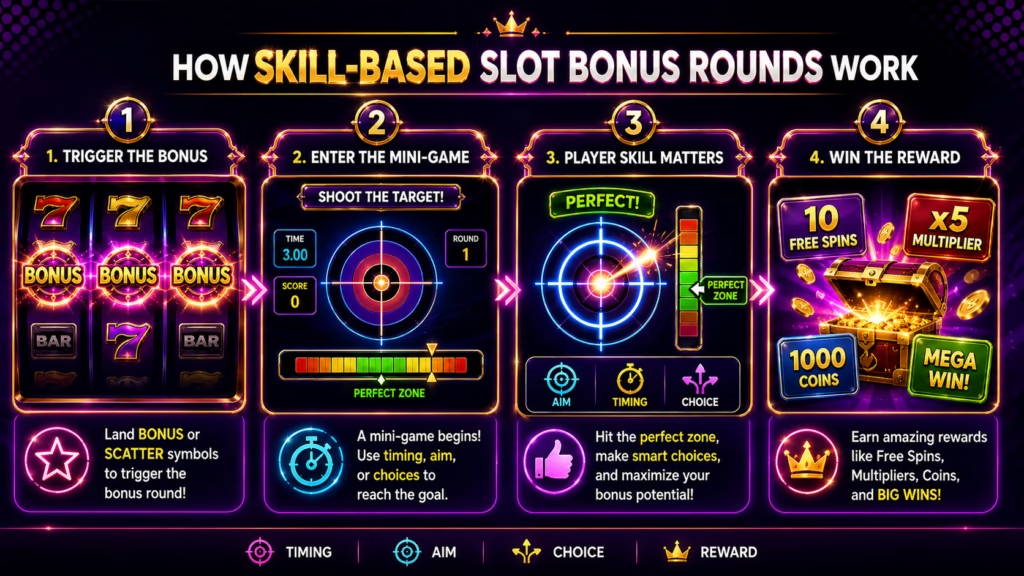
How Do Skill-Based Slot Bonus Rounds Work Step by Step?
Most skill-based slot bonus rounds follow a hybrid structure that separates the chance-based slot game from the skill-based activity.
1. The player places a normal slot wager
The game begins like a standard slot. The player chooses an available stake and starts a spin. Reel symbols, winning combinations and feature triggers are usually governed by the game’s approved mathematical model.
2. The slot triggers the bonus feature
The skill round may be activated by scatters, bonus symbols, a random feature, a collected meter or another condition described in the rules. Player skill usually does not influence when the bonus appears unless the game explicitly says otherwise. Playing faster, changing bet patterns or stopping the reels at a particular moment generally does not force a bonus trigger.
3. The game explains the interactive objective
A legitimate skill round should tell the player what action is required and how performance affects the award. Instructions may include a time limit, scoring system, available controls, prize levels or minimum and maximum outcomes. Clear explanations are especially important when joysticks, controllers, motion sensors or other interaction devices are used.
4. The player completes the challenge
The player may aim, react, solve, remember, choose a route or manage limited resources. The game records a measurable result, such as points scored, targets hit, correct answers or completion time.
5. The score is converted into a bonus award
The game applies its paytable or conversion rules to the final score. A stronger performance may unlock a higher multiplier, move the player into a better prize band or increase the number of credits awarded. The game may still contain chance elements during this process. Randomly appearing targets, unknown prize values or variable layouts can prevent two equally skilled attempts from producing identical rewards.
What Types of Skill Can Affect a Slot Bonus?
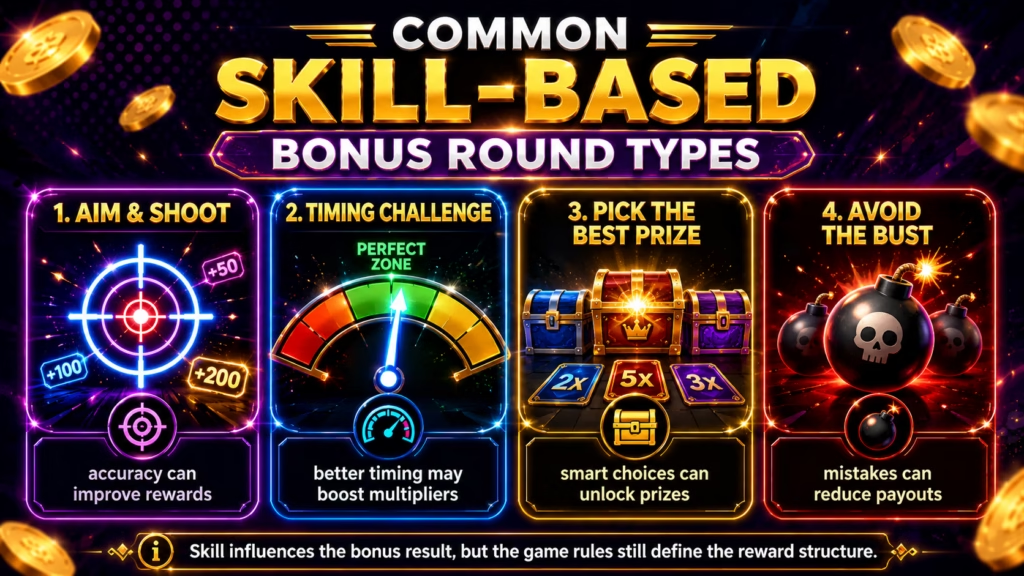
Reaction and timing
Reaction-based bonuses ask the player to act at the correct moment. Examples include stopping a moving indicator inside a high-value zone, pressing a button when symbols align or responding quickly to visual prompts. These rounds are easy to understand but may be difficult to master because small timing errors can lower the score.
Accuracy and hand-eye coordination
Accuracy bonuses resemble arcade shooting or targeting games. The player may need to hit moving objects, avoid obstacles or prioritize valuable targets. The controls matter in this format. Screen size, input delay and mobile responsiveness can affect usability, so a game that feels comfortable on a casino cabinet may work differently on a touchscreen.
Memory and visual recognition
Memory bonuses may briefly display symbols, positions or sequences before asking the player to reproduce them. Better recall can lead to a higher reward. This format rewards attention rather than fast reactions, which may make it more accessible to players who dislike timed shooting challenges.
Logic and strategy
Strategy-based bonuses require the player to make decisions with limited information. The challenge may involve selecting a route, allocating resources, matching patterns or deciding which targets to pursue first. A strategic choice only represents genuine skill when one decision can produce a better expected result than another. If all paths lead to an equivalent hidden prize, the interaction functions more like a traditional pick bonus.
Knowledge and trivia
Some skill games can use factual questions, word puzzles or numerical challenges. Correct answers may increase the score or award level. Knowledge-based mechanics require particularly clear rules because language, regional familiarity and question difficulty can affect player performance.
How Much Can Skill Change the Bonus Payout?
The effect of skill depends on the game’s approved payout model. Skill may control a narrow adjustment, a broad prize range or almost the entire bonus award.
| Bonus model | Role of skill | Role of chance |
| Predetermined reveal | Little or no real influence | The result is selected before or independently of the player’s choice |
| Capped skill bonus | Changes the award within a minimum and maximum range | The game establishes the available range or starting value |
| Hybrid bonus | Performance and random events both affect the result | Random layouts, targets or prize values remain active |
| Predominantly skill-based bonus | Performance has a major effect on the award | Chance may control entry, conditions or occasional events |
A capped skill model can guarantee that the player receives at least a defined bonus value while reserving the highest value for strong performance. Another model may start with a randomly selected prize pool and let the player’s score determine how much of that pool is collected.
The paytable should explain the actual structure. Do not assume that a visually difficult mini-game gives the player unlimited control over the payout.
Are Skill-Based Bonuses Still Random?
Skill-based slot bonuses can still include randomness. A hybrid game combines an element of skill with one or more chance-based elements, so the player can influence the outcome without controlling every variable.
The base spin may randomly trigger the feature. The bonus may then generate random target positions or prize values. Player skill determines how effectively those opportunities are used.
This distinction matters because a highly skilled player may achieve better long-term bonus performance than an unskilled player, but a single attempt can still produce a weak result. Random conditions and the game’s payout limits remain relevant.
Legal classifications and disclosure requirements differ between jurisdictions, so the availability of a particular skill-based game depends on the regulator and operator.
Skill-Based Bonuses vs Traditional Slot Bonuses
Traditional slot bonuses rely mainly on the game’s mathematical model after the feature begins. The player may press buttons or select symbols, but those actions often reveal outcomes rather than improve them.
Skill-based slot bonus rounds require performance that can change the award. A better action should produce a better result under the same game conditions.
The practical differences include:
- Player involvement: Skill rounds require active concentration, while traditional free spins can often run with minimal input.
- Repeatability: Practice may improve performance in a genuine skill round.
- Payout variation: Two players facing similar conditions may receive different awards because of their scores.
- Accessibility: Players with slower reactions, limited dexterity or unfamiliarity with the controls may be disadvantaged.
- Transparency: The rules need to explain what is controlled by skill and what remains random.
Neither format is automatically better. Traditional bonuses suit players who want straightforward slot mechanics. Skill-based bonuses suit players who value interaction and are prepared to learn the controls.
How Skill-Based Bonuses Affect RTP
Return to player, or RTP, represents the theoretical proportion of wagers returned as prizes across a very large number of game rounds. RTP does not predict what one player will receive during a short session.
In a skill-based game, the theoretical RTP may depend on the assumed level of performance. Poor, average and optimal play can produce different theoretical returns if skill directly affects awards.
When a game displays RTP for a skill-based feature, the figure may be based on an advertised strategy or an optimal method of play that can be derived from the game rules.
This does not mean every player will achieve the displayed RTP. A player who misses targets or makes weaker decisions may receive a lower effective return than the optimal figure assumes. The exact calculation and disclosure requirements depend on the jurisdiction, game version and operator.
How to Identify a Genuine Skill-Based Bonus
A genuine skill-based bonus should answer four questions before the player commits money:
- What ability is being measured? The rules should identify timing, accuracy, memory, strategy or another specific skill.
- How is performance scored? The player should be able to understand what improves or reduces the score.
- How does the score affect the award? The game should connect score bands, objectives or results to prize values.
- What remains random? The rules should clarify whether feature entry, layouts, targets or prize pools are chance-based.
A demo mode can help the player understand the controls, but demo availability depends on the provider and operator. Free play also does not confirm that the real-money version uses identical RTP settings, stake limits or bonus conditions.
Common Myths About Skill-Based Slot Bonus Rounds
“A skilled player can beat the slot”
Skill can improve the result of a particular bonus, but it does not automatically eliminate the mathematical advantage built into the overall game. The base slot, bonus frequency and maximum award remain governed by the approved game model.
“Every interactive bonus is skill-based”
Buttons and choices do not prove that skill matters. Some bonuses use player interaction only to reveal a previously determined result.
“Stopping the reels is a skill”
A stop button usually changes the animation speed rather than the underlying outcome. The game rules must explicitly state when timing or another action affects the result.
“The highest score guarantees the jackpot”
A top score may qualify for the highest skill-controlled award, but chance conditions or separate jackpot rules may still apply. Check whether the top prize is based on skill, chance or a combination of both.
“RTP predicts the next bonus result”
RTP is a long-term theoretical measure. It cannot show when a bonus will trigger or what the next skill round will pay.
Practical Tips Before Playing
Read the bonus instructions before increasing the stake. Focus on the scoring system, time limit, controls, minimum award and maximum award.
Use demo mode when available to learn the mechanics without wagering. Practice is useful only when the demo accurately represents the same skill challenge.
Check whether the displayed RTP assumes optimal performance. A single RTP figure can be misleading when the game does not explain the skill level used in its calculation.
Set a spending limit before playing. Fast arcade-style rounds can encourage repeated attempts, especially when the player believes the next performance will be better.
Choose games from operators permitted in your jurisdiction and review the casino’s withdrawal, bonus and wagering terms separately. A slot feature and a casino promotion are different products with different conditions.
How This Information Was Reviewed
This guide evaluates skill-based slot bonus rounds by separating four elements: bonus entry, player action, scoring and payout conversion. The explanation also considers common technical principles for games with skill, player disclosures, RTP calculations and interaction devices.
Players should still check the official game rules and paytable because skill influence, RTP, volatility, controls and bonus limits vary by title and operator. RTP and volatility describe long-term mathematical characteristics, not the outcome of an individual session.
Skill-based slots should be treated as paid entertainment, not as a source of income. Stop playing when spending exceeds the limit set in advance, when losses are being chased or when the game no longer feels recreational.
FAQ
Do skill-based slot bonus rounds let players control the payout?
Skill-based slot bonus rounds let players influence the payout, but they do not always provide complete control. The bonus may contain a minimum award, maximum award, random prize pool or chance-based events that limit how much performance can change the result.
Can practice improve results in skill-based slot bonuses?
Practice may improve results when the bonus genuinely measures reaction, accuracy, memory or strategy. Practice cannot increase the random frequency of bonus triggers or guarantee that a session will be profitable.
Are skill-based slots the same as arcade games?
Skill-based slots borrow controls and mechanics from arcade games, but they remain wagering products when real money is involved. Their prizes, RTP and legal requirements are governed by casino game rules rather than ordinary video game scoring alone.
Is a pick-and-click bonus considered skill-based?
A pick-and-click bonus is skill-based only when informed choices can improve the expected award. If each object simply reveals a random or predetermined prize, the feature is interactive but not meaningfully based on skill.
Can a poor performance reduce the RTP?
Poor performance may reduce the player’s effective return when the published RTP assumes optimal or advertised play. The exact relationship should be checked in the game rules because some bonuses protect the player with a minimum award.
Are skill-based slot bonus rounds available online?
Skill-based slot bonus rounds may be available online, on mobile devices or in land-based casino cabinets. Availability depends on the provider, casino operator, game version and laws of the player’s jurisdiction.
Does betting more make the skill challenge easier?
A higher wager does not normally make the challenge easier unless the rules explicitly connect stake size to difficulty or available features. A larger stake may simply scale the potential credit award and the amount at risk.
Can skill guarantee the maximum bonus prize?
Skill cannot guarantee the maximum bonus prize when random events, prize pools or jackpot conditions remain active. Even in a strongly skill-based round, the player must stay within the game’s advertised rules and payout limits.
How can players check whether skill really matters?
Players should read the paytable for a description of the measured ability, scoring method and prize conversion. A genuine skill mechanic should explain how better performance produces a better result rather than merely changing the animation.
Brief Conclusion
Skill-based slot bonus rounds add reaction, accuracy, memory or strategy to a traditional slot feature. Skill may improve the bonus award, but the trigger, prize range and other conditions can still depend on chance. Check the paytable, understand how RTP is calculated, use strict spending limits and treat the game as entertainment rather than a way to make money.