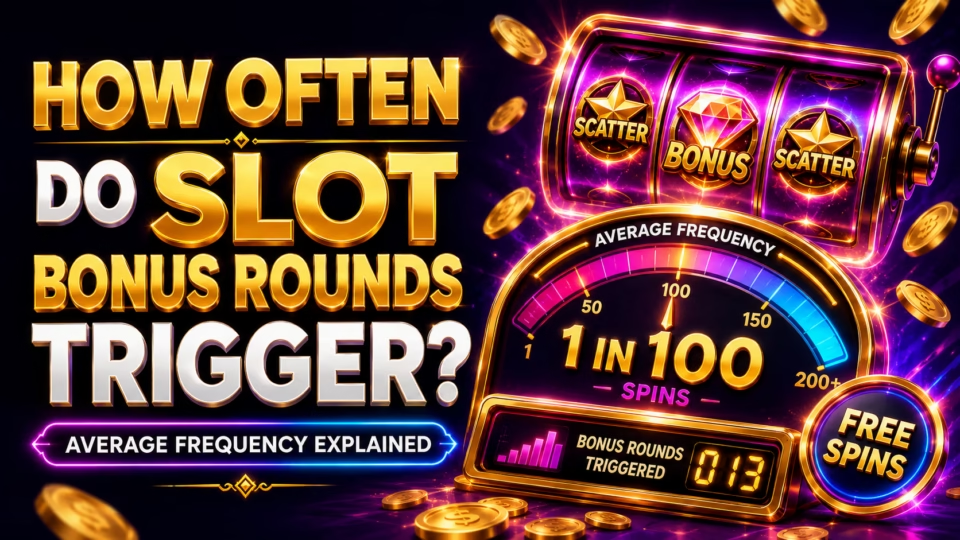
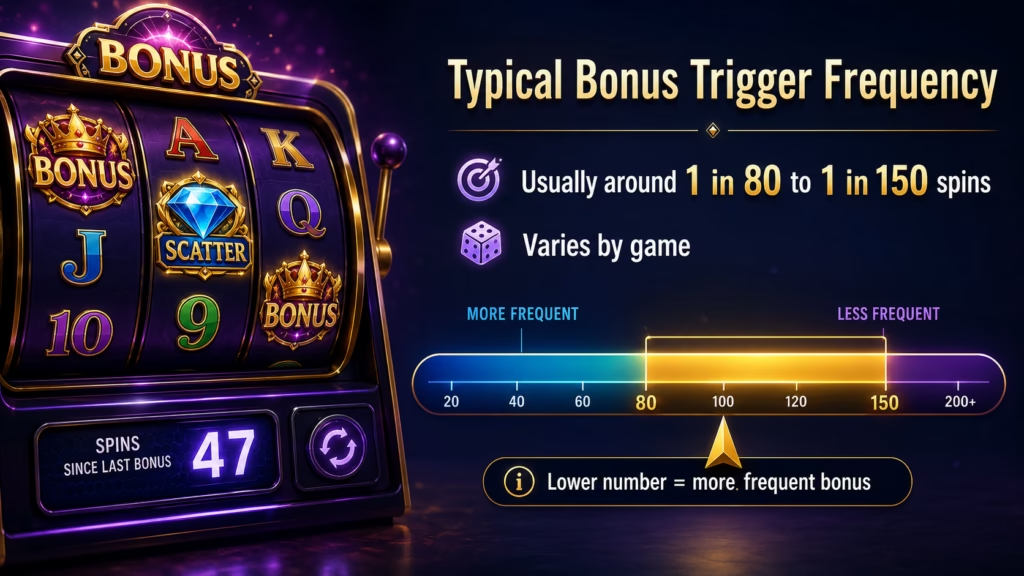
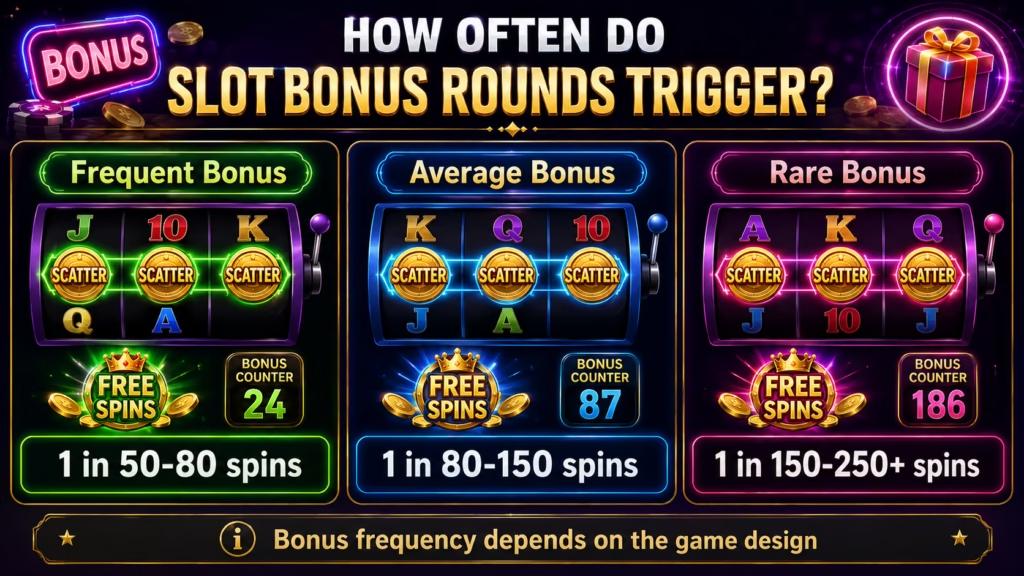
Slot bonus rounds commonly trigger once every 100 to 300 spins, but there is no universal average that applies to every game. Some slots may launch a bonus more often than once per 100 spins, while difficult-to-trigger features may require several hundred spins or more. The exact slot bonus round frequency depends on the game’s mathematical model, trigger mechanic, volatility and selected settings.
Quick takeaways:
- A typical bonus frequency may fall around one trigger per 100 to 300 spins, but the real range is much wider.
- A stated frequency of 1 in 150 spins is a long-term statistical average, not a countdown.
- High-volatility slots often make valuable bonus rounds harder to trigger.
- RTP does not reveal how frequently the bonus feature appears.
- Previous spins do not make the next bonus more likely in a standard random slot.
Bonus frequency matters most to players who enjoy free spins, multipliers, expanding symbols and interactive features. Players with a limited budget should be more cautious because a low-frequency bonus can consume many paid spins before appearing, and the bonus itself may still produce a small payout.
What Is Slot Bonus Round Frequency?
Slot bonus round frequency describes how often a particular bonus feature is expected to activate over a very large number of spins. The figure may be presented as a percentage, such as 0.5%, or as an average interval, such as one bonus in every 200 spins.
A frequency of 0.5% means that each eligible spin has approximately a 0.5% chance of triggering the feature under the stated game conditions. The theoretical average interval can be estimated with this formula:
Expected spins between bonuses = 1 ÷ trigger probability
- 1% probability equals an average of 1 bonus per 100 spins.
- 0.5% probability equals an average of 1 bonus per 200 spins.
- 0.25% probability equals an average of 1 bonus per 400 spins.
These figures describe long-term mathematical expectations. A player could trigger two bonuses within 20 spins and then complete 500 spins without another one. Both outcomes can occur without the game behaving incorrectly.
What Is the Average Slot Bonus Round Frequency?
Many conventional free-spins features appear approximately once every 100 to 300 base-game spins, but this range should be treated as a general reference rather than an industry rule. Feature frequency can fall outside this range depending on how the slot distributes its RTP and potential payouts.
| Approximate frequency | Average interval | Typical experience |
| 1% or higher | 1 in 100 spins or fewer | Relatively frequent bonus action, often with moderate feature values |
| 0.5% to 1% | 1 in 100 to 200 spins | Common range for standard free-spins mechanics |
| 0.25% to 0.5% | 1 in 200 to 400 spins | Less frequent bonuses, often associated with higher volatility |
| Below 0.25% | More than 1 in 400 spins | Rare trigger, potentially paired with stronger feature potential |
The table does not predict the behaviour of a specific slot. Developers do not always publish feature probabilities, and separate versions of the same game may use different RTP settings or mathematical configurations. Players should check the official paytable, help screen or game information panel whenever exact figures are available.
Why Bonus Rounds Do Not Trigger at Fixed Intervals
Slot bonus rounds normally use random outcomes rather than a fixed schedule. A game with an average frequency of one bonus per 150 spins does not have to activate the feature on spin 150, 300 or 450.
Each spin in a standard random slot is usually evaluated independently. After 149 unsuccessful spins, the probability on spin 150 is generally the same as it was on the first spin, unless the game includes a clearly explained progress meter, collection system or guaranteed-feature mechanic.
This independence creates uneven results:
- Bonuses can trigger on consecutive spins.
- A feature can appear several times during a short session.
- Hundreds of spins can pass without a bonus.
- A long dry period does not guarantee that the feature is close.
Random clustering is normal. Players often notice short streaks more strongly than ordinary results, which can create the false impression that a slot follows a predictable cycle.
What Determines How Often Slot Bonus Rounds Trigger?
The Trigger Probability
The feature’s programmed trigger probability has the most direct effect on bonus frequency. A developer can make three scatter symbols relatively common or extremely rare depending on the game’s mathematical design.
The visual number of scatter symbols does not reveal the true probability. Reel weighting matters more than what appears on the screen because symbols can have different chances of being selected on different reels or positions.
Volatility
Volatility describes how unevenly a slot may distribute its payouts. High-volatility slots often produce longer periods with limited returns, while placing more value in occasional large wins or powerful bonus rounds.
A high-volatility slot does not automatically have a rare bonus. Some high-volatility games trigger features fairly often but make strong bonus outcomes uncommon. Others make the initial bonus difficult to reach and concentrate more potential inside it. The paytable and game rules are more useful than volatility alone.
Bonus Value
Feature frequency and average feature value are often connected through the game’s mathematics. A bonus with large multipliers, persistent wilds or very high maximum-win potential may need to occur less frequently so that the slot maintains its intended RTP and risk profile.
A frequent bonus is not automatically better. A slot may trigger free spins often but deliver mostly low-value rounds. Another game may activate the feature less often while assigning a larger portion of its theoretical return to bonus outcomes.
Trigger Type
Different bonus mechanics can produce different frequency patterns.
Scatter-triggered bonuses usually require three or more special symbols to land during one spin. Their frequency depends on reel weighting and the number of required scatters.
Random or mystery bonuses can activate without a visible symbol combination. The game rules should explain whether the trigger is completely random or connected to another event.
Collection features require players to gather symbols, tokens or progress over multiple spins. These games may create the impression that a bonus is approaching, but the meter’s exact effect should be confirmed in the rules.
Cascading bonuses can trigger after several symbol drops within the same paid spin. A single wager may therefore create multiple chances to reach the required condition.
Hold-and-win features often require a set number of special symbols. Their trigger frequency can differ substantially from the frequency of traditional free spins.
Bet Mode and Optional Settings
Some slots include an ante bet, bonus bet or enhanced-feature mode that increases the stake in exchange for a higher chance of triggering the bonus. The higher feature probability does not make the game profitable or remove the risk of losing.
Players should compare the extra cost with the disclosed change in probability. Paying 25% more per spin for a 25% increase in bonus frequency does not necessarily improve the RTP or expected value. The exact relationship depends on the game rules.
Does RTP Affect Bonus Round Frequency?
RTP does not directly tell players how often slot bonus rounds trigger. RTP represents the theoretical percentage of total stakes returned as prizes across a very large number of game rounds. It combines base-game wins, bonus payouts, jackpots and other features included in the model.
Two slots can have the same RTP but very different bonus structures. One may return more value through frequent base-game wins, while the other places a larger share of its RTP inside rare free-spins rounds.
Different RTP versions of the same slot may also affect feature behaviour, average payouts or both. The exact RTP may vary by casino, so players should check the game information before playing rather than relying on a figure from another website or operator.
Bonus Frequency vs Hit Frequency
Bonus frequency and hit frequency measure different events.
Hit frequency describes how often a spin produces any qualifying win. A slot with a 30% hit frequency may deliver some form of win on roughly three out of ten spins over the long term.
Bonus frequency measures only the activation of a specific feature. A game may have frequent small base-game wins but trigger its bonus once every several hundred spins.
Hit frequency does not show whether wins return more than the original stake. A small payout can still count as a hit even when the player loses money on that spin overall. Bonus frequency also does not indicate whether the feature will be profitable.
How Many Spins Should You Expect Before a Bonus?
The mathematical average is not a reliable session target. A bonus expected once every 200 spins may arrive immediately, after 600 spins or not at all during a particular session.
Probability can show how likely at least one trigger is across a given number of spins, but it still cannot guarantee the result. For a feature with a 0.5% independent trigger chance per spin:
- After 100 spins, there is still a substantial chance of seeing no bonus.
- After 200 spins, a bonus is not guaranteed.
- Even after several average intervals, a no-bonus run remains mathematically possible.
Players should not choose a budget by assuming that one theoretical interval will produce one feature. The cost of 200 spins at $1 per spin is $200, while the same number at $0.20 per spin costs $40. Bet size has a greater effect on session cost than the visual excitement of the game.
Can You Tell When a Bonus Round Is About to Trigger?
A standard random slot does not provide a reliable way to predict the next bonus. Near misses, two scatter symbols and repeated teasing animations do not prove that the feature is becoming more likely.
A visible progress system can affect the answer, but only when the official rules confirm how it works. Some meters guarantee a feature after a specific condition. Others provide visual entertainment without creating a fixed trigger point.
Players should avoid increasing their stake because a slot appears “ready” to pay. Previous losses, long dry periods and near misses do not normally create a debt that the game must repay.
Are Bonus Buy Features More Efficient?
A bonus buy provides immediate access to a feature for a stated price, but it does not guarantee that the bonus payout will cover the purchase cost. Availability depends on the game, casino and local regulations.
The buy price often represents many times the base stake. A feature costing 100 times the bet could return less than the purchase amount, close to the purchase amount or substantially more. The outcome remains random.
Bonus buys may suit players who specifically want to experience a feature without waiting through the base game. They are less suitable for players with limited budgets or anyone likely to chase losses by repeatedly purchasing new rounds.
Common Myths About Slot Bonus Frequency
“The Bonus Is Due After a Long Dry Spell”
A bonus is not necessarily due after many unsuccessful spins. Independent random outcomes do not become more favourable simply because the recent sequence was poor.
“Higher Bets Trigger Bonuses More Often”
A larger stake usually changes the amount won or lost rather than the underlying trigger probability. Exceptions may exist when the game offers a separate enhanced mode, and that difference should be stated in the rules.
“Three Scatters Every 200 Spins Means a Fixed Schedule”
An average interval is not a schedule. Statistical frequency becomes more stable only across a very large number of rounds, not during one short playing session.
“Frequent Bonuses Mean a Better Slot”
Frequent bonus rounds can improve entertainment value, but they do not guarantee better payouts. Feature value, RTP, volatility and stake cost must also be considered.
“Near Misses Show That the Feature Is Close”
Near misses are not reliable predictors. Two scatters followed by a blank reel can occur repeatedly without changing the probability of the next spin.
How to Choose a Slot Based on Bonus Frequency
Players who prefer regular feature activity should look for games with clearly published bonus probabilities, moderate volatility or mechanics that create multiple paths into the feature. Frequent bonuses may provide a more varied experience, although the average value of each feature can be lower.
Players who enjoy higher-risk gameplay may prefer rare bonuses with larger multipliers or stronger maximum-win potential. This format requires stricter spending limits because the feature may not appear within the planned session.
Before choosing a game, check:
- The official RTP shown inside the game.
- The stated volatility or risk level.
- The number of scatters required.
- Whether an ante bet changes the trigger chance.
- Whether the bonus can retrigger.
- Whether the game offers a bonus buy.
- The minimum stake and total cost of a realistic session.
- Whether a demo version is available.
Demo mode can help players understand the mechanics and interface, but a short demo session cannot establish the true bonus frequency. Random variation remains too large over a limited number of spins.
Practical Ways to Manage Low-Frequency Bonuses
Set a spending limit before starting rather than stopping only after the bonus appears. A feature may take longer to trigger than expected, and continuing until it arrives can turn entertainment into loss chasing.
Use a stake that allows enough spins for the intended session length. A player with a $40 limit who wants approximately 200 spins would need an average stake near $0.20 per spin. This calculation controls spending but does not guarantee a bonus.
Do not increase the stake after a dry period. Larger bets increase the financial effect of each result without making a random feature due.
Stop when the preset limit is reached, even when two scatters have appeared several times. Teasing animations are part of the presentation, not evidence that the next spin will complete the bonus.
How This Information Was Reviewed
This explanation is based on standard probability principles and the common ways slot developers describe RTP, volatility, hit frequency and bonus triggers. Exact feature probabilities should always be checked in the official paytable, game rules or information panel because mathematical configurations can differ between games and casinos.
RTP, volatility and slot bonus round frequency describe long-term behaviour. None of these figures can predict the outcome of an individual spin, guarantee a bonus or ensure that a feature will return more than it costs to reach.
Slots should be treated as paid entertainment rather than a way to earn money. Players should set time and spending limits before playing, avoid chasing losses and stop when gambling is no longer enjoyable or affordable.
FAQ
How often do slot bonus rounds trigger on average?
Slot bonus rounds often trigger approximately once every 100 to 300 spins, but the exact frequency can be much higher or lower. The official game rules are the most reliable source when a developer publishes the probability.
Is one bonus every 200 spins guaranteed?
No. One bonus every 200 spins is a long-term statistical average, not a guarantee for each block of 200 spins. A feature could trigger several times quickly or remain absent for hundreds of spins.
Do high-volatility slots have fewer bonus rounds?
High-volatility slots often have less frequent or more uneven bonus activity, but this is not a fixed rule. Some trigger bonuses regularly while making the most valuable bonus outcomes rare.
Does betting more increase the bonus frequency?
Betting more usually does not increase the trigger probability. A higher chance may apply only when the slot has a clearly labelled ante bet or enhanced bonus mode, which also increases the cost per spin.
Does a higher RTP mean more bonus rounds?
No. A higher RTP does not necessarily mean that bonuses trigger more often. RTP measures total theoretical returns and does not show how those returns are divided between base-game wins and bonus features.
Can a slot go 500 spins without a bonus?
Yes. A slot can complete 500 or more spins without triggering a bonus, even when its theoretical average interval is much shorter. Random outcomes can produce unusually long dry periods.
Are slot bonuses predetermined?
In a standard regulated random slot, the result of each spin is generated according to the game’s mathematical rules and random-number system. A bonus is not normally scheduled to appear after a fixed number of previous losses.
Are bonus buys better than waiting for free spins?
Bonus buys provide immediate feature access, but they are not automatically better value. The purchase can return less than its cost, and repeated buys can spend a budget quickly.
Can demo mode reveal the real bonus frequency?
Demo mode can show how a feature works, but a short test cannot reliably measure its true frequency. Thousands or millions of rounds may be needed before observed results approach the theoretical probability.
What should I check before playing a bonus-heavy slot?
Check the RTP, volatility, feature rules, minimum stake, optional bet modes and bonus-buy price. Casino bonus terms, wagering requirements and game availability may also vary by operator.
In short
Slot bonus rounds commonly trigger once every 100 to 300 spins, but no fixed interval or guaranteed average applies to a single session. Bonus frequency depends on the game’s probability model, volatility, feature value and trigger mechanic. Check the official paytable, choose a sustainable stake and never continue playing simply because a bonus appears overdue.