The gamble feature in slots is an optional bonus round that lets a player risk a completed win for the chance to increase it. Instead of adding the win directly to the balance, the slot may offer a simple prediction game, such as guessing a card color, choosing a suit or predicting whether the next card will be higher or lower.
The gamble feature does not make the original spin more likely to win. It only changes what happens after an eligible winning spin, and an incorrect prediction can remove the entire amount placed at risk.
Key points:
- The gamble round is normally optional.
- A correct prediction may double or multiply the selected win.
- A wrong prediction usually loses the amount being gambled.
- The result is normally determined by a random number generator.
- Limits may apply to the number of rounds and maximum gamble payout.
The feature may appeal to players who enjoy simple risk-and-reward decisions after a win. It is less suitable for players who prefer predictable bankroll management or feel tempted to keep risking winnings after reaching a reasonable cash-out point.
What Is the Gamble Feature in Slots?
A slot gamble feature is a secondary game activated after certain winning spins. The player chooses whether to collect the win or place some or all of it into a separate prediction round.
The most common version asks the player to guess whether a hidden playing card will be red or black. A correct answer commonly increases the gambled amount, while an incorrect answer removes it. Some games use card suits, higher-or-lower predictions, wheels or other visual formats, but the basic decision remains the same: collect a confirmed win or risk it for a larger possible payout.
The gamble option may appear automatically after every eligible win, only after wins above a minimum amount or only when the payout remains below a game-specific limit. The exact conditions should be checked in the slot’s help screen or paytable.
How Does the Gamble Feature Work in Slots?
The gamble feature usually follows a simple sequence:
- The main slot produces an eligible winning combination.
- The game displays the value of the win.
- The player chooses Collect or Gamble.
- If Gamble is selected, the slot opens a separate prediction screen.
- The player makes a choice, such as red or black.
- The random result is revealed.
- A correct choice increases the gamble balance.
- An incorrect choice normally loses the amount placed at risk.
- After a successful result, the player may be allowed to collect or gamble again.
For example, a player wins $10 and chooses a red-or-black gamble round. If the prediction is correct and the game uses a double-or-nothing format, the gamble balance becomes $20. The player can then collect $20 or risk it again for a possible $40. If the next prediction is wrong, the player may lose the full $20.
Some slots allow only the entire win to be gambled. Others let the player risk part of the payout while collecting the rest. Partial gamble options reduce the amount exposed to one random result, although they do not change the underlying probability of success.
Common Types of Slot Gamble Features
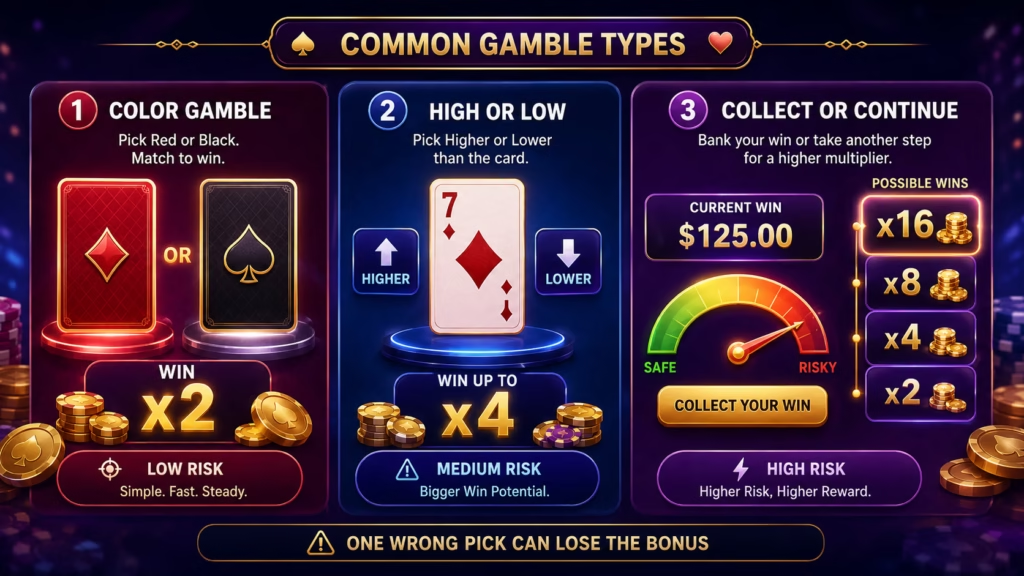
Red or Black Card Gamble
The red-or-black card game is one of the simplest formats. The player predicts whether the next card will be red or black.
In a standard double-or-nothing version, a correct prediction doubles the gambled amount. However, the exact card distribution, payout and rules depend on the slot. Players should not assume that every red-or-black feature uses identical probabilities.

Card Suit Gamble
A suit gamble asks the player to choose hearts, diamonds, clubs or spades. Because there are more possible answers, the potential reward may be larger than in a color prediction.
Some games multiply the gamble balance by four after a correct suit prediction. That does not automatically make the feature more profitable. A larger multiplier usually comes with a lower probability of selecting the correct result.
Higher or Lower Gamble
A higher-or-lower feature reveals one card and asks whether the next card will have a higher or lower value. The probability may depend on the value already displayed and on how the game handles equal cards.
For example, predicting “higher” after a low card may appear more attractive than predicting it after a high card. The game rules still determine whether the displayed cards represent a real deck model, how ties are treated and whether any values are excluded.
Gamble Wheel
Some slots replace cards with a wheel containing winning and losing segments. The player starts the wheel and receives the result selected by the game.
A wheel may look more interactive, but pressing the button at a particular moment does not normally control where it stops. In regulated digital slots, the result is generally generated by the game system rather than by the player’s timing.
Ladder or Level Gamble
A ladder gamble displays several payout levels. A successful choice moves the player to a higher reward, while an unsuccessful choice may reduce or remove the current gamble balance.
This format can make repeated gambling feel like progression through a bonus game. The risk remains real because each additional step exposes money that could already have been collected.
Does the Gamble Feature Improve RTP?
A gamble feature does not necessarily improve the slot’s long-term return to player. In a mathematically balanced double-or-nothing game, the potential reward may correspond to the probability of success, producing a neutral theoretical expectation before any game-specific adjustment.
For example, risking $10 on a genuine 50% chance to receive $20 has an expected value of $10:
- 50% chance of receiving $20
- 50% chance of receiving $0
- Average theoretical value: $10
This does not mean the player is likely to finish with exactly $10. One individual result will normally be either a win or a loss. Expected value describes an average across a very large number of rounds, not the outcome of a short session.
Some slot providers include gamble rounds in the published RTP calculation, while others may present separate information for the base game and optional features. The exact RTP can also vary between casino configurations. Check the official game information rather than assuming that using the gamble feature raises the return.
Is the Gamble Feature Based on Skill?
Most slot gamble features are based on random outcomes rather than player skill. Choosing red instead of black, or pressing a button at a specific moment, does not provide a reliable method of predicting the next result.
The main decision a player controls is how much risk to accept. A player can collect immediately, gamble once, use a partial gamble option or continue until the game’s limit is reached. These decisions affect the size and volatility of the player’s balance, but they do not turn a random result into a predictable one.
A higher-or-lower format may appear to involve more strategy because the current card is visible. Whether that information creates a meaningful probability difference depends on the game’s actual rules. The paytable should explain how cards are selected and how equal values are handled.
How the Gamble Feature Affects Volatility
Using the gamble feature increases short-term volatility because it converts a confirmed win into a wider range of possible outcomes.
Collecting a $20 win locks in $20. Gambling it once may produce $40 or $0. Gambling successfully several times can create a much larger payout, but every additional round also creates another chance to lose the accumulated gamble balance.
The gamble feature may therefore appeal to players who accept sharp balance changes and prefer occasional larger outcomes over preserving smaller wins. Players with a limited budget may find it unsuitable because repeated gamble rounds can remove winnings quickly.
The feature does not change the randomness of the original slot spin. It adds another random event after the spin has finished.
Gamble Feature Limits and Restrictions
Slot games commonly place restrictions on gamble rounds. These limits protect the game’s maximum exposure and prevent winnings from being multiplied indefinitely.
Possible restrictions include:
- A maximum number of consecutive gamble rounds
- A maximum payout that can be reached through gambling
- A minimum win required to activate the feature
- Exclusion of jackpot, bonus or free-spin wins
- Automatic collection after reaching a set amount
- No gamble option during promotional play
- Restrictions connected to casino bonus funds
- Unavailability in certain jurisdictions
The casino may also apply its own maximum-win or withdrawal rules. These operator conditions are separate from the rules built into the slot.
Should You Use the Gamble Feature?
The gamble feature may be suitable when a player understands that the confirmed win can be lost and has already decided on a strict limit.
Before selecting Gamble, consider three questions:
1. Would losing this entire win affect the planned budget? If the answer is yes, collecting is the more controlled option.
2. Was the intention to gamble before the win occurred? Decisions made during excitement are more likely to ignore previous limits.
3. Is there a specific stopping point? Without a stopping rule, a successful gamble can lead directly to another gamble until the full amount is lost.
A practical limit might be one gamble attempt per eligible win or collecting immediately after reaching a predetermined amount. A limit cannot guarantee a positive result, but it can prevent the feature from turning every small win into an all-or-nothing decision.
Common Gamble Feature Myths
“The next card is due to be red”
Previous results do not normally determine the next independent RNG result. A sequence of black cards does not guarantee that the next card will be red.
“Pressing at the right time changes the result”
The animation may respond to a button press, but timing does not usually provide control over a digital slot’s random outcome.
“The gamble feature is a way to recover losses”
The feature only risks a current eligible win. It cannot reliably recover previous losses, and using larger gamble amounts after losing can increase the damage to the bankroll.
“A successful first gamble means the next one is safer”
Each new round carries its own risk. A previous correct prediction does not make the following prediction more likely to succeed.
“Repeated gambling is necessary to get value from the slot”
A slot can be played without using the gamble option. Collecting a win does not mean the player has missed a guaranteed opportunity.
Practical Tips for Using a Slot Gamble Feature
Read the gamble rules before playing because the multiplier, probability model, eligible wins and maximum payout can differ between games.
Decide whether the feature will be used before starting the session. A preselected rule is easier to follow than a decision made immediately after an exciting win.
Avoid gambling money needed to continue the planned session. Losing the gamble balance may encourage additional deposits or higher bets in an attempt to recover it.
Use partial gamble options carefully when available. Risking only part of a win preserves some value, but the gambled portion remains exposed to a random outcome.
Collect after reaching the chosen target. A higher balance creates the temptation to continue, but it also means that more confirmed value is at risk.
Treat the gamble feature as optional entertainment. It is not a strategy for generating income, beating a slot or predicting future results.
How This Information Was Reviewed
This explanation is based on the common structure of card, wheel, higher-or-lower and ladder gamble features used in digital slots. The main evaluation criteria are how the feature is activated, what the player risks, how payouts change, what limits apply and whether the result depends on randomness.
The exact rules should always be confirmed in the slot’s paytable or help section. Players should check whether the game allows partial gambling, how ties are handled, which wins are eligible and whether the gamble feature affects the stated RTP.
RTP, volatility and bonus mechanics describe game behavior over time. They do not predict the result of a specific spin or gamble round. Slot games should be treated as paid entertainment, not as a source of income. Stop playing when the planned time or spending limit has been reached.
FAQ
Can you lose the entire slot win in the gamble feature?
Yes. In many gamble features, an incorrect prediction removes the entire amount placed into the round. Some slots allow a partial gamble, which means only the selected portion is at risk.
Is the slot gamble feature optional?
The gamble feature is usually optional. Players can normally select Collect instead, although the exact interface and availability depend on the game and casino.
Does the gamble feature always double a win?
No. Red-or-black formats often use a doubling mechanic, but suit predictions, wheels and ladder games may use different multipliers. Check the game rules for the exact payout.
Can a player predict the result of a gamble round?
No reliable method can predict a random gamble result. Previous cards, animation timing and recent wins do not guarantee what will happen next.
How many times can a slot win be gambled?
The number of rounds varies by game. Some slots allow several consecutive gambles, while others set a strict round count or automatically collect after a maximum payout is reached.
Are free-spin wins eligible for the gamble feature?
Sometimes, but not always. Many games exclude free-spin, jackpot or bonus-round payouts from gambling. The paytable should list which wins qualify.
Does using the gamble feature increase the chance of winning the main slot?
No. The gamble round takes place after an eligible win and does not affect the probability of symbols landing on the original spin.
Is red or black always a 50% chance?
Not necessarily. Although red-or-black games may be presented as an even choice, the exact probability and card model should be confirmed in the official rules.
Can casino bonus money be used in the gamble feature?
Availability depends on the casino’s bonus terms and the game configuration. Some operators restrict gamble features during bonus play or exclude their results from wagering calculations.
What is the safest way to use the gamble feature?
There is no risk-free way to use it. The most controlled approach is to decide the maximum amount and number of attempts in advance, collect at the chosen limit and never chase a lost gamble.
Brief Conclusion
The gamble feature in slots lets players risk an eligible win for a chance to increase it through a random prediction game. It can create larger payouts, but it also increases volatility and may remove the full gambled amount. Check the game rules, set limits before playing and treat the feature as optional entertainment rather than a way to make money.