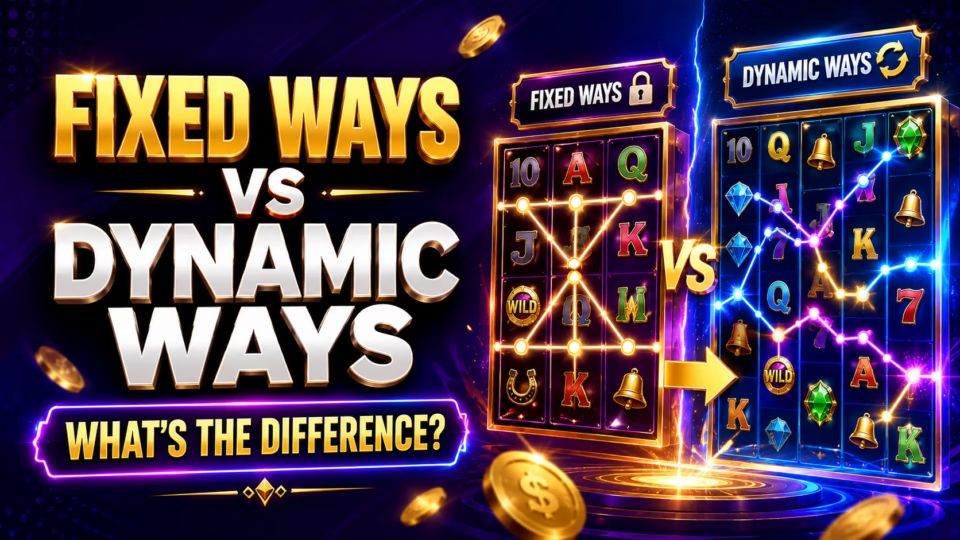
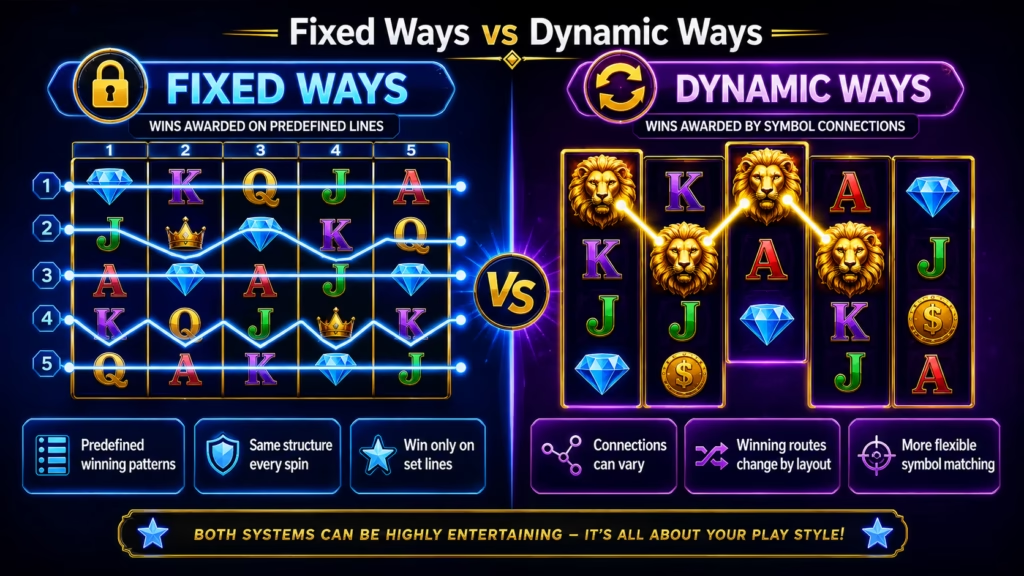
Fixed ways and dynamic ways are two different methods slots use to determine how many symbol combinations can form a win. In a fixed ways slot, the number of ways to win stays the same on every base-game spin. In a dynamic ways slot, the number of active symbol positions can change from spin to spin, so the total number of possible winning ways can also change.
The main difference is therefore not whether a slot can pay, but how its reel layout creates eligible combinations.
Quick takeaways:
- Fixed ways slots use a predetermined number of ways to win.
- Dynamic ways slots can change the number of active ways between spins.
- Megaways is one of the best-known examples of a dynamic ways mechanic.
- More ways do not guarantee a winning spin or a larger payout.
- The paytable, symbol values, RTP, volatility and bonus rules still matter when comparing games.
Fixed ways may appeal more to players who prefer a consistent reel structure that is easy to understand. Dynamic ways to win slots are usually more attractive to players who enjoy changing reel layouts, variable symbol counts and mechanics such as cascades or expanding reels.
Neither system provides a strategy for predicting wins. Slot outcomes remain random, and the game should be treated as entertainment rather than a way to make money.
What Are Ways to Win in Slots?
Ways to win are a slot payout system in which matching symbols generally need to appear on consecutive reels, usually beginning from the leftmost reel, without having to follow a traditional fixed payline pattern. The exact rules depend on the game.
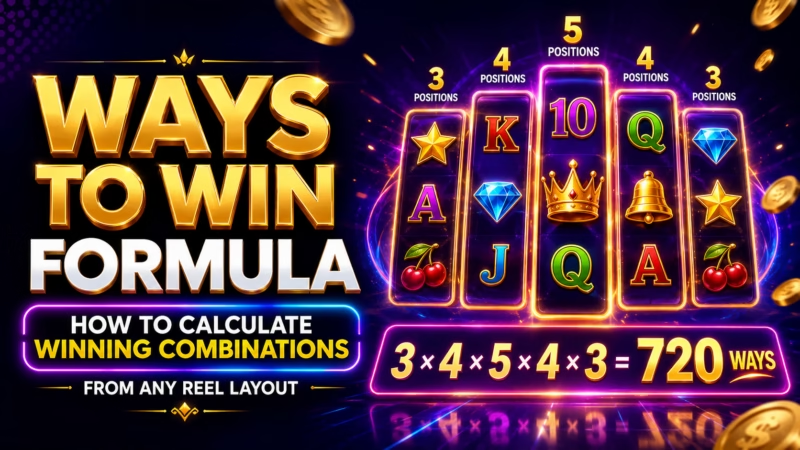
For example, consider a five-reel slot where three symbols are visible on each reel. If every position can participate in a ways-to-win calculation, the game may offer:
3 × 3 × 3 × 3 × 3 = 243 ways
This is where the familiar term 243 Ways to Win comes from.
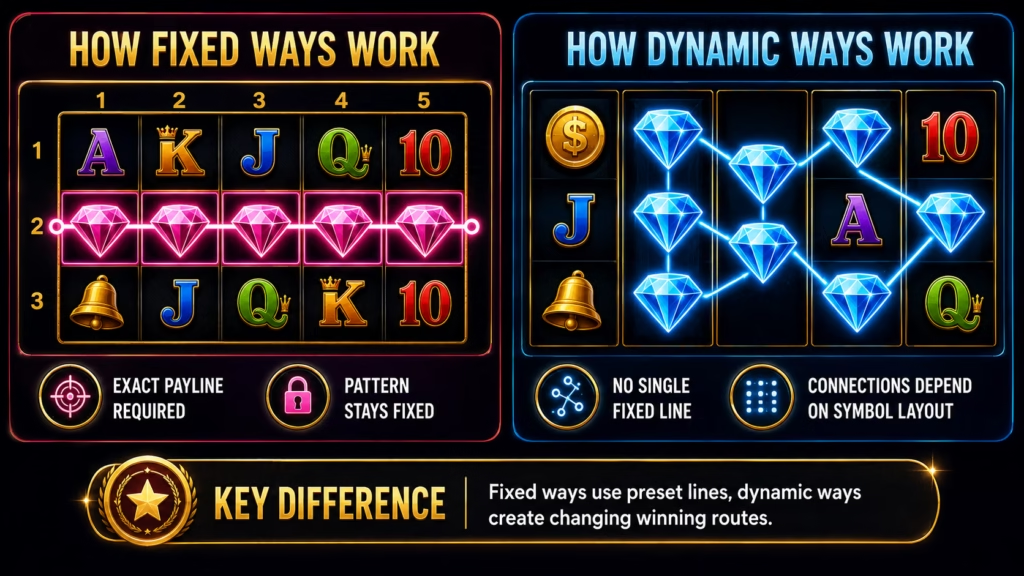
Unlike a traditional payline slot, a symbol does not necessarily need to land on a predefined line drawn across the reels. Matching symbols can occupy different vertical positions as long as the game’s rules consider those positions part of the same winning combination.
The important point is that “ways to win” describes how winning combinations are evaluated, not how frequently the slot must pay.
What Are Fixed Ways Slots?
Fixed ways slots use the same maximum number of possible winning combinations on each standard spin because the number of active symbol positions remains predetermined.
A classic 243-ways slot with five reels and three active positions per reel is a simple example. Unless a special feature changes the layout, the slot continues to offer the same 243 possible ways from one spin to the next.
Other fixed configurations can use much larger numbers. A slot might offer 1,024, 3,125 or another predetermined number of ways depending on its reel and row structure.
How fixed ways are calculated
A simplified calculation multiplies the number of active symbol positions on each reel.
For a five-reel layout with four active positions per reel:
4 × 4 × 4 × 4 × 4 = 1,024 ways
If the reel configuration does not change, the maximum number of ways also remains fixed at 1,024.
The exact payout calculation can be more complicated because games may include wild symbols, scatters, special symbols, bonus mechanics or exceptions described in the paytable.
What Are Dynamic Ways to Win Slots?
Dynamic ways to win slots use a reel structure in which the number of active symbol positions can change, causing the number of possible ways to vary between spins or stages of a feature.
Instead of always showing three or four symbols on every reel, one spin might display different reel heights such as:
3 × 5 × 4 × 6 × 3 × 5
The next spin could use a completely different configuration.
Because the reel heights have changed, the number of possible ways changes as well.
Using the example above:
3 × 5 × 4 × 6 × 3 × 5 = 5,400 possible ways
This is why dynamic ways slots can display very different ways counts during gameplay.
Dynamic does not mean the player controls the number of ways. Reel configurations and outcomes are determined by the game’s underlying mechanics and random outcome generation.
Fixed Ways vs Dynamic Ways Slots
| Feature | Fixed Ways | Dynamic Ways |
| Number of ways | Predetermined | Can change |
| Reel height | Usually consistent | May vary |
| Complexity | Usually easier to follow | Often more complex |
| Ways calculation | Same basic structure each spin | Recalculated when reel layout changes |
| Visual layout | More predictable | Can change between spins |
| Common mechanics | Standard ways-to-win format | Variable reels, Megaways-style systems, expanding layouts |
| Guaranteed advantage | No | No |
| Predicts wins | No | No |
The practical difference is consistency. Fixed ways give players a stable mathematical layout, while dynamic ways make the available combination count part of the changing game structure.
That does not automatically make dynamic ways better. A fixed 243-ways slot can have completely different volatility, RTP, payout distribution and bonus potential from another 243-ways game. The same principle applies to dynamic formats.
How Megaways Relates to Dynamic Ways
Megaways is a well-known dynamic reel mechanic in which the number of symbols appearing on individual reels can vary, creating a changing number of possible ways to win.
The important distinction is that Megaways is a specific game mechanic, while dynamic ways is a broader concept. A slot can theoretically use a changing number of ways without being a Megaways game.
Players should therefore avoid treating “dynamic ways” and “Megaways” as interchangeable terms.
A game using variable reel heights may also combine the mechanic with cascades, multipliers, free spins or other features. Those additional mechanics can significantly affect the gameplay even when two slots advertise similar maximum numbers of ways.
Do More Ways to Win Increase Your Chance of Winning?
A larger advertised number of ways does not by itself prove that a slot has a higher overall chance of producing a win.
The number of ways describes how many positional combinations are eligible to create wins. Hit frequency depends on additional factors, including symbol distribution, reel configuration, payout rules and the mathematical model of the game.
For example, a game advertising tens of thousands of ways could still be designed to produce relatively irregular paying combinations. Another slot with fewer ways could generate smaller wins more frequently.
This is why players should not compare slots by the ways number alone.
If available, consider:
- RTP
- volatility
- hit frequency
- symbol values
- minimum symbols required for a payout
- wild behavior
- cascade or tumble mechanics
- free spins
- multipliers
- bonus triggers
- maximum win limits
RTP and volatility also do not predict what will happen during a particular session. They describe characteristics of the game’s mathematical model over much larger samples.
Does a Dynamic Ways Slot Pay More Than a Fixed Ways Slot?
Dynamic ways slots do not automatically pay more than fixed ways slots.
A larger number of possible combinations can create more ways for matching symbols to connect, but providers design symbol probabilities, payout values and game mathematics around the complete system.
A slot offering 100,000 possible ways cannot be assumed to be more generous than a slot offering 243 ways.
The meaningful comparison is the complete game model rather than the headline number printed beside “ways to win.”
Players interested in payout characteristics should check the game’s paytable and available information about RTP and volatility instead of assuming that more ways equals better returns.
Why Can the Number of Dynamic Ways Change So Much?
The number of dynamic ways can change dramatically because the total is often calculated by multiplying the number of active positions across several reels.
Consider two simplified five-reel configurations.
Configuration A:
2 × 2 × 3 × 2 × 3 = 72 ways
Configuration B:
6 × 5 × 6 × 7 × 5 = 6,300 ways
Changing only a few reel heights can therefore produce a large difference in the total number of possible positional combinations.
This multiplication effect explains why dynamic ways games can move from relatively small ways counts to thousands of ways without requiring thousands of visible symbols.
Fixed Ways vs Paylines
Fixed ways and fixed paylines are not the same mechanic.
A fixed-payline slot evaluates symbol combinations along predetermined patterns. A 20-payline game, for example, may contain 20 specific paths across the reels.
A fixed-ways slot evaluates combinations based primarily on eligible positions across consecutive reels rather than requiring symbols to follow those predefined paths.
This makes a 243-ways slot fundamentally different from a 20-payline slot even if both use the same five-reel, three-row visual layout.
Always check the paytable because individual games can apply different rules regarding starting reels, matching symbols, wild substitutions and bonus symbols.
Dynamic Ways vs Cluster Pays
Dynamic ways and cluster pays also use different methods for determining wins.
Dynamic ways usually evaluate matching symbols across consecutive reels while allowing the number of active positions to vary.
Cluster pays typically award combinations when enough matching symbols connect horizontally or vertically in a group. Traditional left-to-right reel progression may not be required.
Some modern slots combine unusual reel structures with cascades, clusters or other mechanics, so the interface alone may not tell you exactly how wins are evaluated.
The paytable remains the authoritative place to check the rules of a specific game.
Which Is Better: Fixed Ways or Dynamic Ways?
Neither fixed ways nor dynamic ways is objectively better because the mechanic mainly changes how winning combinations are structured.
Fixed ways may suit players who prefer:
- a consistent reel layout;
- simpler ways calculations;
- fewer changing numbers on screen;
- a more predictable visual structure.
Dynamic ways may suit players who prefer:
- reel layouts that change between spins;
- variable numbers of active combinations;
- Megaways-style gameplay;
- cascades and expanding mechanics;
- more visually active slot designs.
The choice should be based on gameplay preference rather than an expectation that one system produces better financial results.
Common Myths About Fixed and Dynamic Ways
More ways means better RTP
Not necessarily. Ways to win and RTP measure different characteristics. RTP describes the theoretical proportion of stakes returned over a very large number of game rounds, while ways describe eligible symbol combinations.
Maximum ways are active on every dynamic spin
Not necessarily. A dynamic slot may advertise its maximum possible number of ways even though many spins use substantially fewer combinations.
Dynamic ways make wins easier to predict
No. Changing reel configurations do not provide a reliable method of predicting the next result.
Fixed ways mean every spin has the same chance of winning
Not necessarily. A stable number of ways does not mean every possible symbol configuration has equal probability or that all winning combinations are equally likely.
A slot with fewer ways is worse value
No. The ways count alone is not enough to judge value. RTP, volatility, symbol weighting, payout values and bonus mechanics are more informative when evaluating how a slot is structured.
What Should You Check Before Playing a Ways-to-Win Slot?
Start with the game’s paytable rather than the headline ways number.
Check how winning symbols must connect, whether combinations start from the leftmost reel, how many matching symbols are required and whether individual symbol positions can contribute to multiple wins.
For dynamic ways slots, also check whether the displayed number represents the ways available on the current spin or the maximum the game can produce.
RTP and volatility are useful additional indicators when they are available, but neither predicts short-term results. RTP may also differ between versions of the same game, depending on the provider and casino configuration.
Players should also decide on spending and time limits before gambling. Increasing the number of ways, changing the stake or choosing a more complex mechanic cannot remove the random nature of slot outcomes.
How This Information Was Reviewed
The comparison between fixed ways and dynamic ways is based on how the two mechanics structure active symbol positions and evaluate possible winning combinations.
When evaluating a specific slot, the game’s current paytable and official rules should take priority because providers can implement ways mechanics differently. Players should verify the exact number of ways, eligible reels, wild behavior, bonus rules, RTP configuration and any feature-specific changes directly in the game information.
RTP, volatility, ways to win and bonus mechanics describe different parts of a slot’s mathematical design. None guarantees a particular result during an individual session.
Slots should be treated as paid entertainment rather than a source of income. If gambling stops being enjoyable or spending exceeds a predetermined limit, stopping is more important than changing the game or betting pattern.
FAQ
What is the main difference between fixed ways and dynamic ways slots?
The main difference is that fixed ways slots maintain a predetermined number of possible winning ways, while dynamic ways slots can change that number as the active reel layout changes. The exact method used by a particular game should be confirmed in its paytable.
What does fixed ways to win mean?
Fixed ways to win means the game’s standard reel configuration provides a predetermined maximum number of eligible positional combinations. A five-reel, three-position layout can produce 243 ways when all three positions on each reel participate in the calculation.
What does dynamic ways to win mean?
Dynamic ways to win means the number of possible symbol combinations can vary because the number of active positions on one or more reels changes. A spin with taller reels can therefore have more potential ways than a spin with shorter reels.
Are all dynamic ways slots Megaways slots?
No. Megaways is a specific variable-reel mechanic, while dynamic ways is a broader description of systems in which the number of available winning combinations can change. Not every slot with changing ways should automatically be described as Megaways.
Are dynamic ways better than fixed ways?
Dynamic ways are not inherently better. They provide a different gameplay structure and may appeal to players who enjoy changing reels and variable combination counts. Fixed ways may be easier to understand because their basic layout stays consistent.
Do more ways to win mean more frequent wins?
Not necessarily. The number of ways is only one part of a slot’s mathematical model. Hit frequency also depends on factors such as symbol distribution, reel design and payout rules, so a larger ways number does not guarantee more frequent wins.
Can a dynamic ways slot have fewer ways on some spins?
Yes. If reel heights or the number of active positions change, a dynamic slot may generate relatively few ways on one spin and substantially more on another. The advertised figure may represent the game’s maximum rather than the number available every time.
Do fixed ways slots have fixed RTP?
No. A fixed number of ways does not imply a fixed RTP across every version or casino. RTP is a separate characteristic, and some games can be supplied in different RTP configurations. Check the game’s information before playing.
Can I use the number of ways to predict a winning spin?
No. The number of ways cannot reliably predict the outcome of the next spin. It explains which symbol positions can form eligible combinations, while individual game results remain random.
Should I choose a slot based on its maximum number of ways?
No. Maximum ways should be treated as one gameplay characteristic rather than the main selection criterion. Paytable rules, RTP, volatility, bonus features, betting limits and personal entertainment preferences provide a more complete picture of a slot.
Short Conclusion
Fixed ways slots use a predetermined number of winning combinations, while dynamic ways slots can increase or decrease the number of available combinations as their reel structure changes.
Dynamic mechanics can create much larger and more variable ways counts, but more ways do not guarantee more wins, higher RTP or better payouts. Compare the complete game structure, check the paytable and treat slot play as entertainment rather than a way to make money.