Pay Anywhere slots use a payout system where matching symbols can form a win without following fixed paylines. In the most common version of the mechanic, the game counts how many identical symbols appear anywhere on the grid, then checks that number against the paytable. The symbols usually do not need to touch each other or appear on specific reels.
The exact rules are not universal. One Pay Anywhere slot may require eight matching symbols, while another may start paying from five. This is why the individual game’s paytable matters more than the mechanic’s name alone.
Quick takeaways:
- Pay Anywhere slots usually replace traditional paylines with symbol-count payouts.
- Matching symbols can often land in different parts of the grid and still contribute to the same win.
- The minimum number of matching symbols depends on the individual game.
- Pay Anywhere is frequently combined with cascading wins, multipliers and free spins.
- The mechanic does not automatically mean a higher RTP, better odds or more frequent wins.
Pay Anywhere games may appeal to players who prefer large grids, easy-to-read winning combinations and cascade-based gameplay. Players who want predictable line structures or simple three-reel mechanics may prefer traditional paylines instead.
What Are Pay Anywhere Slots?
A Pay Anywhere slot is a slot game that determines at least some winning combinations by the number of matching symbols visible across the playing grid rather than by fixed payline patterns.
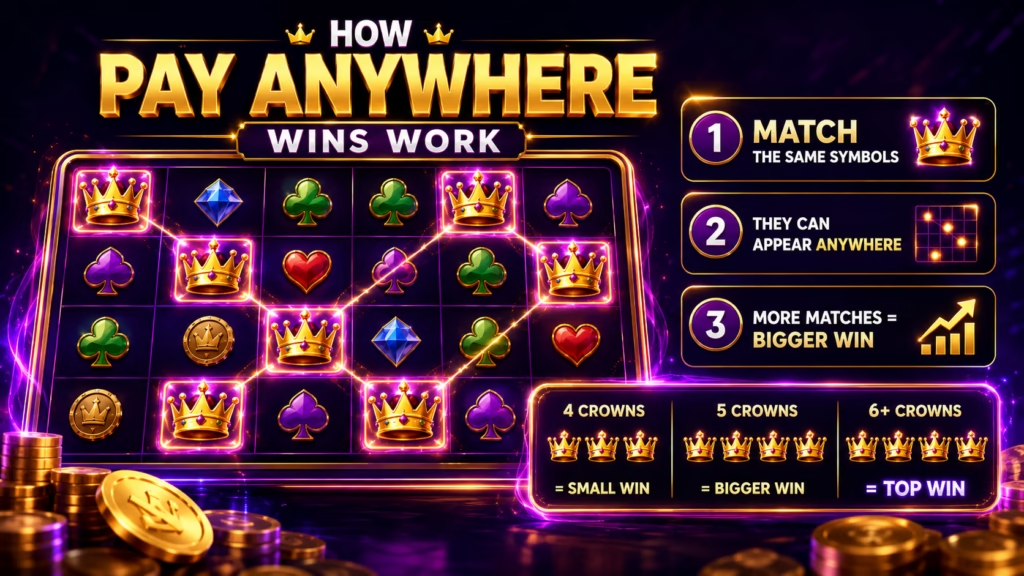
In a conventional payline slot, matching symbols generally have to occupy specific positions along one of the game’s active lines. Pay Anywhere removes that requirement. If the game’s rules say that eight matching symbols produce a payout, those eight symbols can generally be distributed across different positions on the grid.
The term should still be treated as a description of the game’s payout mechanic rather than a universal technical standard. Providers can set different minimum symbol counts, payout values, grid sizes and bonus rules.
Some games use a 6×5 grid and award payouts for eight or more matching symbols appearing anywhere on the reels. Other implementations may use different thresholds or grid formats.
How Do Pay Anywhere Slots Work?
Pay Anywhere slots typically work by counting matching symbols after a spin has stopped.
- You make a spin.
- The game fills the grid with symbols.
- The game counts each symbol type.
- Any symbol reaching the required minimum qualifies for a payout according to the paytable.
- If the slot has a cascade mechanic, winning symbols may disappear.
- New symbols fall into the empty positions.
- The game checks the grid again for another qualifying combination.
Suppose a 6×5 Pay Anywhere slot requires eight matching gem symbols. If three gems appear on the first two reels, two appear near the center and three appear on the final reels, all eight may count toward the same payout even though they do not form a conventional line.
The important number is not always eight. Some Pay Anywhere games start with five matching symbols, while others require eight or another threshold. Always check the individual game’s paytable before assuming how many symbols are required.

Is Pay Anywhere the Same as Scatter Pays?
Pay Anywhere and Scatter Pays are often used to describe very similar count-based payout systems, but players should not assume the terms have identical rules in every slot.
Traditional scatter symbols already have an “anywhere” characteristic in many slot games because they can trigger a payout or feature without forming a normal payline. Some modern slots apply a similar principle to ordinary paying symbols, which is why the mechanic is frequently described as Scatter Pays.
The practical rule is simple: ignore the marketing label and read the paytable. The paytable tells you which symbols qualify, how many are required and whether additional positioning rules apply.
Pay Anywhere vs Paylines vs Ways to Win vs Cluster Pays
These mechanics determine wins differently.
| Mechanic | How a typical win is formed | Must symbols touch? | Fixed paylines? |
| Pay Anywhere | Reach a required number of matching symbols across the grid | Usually no | No |
| Paylines | Match symbols along predefined lines | Position-dependent | Yes |
| Ways to Win | Match symbols across qualifying adjacent reels | Not necessarily | No |
| Cluster Pays | Create a connected group of matching symbols | Usually yes | No |
Pay Anywhere vs Paylines
Payline slots evaluate specific paths across the reels. Pay Anywhere slots generally care about the number of matching symbols rather than whether they occupy one predefined route.
This makes the winning pattern visually less important. A symbol in the top-left corner may contribute to the same Pay Anywhere combination as another symbol near the bottom-right.
Pay Anywhere vs Ways to Win
Ways to Win systems normally require matching symbols to appear across consecutive reels according to the game’s rules. A common structure starts from the leftmost reel and continues through adjacent reels.
Pay Anywhere can remove this reel sequence requirement. A qualifying symbol count may be spread throughout the entire grid.
Pay Anywhere vs Cluster Pays
Cluster Pays normally requires matching symbols to connect horizontally, vertically or according to another specified adjacency rule.
Pay Anywhere generally does not require a connected cluster. Eight matching symbols scattered around the grid may qualify even when none of them touch.
This difference matters because Pay Anywhere and Cluster Pays can look similar on large slot grids while using fundamentally different payout calculations.
Why Pay Anywhere Slots Often Use Cascading Wins
Pay Anywhere works particularly well with cascading mechanics because large grids create opportunities for the symbol count to change repeatedly during one paid spin.
After a qualifying win, the winning symbols may disappear and new symbols can fall into their positions. The new arrangement is then evaluated again. One initial spin can therefore contain several separate cascades.
A cascade does not guarantee another payout. New symbols are still determined according to the game’s underlying mathematics, so a sequence can stop immediately after the first win.
How Multipliers Work With Pay Anywhere
Multipliers can increase the value of qualifying Pay Anywhere wins, but multiplier rules vary considerably between games.
- apply only to the current cascade;
- accumulate throughout a sequence of cascades;
- appear randomly on the grid;
- remain active during a free spins feature;
- affect only certain winning combinations.
Players should therefore check both the Pay Anywhere payout table and the multiplier rules. A game with large advertised multipliers may require specific circumstances before those multipliers can affect a win.
The presence of multipliers also says very little by itself about how frequently meaningful payouts occur.
Do Pay Anywhere Slots Pay More Often?
Pay Anywhere mechanics do not automatically make a slot pay more frequently.
Hit frequency depends on the complete mathematical model of the game, including symbol probabilities, payout thresholds, reel or grid configuration, bonus features and other design choices. Two Pay Anywhere slots can therefore produce very different playing experiences.
The number of required symbols is also not enough to determine which game pays more often. A five-symbol requirement may sound easier than an eight-symbol requirement, but the underlying symbol distribution and grid design can be completely different.
Players looking for information about expected long-term return should examine RTP separately. Players concerned about the size and distribution of wins should also consider volatility.
Neither RTP nor volatility predicts what will happen during an individual session.
Does Pay Anywhere Increase RTP?
Pay Anywhere does not inherently increase RTP.
RTP, or Return to Player, is the theoretical percentage of wagered money a game is designed to return over a very large number of plays under specified conditions. Pay Anywhere simply describes how qualifying symbol combinations are identified.
A developer can build Pay Anywhere slots with different RTP settings. The exact RTP may also vary between versions supplied to different casino operators, so the value shown inside the game’s information or help section should be checked before playing.
A visually generous payout mechanic should never be treated as proof of a better mathematical return.
What Makes a Good Pay Anywhere Slot?
A useful way to evaluate Pay Anywhere slots is to examine the complete rules rather than choosing a game because it advertises a large grid or large multiplier.
1. Minimum symbol requirement
Find out whether payouts start at five, eight or another number of matching symbols.
Also check whether higher symbol counts produce substantially different payouts. Some games divide wins into ranges such as 8, 9, 10, 11 or 12+ matching symbols.
2. Grid size
A larger grid gives the game more symbol positions, but more positions do not automatically translate into better odds.
Grid size only makes sense when considered alongside symbol probabilities and the required number of matches.
3. Paytable
The paytable shows what each symbol is worth at different matching quantities.
Higher-value symbols may require the same number of matches as lower-value symbols while paying substantially more.
4. Cascading rules
Check whether winning symbols disappear after a payout and whether cascades continue until no new winning combination appears.
Also determine whether multipliers increase during a cascade sequence or reset immediately.
5. RTP
Check the RTP displayed in the version of the game you are actually considering.
Do not rely exclusively on an RTP number from an unrelated review because casinos can sometimes offer different mathematical configurations of the same title.
6. Volatility
Volatility describes how payouts are distributed rather than whether the Pay Anywhere mechanic itself is good or bad.
Higher-volatility slots can produce less regular results with greater variation in payout size. Lower-volatility games generally aim for a different distribution of wins.
7. Bonus features
Pay Anywhere games can include free spins, multipliers, bonus bets, bonus buys, wild symbols and other mechanics.
Check whether those features alter the stake, RTP or payout structure before using them. Availability and rules can depend on the game version and casino.
Common Pay Anywhere Slot Myths
“Anywhere means every matching symbol wins”
Not necessarily. A minimum number of matching symbols is still required.
If a game requires eight identical symbols, seven matching symbols normally do not create that particular Pay Anywhere payout.
“Pay Anywhere gives better odds than paylines”
The payout format alone cannot establish better odds.
The underlying game mathematics determine expected return and win distribution.
“More symbols on the grid means more wins”
A larger grid creates more positions but can also come with different symbol probabilities and payout thresholds.
Grid size should never be evaluated in isolation.
“Cascades make every winning spin continue”
Cascading systems only continue when the replacement symbols create another qualifying combination.
A cascade can end after the first evaluation.
“A high multiplier makes the slot more profitable”
Large multipliers describe potential payout mechanics, not guaranteed results.
Their frequency and activation conditions matter, and individual spins remain unpredictable.
Who Might Prefer Pay Anywhere Slots?
Pay Anywhere slots may suit players who prefer modern video slots with large grids and straightforward symbol-count mechanics.
The format can be particularly appealing if you like:
- seeing winning symbols distributed across the whole screen;
- cascading sequences;
- multiplier mechanics;
- bonus rounds built around large grids;
- games without complex payline diagrams.
Traditional payline slots may be a better fit if you prefer clearly defined winning routes and simpler reel structures.
Neither format provides a reliable way to make money. Slot results should be treated as entertainment, not an income strategy.
Practical Tips Before Playing a Pay Anywhere Slot
Start by opening the game’s information screen rather than assuming that every Pay Anywhere title follows the same rules.
Check the minimum symbol requirement, payout values, RTP, volatility information, cascade rules and bonus conditions.
If a demo version is legally available in your location, it can help you understand the mechanics without risking money. Demo play does not reveal what future real-money spins will produce.
If you choose to wager real money, decide on a spending limit before starting and avoid increasing stakes to recover losses. Bonus Buy or enhanced-bet features can substantially change the cost of a spin, so their price and rules should be understood before activation.
Stop when gambling is no longer entertainment or when you reach the limit you set.
How This Information Was Reviewed
This explanation focuses on the payout conditions that define Pay Anywhere mechanics, including symbol-count requirements, grid structure, cascading rules, multipliers and differences from paylines, Ways to Win and Cluster Pays.
Pay Anywhere is not tied to one universal matching threshold. Different games can use different minimum symbol counts, grid layouts and payout rules.
Before playing any specific slot, verify its current paytable, RTP, volatility, bet limits and bonus rules inside the game. These details can vary between titles and sometimes between operator configurations.
Pay Anywhere, RTP, volatility, cascades and multipliers describe aspects of a game’s mathematics and presentation. None of them can guarantee a particular result on the next spin or during a short session. Casino games should be treated as entertainment and played only with money you can afford to lose.
FAQ
What is a Pay Anywhere slot?
A Pay Anywhere slot generally awards payouts when a required number of matching symbols appear across the grid without needing to follow fixed paylines. The minimum number of symbols and exact payout rules depend on the individual game.
How do Pay Anywhere slots work?
Pay Anywhere slots count matching symbols after a spin and compare the total with the paytable. If enough identical symbols appear, the combination qualifies for a payout even when the symbols are located in different areas of the grid.
Do symbols need to touch in Pay Anywhere slots?
Usually, Pay Anywhere symbols do not need to touch. That is one of the main differences between Pay Anywhere and Cluster Pays, where matching symbols generally have to form a connected group. Always check the individual game’s rules for exceptions.
How many matching symbols are needed in a Pay Anywhere slot?
There is no universal number. Some Pay Anywhere games start paying from five matching symbols, while others use eight or another threshold. The game paytable should be treated as the definitive source.
Is Pay Anywhere the same as Scatter Pays?
The terms can describe very similar mechanics, especially when ordinary symbols pay according to how many appear anywhere on the grid. However, terminology varies between providers, so the game’s paytable is the definitive source for its payout rules.
Are Pay Anywhere slots better than payline slots?
Neither system is automatically better. Pay Anywhere provides a different way of forming wins, while RTP, volatility, hit frequency and payout distribution depend on the complete mathematical design of each slot.
Do Pay Anywhere slots have higher RTP?
Not necessarily. Pay Anywhere describes the win mechanic rather than the theoretical return. Check the RTP shown in the specific version of the game because RTP cannot be inferred from the payout system.
Do Pay Anywhere slots have more frequent wins?
Not necessarily. Win frequency depends on symbol probabilities, payout thresholds, grid design and the rest of the game’s mathematical model. A Pay Anywhere mechanic alone cannot tell you how often a slot will produce a payout.
Can Pay Anywhere slots use cascades and multipliers?
Yes. Pay Anywhere is frequently combined with cascading wins, multipliers and free spins. Exact feature rules vary by game.
Can you predict wins in Pay Anywhere slots?
No. Understanding the Pay Anywhere system can help you read the game correctly, but it does not allow you to predict future outcomes. RTP, volatility, previous spins and recent wins do not tell you what the next spin will produce.
Brief Conclusion
Pay Anywhere slots replace fixed winning lines with a system that usually counts matching symbols across the entire grid. The mechanic can make large-grid slots easier to read and works naturally with cascades, multipliers and free spins, but there is no universal Pay Anywhere rule.
Before choosing a game, check the required symbol count, paytable, RTP, volatility, cascade rules and bonus conditions. Most importantly, Pay Anywhere changes how wins are calculated, not whether you can reliably win. Slot outcomes remain uncertain, so play should be treated as entertainment rather than a way to make money.