Any Adjacent Pays slots allow winning combinations to form across adjacent reel positions without always requiring the match to begin on the leftmost reel. In a common implementation, three or more matching symbols can create a win on consecutive reels such as reels 2, 3 and 4, rather than only reels 1, 2 and 3. However, the exact definition of “adjacent” depends on the individual slot, so the game’s paytable remains the final authority.
Quick takeaways:
- Any Adjacent Pays removes some of the positional restrictions found in conventional left-to-right ways-to-win systems.
- Matching symbols normally need to appear on neighboring reels or positions, but the exact connection rules vary by game.
- A winning combination may be able to start away from reel 1.
- Any Adjacent Pays is not automatically the same as Cluster Pays, Pay Both Ways or standard Ways to Win.
- The mechanic changes how wins are formed, but it does not guarantee more profitable play or predict the result of a spin.
Any Adjacent Pays slots may appeal to players who dislike checking rigid paylines and prefer grids where winning combinations can originate from more areas of the screen. Players should still check RTP, volatility, symbol values and the game’s exact win rules rather than assuming that a more flexible payout system makes a slot better value.
What Does Any Adjacent Pays Mean in Slots?
Any Adjacent Pays is a slot payout mechanic in which identical symbols can create a winning combination when they occupy qualifying adjacent positions. Unlike a traditional ways-to-win game that normally requires matching symbols to begin on the first reel and continue across consecutive reels, some Any Adjacent Pays games allow the sequence to begin farther inside the grid.
For example, Arctic Valor has been described as allowing a three-symbol combination across reels 2, 3 and 4. Banana Drop similarly uses an Any Adjacent Pays system where three or more matching symbols on consecutive reels can produce a payout regardless of whether the sequence begins on the first, second or another qualifying reel.
That distinction is the central idea behind how Any Adjacent Pays works in slots. The mechanic expands the locations from which a valid combination can originate, although it does not necessarily remove every positional rule.
How Does Any Adjacent Pays Work in Slots?
A typical Any Adjacent Pays spin follows three basic stages. The slot generates the reel result, the game identifies groups of identical symbols that satisfy its adjacency rules, and qualifying combinations are paid according to the paytable.
Consider a five-reel slot where three matching symbols are required:
Reel 1: Q
Reel 2: Diamond
Reel 3: Diamond
Reel 4: Diamond
Reel 5: K
Under a conventional left-to-right ways system, the Diamonds on reels 2, 3 and 4 might not qualify because the sequence does not begin on reel 1.
Under an Any Adjacent Pays system that permits wins from any consecutive reel, the Diamonds may create a three-symbol win because reels 2, 3 and 4 are adjacent.
Build The Bank provides an example of this type of implementation. The game’s Any Adjacent Pays system allows a win to form away from the first reel when three matching symbols appear on adjacent reels.
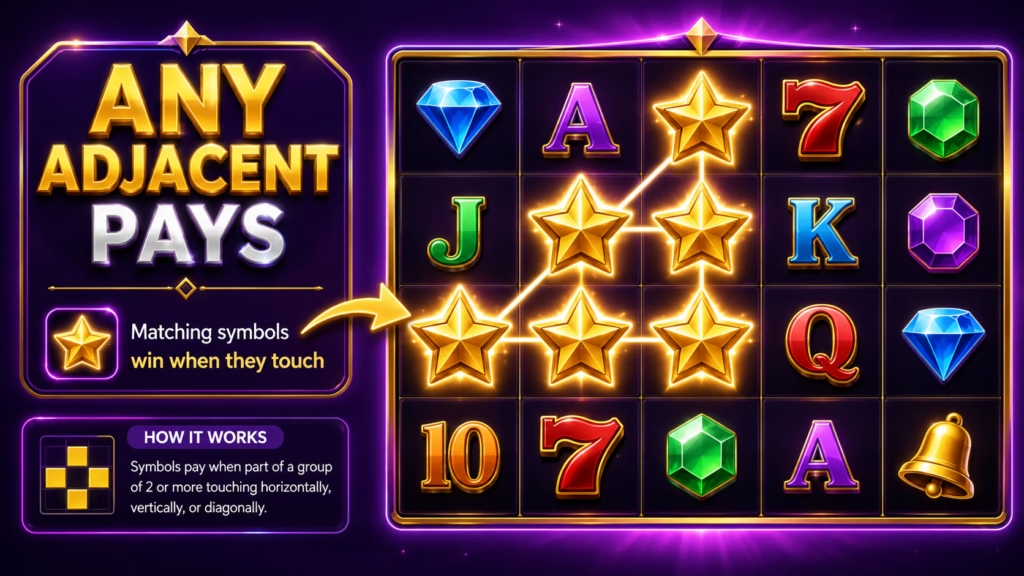
The important qualification is that Any Adjacent Pays is not a single universal mathematical specification used identically by every developer. Some titles describe adjacency primarily in terms of consecutive reels, while other grid-based games may use different positional relationships. The paytable should therefore be checked before assuming horizontal, vertical or diagonal connections qualify.
Do Symbols Have to Touch Each Other?
Not necessarily. “Adjacent” can refer to adjacent reels rather than symbols physically touching edge-to-edge.
In a ways-to-win style implementation, one matching symbol may appear at the top of reel 2 while another appears near the bottom of reel 3. They can still belong to the same winning way if the game’s rules treat matching positions anywhere on neighboring reels as connected.
Other games may use grid rules where physical proximity matters more directly. For example, Rhino Rilla Rex has been described as allowing combinations of matching symbols on its 5×5 grid when qualifying symbols are adjacent horizontally, vertically or diagonally.
This variation is why players should not interpret the phrase “Any Adjacent Pays” literally without reading the individual rules.
Any Adjacent Pays vs Ways to Win
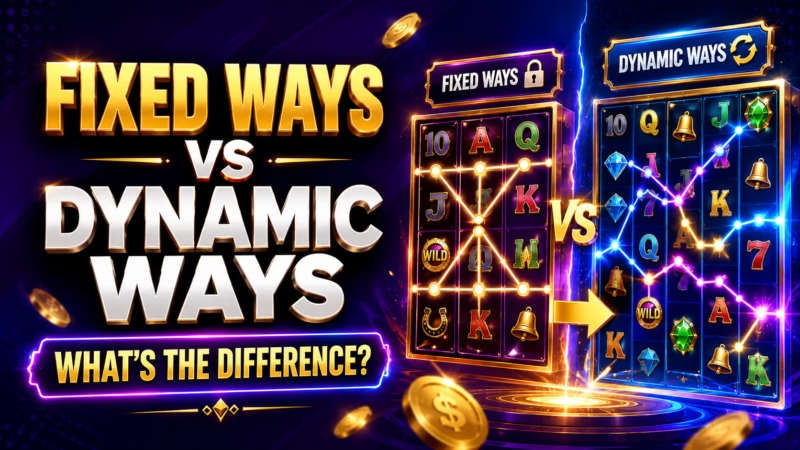
Standard Ways to Win and Any Adjacent Pays can look similar because neither necessarily uses visible fixed paylines. The major difference is usually where a valid matching sequence may begin.
| Mechanic | Typical requirement | Must start from reel 1? | Main characteristic |
| Fixed paylines | Symbols follow predefined lines | Usually | Exact patterns determine wins |
| Ways to Win | Matching symbols appear on consecutive reels | Usually | Vertical position normally does not matter |
| Any Adjacent Pays | Matching symbols appear in qualifying adjacent positions | Not always | Winning sequences may begin deeper in the grid |
| Pay Both Ways | Matches can form from either outside edge | Usually from reel 1 or final reel | Left-to-right and right-to-left wins |
| Cluster Pays | A minimum group of connected symbols forms | No | Uses connected groups rather than reel sequences |
Any Adjacent Pays should therefore not simply be treated as another name for Ways to Win. The two systems may use similar symbol counting, but Any Adjacent Pays can remove the conventional requirement that winning combinations originate at the first reel.
Any Adjacent Pays vs Pay Both Ways
Pay Both Ways normally means a slot checks qualifying combinations from both the left and right sides of the reels.
For example, a five-reel Pay Both Ways game may recognize:
reels 1 → 2 → 3
and
reels 5 → 4 → 3
Any Adjacent Pays can be more flexible because a sequence may potentially begin in an interior position such as reels 2 → 3 → 4.
Three Star Fortune provides a clear example of the Pay Both Ways concept. Its symbols pay left-to-right and right-to-left on selected paylines, which differs from a system that permits qualifying combinations to originate from any adjacent reel group.
Any Adjacent Pays vs Cluster Pays
Any Adjacent Pays and Cluster Pays are particularly easy to confuse because both use the concept of neighboring symbols.
Cluster Pays normally requires a specified number of matching symbols to create a connected group on a grid. Candy Jar Clusters, for example, requires clusters of six or more adjacent matching symbols and then removes winning symbols to trigger cascades.
Any Adjacent Pays can instead remain reel-based. Three identical symbols across neighboring reels may qualify even though they do not form the compact block normally associated with a cluster game.
The practical rule is simple: if the game counts connected groups on a grid, it is probably operating as a Cluster Pays title. If the game evaluates matching symbols across adjacent reels without forcing the sequence to begin on reel 1, it is closer to the classic Any Adjacent Pays model.
Does Any Adjacent Pays Create More Ways to Win?
Any Adjacent Pays can create more potential qualifying symbol arrangements than a comparable system that only accepts combinations beginning on the leftmost reel. That does not mean every Any Adjacent Pays slot has a higher hit frequency or better RTP.
A slot’s payout model is balanced as a complete mathematical system. Symbol weighting, reel configuration, paytable values, bonus frequency, wild behavior, RTP and volatility all contribute to the final game model.
A developer can therefore allow wins from many positions while assigning lower values to common combinations or adjusting another part of the mathematics.
The number of possible winning combinations should never be interpreted as the player’s mathematical return.
Does Any Adjacent Pays Improve RTP?
Any Adjacent Pays does not by itself determine RTP.
RTP represents the theoretical percentage of stakes that a game is designed to return over a very large number of plays. Any Adjacent Pays determines which symbol arrangements qualify as wins. These are related parts of the slot mathematics, but one does not directly establish the other.
Two slots can use similar adjacency mechanics and still have different RTP figures because their symbol probabilities, bonus features and payout values are different.
Players interested in theoretical return should check the actual RTP displayed in the game information rather than judging a slot by its payout mechanic alone.
Does Any Adjacent Pays Mean Wins Are More Frequent?
Any Adjacent Pays may provide more locations from which combinations can form, but this does not prove that the slot has a higher hit frequency.
Hit frequency measures how often a game produces a qualifying win over its mathematical model. A developer can compensate for flexible win formation through symbol probabilities, payout sizes or other mechanics.
For this reason, statements such as “Any Adjacent Pays means you win more often” are too simplistic.
The mechanic describes where wins are allowed to form, not how frequently the RNG will generate them.
Examples of Any Adjacent Pays Slots
The mechanic has appeared particularly often in games associated with Crazy Tooth Studio. The developer’s catalogue includes titles such as Arctic Valor, Diamond Force, Build The Bank, Banana Drop, Rhino Rilla Rex and the Lucky Clucks series.
Several of these titles use variations of the same general concept. Build The Bank allows matching combinations on adjacent reels without requiring the winning sequence to start on reel 1, while Lucky Clucks 2 combines Any Adjacent Pays with an expanding 3-4-4-4-3 reel configuration and additional ways to win.
The implementation should still be checked individually because grid size, required symbol count and bonus features can change how the mechanic behaves.
How to Read an Any Adjacent Pays Slot Paytable
The paytable is more useful than the marketing label when evaluating an Any Adjacent Pays game.
Check four details first: the minimum number of identical symbols needed for a payout, what the game means by “adjacent,” whether combinations can start on every reel, and whether wild symbols substitute inside those combinations.
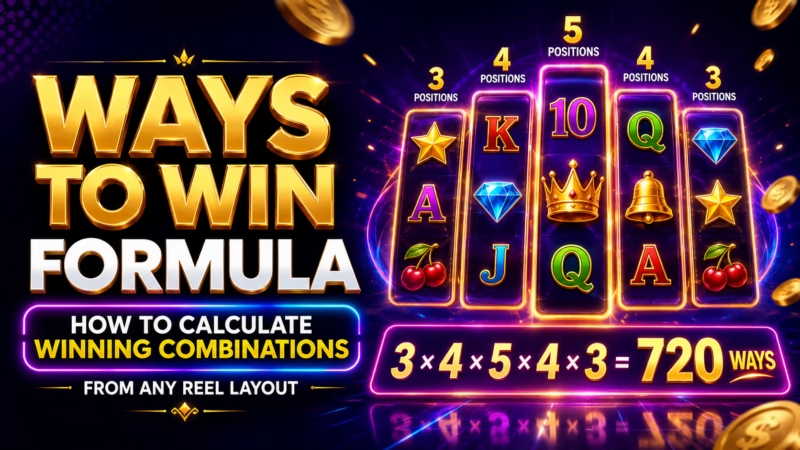
Then check whether multiple combinations of the same symbol are counted separately. This becomes especially important in games with tall reels or expanding grids because several copies of a symbol on each qualifying reel can generate multiple winning ways.
Bonus modes should also be checked separately. Some slots change their reel dimensions, wild behavior or payout system during free spins, so the base-game rules may not fully describe the bonus round.
Common Misconceptions About Any Adjacent Pays
The biggest misconception is that Any Adjacent Pays means any two symbols touching anywhere automatically win. Most games still require a minimum number of matching symbols and a specific type of connection.
Another mistake is assuming the mechanic is identical to Cluster Pays. Cluster games normally calculate connected groups, while many Any Adjacent Pays titles calculate matching symbols across neighboring reels.
A third misconception is that additional winning arrangements automatically increase RTP. The developer builds the entire probability and payout model around the mechanic, so more possible combinations do not guarantee a higher theoretical return.
Finally, flexible win formation does not make future spins predictable. Online slot outcomes are determined independently according to the game’s underlying system, and previous wins or losses do not reveal where the next qualifying combination will appear.
Who Might Prefer Any Adjacent Pays Slots?
Any Adjacent Pays slots may suit players who want a less rigid alternative to traditional paylines.
They can be particularly appealing to players who already understand Ways to Win games but want winning sequences to originate from more parts of the reel set. The mechanic can also make tall or expanding reel layouts easier to follow because the player can focus on neighboring matching symbols instead of memorizing dozens of fixed paylines.
Players who prefer extremely simple three-reel games may find some Any Adjacent Pays titles unnecessarily complex, particularly when the mechanic is combined with expanding grids, respins, wild modifiers or several bonus systems.
The best approach is to understand the win rules before considering any other feature.

How This Information Was Reviewed
This explanation distinguishes Any Adjacent Pays from fixed paylines, conventional Ways to Win, Pay Both Ways and Cluster Pays by comparing how each mechanic forms winning combinations. Developer material and documented game implementations were used where available, while game-specific rules should always take precedence because different slots can interpret adjacency differently.
Before playing for money, check the game’s paytable for its exact winning-symbol requirement, RTP, volatility, wild rules and bonus conditions. RTP and volatility describe long-term mathematical characteristics and cannot predict the result of a particular session.
Slots should be treated as paid entertainment rather than a way to generate income. Set spending and time limits before playing, and stop if gambling is no longer enjoyable or remains within neither your budget nor your intended limits.
FAQ
What are Any Adjacent Pays slots?
Any Adjacent Pays slots are games where qualifying matching symbols can form winning combinations across adjacent reel positions without necessarily starting from the first reel. The precise adjacency rule depends on the game, so players should confirm it in the paytable.
How does Any Adjacent Pays work in slots?
Any Adjacent Pays checks neighboring qualifying positions for matching symbols and awards a payout when the required number is reached. In some implementations, three identical symbols on reels 2, 3 and 4 can win even though reel 1 does not contain that symbol.
Do Any Adjacent Pays wins have to start on the first reel?
No, removing the mandatory leftmost-reel starting point is one of the defining features of many Any Adjacent Pays implementations. The exact starting positions permitted depend on the individual game’s rules.
Is Any Adjacent Pays the same as Cluster Pays?
No. Cluster Pays normally requires a connected group of matching symbols on a grid, while classic Any Adjacent Pays mechanics may evaluate matching symbols across adjacent reels. Some game designs can blur the distinction, so the paytable should be checked.
Is Any Adjacent Pays the same as Pay Both Ways?
No. Pay Both Ways normally evaluates combinations starting from either the leftmost or rightmost reel. Any Adjacent Pays may also recognize combinations that begin on an interior reel, depending on the game.
Does Any Adjacent Pays increase the chance of winning?
Not necessarily. The mechanic can increase the number of positions capable of forming a valid combination, but overall hit frequency depends on the game’s complete mathematical model, including symbol probabilities and payout rules.
Do Any Adjacent Pays slots have higher RTP?
Not automatically. RTP is determined by the complete payout model rather than the presence of one mechanic. Players should check the RTP shown in the specific game rather than assuming that Any Adjacent Pays provides a higher theoretical return.
Can wild symbols be used in Any Adjacent Pays combinations?
Wild symbols can contribute when the individual game’s rules allow them to substitute for the required paying symbol. Wild behavior varies significantly between slots, and some special symbols may be excluded, so the paytable should be checked.
Are Any Adjacent Pays slot outcomes predictable?
No. The payout mechanic defines which completed reel arrangements count as wins, but it does not provide a method for predicting future outcomes. Previous spins do not establish when the next winning combination will appear.
In short
Any Adjacent Pays is a flexible slot payout mechanic that can allow matching symbols on adjacent positions to win without forcing every combination to begin on the first reel. Its exact implementation varies between games, which makes the paytable more important than the mechanic’s name alone.
The feature should not be confused with Cluster Pays, Pay Both Ways or conventional Ways to Win, and it does not automatically produce higher RTP or more frequent wins. Use Any Adjacent Pays as a way to understand how a slot evaluates symbols, not as an indicator of whether the game will be profitable.