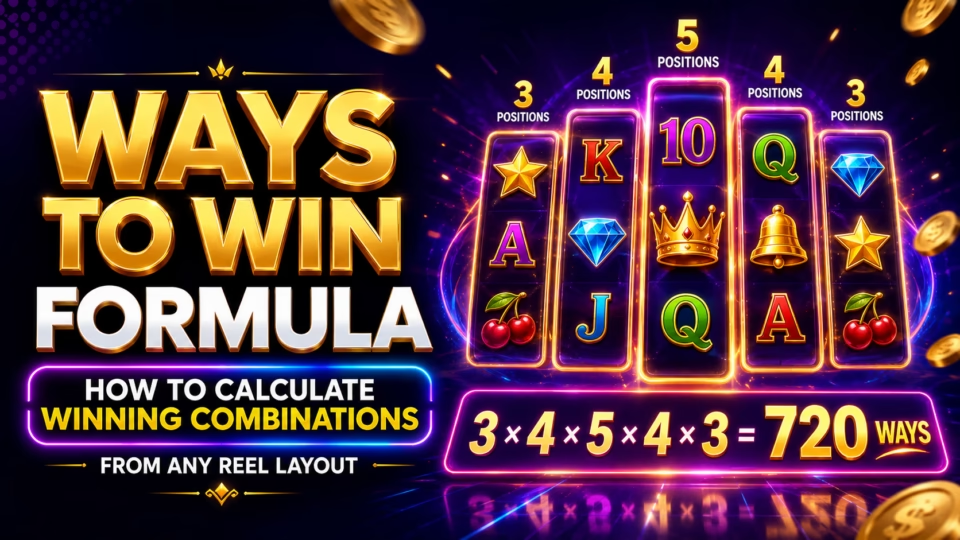
To calculate ways to win in slots, multiply the number of active symbol positions on each eligible reel. For a standard 5-reel slot with 3 positions on every reel, the calculation is 3 × 3 × 3 × 3 × 3 = 243 ways to win. For variable reel layouts, multiply the actual number of active positions on each reel.
The same principle can also calculate how many winning combinations a specific symbol creates on a particular spin. Instead of multiplying every position, multiply the number of matching symbols appearing on consecutive eligible reels.
Quick takeaways:
- Maximum ways to win = active positions on Reel 1 × Reel 2 × Reel 3 and so on.
- A 5×3 layout normally creates 243 possible ways because 3⁵ = 243.
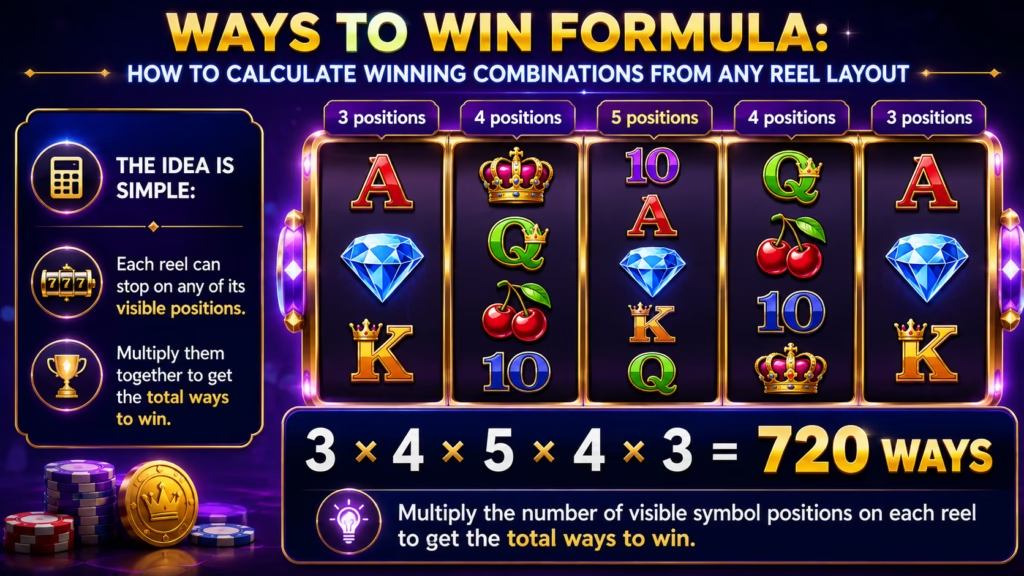
- A 3-4-5-4-3 layout creates 720 possible ways because 3 × 4 × 5 × 4 × 3 = 720.
- Actual winning ways for one symbol depend on how many copies of that symbol appear on consecutive reels.
- More ways to win do not automatically mean higher RTP, higher hit frequency, or better expected returns.
Ways-to-win mechanics are especially useful to understand for players comparing traditional paylines, 243 Ways slots, variable-reel games and Megaways-style systems. The mathematics explains how combinations are counted, but it cannot predict the result of the next spin.
What Does Ways to Win Mean in Slots?
Ways to win is a slot mechanic that counts combinations of matching symbols across consecutive reels instead of requiring symbols to land on fixed paylines. In a typical left-to-right ways game, a winning symbol can appear in any visible position on Reel 1, any position on Reel 2, and any position on subsequent reels required for a paying combination.
For example, imagine a 5×3 slot. Each reel displays three symbol positions. A traditional payline system might evaluate only specific predefined patterns, while a 243 Ways system can connect any position on one reel with any position on the next eligible reel.
This creates:
3 × 3 × 3 × 3 × 3 = 243 possible reel-position paths
The number 243 describes possible positional combinations across all five reels. It does not mean that every spin contains 243 winning combinations.
Slot Ways to Win Formula
The basic slot ways to win formula is:
W = R₁ × R₂ × R₃ × … × Rₙ
Where:
- W = total possible ways
- R₁ = number of active symbol positions on Reel 1
- R₂ = number of active symbol positions on Reel 2
- Rₙ = number of active symbol positions on the final eligible reel
For a slot with five reels and three visible positions per reel:
W = 3 × 3 × 3 × 3 × 3
W = 243
For six reels with four visible positions each:
W = 4⁶ = 4,096
The formula works because every position on one reel can potentially combine with every eligible position on the next reel.
Common Fixed Reel Layout Examples
| Reel layout | Formula | Maximum ways |
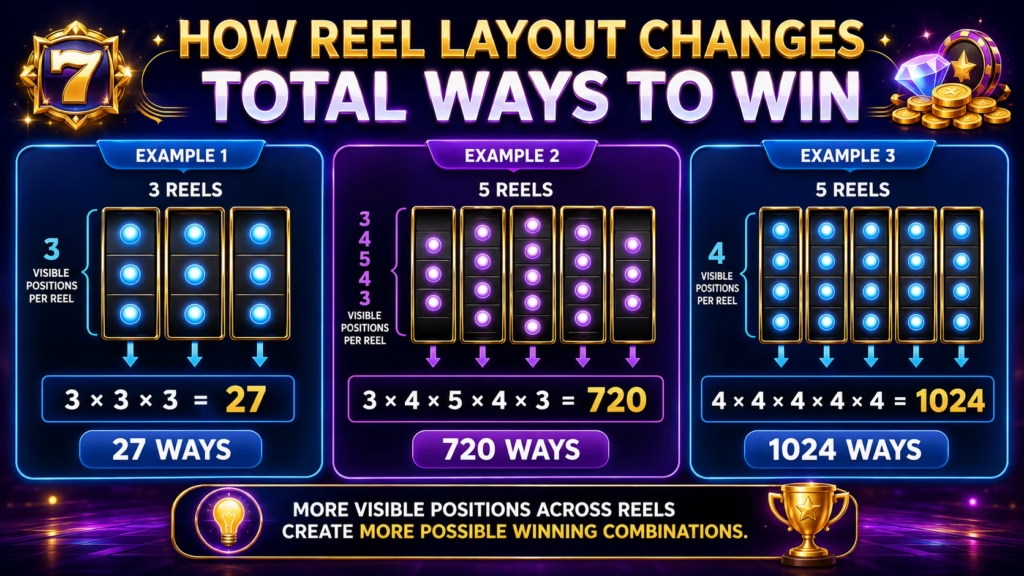
| 3×3 | 3 × 3 × 3 | 27 |
| 4×3 | 3 × 3 × 3 × 3 | 81 |
| 5×3 | 3⁵ | 243 |
| 5×4 | 4⁵ | 1,024 |
| 6×4 | 4⁶ | 4,096 |
| 6×5 | 5⁶ | 15,625 |
| 6×6 | 6⁶ | 46,656 |
| 6×7 | 7⁶ | 117,649 |
These numbers apply only when every visible position on every relevant reel participates in the ways system. Special reels, inactive positions or game-specific rules can change the calculation, so the official paytable remains the final reference.
How to Calculate Ways to Win from Any Reel Layout
For an uneven reel layout, count the active symbol positions on each reel and multiply those numbers together.
Suppose a five-reel game displays:
- Reel 1: 3 positions
- Reel 2: 4 positions
- Reel 3: 5 positions
- Reel 4: 4 positions
- Reel 5: 3 positions
The calculation is:
3 × 4 × 5 × 4 × 3 = 720 ways
The slot therefore has a maximum of 720 possible position combinations across the five reels.
This method works even when every reel has a different height. The important question is not how many total symbols are visible on the screen, but how many eligible positions each reel contributes to a complete reel-to-reel path.
How to Calculate Actual Winning Combinations for a Symbol
Calculating the theoretical number of ways in a reel layout is different from calculating the number of actual winning combinations on a specific spin.
For a particular symbol, use:
Winning ways = C₁ × C₂ × C₃ × … × Cₖ
Where C is the number of matching symbols appearing on each consecutive reel involved in the win.
Imagine a symbol appears:
- twice on Reel 1
- three times on Reel 2
- once on Reel 3
If three consecutive reels are enough for a payout:
2 × 3 × 1 = 6 winning ways
There are six different positional combinations that can create that symbol sequence.
Now suppose two copies of the same symbol also appear on Reel 4:
2 × 3 × 1 × 2 = 12
That produces 12 possible four-reel combinations for the symbol.
Whether the game separately awards shorter combinations when a longer combination exists depends on the paytable. Many games evaluate the longest qualifying combination according to their rules, so payout calculation should always follow the specific game’s documentation rather than assuming every combination length is added independently.
Worked Example: Calculating a Win Step by Step
Consider a 5×4 ways slot where a fictional symbol called A pays when it appears on three or more consecutive reels starting from Reel 1.
After a spin, Symbol A appears:
- Reel 1: 2 times
- Reel 2: 2 times
- Reel 3: 3 times
- Reel 4: 1 time
- Reel 5: 0 times
For the first three reels:
2 × 2 × 3 = 12
There are 12 three-reel positional combinations.
Because Symbol A also appears once on Reel 4:
2 × 2 × 3 × 1 = 12
The symbol forms 12 combinations extending through four consecutive reels.
The sequence stops at Reel 5 because no Symbol A is present there.
The paytable determines which payout value applies. The combination count identifies the number of ways involved, while the symbol’s listed payout determines the value assigned to the qualifying result.
How Variable Reel Layouts and Megaways Change the Formula
Variable-reel slots use the same multiplication principle, but the number of active positions can change between spins.
Suppose a six-reel spin shows:
3 × 5 × 4 × 6 × 2 × 7
Multiplying the positions gives:
3 × 5 × 4 × 6 × 2 × 7 = 5,040 ways
If the next spin displays different reel heights, the total number of available ways can also change.
Megaways-style games commonly use dynamically changing numbers of symbols on their reels. When a particular game calculates its ways directly from the active positions on each reel, the same multiplication method applies.
For example:
7 × 7 × 7 × 7 × 7 × 7 = 117,649
This is why 117,649 ways is associated with many six-reel Megaways implementations that can display up to seven participating symbols on every reel.
However, not every game with variable reels uses identical rules. Extra reels, horizontal reels, special symbols and proprietary mechanics can modify how combinations are evaluated. Check the game’s paytable when its layout contains additional elements beyond the main reels.
Ways to Win vs Paylines
Ways to win and paylines calculate winning combinations differently. Payline slots require qualifying symbols to land on predefined lines, while standard ways-to-win slots normally allow matching symbols to occupy any eligible position on consecutive reels.
For example, a 20-payline slot has 20 predefined patterns even if many more geometrical combinations could theoretically be drawn across its reels.
A 243 Ways slot with five reels and three positions per reel instead evaluates:
3⁵ = 243 positional paths
The practical difference is flexibility. A matching symbol does not normally need to sit on one specific horizontal, diagonal or zigzag line in a ways game.
That does not mean 243 Ways is automatically better than 20 paylines. Payout values, symbol probabilities, RTP, volatility and the mathematical model behind the game also affect the playing experience.
Ways to Win vs Adjacent Pays and Cluster Pays
Ways-to-win mechanics should not be confused with every system that removes traditional paylines.
Adjacent pays may award combinations when matching symbols appear on neighboring reels or positions according to rules that differ from standard left-to-right ways.
Cluster pays usually require matching symbols to touch horizontally or vertically in groups. Because cluster games evaluate connected areas rather than reel-to-reel paths, multiplying reel heights does not normally calculate their winning combinations.
The correct formula therefore depends on the underlying mechanic:
- Fixed paylines: evaluate predefined lines.
- Ways to win: multiply eligible positions across reels.
- Variable ways or Megaways: multiply the active positions shown on each participating reel.
- Cluster pays: evaluate connected groups according to the game’s cluster rules.
- Other adjacent systems: follow the game’s specified adjacency conditions.
Calling every line-free slot a ways-to-win game can produce incorrect calculations.
Does More Ways to Win Mean a Better Chance of Winning?
A larger ways-to-win number creates more possible positional paths, but it does not by itself reveal the probability of receiving a winning spin.
A slot with 10,000 ways can have very different symbol distributions from a game with 243 ways. The frequency with which paying symbols appear depends on the game’s mathematical model, including symbol weighting and other design factors.
This is why the advertised number of ways should not be used as a substitute for:
- RTP
- hit frequency
- volatility
- paytable values
- symbol probability
- bonus frequency
For example, increasing the number of available position combinations could be balanced by different symbol frequencies or payout values. The ways number describes the structure of possible combinations, not the expected profitability of playing the game.
Does the Number of Ways Affect RTP?
Ways to win and RTP measure different properties of a slot. Ways to win describes how symbol positions can combine, while RTP represents the game’s theoretical long-term return under specified conditions.
Two slots can both use 243 Ways and still have different RTP percentages. Similarly, a variable-reel game with thousands of ways can have an RTP similar to a much simpler fixed-reel game.
RTP is calculated across a very large theoretical sample and does not predict the result of an individual session. The exact RTP can also vary between game configurations or casino implementations, so players should check the information provided inside the specific version of the game.
Does More Ways to Win Mean Higher Hit Frequency?
More ways do not automatically produce a higher hit frequency. Hit frequency measures how often a game produces a qualifying win, while ways to win measures the number of eligible positional combinations.
Symbol distribution is crucial. A game can offer a huge number of ways but make high-paying symbols relatively difficult to connect. Another game with fewer ways could produce small qualifying wins more frequently.
When comparing two games, the ways count should therefore be treated as one mechanical characteristic rather than a direct measure of how often either game pays.
Common Mistakes When Calculating Ways to Win
Adding reel positions instead of multiplying them
A 5×3 game does not have 15 ways because 3 + 3 + 3 + 3 + 3 = 15. Each position can combine with positions on other reels, so multiplication is required.
The correct calculation is:
3 × 3 × 3 × 3 × 3 = 243
Multiplying the total number of visible symbols
A reel layout containing 15 visible positions does not mean the calculation is 15 × 15 or 15⁵. Count the eligible positions on each individual reel.
Counting non-consecutive reels
In a standard left-to-right ways game, a symbol on Reel 1 and Reel 3 normally cannot form a qualifying sequence when the required symbol is absent from Reel 2.
Game rules can contain exceptions, so features such as special wilds should be evaluated according to the paytable.
Treating every possible way as an actual win
A slot may advertise 243, 1,024 or 117,649 ways, but these figures describe potential positional routes. Only combinations containing qualifying symbols according to the paytable produce wins.
Assuming a higher ways count means better returns
The advertised number of ways does not establish RTP or expected loss. Comparing games purely by the largest ways number ignores the rest of the mathematical model.
A Simple Method for Checking Any Ways-to-Win Slot
When analyzing an unfamiliar reel layout, use this process:
- Count the participating reels. Ignore decorative or auxiliary elements unless the rules say they contribute to combinations.
- Count active positions on each reel. Variable-reel games may have different counts on every spin.
- Multiply the reel counts. This gives the maximum number of positional ways for that layout.
- Identify the minimum matching sequence. Check whether wins require three, four or another number of consecutive reels.
- Count matching symbols per consecutive reel. Multiply those counts to calculate actual ways for the symbol.
- Check wild behavior. Wilds can substitute for certain symbols and may change the number of qualifying combinations.
- Read the paytable. The paytable determines payout values, direction of evaluation and special exceptions.
This method separates the mathematical layout from the game’s payout rules, which prevents most ways-to-win calculation errors.
How This Information Was Reviewed
The ways-to-win calculations in this guide are based on combinatorial multiplication: each eligible symbol position on one reel can be paired with eligible positions on subsequent participating reels.
Specific slot rules can alter how a winning combination is evaluated. Players should verify the game’s official paytable for minimum matching reels, left-to-right or alternative payout directions, wild substitutions, special reels and variable layouts.
Ways to win, RTP, volatility and bonus mechanics describe different parts of a game’s mathematical model. None of them can guarantee a winning spin or predict a future outcome. Casino games should be treated as entertainment, and players should set spending and time limits before playing.
FAQ
How do you calculate ways to win in a slot?
Multiply the number of active positions on every participating reel. A five-reel slot with three positions on each reel has 3 × 3 × 3 × 3 × 3 = 243 ways to win. If reel heights differ, multiply the individual reel heights instead.
What is the formula for 243 Ways?
The formula is 3⁵ = 243 for a five-reel game displaying three eligible symbol positions on each reel. The 243 represents every possible choice of one position from each of the five reels.
How do you calculate winning ways for one symbol?
Count how many copies of the symbol appear on each consecutive eligible reel and multiply the counts. If the symbol appears twice on Reel 1, three times on Reel 2 and twice on Reel 3, it creates 2 × 3 × 2 = 12 three-reel ways, subject to the game’s payout rules.
How many ways are there in a 5×4 slot?
A five-reel slot with four active positions on every reel has 4⁵ = 1,024 possible ways when all five reels participate in the standard ways system.
How are Megaways calculated?
Megaways are generally calculated by multiplying the number of participating symbol positions visible on each main reel for that spin. For example, six reels each showing seven participating positions produce 7⁶ = 117,649 ways. Individual games can contain additional rules, so the paytable should be checked.
Are 117,649 ways better than 243 ways?
Not necessarily. 117,649 ways provides more possible positional combinations than 243 ways, but the number alone does not determine RTP, hit frequency, volatility or expected returns. Symbol probabilities and payout values remain important.
Do wild symbols increase the number of winning ways?
Wild symbols can increase the number of qualifying combinations when they substitute for regular symbols. The exact calculation depends on which symbols the wild can replace and whether the game uses additional wild rules such as expanding, stacked or multiplier wilds.
Do ways-to-win slots need matching symbols on the same row?
Standard ways-to-win slots generally do not require symbols to occupy the same row. Qualifying symbols can appear in different eligible positions as long as they satisfy the required consecutive-reel rules.
Does a higher number of ways increase RTP?
A higher number of ways does not automatically increase RTP. RTP is determined by the complete mathematical model of the game, including symbol probabilities and payout values. The number of ways only describes how eligible positions can form combinations.
Can the ways-to-win formula predict whether the next spin will win?
No. The formula calculates possible or existing symbol combinations, not future random outcomes. It cannot predict the next spin or provide a guaranteed strategy for winning.
In short
The basic formula for calculating ways to win is simple: multiply the number of eligible positions on each participating reel. A 5×3 slot therefore has 243 ways, while variable layouts require multiplying the actual reel heights shown.
To calculate winning combinations for a specific symbol, multiply the number of matching symbols on each consecutive reel involved in the win. The ways count explains the structure of a slot, but it does not predict outcomes or determine RTP, hit frequency or profitability.