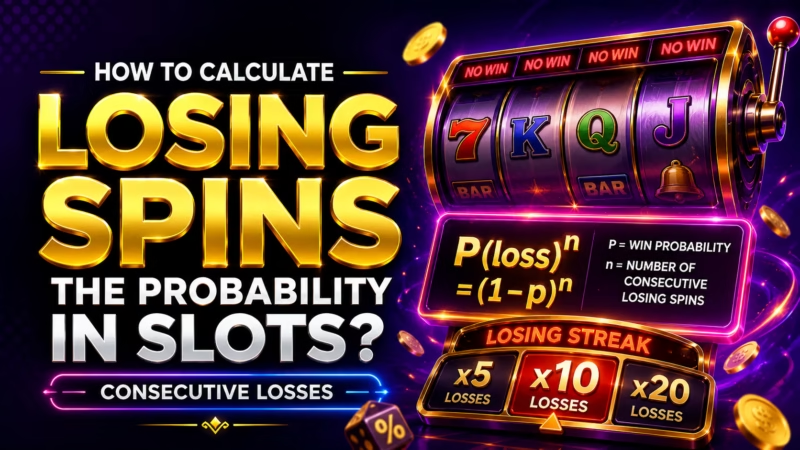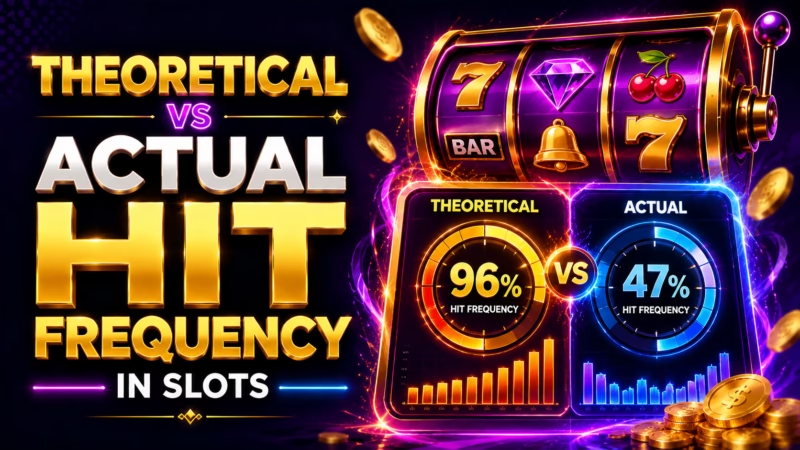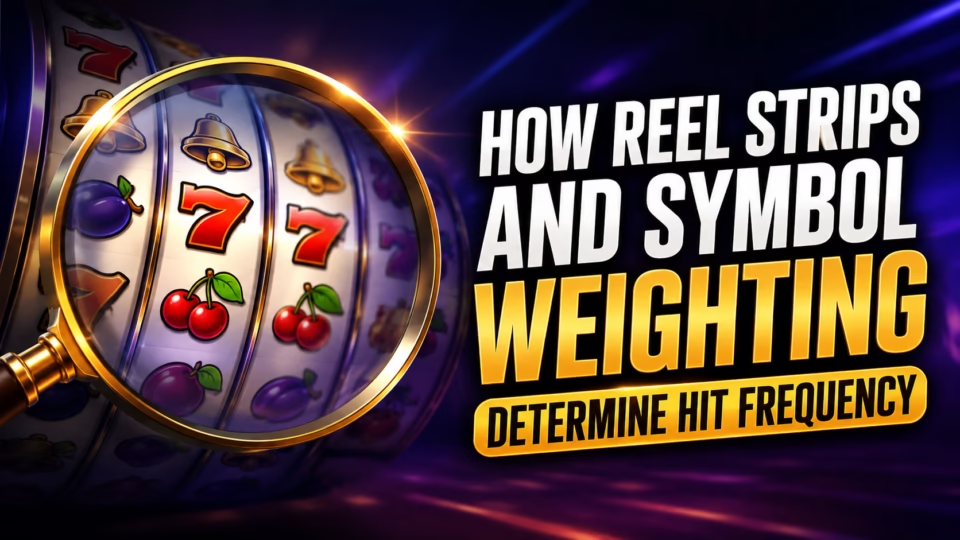
Slot reel strips and symbol weighting are two of the main mathematical tools used to determine how often different symbols and winning combinations can appear in a slot. A reel strip defines the possible stopping positions on each reel, while symbol weighting determines how frequently particular symbols are represented within those positions. Together, they directly influence hit frequency, payout distribution, volatility, and the overall feel of a slot.
The important point is that symbols do not necessarily have equal probabilities of appearing. A high-paying symbol may occupy relatively few reel positions, while a low-paying symbol may appear many times. This allows developers to create specific mathematical profiles without changing what players see on the screen.
Key takeaways:
- A reel strip is the sequence of symbols or possible stops assigned to a reel.
- Symbol weighting makes some symbols statistically more common than others.
- More winning combinations can increase hit frequency, but their values may be small.
- Rare high-paying symbols can reduce the probability of premium combinations.
- Hit frequency describes how often winning outcomes occur, not whether a session will be profitable.
Understanding reel strips is especially useful for players comparing slot mechanics, hit frequency and volatility. However, reel mathematics cannot be used to predict the next spin because outcomes in properly implemented RNG slots are generated independently according to the game’s configured mathematics.
What Are Slot Reel Strips?
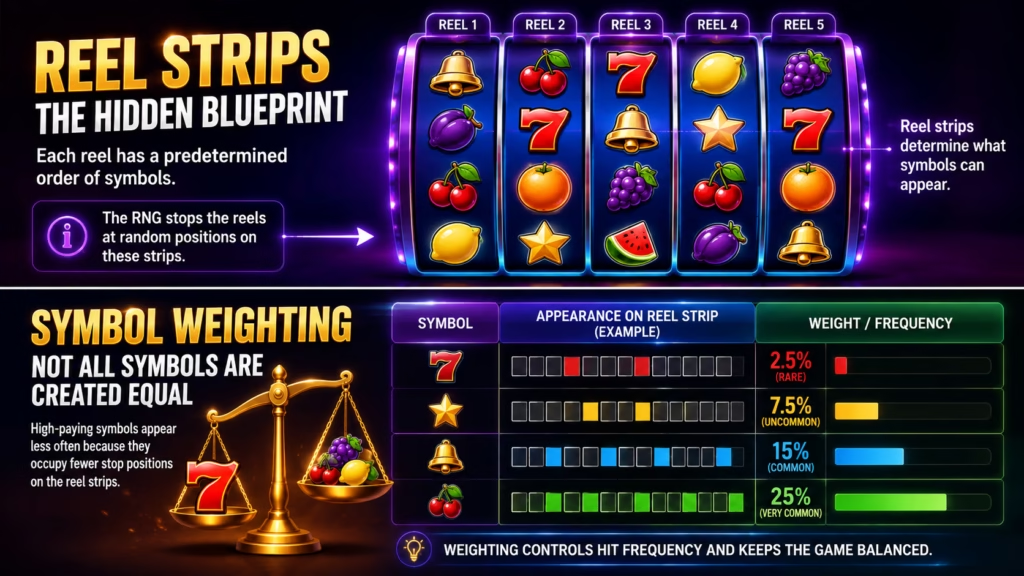
A slot reel strip is the ordered set of symbol positions associated with a reel. Traditional mechanical slots used physical strips wrapped around real reels. Modern online slots usually reproduce the same mathematical concept digitally, even though the visible reels are generated on a screen.
A simplified reel strip might contain:
Cherry – BAR – Cherry – 7 – Lemon – Cherry – BAR – Lemon – Cherry – Wild
If the example strip contains ten equally selectable stopping positions, Cherry occupies four of them. Its probability of landing on the relevant stop would therefore be higher than the probability of landing on the single 7 or Wild position.
Real slot mathematics can be considerably more complicated. Different reels may have different strips, and modern games may use virtual reel mapping, expanding reels, variable layouts, cascading systems or other mechanics that make the final probability model less obvious from the visible interface.
Visible Reels Are Not Necessarily the Full Mathematical Reel
The symbols shown during a spin should not be confused with the entire mathematical reel.
A player might see only three, four, five or six rows at once, while the underlying reel configuration can contain many possible stopping positions. The game selects a reel position and then displays the relevant portion of the reel around that position.
This distinction explains why visually counting symbols during a few dozen spins cannot reliably reveal their true probability.
What Is Slot Symbol Weighting?
Slot symbol weighting is the practice of assigning different probabilities to different symbols or outcomes. Instead of every visible symbol having the same chance of appearing, some symbols can effectively have more representation in the game’s mathematical model.
Consider a simplified reel containing 20 positions:
| Symbol | Positions | Approximate probability |
| Low-value symbol A | 6 | 30% |
| Low-value symbol B | 5 | 25% |
| Medium symbol | 4 | 20% |
| Premium symbol | 2 | 10% |
| Wild | 2 | 10% |
| Scatter | 1 | 5% |
In this simplified example, the scatter is much rarer than the low-value symbols.
The actual probability of triggering a feature would still depend on how scatters are distributed across all relevant reels, how many are required and whether additional game rules modify the result.
Symbol weighting therefore allows a slot to display a relatively small set of recognizable symbols while giving each symbol a different mathematical importance.
How Reel Strips Determine Symbol Probability
A symbol’s probability on a conventional reel-strip model depends on the number of eligible positions assigned to that symbol compared with the total number of reel positions.
A simplified formula is:
Symbol probability = Number of positions containing the symbol / Total reel positions
If a reel contains 50 stopping positions and a premium symbol appears twice:
2 / 50 = 4%
If a low-value symbol appears ten times:
10 / 50 = 20%
The low-value symbol would therefore be five times as likely to occupy the selected position in this simplified example.
For a multi-reel combination, the probabilities must be considered across the required reels. If the same premium symbol has a 4% probability on three independent reels, the probability of obtaining that exact three-symbol sequence would be much lower than 4%.
This is one reason top-paying combinations can remain rare even when their symbols occasionally appear on individual reels.
How Reel Strips Affect Hit Frequency
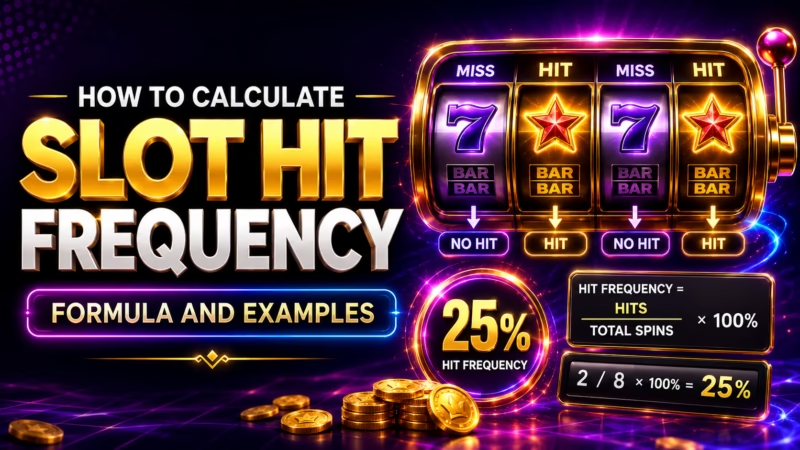
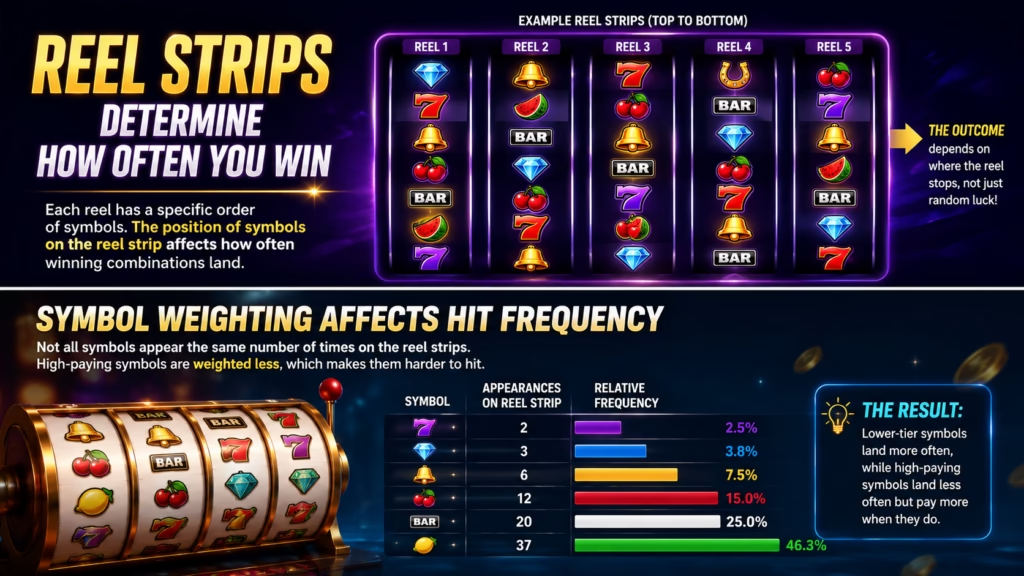
Hit frequency measures the proportion of spins that produce a qualifying win under the game’s rules. Reel strips affect hit frequency because they determine how often symbols capable of forming winning combinations can reach relevant positions.
A slot containing many frequently occurring low-value symbols may generate wins relatively often. A different slot may allocate fewer positions to useful combinations and therefore produce winning spins less frequently.
Developers can adjust hit frequency through several interconnected variables:
- number of symbol positions;
- frequency of each symbol;
- payline or ways-to-win structure;
- number of active rows;
- wild frequency;
- scatter distribution;
- required combination length;
- bonus feature probability;
- payout values attached to each combination.
This means hit frequency cannot normally be inferred from symbol weighting alone.
Two games could theoretically have similar symbol distributions yet different hit frequencies because their paylines, paytables, wild mechanics or combination requirements differ.
Example of Reel Weighting Across Three Reels
Consider a simplified three-reel slot with 20 equally selectable positions on each reel.
Suppose a jackpot symbol appears:
- twice on Reel 1;
- once on Reel 2;
- once on Reel 3.
The probability of landing that symbol on the relevant stop would be:
- Reel 1: 2/20
- Reel 2: 1/20
- Reel 3: 1/20
For the exact three-symbol combination:
2/20 x 1/20 x 1/20 = 2/8,000
That equals 1 in 4,000 in this simplified model.
Now imagine a low-paying symbol appears eight times on every reel:
8/20 x 8/20 x 8/20 = 512/8,000
That is 6.4%, or roughly 1 in 15.6 outcomes for that exact three-symbol combination under the simplified assumptions.
The difference shows why the number of visible symbol types tells players very little about their actual probability. What matters mathematically is how heavily each symbol is represented.
Virtual Reel Strips and Weighted Stops
Digital slots are not restricted by the physical size of mechanical reels. Software can use virtual positions or mathematical mappings that represent far more possible outcomes than players can see.
A visible reel might appear to contain a modest number of repeating symbols, while the internal model assigns probabilities using a much larger set of possible stops or weighted selections.
Virtual weighting gives designers greater control over:
- symbol frequency;
- bonus frequency;
- top-prize rarity;
- hit frequency;
- payout distribution;
- volatility.
The exact implementation varies between games and providers. Players generally cannot reconstruct a game’s complete probability model merely by observing animations or recording a small sample of spins.
Reel Strips vs Paytable: What Is the Difference?
A reel strip controls availability and probability, while a paytable controls how much qualifying combinations pay.
Both are required to understand the mathematical behavior of a conventional slot.
For example, Game A could make premium symbols relatively common but assign modest payouts to them. Game B could make equivalent symbols extremely rare but attach much larger payouts.
Both games could potentially be designed around similar theoretical RTP values while producing very different playing experiences.
This is why RTP alone does not describe how often a slot wins or how winnings are distributed.
Hit Frequency vs RTP
Hit frequency and RTP measure different characteristics of a slot.
Hit frequency describes how frequently winning outcomes occur. RTP represents the theoretical proportion of wagered value returned to players over the mathematical long run according to the game’s configured model.
A slot can therefore have:
- relatively high hit frequency with many small wins;
- relatively low hit frequency with fewer but potentially larger wins;
- similar RTP to another game despite a very different payout pattern.
For example, a frequent payout that returns less than the original stake may technically qualify as a winning combination under some game definitions while still reducing the player’s balance.
Players should therefore avoid treating hit frequency as a measure of profitability.
Symbol Weighting and Slot Volatility
Symbol weighting can also contribute to slot volatility, because the frequency assigned to high-value combinations affects how winnings are distributed.
A game that makes valuable symbols exceptionally rare while assigning substantial payouts to their combinations may produce larger differences between ordinary outcomes and rare high-value results.
A game that distributes more of its theoretical return through frequent smaller combinations may feel steadier.
However, volatility depends on the complete probability and payout distribution, not just reel-strip composition. Bonus rounds, jackpots, multipliers, wilds and other features can account for a substantial portion of a game’s variance.
Therefore, seeing rare premium symbols does not by itself prove that a slot has high volatility.
How Wild Symbols Affect Hit Frequency
Wild symbols can raise the number of combinations capable of producing a win because they commonly substitute for other symbols according to the game’s rules.
Their impact depends on:
- how often Wilds appear;
- which reels can contain them;
- which symbols they substitute for;
- whether they expand, move or multiply;
- whether they appear during base spins, bonuses or both.
A heavily weighted Wild can potentially increase the frequency of ordinary combinations. A very rare Wild with powerful modifiers may instead contribute more strongly to occasional higher-value outcomes.
The game’s official rules or paytable should be checked because Wild behavior differs substantially between slots.
How Scatter Weighting Affects Bonus Frequency
Scatter symbols commonly trigger free spins or other bonus features when enough appear within one spin. Their weighting therefore helps determine how frequently those features can occur.
If a slot requires three Scatter symbols, their individual probabilities across the relevant reels influence the overall trigger probability.
However, developers may use more complicated rules, such as:
- Scatters appearing only on selected reels;
- different probabilities for each reel;
- special bonus reels;
- additional Scatter symbols during certain states;
- separate bonus-generation systems.
Because of these possibilities, estimating bonus frequency by watching how often one Scatter appears is unreliable.
Why Near-Misses Do Not Reveal the Next Outcome
Seeing two jackpot symbols followed by another symbol does not mean the jackpot was “almost due.”
The displayed reel position is simply one outcome from the game’s configured probability model. Previous unsuccessful spins do not make a required symbol more likely on the next independent RNG spin.
Near-miss displays can feel psychologically significant because the symbols appear close to forming a valuable combination, but visual proximity does not provide information that can be used to predict a future spin.
Can Players Discover Reel Strips by Recording Spins?
Recording spins can produce observations about what appeared during a particular sample, but a practical sample is unlikely to reveal a modern slot’s complete reel model reliably.
Several problems make reverse engineering difficult:
- Rare symbols may require very large samples before their frequency becomes clear.
- Different reels can use different weighting.
- Bonus states may use different configurations.
- Virtual stops may not correspond directly to visible symbols.
- Some mechanics change the active reel layout.
- Random variation can produce misleading short-term frequencies.
A long sequence of observed spins can therefore differ substantially from theoretical probabilities without indicating that the game mathematics has changed.
Common Myths About Reel Strips and Symbol Weighting
“Every symbol has the same probability”
Usually, no. Symbols can have different frequencies or mathematical weights, especially when they have substantially different payout values or functions.
“A symbol that has not appeared recently is due”
No. In an independently generated RNG game, previous spins do not create a schedule that forces a missing symbol to appear.
“High hit frequency means better RTP”
No. Hit frequency describes how often winning combinations occur, while RTP describes theoretical long-term return. One does not automatically determine the other.
“Seeing many bonus symbols means the bonus is about to trigger”
Not necessarily. A single Scatter appearing frequently does not reveal the probability of obtaining the complete combination required for a bonus.
“You can identify the best slot by counting reel symbols”
No. Reel weighting is only one part of the mathematics. Paytables, Wilds, bonuses, jackpots, paylines, multipliers and other mechanics also influence the game’s return distribution.
What Players Should Check Instead
Players comparing slot mechanics should focus on information that describes the complete game rather than trying to predict outcomes from visible reel behavior.
Useful information includes:
- published RTP, where available;
- stated volatility or variance;
- paytable values;
- paylines or ways to win;
- Wild and Scatter rules;
- bonus triggering conditions;
- jackpot mechanics;
- maximum win limits;
- bet limits;
- special feature rules.
These characteristics can explain how a slot is structured, but none can predict whether a particular spin or session will win.
RTP and hit frequency are statistical properties measured across large theoretical or simulated samples. They should not be treated as short-session forecasts.
How This Information Was Reviewed
The relationship between reel strips, slot symbol weighting and hit frequency should be evaluated through the game’s probability structure rather than individual spin observations. The key criteria are the number and distribution of possible symbol positions, combination rules, paytable values, Wild and Scatter behavior and any bonus mechanics that modify the base game.
Exact reel strips and symbol weights are not always publicly disclosed, so game-specific probabilities should not be assumed without reliable technical documentation. Players should check the official game rules and paytable for published RTP, feature conditions and other available mathematical information.
RTP, volatility, symbol weighting and hit frequency describe statistical characteristics. They do not guarantee the outcome of a spin or session. Casino games should be treated as paid entertainment rather than a way to generate income, and players should establish spending and time limits before playing.
FAQ
What is a reel strip in a slot?
A reel strip is the sequence or mathematical set of possible symbol positions associated with a slot reel. The number and distribution of symbols on the strip help determine how likely different symbols and combinations are to appear.
What does symbol weighting mean in slots?
Symbol weighting means that different symbols can have different probabilities of appearing. Low-value symbols may receive more positions or greater mathematical weight, while premium symbols, Scatters or other valuable symbols may be less common.
Do all slot symbols have equal odds?
No. Slot symbols do not necessarily have equal probabilities. Their frequency can depend on the game’s reel strips, virtual stops or other mathematical weighting methods.
Does symbol weighting determine hit frequency?
Symbol weighting is one factor that affects hit frequency, but it does not determine it alone. Paylines, ways to win, Wilds, combination requirements, reel layouts and bonus mechanics also influence how often a spin produces a winning result.
Can two slots have the same RTP but different hit frequencies?
Yes. Two slots can have similar theoretical RTP values while distributing their returns differently. One may produce more frequent small wins, while another may produce fewer wins with a greater proportion of theoretical return concentrated in larger outcomes.
Does a high hit frequency mean a slot pays more money?
No. High hit frequency only means that qualifying winning outcomes occur relatively often. Those wins can be smaller than the original wager, so hit frequency should not be interpreted as expected profitability.
Can I calculate a slot’s odds by watching the reels?
Usually not with useful precision. Visible symbols do not necessarily reveal the complete mathematical reel model, and short samples are strongly affected by random variation. Virtual weighting and complex bonus mechanics can make observation even less informative.
Why are jackpot symbols usually rarer?
High-paying combinations generally need sufficiently low probabilities for the game’s overall mathematical model to remain within its intended payout distribution. One way to accomplish this is to assign jackpot or premium symbols fewer eligible positions, although the exact implementation varies by game.
Does a near-miss make a win more likely on the next spin?
No. A near-miss does not make the next independent RNG spin more likely to produce the missing symbol. Previous outcomes should not be used to predict future results.
Can reel strips change during bonus rounds?
They can in some games. A slot may use different reel layouts, symbol sets, symbol frequencies or special mechanics during a bonus feature. The exact behavior depends on the game’s rules and should be checked in the official paytable or help information.
In short
Slot reel strips define the available stopping positions, while slot symbol weighting determines how frequently different symbols can occur within the mathematical model. Together with paylines, paytables, Wilds, Scatters and bonus mechanics, they help determine hit frequency and payout distribution.
The key distinction is simple: reel weighting explains probability, not prediction. A symbol can be statistically rare or common, but that information cannot tell a player what will happen on the next spin. Hit frequency, RTP and volatility should be used to understand how a slot is designed, not as signals for when to bet or expect a win.