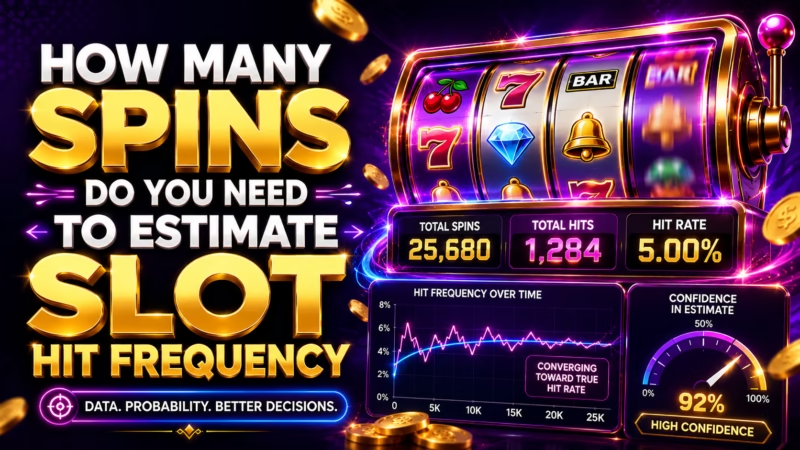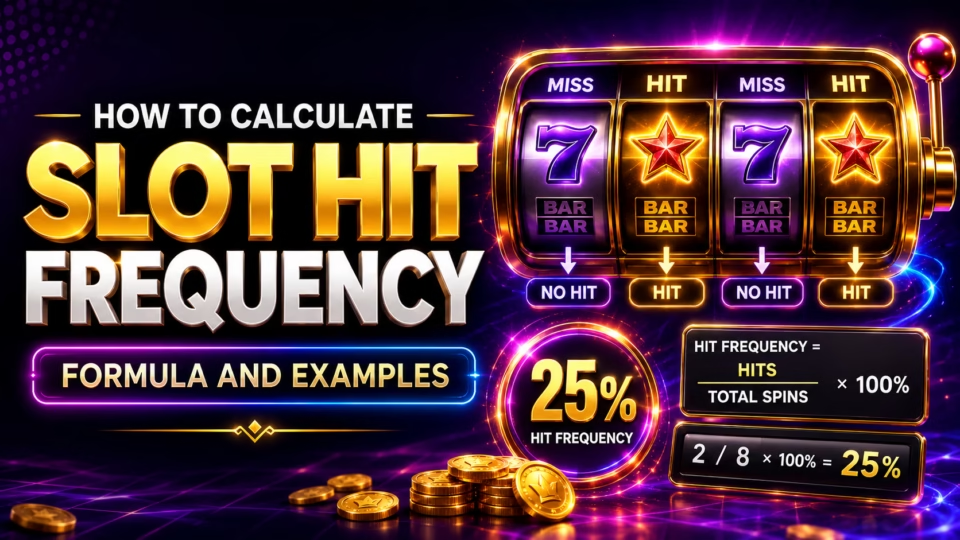
Slot hit frequency is calculated by dividing the number of winning spins by the total number of spins and multiplying the result by 100. The basic slot hit frequency formula is:
Hit Frequency (%) = Winning Spins ÷ Total Spins × 100
For example, if a slot produces 260 winning spins during a sample of 1,000 spins, the observed hit frequency is 26%.
A 26% hit frequency does not mean the slot will pay on exactly 26 of every 100 spins. Slot outcomes are random, so wins can appear in clusters or be separated by long losing sequences. Hit frequency describes how often qualifying winning outcomes occur across a sample or, when supplied by the game developer, across the mathematical model of the game.
Quick answers
- Hit frequency measures how often a slot produces a winning spin.
- The formula is winning spins ÷ total spins × 100.
- A 25% hit frequency corresponds mathematically to about one winning spin per four spins on average, not one guaranteed win every four spins.
- Hit frequency is different from RTP because RTP measures the proportion of wagered money theoretically returned over a very large number of rounds.
- Hit frequency alone does not show how large wins will be or how risky the slot feels.
Understanding hit frequency is particularly useful for players comparing games that appear to have similar RTP values but produce very different patterns of wins. Players who prefer frequent feedback may pay more attention to hit frequency, while players interested in payout size and bankroll swings should also examine volatility, RTP and the game’s paytable.
What Is Slot Hit Frequency?
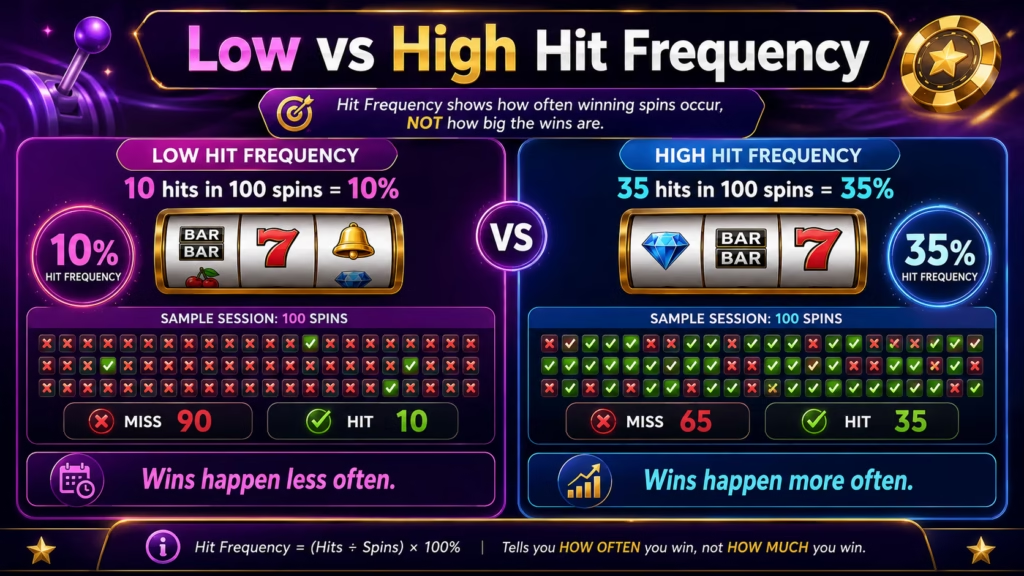
Slot hit frequency is the percentage of spins that produce an outcome classified as a win under the game’s rules. A higher hit frequency generally means winning combinations occur more often, while a lower hit frequency means qualifying wins occur less frequently.
The important word is frequency. Hit frequency tells you how often wins occur, not how valuable those wins are.
Consider two hypothetical slots:
| Slot | Hit Frequency | What It Suggests |
| Slot A | 35% | Winning outcomes occur relatively frequently |
| Slot B | 18% | Winning outcomes occur less frequently |
Slot A can produce wins more often without necessarily being more profitable for the player. Many of its wins could be smaller than the original wager. Slot B might produce fewer but potentially larger payouts.
Hit frequency should therefore be treated as one part of a slot’s mathematical profile rather than a measure of whether a game is “better.”
Slot Hit Frequency Formula
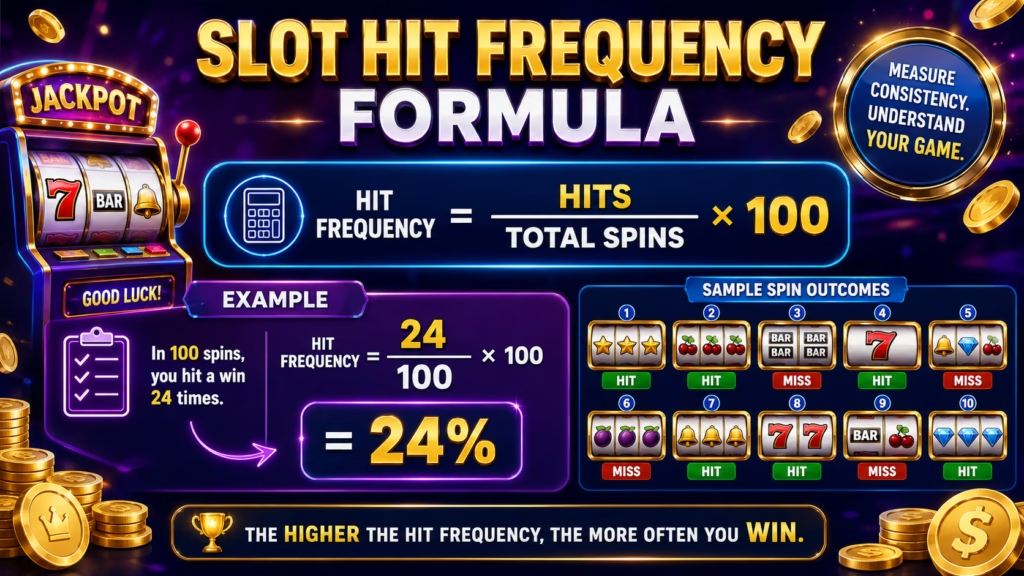
The standard formula for calculating observed slot hit frequency is:
Hit Frequency (%) = (Number of Winning Spins ÷ Total Number of Spins) × 100
The calculation requires two values:
- Total spins, meaning every spin included in the sample.
- Winning spins, meaning spins that meet the chosen definition of a winning result.
Suppose you record:
- Total spins: 2,000
- Winning spins: 480
The calculation is:
480 ÷ 2,000 × 100 = 24%
The observed hit frequency for the sample is therefore 24%.
This calculation is straightforward, but interpreting the number correctly matters. An observed hit frequency calculated from your own session is not necessarily the slot’s theoretical hit frequency.
How to Calculate Slot Hit Frequency Step by Step
To calculate slot hit frequency manually, record a sufficiently clear sample of spins and classify each result consistently.
Step 1: Count the total spins
Record every completed base-game spin included in your sample.
For example:
Total spins = 1,500
Do not remove losing spins or unusually large wins from the sample because doing so would distort the calculation.
Step 2: Count winning spins
Count the spins that produced a payout according to the definition you are using.
For example:
Winning spins = 390
The definition of a “hit” should remain consistent throughout the sample. Game developers may use their own mathematical definitions, so player-calculated hit frequency may not exactly reproduce a published specification.
Step 3: Divide wins by total spins
390 ÷ 1,500 = 0.26
Step 4: Convert the result into a percentage
0.26 × 100 = 26%
The observed slot hit frequency is therefore 26%.
This means 26% of the recorded spins produced qualifying winning outcomes within that particular sample.
Slot Hit Frequency Examples
Examples make the formula easier to understand because hit frequency can be expressed as either a percentage or an approximate “one hit every X spins” ratio.
Example 1: 1,000 spins
Suppose a slot produces 280 winning spins during 1,000 recorded spins.
280 ÷ 1,000 × 100 = 28%
Observed hit frequency:
28%
Approximately 28 out of every 100 spins in this sample produced a qualifying win.
Example 2: 5,000 spins
Suppose you record:
- 5,000 total spins
- 1,125 winning spins
Calculation:
1,125 ÷ 5,000 × 100 = 22.5%
Observed hit frequency:
22.5%
A larger sample usually gives a more stable observation than a very short session, although it still should not automatically be treated as the developer’s theoretical value.
Example 3: Converting hit frequency into “1 in X spins”
If a slot has a stated hit frequency of 20%, you can calculate the corresponding average interval:
100 ÷ 20 = 5
This can be expressed as approximately:
1 hit per 5 spins on average
For a 25% hit frequency:
100 ÷ 25 = 4
That corresponds to approximately:
1 hit per 4 spins on average
These ratios describe averages. They do not mean the slot must produce a win after a fixed number of losing spins.
Does a Winning Spin Have to Return More Than the Bet?
Not necessarily. A spin can be classified as a payout even when the amount returned is smaller than the amount wagered.
Suppose you bet $1 and receive a $0.40 payout. The spin may still count as a winning outcome when calculating hit frequency, even though the player’s net result for that spin is a $0.60 loss.
This distinction explains why a slot can have a relatively high hit frequency without frequently producing profitable spins.
When comparing published hit-frequency figures, check how the developer defines a hit whenever that information is available. Different mathematical documentation or game rules may classify outcomes differently.
Hit Frequency vs RTP
Hit frequency and RTP measure different characteristics of a slot.
Hit frequency measures how often winning outcomes occur. RTP measures how much of the total money wagered a game’s mathematical model is designed to return to players over a very large number of rounds.
For example, imagine two hypothetical slots with an RTP of 96%.
Slot A could have:
- RTP: 96%
- Hit frequency: 35%
Slot B could have:
- RTP: 96%
- Hit frequency: 18%
The games can have the same theoretical RTP while distributing payouts very differently.
Slot A might generate many small payouts. Slot B might concentrate more of its theoretical return into less frequent outcomes.
RTP also does not predict what will happen during an individual session. A theoretical RTP figure is a long-run mathematical characteristic, not a promise that a player wagering $100 will receive $96 back.
Hit Frequency vs Volatility
Hit frequency describes how often wins occur, while volatility describes the general distribution and variability of payouts.
A lower hit frequency is sometimes associated with longer periods without wins, but hit frequency alone is not enough to determine a game’s volatility.
A slot could theoretically produce frequent small wins while reserving a substantial portion of its payout potential for rare bonus events. Another game could use a completely different distribution.
When evaluating how a slot may feel to play, consider:
- Hit frequency
- RTP
- Volatility
- Paytable
- Bonus frequency
- Maximum payout structure
- Distribution of small and large wins
Looking at only one metric can create a misleading impression of the game’s risk and payout pattern.
Theoretical Hit Frequency vs Observed Hit Frequency
Theoretical hit frequency is derived from the mathematical model of a slot, while observed hit frequency is calculated from a real or simulated sample of spins.
If a developer states that a game has a theoretical hit frequency of 25%, that percentage is based on the game’s mathematical configuration.
If you play 200 spins and receive only 38 winning outcomes, your observed calculation would be:
38 ÷ 200 × 100 = 19%
That does not automatically mean the advertised mathematical value is incorrect. Random variation can produce substantial differences over short samples.
Likewise, receiving 65 wins in 200 spins would give:
65 ÷ 200 × 100 = 32.5%
Neither result proves that the underlying hit frequency has changed.
This is one reason short playing sessions should not be used to determine the mathematical characteristics of a slot with confidence.
Can You Calculate a Slot’s Exact Hit Frequency Yourself?
You can calculate the observed hit frequency of your sample, but ordinary gameplay usually cannot reveal the exact theoretical hit frequency with certainty.
A slot’s true mathematical configuration is determined by its reel structure, symbol probabilities, paylines or ways to win, bonus mechanics and other game rules. Some of these probabilities may not be visible to the player.
A manual calculation therefore answers:
“How often did wins occur in this sample?”
It does not necessarily answer:
“What is the exact mathematical hit frequency programmed into the game?”
If the provider publishes an official game specification or help file containing hit-frequency information, that source is generally more appropriate for identifying the theoretical figure.
Common Mistakes When Calculating Hit Frequency
Treating a small sample as the theoretical rate
Calculating 30 wins from 100 spins gives an observed hit frequency of 30%, but 100 spins are too limited to assume that 30% represents the slot’s long-term mathematical hit frequency.
Assuming a 25% hit frequency guarantees a win every four spins
A 25% rate means approximately one qualifying win per four spins when expressed as an average. Random outcomes do not follow a fixed schedule. You could receive multiple wins consecutively or experience many losing spins in a row.
Confusing hit frequency with profitability
A winning spin may return less than the wager. Higher hit frequency therefore does not automatically mean better financial results.
Using hit frequency as a prediction tool
Previous wins and losses do not tell you when the next random win will occur. A long losing sequence does not mean that a winning spin is “due.”
Ignoring bonus mechanics
A base-game hit and a bonus trigger are not necessarily the same metric. A slot might have a relatively frequent base-game payout rate while triggering its main bonus feature much less often.
How to Compare Slots Using Hit Frequency
Hit frequency is most useful when it is compared alongside other game characteristics.
A player who prefers frequent visual feedback and smaller payouts may find a higher-hit-frequency format more appealing. A player comfortable with less frequent wins may consider lower-hit-frequency games, but should understand that this does not guarantee larger payouts.
A practical comparison should include:
1. Hit frequency for win regularity.
2. RTP for theoretical long-term return.
3. Volatility for payout variability.
4. Paytable for symbol and feature values.
5. Bonus mechanics for how special features influence the payout structure.
None of these statistics can predict the outcome of the next spin.
How This Information Was Reviewed
The slot hit frequency calculations in this guide use the standard percentage relationship between qualifying winning spins and total spins. The examples demonstrate observed hit frequency and should not be interpreted as published mathematical specifications for any particular slot.
For an individual game, check the official paytable, help screen or provider documentation for definitions of wins, RTP, bonus rules and any published hit-frequency information. RTP, volatility and hit frequency describe mathematical characteristics of a game but do not guarantee a particular result during a session.
Slots should be treated as entertainment rather than a source of income. Set spending and time limits before playing and avoid increasing bets in an attempt to recover previous losses.
FAQ
What is the formula for slot hit frequency?
The slot hit frequency formula is winning spins ÷ total spins × 100. If 240 of 1,000 spins produce qualifying wins, the observed hit frequency is 24%.
What does a 25% hit frequency mean?
A 25% hit frequency means qualifying winning outcomes occur at a rate equivalent to approximately 25 per 100 spins over the relevant mathematical model or sample. It can also be expressed as about one hit every four spins on average, but wins are not scheduled every fourth spin.
Is a higher hit frequency better?
A higher hit frequency means wins occur more frequently, but it does not automatically make a slot better. The value of those wins, RTP, volatility and bonus structure also matter. Frequent payouts can include amounts smaller than the original wager.
How do you calculate hit frequency from 500 spins?
Divide the number of winning spins by 500 and multiply by 100. For example, 115 winning spins from 500 total spins produce an observed hit frequency of 23%.
Is hit frequency the same as RTP?
No. Hit frequency measures how often qualifying wins occur, while RTP measures the theoretical proportion of total wagers returned to players over a very large number of rounds. Two slots can have similar RTP values and very different hit frequencies.
Is hit frequency the same as bonus frequency?
No. Hit frequency usually refers to qualifying winning outcomes, while bonus frequency describes how often a particular bonus feature is triggered. The exact definition should be checked in the game’s rules or provider documentation.
Can I determine a slot’s true hit frequency by playing it?
You can calculate the observed hit frequency of your own sample, but this does not necessarily reveal the exact theoretical hit frequency. Random variation and incomplete knowledge of the game’s underlying probabilities limit what can be concluded from normal gameplay.
Does a low hit frequency mean bigger wins?
Not necessarily. A lower hit frequency means qualifying wins occur less often, but it does not guarantee that those wins will be larger. The paytable, volatility and payout distribution determine how winning amounts are structured.
Can hit frequency predict when the next slot win will happen?
No. Hit frequency cannot predict the next winning spin. Random slot outcomes can produce consecutive wins or long sequences without a win, and previous outcomes do not establish that another result is due.
In short
Slot hit frequency is calculated with a simple formula: winning spins ÷ total spins × 100. The percentage shows how often qualifying wins occurred in a sample or, when officially published, within a game’s mathematical model.
Hit frequency is useful for understanding the rhythm of a slot, but it should not be confused with RTP, volatility or profitability. Use it as one comparison metric, check official game information where available, and remember that no hit-frequency percentage can predict the next random outcome.