In most standard slot games, bet size does not affect slot hit frequency. Raising your stake usually changes how much money is won or lost on a spin, not how often the reels produce a winning combination. However, there are important exceptions when changing the bet also activates extra paylines, bonus mechanics, jackpot eligibility or a different game configuration.
Quick answer:
- A larger bet normally does not make a standard slot hit more frequently.
- Increasing the stake usually increases the value of potential payouts rather than the probability of a winning result.
- Hit frequency is different from RTP and volatility.
- Some slots change their mechanics when an extra bet, ante bet or feature bet is activated.
- The paytable and game rules are the best places to check whether stake size changes anything besides payout values.
Players who are trying to understand why a slot sometimes seems to win more often at one stake level should focus on the game’s mathematical configuration rather than assuming that a higher bet creates better odds.
What Is Slot Hit Frequency?
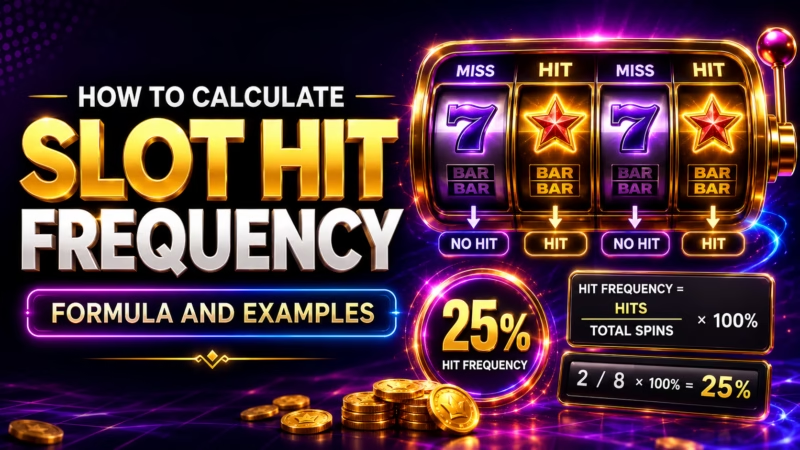
Slot hit frequency is the percentage of spins that produce a payout according to the game’s rules. If a slot has a theoretical hit frequency of 25%, that would mean roughly 25 winning outcomes per 100 spins over a sufficiently large mathematical sample.
That does not mean every group of 100 spins will contain exactly 25 wins. Random variation can produce considerably more or fewer winning spins during a normal playing session.
Hit frequency also does not necessarily tell you whether a spin is profitable. A winning spin can return less money than the amount wagered.
- Bet: $1
- Payout: $0.40
- Result for hit-frequency purposes: potentially a winning hit
- Financial result: $0.60 net loss
This distinction matters because a slot with frequent small payouts can have a high hit frequency while still producing substantial losing periods.
Does Bet Size Affect Slot Hit Frequency?
Bet size normally does not affect hit frequency when changing the wager only scales the value of the same underlying outcomes.
Suppose a slot uses exactly the same reel structure, symbols and winning probabilities at both a $0.50 and $1 bet. If the stake merely doubles every payout, the frequency of winning combinations should remain unchanged even though the dollar value of those wins increases.
A simplified example might look like this:
| Bet per spin | Example hit frequency | Typical effect |
| $0.50 | 25% | Base payout values |
| $1.00 | 25% | Payout values approximately double |
| $2.00 | 25% | Payout values approximately quadruple versus $0.50 |
The percentages above are illustrative rather than figures for a specific game. Actual slot mathematics must be checked in the game’s rules, help section or technical information where available.
The important principle is that changing the monetary value of a wager does not automatically change the probability distribution behind the spin.

Does Bet Size Affect Slot Wins?
Bet size commonly affects how much a slot win is worth, but it does not automatically affect how often wins occur.
If payouts scale proportionally with the stake, a 20x bet win would be:
- $10 at a $0.50 stake
- $20 at a $1 stake
- $40 at a $2 stake
The multiplier is the same. Only the monetary amount changes.
This is why the question “does bet size affect slot wins?” needs to be divided into two separate issues:
Win frequency: usually unchanged on a standard fixed-math game.
Win value: usually increases as the stake increases.
A larger wager therefore exposes more money on every spin. Higher potential payouts do not create a mathematical advantage if the underlying RTP and probability distribution remain the same.
When Can Bet Size Affect the Chances of Winning?
There are slots where changing the bet does more than simply change the monetary stake. In those games, the probabilities or available winning opportunities may change because the player has activated a different mechanic.
Adjustable Paylines
Some traditional multi-line slots allow players to choose how many paylines are active.
If increasing the total wager activates additional paylines, the player may create more ways for a spin to produce a payout.
In that situation, it is not the larger monetary stake itself that changes the chance of a hit. The difference comes from playing more paylines.
For example, playing one line and playing 20 lines are mechanically different configurations even if they use the same reels.
Ante Bets and Feature Bets
Some slots offer an optional additional wager that increases the chance of entering a bonus feature or changes another part of the game.
An ante bet might:
- increase bonus-trigger probability;
- add special symbols;
- modify reel behavior;
- activate additional features.
Here, the higher total stake can be associated with a different hit or bonus frequency because the player has selected an alternative game mode.
The exact effect varies by slot and should be verified in the official game rules.
Bonus Bet Options
A bonus bet may increase the stake specifically to activate additional mechanics.
For example, a slot could charge 25% more per spin in exchange for an increased probability of triggering free spins. That does not necessarily mean ordinary winning combinations become more frequent. It could affect only the bonus frequency.
Players should therefore distinguish between:
- overall hit frequency;
- base-game hit frequency;
- bonus frequency;
- jackpot frequency.
These are not interchangeable measurements.
Jackpot Eligibility
Some games require a minimum bet, specific bet configuration or particular wager option to qualify for certain jackpots.
Increasing the bet might therefore unlock access to an additional potential prize.
This does not necessarily make normal combinations more frequent. It changes which outcomes the player is eligible to receive.
Jackpot requirements differ between games, so eligibility should always be checked in the paytable or rules.
Different Denominations or Game Configurations
In some slot systems, changing denomination or another wager setting may effectively select a different mathematical configuration.
The alternative version could potentially have different:
- RTP;
- paytable;
- feature frequency;
- volatility;
- jackpot structure.
Players should not assume that every denomination or betting option uses identical mathematics unless the game information confirms it.
Bet Size vs Hit Frequency vs RTP
Bet size, hit frequency and RTP describe different aspects of a slot and should not be treated as the same measurement.
Hit Frequency
Hit frequency estimates how often spins produce a qualifying payout.
A slot could theoretically pay frequently but mostly return small amounts.
RTP
Return to Player, or RTP, represents the theoretical percentage of wagered money that a game is designed to return to players over a very large number of rounds.
A 96% theoretical RTP does not mean a player will receive $96 after betting $100 during an individual session.
Short-term outcomes can differ dramatically from the theoretical percentage.
Bet Size
Bet size is simply the amount risked on a spin unless changing the wager also activates another rule or configuration.
Increasing a $1 bet to $2 does not turn a 96% theoretical RTP into 192%. Both the wager and proportional payout values normally scale together.
Does Betting More Increase Slot RTP?
Betting more does not normally increase RTP when all stake levels use the same mathematical configuration.
If a slot has a theoretical RTP of 96% across its regular betting range, changing the bet from $0.50 to $5 would normally leave that percentage unchanged.
There are exceptions.
Some games may offer multiple RTP configurations or features that alter theoretical return. A special bet option could also have its own RTP.
Because slot configurations can vary between operators, the exact RTP should be checked in the game’s information screen rather than inferred from the size of the wager.
Does a Higher Bet Improve the RNG Outcome?
A higher bet does not normally persuade a random number generator to produce a better result.
In a standard RNG slot, the game determines outcomes according to its programmed mathematical rules. The fact that a player increased the wager does not by itself mean the next random result becomes more favorable.
Statements such as:
- “The slot knows I increased my bet.”
- “Max bet makes the machine start paying.”
- “A few small bets followed by a large bet improves the chance of winning.”
should not be treated as reliable strategies.
A game can legitimately contain bet-dependent mechanics, but those mechanics should be defined in its rules. They are different from the idea that the slot rewards someone simply for risking more money.
Why Can a Larger Bet Feel Like It Produces More Wins?
A larger stake can make wins more noticeable even when hit frequency remains unchanged.
Imagine a slot producing the same 10x result at two stake levels:
- $0.20 bet produces $2
- $2 bet produces $20
The second result feels much more significant, although the underlying multiplier is identical.
This psychological difference can make higher stakes appear more successful.
There is also normal short-term randomness. A player might increase the stake and immediately encounter several wins. Another player could do exactly the same and encounter a losing streak.
Neither sequence proves that changing the bet caused the results.
Can Lower Bets Produce More Frequent Wins?
Lower bets do not normally produce more frequent winning combinations simply because less money is being wagered.
If the game’s mathematical structure is unchanged, a player betting $0.20 and a player betting $2 face the same underlying distribution of outcomes.
The financial experience can still feel very different.
A bankroll of $100 provides:
- 500 theoretical $0.20 spins;
- 100 theoretical $1 spins;
- only 50 theoretical $2 spins,
assuming the entire bankroll were used and ignoring intermediate payouts.
Lower stakes can therefore allow more spins from the same starting budget. That gives the player more opportunities to observe outcomes, but it does not make an individual spin more likely to win.
Does Max Bet Increase Hit Frequency?
Max bet does not automatically increase slot hit frequency.
On many modern online slots, maximum bet simply multiplies the financial size of the same potential outcomes.
However, older slot designs and certain specialized games can use maximum-bet conditions to unlock:
- extra paylines;
- jackpots;
- bonus features;
- enhanced game modes.
Players should check what actually changes when selecting max bet.
If nothing changes except the wager amount and payout values, there is no sound reason to assume hit frequency increases.
Hit Frequency and Volatility Are Not the Same Thing
Hit frequency measures how often payouts occur, while volatility describes the broader pattern and size distribution of wins and losses.
A slot could theoretically have frequent low-value payouts and still include occasional high-value outcomes.
Another game could pay less frequently but concentrate more of its return into larger wins.
Hit frequency alone therefore cannot tell you:
- how long losing streaks might last;
- how large typical wins are;
- how frequently bonus rounds appear;
- how much money a player is likely to lose during one session.
Players comparing slots should consider hit frequency alongside RTP, volatility, paytable structure and bonus mechanics.
How to Check Whether Bet Size Changes a Slot
Before assuming that a larger bet changes winning probability, check the game information for mechanical differences.
- Paylines: Does the number of active lines increase?
- RTP: Is a different theoretical return listed for certain options?
- Bonus bets: Does an extra wager increase feature frequency?
- Jackpots: Is a minimum stake required for eligibility?
- Paytable: Do symbol payouts or conditions change?
- Denominations: Are different denominations separate configurations?
- Game rules: Does the provider explicitly explain an enhanced bet mode?
If the only change shown is the monetary stake, a larger bet should not be assumed to improve hit frequency.
Common Myths About Bet Size and Slot Wins
Myth: Slots Pay More Often After You Increase the Bet
A short sequence of wins after increasing the stake does not demonstrate that the higher bet caused them. Random games naturally produce streaks and clusters.
Myth: The Machine Needs Bigger Bets Before It Pays
Slots do not need to recover a particular amount from one player before producing a winning result. Individual sessions should not be interpreted as a predictable cycle.
Myth: Changing the Bet Can Reset a Losing Streak
Changing stake size does not guarantee that the next spin will be different. Previous losses do not make a future win due.
Myth: Maximum Bet Is Always the Best Bet
Maximum bet increases financial exposure. It should only be considered mechanically different if the game’s rules show that it unlocks something specific.
Practical Approach to Choosing a Bet Size
Bet size is better chosen according to budget and risk tolerance than according to an attempt to manipulate hit frequency.
A useful approach is to:
- check the minimum and maximum stake;
- read the paytable before playing;
- identify any bet-dependent features;
- understand the game’s volatility;
- set a spending limit in advance;
- avoid increasing the bet to recover losses;
- treat every stake level as money that can be lost.
A higher bet can produce larger monetary payouts, but it also increases the amount lost when a spin returns nothing or returns less than the wager.
Slots should be treated as paid entertainment rather than a way to generate income.

How This Information Was Reviewed
The distinction between bet size and hit frequency should be evaluated by looking at the game’s mathematical rules rather than short-term playing results.
The most important factors to verify are the paytable, active paylines, RTP configuration, bonus-bet rules, jackpot eligibility and any feature that changes when the wager changes.
RTP, volatility and hit frequency describe long-term characteristics of a game. None of them predicts the outcome of a particular spin or guarantees that a specific session will produce a win.
If increasing stakes begins to exceed a planned entertainment budget or is being used to chase previous losses, stopping the session is safer than attempting to recover money through larger bets.
FAQ
Does increasing your bet increase slot hit frequency?
Usually no. Increasing the bet normally changes the monetary value of wins and losses rather than the probability of producing a winning combination. The exception is when a higher wager activates additional paylines, features or a different game configuration.
Does bet size affect slot wins?
Bet size usually affects the monetary amount of slot wins. A larger wager can produce a larger cash payout from the same multiplier, but it does not automatically make winning combinations occur more frequently.
Do slots pay more often on max bet?
Not necessarily. Max bet often increases only the stake and potential payout amount. Some games may unlock paylines, jackpots or special features at certain wager levels, so the game’s paytable and rules should be checked.
Does betting more improve your chances of triggering free spins?
Not on every slot. Standard stake increases normally do not change free-spin probability, but some games have optional ante bets or enhanced feature bets specifically designed to alter bonus-trigger frequency.
Can changing your bet make a slot start paying?
There is no reliable reason to expect a standard random slot to start producing winning outcomes simply because the stake changed. Short-term winning and losing streaks can occur at any bet size.
Is hit frequency the same as RTP?
No. Hit frequency measures how often payouts occur, while RTP represents the theoretical proportion of wagers returned over a very large number of rounds. A slot can have relatively frequent wins without having a higher RTP.
Does betting less increase your chance of winning?
Betting less does not normally increase the probability of a winning combination. It reduces the amount risked on each spin and may allow a fixed bankroll to last for more spins.
Can different bet sizes have different RTP?
They can in certain games, but this should not be assumed. Some slots use different configurations, denominations or enhanced bet options with separate mathematical characteristics. Check the game’s information or paytable for the exact RTP.
Does a higher bet make the RNG give better results?
Normally no. A larger monetary stake does not by itself make the random outcome more favorable. If a game changes probabilities at a particular wager level, that difference should come from a defined game mechanic rather than the RNG rewarding larger bets.
In short
For most slots, bet size does not affect hit frequency. Increasing the wager usually increases the monetary size of potential wins and losses while leaving the underlying probability of winning combinations unchanged.
The main exceptions are slots where the bet changes something mechanical, such as active paylines, bonus probability, jackpot eligibility or the mathematical configuration. Check the paytable and game rules before assuming that a higher stake provides different odds, and treat slot play as entertainment rather than a way to make money.