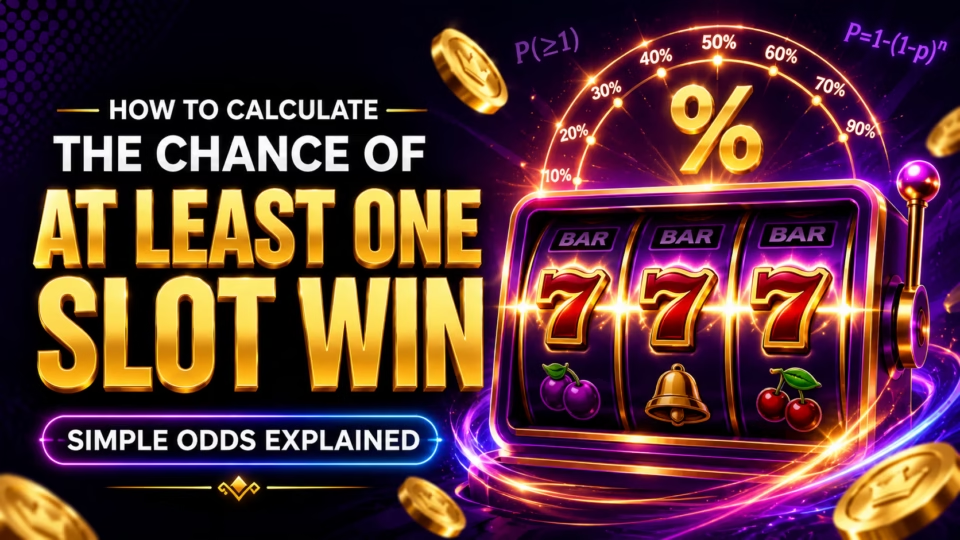
The chance of at least one slot win over a fixed number of spins can be calculated with a simple probability formula:
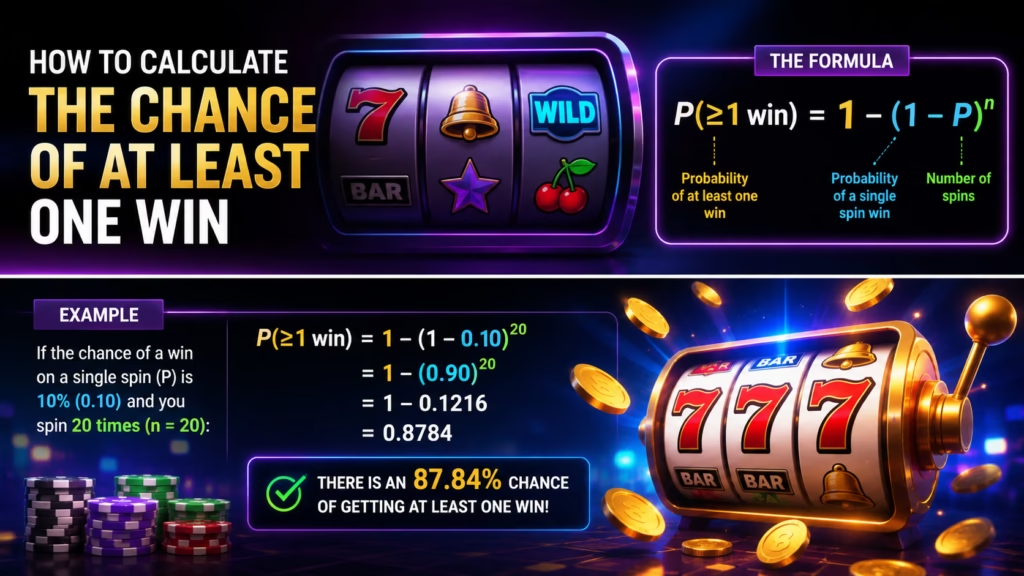
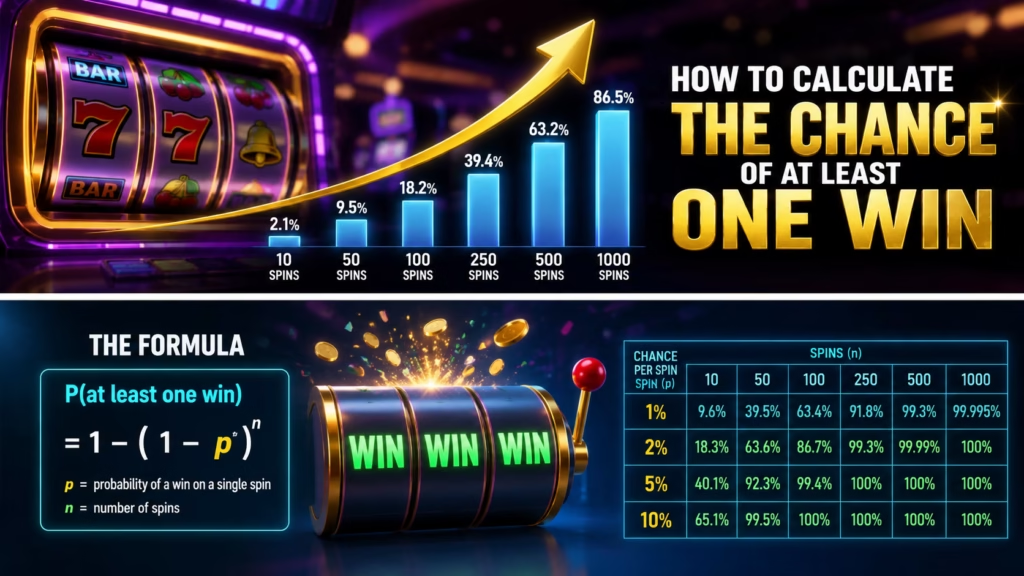
P(at least one win) = 1 – (1 – p)^n
where:
- p = probability of a win on one spin
- n = number of spins
- 1 – p = probability of losing one spin
- (1 – p)^n = probability of getting no wins across all spins
For example, if a slot has a 20% probability of producing a winning payout on each spin, the probability of getting at least one win within 10 independent spins is:
1 – (1 – 0.20)^10 = 1 – 0.8^10 ≈ 89.3%
This calculation describes the probability of receiving at least one qualifying win. It does not tell you whether the session will be profitable, how large the win will be, or when it will occur.
Quick Takeaways
- Use 1 – (1 – p)^n when the per-spin win probability is known and spins can reasonably be treated as independent.
- A higher number of spins increases the probability of seeing at least one win.
- Hit frequency may be useful as the value of p, but only if the game defines what counts as a hit.
- RTP cannot be used as a substitute for slot win probability.
- A winning spin may return less than the amount wagered, so at least one win does not necessarily mean an overall profit.
This calculation is most useful for players who want to understand slot probability rather than rely on intuition about winning and losing streaks.
What Does “At Least One Slot Win” Mean?
“At least one slot win” means that one or more spins in a group of spins produces an outcome classified as a win.
If you play 20 spins, the condition is satisfied whether you receive:
- exactly one winning spin;
- five winning spins;
- 10 winning spins;
- or a win on every spin.
Probability becomes easier to calculate by looking at the opposite event. Instead of separately calculating the probability of one win, two wins, three wins, and so on, calculate the probability of zero wins and subtract it from 1.
P(at least one win) = 1 – P(no wins)
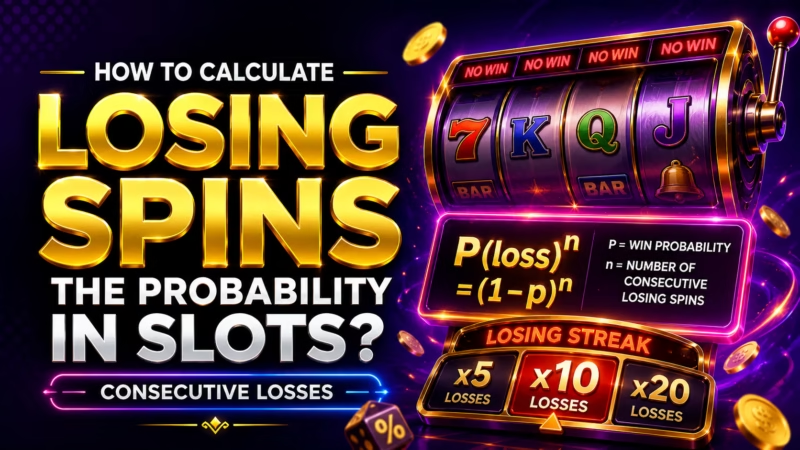
If the probability of losing one independent spin is 1 – p, then the probability of losing all n spins is:
(1 – p)^n
Subtracting that result from 1 gives the chance of seeing at least one win.
The Formula for At Least One Slot Win
For independent spins with the same win probability:
P(X ≥ 1) = 1 – (1 – p)^n
Per-Spin Win Probability
The variable p represents the probability that one spin produces whatever outcome you have defined as a win.
- 5% win probability = 0.05
- 15% win probability = 0.15
- 25% win probability = 0.25
- 40% win probability = 0.40
Percentages must be converted to decimals before using the formula.
Number of Spins
The variable n is simply the number of independent spins being considered.
If you want to calculate the probability of at least one win over 50 spins, then:
n = 50
Increasing the number of spins increases the probability of observing at least one winning outcome, assuming the per-spin probability remains above zero.
Step-by-Step Example
Assume a hypothetical slot has a 10% slot win probability per spin, and you want to know the probability of receiving at least one win within 20 spins.
Step 1: Convert the Win Probability
10% becomes:
p = 0.10
Step 2: Calculate the Probability of No Win on One Spin
1 – 0.10 = 0.90
There is therefore a 90% probability of not receiving a win on an individual spin under this simplified example.
Step 3: Calculate the Probability of No Wins in 20 Spins
0.90^20 ≈ 0.1216
The probability of seeing zero wins across all 20 spins is approximately 12.2%.
Step 4: Subtract from 1
1 – 0.1216 = 0.8784
The probability of at least one winning spin is therefore approximately 87.8%.
This does not mean a win is guaranteed within 20 spins. A roughly 12.2% chance of zero wins still remains under the assumptions of the example.
Slot Win Probability Examples
The effect of spin count becomes easier to see when several scenarios are compared.
| Win Probability per Spin | Spins | Chance of At Least One Win |
| 5% | 10 | 40.1% |
| 5% | 50 | 92.3% |
| 10% | 10 | 65.1% |
| 10% | 20 | 87.8% |
| 20% | 10 | 89.3% |
| 25% | 10 | 94.4% |
| 25% | 20 | 99.7% |
These values illustrate an important probability principle. More trials increase the chance of seeing an event at least once, but they do not make the event certain unless the mathematical probability actually reaches 100%.
Can Hit Frequency Be Used as Slot Win Probability?
Hit frequency can sometimes be used as the per-spin win probability, but only when its definition matches the event you want to calculate.
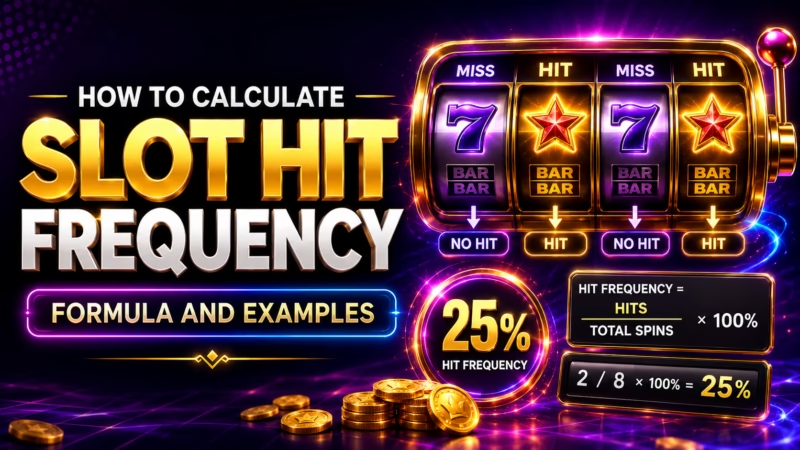
A slot with a stated 25% hit frequency might be interpreted as producing a winning combination on approximately 25% of spins over a sufficiently large sample. In that simplified case:
p = 0.25
However, slot developers and game documentation may define hit frequency differently. A reported figure may include particular combinations, bonus events, or payouts that are smaller than the original stake.
Always check the game rules or paytable before treating hit frequency as the exact value of p.
A Winning Spin Is Not the Same as a Profitable Spin
One of the most important limitations of this calculation is that a slot “win” may simply mean that the game pays something.
Suppose you wager $1 and a spin returns $0.40. The slot may classify the outcome as a winning combination because a payout occurred, but your net result from that spin is still:
$0.40 – $1.00 = -$0.60
The probability of at least one payout is therefore different from:
- the probability of finishing a spin with a net profit;
- the probability of finishing a session ahead;
- the probability of triggering a bonus;
- the probability of hitting a large prize;
- the probability of reaching the maximum win.
Before calculating slot win probability, define precisely what counts as a “win.”
Why RTP Cannot Tell You the Chance of a Win
RTP and win probability measure different things.
Return to Player, or RTP, represents the theoretical proportion of wagered money that a game is designed to return over a very large number of plays. RTP describes expected return, not how frequently individual wins occur.
Two hypothetical slots could both have 96% RTP while distributing their payouts very differently.
One might produce many relatively small wins. Another might produce fewer wins but allocate more of its theoretical return to larger prizes.
It would therefore be incorrect to use:
p = RTP
A slot with 96% RTP does not have a 96% probability of winning every spin.
For calculating the chance of at least one win, you need an actual per-spin probability for the event being measured.
Hit Frequency vs RTP vs Volatility
These three metrics answer different questions.
Hit frequency describes how often a defined winning outcome may occur.
RTP describes theoretical long-term return relative to wagers.
Volatility describes how payouts tend to be distributed in terms of size and frequency.
A high probability of receiving at least one win does not necessarily mean a slot has high RTP or low volatility. Small payouts can create a relatively high hit frequency while still producing substantial bankroll fluctuations.
Players should therefore avoid judging a slot from one metric alone.
What If the Probability Changes Between Spins?
The basic formula assumes each spin has the same probability p.
If the probability differs between independent events, the calculation becomes:
P(at least one win) = 1 – [(1 – p1)(1 – p2)(1 – p3)…(1 – pn)]
For example, if three independent events have win probabilities of 10%, 20%, and 30%, the probability of getting no win is:
0.90 × 0.80 × 0.70 = 0.504
The probability of at least one win is therefore:
1 – 0.504 = 49.6%
In real slot games, bonus rounds, persistent mechanics, collected symbols, or other state-based features can make a simple constant-probability model inappropriate. The game rules should be checked before assuming every relevant event has exactly the same probability.
Does Playing More Spins Guarantee a Win?
No. More spins increase the mathematical probability of seeing at least one win, but they do not guarantee one.
For a game with a 10% independent win probability:
- 1 spin gives a 10% chance of at least one win;
- 10 spins give about a 65.1% chance;
- 20 spins give about an 87.8% chance;
- 50 spins give about a 99.5% chance.
Even when the calculated probability becomes very high, a sequence containing zero wins can still occur.
This is also why statements such as “the slot is due to pay” are misleading. Previous losses do not automatically force a future independent RNG spin to become a winner.
How to Calculate the Number of Spins for a Target Probability
The formula can also be rearranged to estimate how many independent spins would be required to reach a chosen probability of seeing at least one win.
Starting with:
q = 1 – (1 – p)^n
where q is your target probability, the equation becomes:
n = ln(1 – q) / ln(1 – p)
Suppose the win probability per spin is 10% and you want the mathematical probability of at least one win to reach 95%.
n = ln(0.05) / ln(0.90) ≈ 28.4
Because you cannot play a fraction of a spin, you would round upward to 29 spins.
This means 29 independent trials are required for the calculated probability to reach at least 95%. It still does not guarantee a winning spin.
Common Mistakes When Calculating Slot Win Probability
Using RTP as the Win Probability
RTP is not the probability that an individual spin wins. Use hit frequency or another explicitly defined event probability instead.
Assuming a Win Means Profit
A payout below the wager can still be classified as a winning result. Decide whether you are calculating any payout or only a net-positive outcome.
Treating High Probability as Certainty
A 95% probability still leaves a 5% probability of the opposite result.
Assuming Previous Spins Change the Next Result
For independent RNG outcomes, a losing streak does not make the next spin mathematically “due” to win.
Ignoring Bonus Mechanics
Free spins, bonus rounds, persistent features, and other game states may have different probability structures from standard base-game spins.
Practical Way to Use the Formula
The at-least-one formula is best used as an educational probability tool.
A useful process is:
- Define exactly what counts as a win.
- Find a reliable per-spin probability for that event.
- Convert the percentage to a decimal.
- Choose the number of spins.
- Calculate 1 – (1 – p)^n.
- Interpret the result as a probability, not a prediction.
- Keep payout size, RTP, volatility, and bankroll risk separate from win frequency.
The calculation may help explain why an event becomes more likely across repeated trials, but it cannot identify which spin will win or whether playing additional spins will produce a positive financial result.
How This Information Was Reviewed
The calculation in this guide is based on standard probability rules for repeated independent events. The key distinction is between win probability, hit frequency, RTP, volatility, and actual financial profit.
For a specific slot, players should verify the game rules or paytable because the definition of a winning spin, hit frequency, RTP configuration, bonus mechanics, and other parameters can differ between games or operators.
RTP, volatility, hit frequency, and probability calculations cannot predict the outcome of an individual random spin. Slots should be treated as paid entertainment rather than a method of earning money. Setting spending and time limits before playing is safer than increasing play because a win appears mathematically likely.
FAQ
What is the formula for the chance of at least one slot win?
For n independent spins with the same per-spin win probability p, use 1 – (1 – p)^n. The formula calculates the probability of avoiding a complete sequence of losing outcomes.
What is the probability of at least one win with a 20% chance over 10 spins?
The probability is approximately 89.3%. The calculation is 1 – 0.8^10, because 0.8 is the probability of not winning an individual spin.
Does a 25% hit frequency mean I will win once every four spins?
No. A 25% probability describes a long-run frequency, not a fixed schedule. You can experience several winning spins close together or many losing spins in succession.
Can I calculate slot win probability from RTP?
No. RTP measures theoretical long-term return and cannot by itself reveal how frequently the game produces winning spins. You need hit frequency or another probability that directly describes the event being calculated.
Does a 99% chance of at least one win mean a win is guaranteed?
No. A 99% probability still leaves a 1% probability of receiving no qualifying win. Probability describes uncertainty rather than guaranteeing a particular sequence.
Does getting at least one slot win mean I will make money?
No. A winning spin can pay less than the original wager, and one or more wins may not compensate for losses on other spins. Win frequency and session profitability are different measurements.
How many spins are needed for a 95% chance of at least one win?
Use n = ln(1 – q) / ln(1 – p), where q is the target probability and p is the per-spin win probability. With a 10% win probability, approximately 29 independent spins are required to exceed a 95% calculated probability of at least one win.
Are slot spins independent?
Standard RNG slot outcomes are generally designed so that an individual random result cannot be predicted from previous base-game results, but the exact probability model may become more complicated when bonuses or persistent features are involved. Check the game rules before applying a simple constant-probability formula to every type of spin.
Can this formula predict when a slot will win?
No. The formula estimates the probability of observing at least one defined winning event across a number of trials. It cannot identify the spin on which a win will occur or predict the next RNG result.
Short Conclusion
To calculate the chance of at least one slot win, use 1 – (1 – p)^n, where p is the probability of a qualifying win on one spin and n is the number of independent spins. The formula is useful for understanding probability, but it does not predict individual outcomes, guarantee a win, or show whether a session will be profitable. Use the correct hit probability, keep RTP and volatility separate, and treat slot play as entertainment rather than a way to make money.