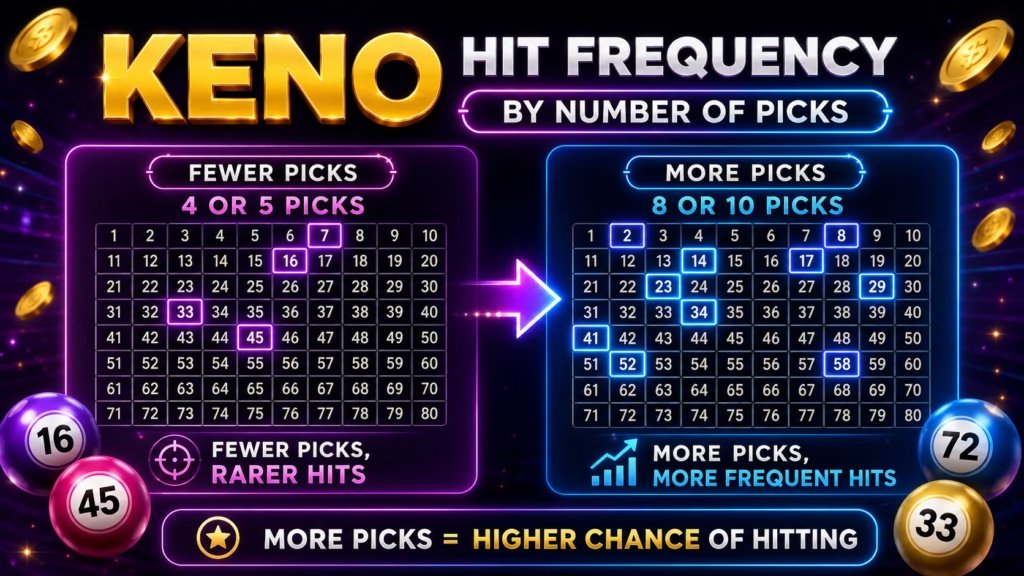
Keno hit frequency changes with the number of picks because each additional number gives the ticket another opportunity to match one of the numbers drawn. In standard 80-number keno, 20 numbers are drawn, so any individual number has a 25% chance of appearing in the draw. However, picking more numbers does not simply multiply the chance of winning, because keno payouts depend on how many selected numbers match and which hit combinations are rewarded by the paytable.
For a standard 80-number, 20-draw game:
- A 1-pick ticket has a 25% chance of matching its single number.
- A 5-pick ticket has about a 77.28% chance of matching at least one number.
- A 10-pick ticket has about a 95.42% chance of matching at least one number.
- More picks increase the frequency of getting some matches, but they also make hitting every selected number dramatically less likely.
- A match is not necessarily a winning payout. The paytable determines which hit counts actually return money.
Keno hit frequency is most useful for understanding how different pick sizes behave. Players looking for simpler tickets may prefer fewer picks, while players who want more frequent partial matches may be more interested in larger pick sizes. Neither approach changes the random nature of the draw or guarantees a profitable result.
Keno Hit Frequency by Number of Picks
The table below uses the standard keno structure of 80 available numbers with 20 numbers drawn. “At least one hit” means that one or more selected numbers appear among the 20 drawn numbers.
| Number of Picks | Chance of No Hits | Chance of At Least One Hit | Average Number of Hits |
| 1 | 75.00% | 25.00% | 0.25 |
| 2 | 56.01% | 43.99% | 0.50 |
| 3 | 41.65% | 58.35% | 0.75 |
| 4 | 30.83% | 69.17% | 1.00 |
| 5 | 22.72% | 77.28% | 1.25 |
| 6 | 16.66% | 83.34% | 1.50 |
| 7 | 12.16% | 87.84% | 1.75 |
| 8 | 8.83% | 91.17% | 2.00 |
| 9 | 6.37% | 93.63% | 2.25 |
| 10 | 4.58% | 95.42% | 2.50 |
These figures show why larger keno tickets appear to hit more often. A 10-pick ticket will normally contain at least one drawn number much more frequently than a 1-pick ticket. That does not mean the 10-pick ticket has a 95.42% probability of producing a payout. Some paytables may require several hits before the ticket pays anything.
What Does Hit Frequency Mean in Keno?
Keno hit frequency describes how often a particular matching result can be expected to occur over a very large number of statistically independent games. It can refer to the probability of getting any match, a specific number of matches, or a payout-producing combination.
The distinction matters because three different concepts are often mixed together:
- Number hit frequency is the probability that selected numbers appear in the draw.
- Winning frequency is the probability of landing a combination that actually pays according to the paytable.
- RTP is the theoretical percentage of stakes returned to players over a very large sample of games.
A ticket can therefore record several “hits” without generating a winning payout.
For example, imagine a 7-pick ticket where two selected numbers appear in the draw. Mathematically, the ticket has two hits. If that game’s paytable pays nothing for 2 out of 7, the ticket still loses its stake.

How Keno Odds Change as You Pick More Numbers
Keno odds by number of picks change in two opposite directions. Increasing the number of picks makes it easier to match at least one selected number, but it makes matching every selected number much harder.
The difference becomes extreme as the ticket size increases.
| Picks | Chance of Hitting Every Pick | Approximate Odds |
| 1 | 25.000000% | 1 in 4 |
| 2 | 6.012658% | 1 in 17 |
| 3 | 1.387537% | 1 in 72 |
| 4 | 0.306339% | 1 in 326 |
| 5 | 0.064492% | 1 in 1,551 |
| 6 | 0.012898% | 1 in 7,753 |
| 7 | 0.002440% | 1 in 40,979 |
| 8 | 0.000435% | 1 in 230,115 |
| 9 | 0.000072% | 1 in 1,380,688 |
| 10 | 0.000011% | 1 in 8,911,711 |
A 10-pick ticket therefore has a very high probability of matching something, but matching all 10 numbers is extremely rare. Large advertised prizes are commonly attached to these difficult high-hit outcomes.
Why the Average Number of Hits Increases Predictably
In standard 80-number keno, 20 of the 80 numbers are drawn. That means 25% of the available numbers appear in each game.
The expected number of hits is therefore:
Number of picks x 20 / 80
This simplifies to:
Number of picks x 0.25
A 4-pick ticket has an expected value of 1 matching number per draw. An 8-pick ticket has an expected value of 2 matches, and a 10-pick ticket has an expected value of 2.5 matches.
Expected hits are a statistical average, not a prediction for the next game. A 10-pick ticket does not alternate neatly between two and three matches. It can produce zero matches, one match, several matches, or occasionally a much larger number.
How Exact Keno Hit Probabilities Are Calculated
Keno match probabilities use a hypergeometric probability model because numbers are drawn from a fixed pool without replacement.
For a standard 80-number game, the probability of exactly h matches when selecting k numbers can be expressed as:
P(H = h) = C(k,h) x C(80-k,20-h) / C(80,20)
Where:
- k is the number of numbers selected.
- h is the exact number of hits.
- 20 numbers are drawn.
- 80 numbers are available.
- C(n,r) represents the number of combinations of r items from n items.
This formula calculates the probability of a specific outcome, such as hitting exactly 3 numbers on a 6-pick ticket.
Players do not need to calculate the formula manually to understand keno, but it explains why probabilities change sharply between different pick sizes and hit requirements.
At Least One Hit Is Not the Same as a Winning Ticket
One of the most common mistakes when reading keno statistics is assuming that a high hit frequency means a high chance of winning money.
Consider a 10-pick ticket. The probability of matching at least one selected number is approximately 95.42%. That sounds extremely high, but a single hit on a 10-pick ticket may have no payout at all.
The relevant question for a player is therefore not only:
How often will my numbers hit?
It is also:
Which numbers of hits does the paytable reward?
Before playing, check the game’s paytable for every possible result. Two keno games with the same 80-number and 20-draw structure can use different payout schedules, so their mathematical matching probabilities may be identical while their payout frequencies and RTP differ.
Fewer Picks vs More Picks
Choosing fewer or more keno numbers changes the structure of the ticket rather than creating a universally better strategy.
Fewer Picks
Tickets with fewer selections are easier to understand because there are fewer possible hit combinations.
A 1-pick ticket has only two outcomes in terms of matching: either the selected number appears or it does not. A 2-pick ticket can produce zero, one, or two hits.
Fewer picks may suit players who want a straightforward relationship between the draw and the result.
More Picks
Larger tickets generate more possible hit combinations. They also produce partial matches much more frequently.
A 10-pick ticket has a 95.42% probability of matching at least one number, but the player must distinguish between small partial hits and the much rarer combinations associated with larger payouts.
More picks may appeal to players who prefer watching several selected numbers during the draw, but they should not be interpreted as increasing the chance of profit.
Which Number of Picks Has the Highest Hit Frequency?
If hit frequency means “matching at least one number,” larger pick sizes have a higher hit frequency in standard keno.
Among tickets from 1 to 10 picks, a 10-pick ticket has the highest probability of recording at least one match, at approximately 95.42%.
However, this comparison is incomplete if the goal is to evaluate winning frequency. To determine how often a ticket actually pays, the hit probabilities must be combined with the game’s specific paytable.
For example, a paytable might reward a particular 4-of-7 result but pay nothing for 1-of-7 or 2-of-7. In that case, the frequency of any match is much higher than the frequency of a paid result.
Does Picking More Numbers Improve Keno RTP?
Picking more numbers does not automatically improve keno RTP. RTP depends on both the probability of each possible hit combination and the payout assigned to that combination.
A game operator can offer different RTP values for different ticket sizes by adjusting the paytable. A 5-pick game could theoretically have a higher or lower RTP than a 10-pick game even though the 10-pick ticket records partial matches more frequently.
If RTP information is provided, check the exact value associated with the chosen pick size. Do not assume that the same RTP applies to every spot selection unless the game rules explicitly say so.
RTP is also a long-run mathematical measure. It does not predict how much an individual session will return.
Common Misconceptions About Keno Hit Frequency
“More hits mean better odds of making money”
Not necessarily. More picks increase the probability of matching at least one number, but many low-level matches may pay nothing or return less than larger, rarer combinations.
“A number that has not appeared recently is more likely to hit”
In a properly random independent draw, previous outcomes do not make a particular number due to appear. Each new draw is governed by the rules and probabilities of that draw.
“Picking 10 numbers gives a 95% chance of winning”
A 10-pick ticket has about a 95.42% chance of matching at least one number in standard 80-number keno. That is not the same as a 95.42% chance of receiving a payout.
“Expected hits tell you what will happen next”
Expected hits describe the long-run mathematical average. They cannot predict a single draw or short sequence of draws.
How to Compare Keno Pick Sizes
When comparing keno tickets, use four separate criteria instead of looking only at the largest advertised prize.
- Check the number of picks. Larger tickets produce partial matches more frequently.
- Check which hit levels pay. A match that is not included in the paytable has no monetary value.
- Check the payout for each winning combination. Rare outcomes may have much larger payouts.
- Check RTP if available. RTP provides a broader measure of the game’s theoretical long-run return.
Players with a fixed entertainment budget should also check the cost per ticket and avoid increasing stake size simply because a particular pick structure offers larger maximum prizes.
How This Information Was Reviewed
The keno probabilities in this guide are based on the conventional mathematical model with 80 available numbers and 20 numbers drawn without replacement. Hit frequency was evaluated separately from payout frequency because a mathematical match does not necessarily qualify for a prize.
Individual keno games can use different rules, ticket sizes, payout tables, maximum prizes, and RTP configurations. The official game rules and paytable should therefore be checked before applying these figures to a specific game.
Keno outcomes remain random. Hit frequency, historical results, payout tables, and RTP cannot guarantee a win or predict the next draw. Keno should be treated as paid entertainment, with spending and time limits set before play.
FAQ
What is keno hit frequency?
Keno hit frequency is the probability of matching a specific number of selected numbers during a draw. In standard 80-number keno, 20 numbers are drawn, so each individually selected number has a 25% probability of being among the drawn numbers.
What is the hit frequency for a 1-pick keno ticket?
A 1-pick ticket has a 25% probability of hitting its selected number in standard 80-number, 20-draw keno. That is equivalent to average odds of 1 in 4 per draw.
What is the chance of hitting something with 5 keno picks?
A 5-pick ticket has approximately a 77.28% chance of matching at least one number in standard keno. Whether that match produces a payout depends on which match counts are rewarded by the game’s paytable.
What is the chance of getting at least one hit with 10 picks?
A 10-pick keno ticket has approximately a 95.42% probability of matching at least one of its numbers when 20 numbers are drawn from 80. This does not mean the ticket has a 95.42% chance of winning money.
What are the odds of hitting all 10 numbers in keno?
The probability of hitting all 10 selected numbers in a standard 80-number, 20-draw game is approximately 0.00001122%, or around 1 in 8.9 million. Exact payout terms depend on the game’s paytable.
Does choosing more numbers increase the chance of winning keno?
Choosing more numbers increases the probability of recording at least one match, but it does not automatically increase the probability of receiving a profitable payout. Winning frequency depends on which hit combinations the paytable rewards.
How many hits should I expect in keno?
The average number of hits in standard 80-number keno is approximately 25% of the numbers selected. A 4-pick ticket averages 1 hit, an 8-pick ticket averages 2 hits, and a 10-pick ticket averages 2.5 hits over a very large number of draws.
Does keno hit frequency affect RTP?
Hit frequency contributes to RTP calculations, but it does not determine RTP by itself. RTP also depends on how much the game pays for each possible winning combination.
Can previous keno draws predict which numbers will hit?
Previous draws do not reliably predict the next result in a random keno game. Statistical hit frequency describes long-run probabilities, not which specific numbers will appear in the next draw.
Is there a best number of picks in keno?
There is no universally best number of keno picks. Different pick sizes produce different hit distributions and payout structures, so the appropriate comparison is based on the paytable, RTP, ticket cost, and the type of playing experience desired.
Short Conclusion
Keno hit frequency rises as more numbers are selected, but higher match frequency should not be confused with higher winning frequency. In standard 80-number keno, the chance of at least one match rises from 25% with one pick to about 95.42% with 10 picks, while hitting every selected number becomes dramatically less likely. Compare pick sizes using the actual paytable and RTP, and treat keno as entertainment rather than a way to generate income.