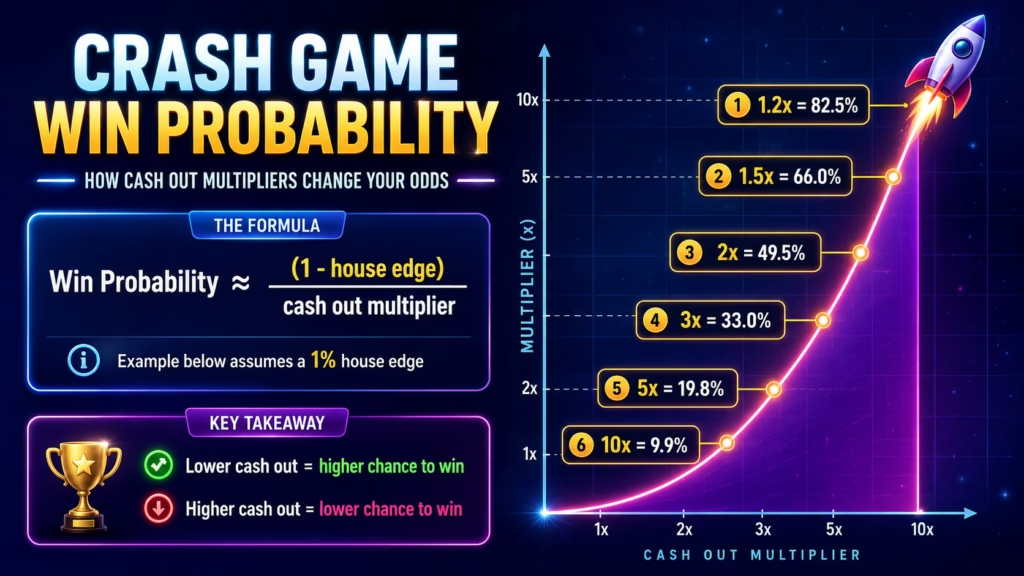
Crash game win probability decreases as the cash-out multiplier increases. In a common mathematical crash model with a 1% house edge, the approximate probability of reaching a target multiplier is 0.99 divided by the target multiplier. That means a 2x cash-out target has about a 49.5% chance of being reached, while a 10x target has about a 9.9% chance.
The exact probability depends on the individual game’s algorithm, RTP, house edge, rounding rules and possible maximum multiplier. Players should therefore check the rules or provably fair documentation for the specific crash game before treating any probability table as exact.
Quick takeaways:
- Lower cash-out multipliers are reached more frequently but produce smaller payouts.
- Higher multipliers offer larger potential payouts but have much lower hit probabilities.
- A 2x multiplier is not automatically a 50% event when the game includes a house edge.
- Raising or lowering the cash-out target does not necessarily remove the mathematical house advantage.
- Previous crashes do not provide a reliable way to predict the next multiplier in independently generated rounds.
Crash games are suitable for players who want a simple risk-versus-reward mechanic and understand probability. They require more caution from anyone tempted to chase losses, increase stakes after losing rounds or treat a high multiplier as “due.”
How Crash Game Win Probability Works
Crash game win probability is the chance that the crash multiplier reaches your chosen cash-out point before the round ends.
If you select 2x, the round must reach at least 2x for the bet to succeed. If you select 5x, the multiplier must survive all the way to 5x. Because increasingly high crash points are less probable, the chance of successfully cashing out decreases as the target rises.
For a common theoretical crash distribution, the probability can be represented as:
Probability of reaching multiplier X = (1 – house edge) / X
For a game with a 1% house edge:
P(X) = 0.99 / X
At 2x:
0.99 / 2 = 0.495 = 49.5%
At 5x:
0.99 / 5 = 0.198 = 19.8%
At 10x:
0.99 / 10 = 0.099 = 9.9%
This formula is useful for understanding crash game probability by multiplier, but it is not a universal specification for every crash title. Providers can implement different distributions, instant-crash rules, rounding methods or RTP settings.
Crash Game Probability by Multiplier
The following table shows illustrative probabilities for a crash game using a 99% theoretical return and a corresponding 1% mathematical house edge.
| Cash-Out Target | Approx. Chance of Reaching It | Approx. Chance of Failing Before It |
| 1.10x | 90.00% | 10.00% |
| 1.20x | 82.50% | 17.50% |
| 1.50x | 66.00% | 34.00% |
| 2x | 49.50% | 50.50% |
| 3x | 33.00% | 67.00% |
| 5x | 19.80% | 80.20% |
| 10x | 9.90% | 90.10% |
| 20x | 4.95% | 95.05% |
| 50x | 1.98% | 98.02% |
| 100x | 0.99% | 99.01% |
These figures demonstrate the main trade-off in crash games. Moving from 2x to 10x increases the potential payout by five times, but the probability of reaching the target falls from roughly 49.5% to 9.9% in this example.
The table should not be copied to a specific crash game without checking its published RTP and rules. A different house edge changes the percentages.
Why Higher Cash-Out Multipliers Are Less Likely
Higher crash multipliers are less likely because the probability distribution must compensate for their larger payouts.
Consider a simplified 99% RTP model. A successful 2x bet pays twice the stake but occurs approximately 49.5% of the time:
2 × 49.5% = 99%
A successful 10x target occurs approximately 9.9% of the time:
10 × 9.9% = 99%
A 100x target occurs approximately 0.99% of the time:
100 × 0.99% = 99%
The theoretical return remains similar while the distribution of wins changes dramatically.
This is why a higher cash-out target should not be interpreted as a better-value target simply because the potential payout is larger. In a model with a constant house edge, the higher payout is offset by a proportionally lower probability of reaching it.
Is 2x a 50% Chance in Crash?
A 2x cash-out target is not necessarily a 50% chance.
Without a house edge, the simple theoretical relationship would give:
1 / 2 = 50%
With a 1% house edge incorporated into the common model:
0.99 / 2 = 49.5%
That 0.5 percentage-point difference may look small in one round, but it represents the mathematical advantage built into the game over a large number of wagers.
The exact percentage should still be checked against the individual game’s rules because crash implementations are not identical.
Low Multipliers vs High Multipliers
Low and high crash multipliers create different patterns of wins and losses rather than eliminating risk.
Low Cash-Out Multipliers
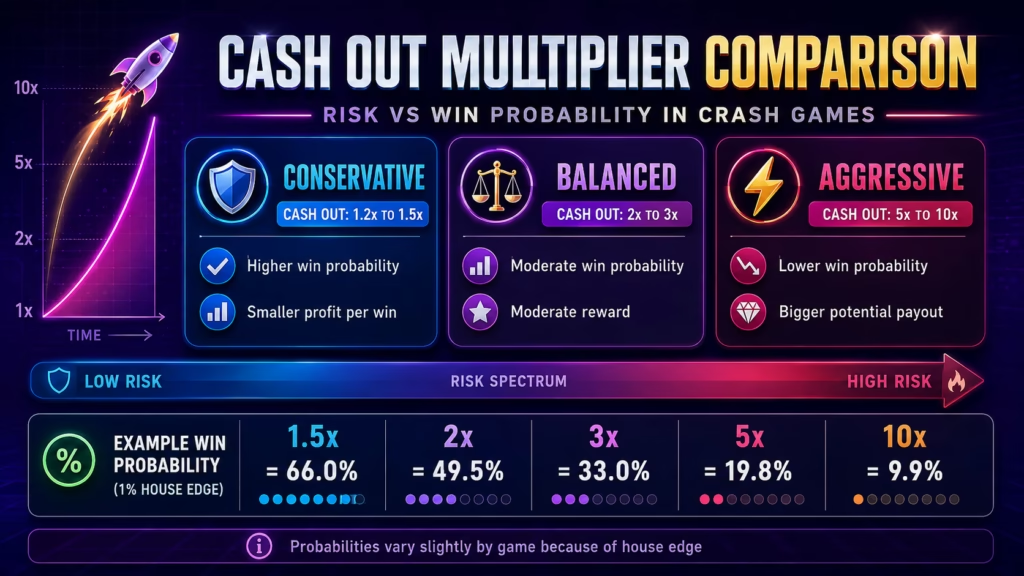
Targets such as 1.10x to 1.50x generally have a high probability of being reached under the common crash model.
A 1.20x target with a 1% house edge has an illustrative success probability of approximately 82.5%. The trade-off is that a successful round produces only a 20% gross increase over the original stake.
Low targets may appeal to players who prefer more frequent successful cash-outs. However, a high win frequency should not be confused with guaranteed profit. One losing bet can erase several small successful cash-outs.
For example, with equal $10 stakes at 1.20x, a successful round produces $2 in net profit. A single $10 loss therefore offsets the net profit from five successful rounds.
Medium Cash-Out Multipliers
Targets around 2x to 3x create a more balanced relationship between payout size and frequency.
Using the same illustrative 1% house-edge model, 2x has a 49.5% probability and 3x has a 33% probability.
These targets can still generate substantial losing streaks. A probability near 50% does not mean wins and losses must alternate, and a 33% probability does not mean exactly one of every three rounds will reach 3x.
Probability describes long-run tendencies, not a schedule of future results.
High Cash-Out Multipliers
Targets such as 10x, 20x, 50x or 100x have much lower probabilities.
At an illustrative 1% house edge, the probability of reaching 50x is about 1.98%, while 100x is about 0.99%.
High-target play therefore creates a pattern dominated by losing bets with occasional large payouts. It may appeal to players interested in rare multiplier outcomes, but it can also consume a bankroll quickly when a long sequence fails to reach the target.
Does Changing the Cash-Out Multiplier Improve RTP?
Changing the cash-out target does not automatically improve the theoretical RTP when a crash game uses a constant house-edge distribution.
Consider three targets under the simplified 1% edge model:
- 2x × 49.5% = 0.99
- 5x × 19.8% = 0.99
- 10x × 9.9% = 0.99
Each produces an expected gross return of approximately 0.99 units for every 1 unit wagered before considering game-specific rounding, limits or other implementation details.
The important difference is variance, not necessarily expected return. A 2x target produces successful cash-outs much more frequently than 10x, while the 10x target concentrates returns into rarer events.
What Happens if the House Edge Changes?
Crash game probability by multiplier changes when the house edge changes.
Using the same general formula:
P(X) = (1 – house edge) / X
At a 2x target:
- 0% edge: 50.00%
- 1% edge: 49.50%
- 2% edge: 49.00%
- 3% edge: 48.50%
- 5% edge: 47.50%
This is why the published RTP or house edge matters when comparing crash games.
Two games can use the same visible multiplier mechanic while providing different underlying probabilities. Players should check the official game information rather than assuming every crash game uses identical odds.
Example of a $10 Crash Bet
Suppose a player places $10 and chooses an automatic cash-out at 5x.
If the multiplier reaches 5x, the gross payout is:
$10 × 5 = $50
The net gain relative to the original stake is:
$50 – $10 = $40
Under the illustrative 1% house-edge model, the probability of reaching 5x is approximately:
0.99 / 5 = 19.8%
The approximate probability of crashing before 5x is therefore:
100% – 19.8% = 80.2%
The $50 payout can look attractive in isolation, but the 80.2% failure probability is equally important when evaluating the risk.
Can Previous Crash Multipliers Predict the Next Round?
Previous crash multipliers should not be used as evidence that a particular multiplier is due in an independently generated crash game.
A sequence such as 1.12x, 1.43x, 1.06x, 2.18x, 1.31x does not by itself make a 10x result more likely next.
Likewise, seeing a 100x multiplier does not logically mean another high multiplier must be less likely simply because one just occurred.
Independent random or provably fair rounds are designed so that previous results do not determine the next result. Some platforms publish methods allowing users to verify completed outcomes.
The relevant check is the game’s actual probability model, not visual patterns in recent history.
Common Crash Probability Myths
A long losing streak means a high multiplier is due
A losing streak does not guarantee that the next round will reach a high multiplier. Random sequences can contain clusters of low or high outcomes.
Cashing out at 1.10x is almost risk-free
A high success probability is not the same as zero risk. Under the illustrative 1% model, a 1.10x target still fails approximately 10% of the time. Because the profit on each successful 1.10x bet is small relative to the full stake lost in an unsuccessful round, occasional crashes can offset many small wins.
10x gives better value because it pays more
A larger multiplier does not automatically mean better mathematical value. In a constant-edge model, the additional payout is balanced by a lower probability of success.
Auto cash-out changes the probability
Auto cash-out does not normally change the probability of the crash point itself. It simply attempts to execute the cash-out at a predetermined multiplier according to the game’s rules. Players should still check whether a particular platform has technical or rule-based conditions affecting cash-outs.
How to Compare Cash-Out Multipliers
The most useful way to compare crash multiplier targets is to evaluate probability, payout size and bankroll impact together.
- What is the game’s published RTP or house edge? Probability calculations depend on the underlying game mathematics.
- What percentage of rounds should theoretically reach the target? A 2x and 20x target create very different hit frequencies.
- How much is lost when the target is missed? The entire wager is normally at risk when the crash happens before cash-out.
- How large is the stake relative to the bankroll? Low-probability targets can generate long sequences of unsuccessful rounds.
- Does the game publish its fairness mechanism? Provably fair documentation can help users verify how results are generated or committed.
These criteria do not create a winning strategy. They simply make the risk easier to understand before placing a wager.
How This Information Was Reviewed
The crash probabilities in this article are based on a mathematical example using a 1% house edge and the formula P(X) = 0.99 / X. They are intended to explain the relationship between cash-out multiplier and probability rather than claim that every crash game uses exactly the same algorithm.
Before playing a specific game, check its published RTP, house edge, maximum multiplier, rounding rules, cash-out conditions and fairness documentation. Some crash games can implement the mechanic differently.
RTP describes expected performance over a very large number of wagers. It does not predict whether an individual round, session or cash-out target will win.
Crash games should be treated as entertainment rather than a way to earn money. Set spending and time limits before playing, avoid chasing losses and stop if gambling stops being recreational.
FAQ
What is the probability of winning a crash game?
Crash game win probability depends mainly on the cash-out multiplier and the game’s mathematical model. In a common model with a 1% house edge, the approximate probability is 0.99 divided by the target multiplier. A 2x target would therefore have an illustrative probability of 49.5%.
What is the probability of reaching 2x in Crash?
The probability of reaching 2x is approximately 49.5% in a simplified crash model with a 1% house edge. A different RTP or probability distribution can produce a different figure, so the specific game’s rules should be checked.
What is the probability of reaching 5x in Crash?
A 5x cash-out target has an approximate 19.8% success probability under a 1% house-edge model because 0.99 divided by 5 equals 0.198. This also means roughly 80.2% of rounds would fail to reach 5x under the same simplified assumptions.
What are the odds of reaching 10x in a crash game?
A 10x target has an illustrative probability of about 9.9% when the game uses a 1% edge and the common inverse multiplier model. Roughly nine out of ten rounds would therefore fail to reach 10x over a sufficiently large sample, although actual short-term sequences can vary widely.
Is a lower crash cash-out multiplier safer?
A lower multiplier has a higher probability of being reached, but it does not eliminate risk. Lower targets also provide smaller profits per successful wager, so occasional full-stake losses can offset multiple small wins.
Does 1.50x have a 66% win probability?
A 1.50x target has approximately a 66% probability under the illustrative 1% house-edge formula because 0.99 / 1.5 = 0.66. That percentage is not universal across every crash game and should be compared with the game’s published rules.
Which crash multiplier has the highest win probability?
The lowest permitted cash-out multiplier generally has the highest probability of being reached because fewer rounds crash before a low target. A higher hit rate does not mean the target has a positive expected value or guarantees long-term profit.
Can a crash game strategy increase the probability of the next multiplier?
A betting strategy cannot change an independently generated crash point simply by changing stake size or reacting to previous outcomes. Strategies can change how much money is exposed and when a player cashes out, but they do not make a particular random multiplier guaranteed.
Do high crash multipliers eventually have to appear?
High multipliers do not become guaranteed because they have been absent for several rounds. Probability does not require rare outcomes to appear on a predictable schedule, and long gaps between high multipliers are possible.
Does RTP tell me which crash multiplier to choose?
RTP does not identify a guaranteed or optimal winning multiplier. RTP describes long-term theoretical return under the game’s rules, while the cash-out multiplier determines how that return is distributed between more frequent smaller payouts and rarer larger payouts.
Short Conclusion
Crash game win probability falls sharply as the cash-out multiplier rises. In a common 1% house-edge model, the approximate probability is 0.99 / multiplier, giving about 49.5% at 2x, 19.8% at 5x, 9.9% at 10x and 0.99% at 100x.
Lower targets produce more frequent successful cash-outs, while higher targets trade hit frequency for larger potential payouts. Neither approach removes the house edge or guarantees profit. Always verify the specific game’s RTP and probability rules, set limits before playing and treat crash games as entertainment rather than a source of income.