
Plinko odds depend mainly on where the ball can land, how many rows the board has, and which multipliers are assigned to the landing pockets. Increasing the number of rows creates more possible paths and makes the extreme left and right pockets progressively less likely. Risk level usually changes the payout structure and volatility rather than giving the player better control over where the ball lands.
The key points are:
- More rows generally make extreme outcomes less probable.
- Middle pockets are much more likely than edge pockets on a standard symmetrical Plinko board.
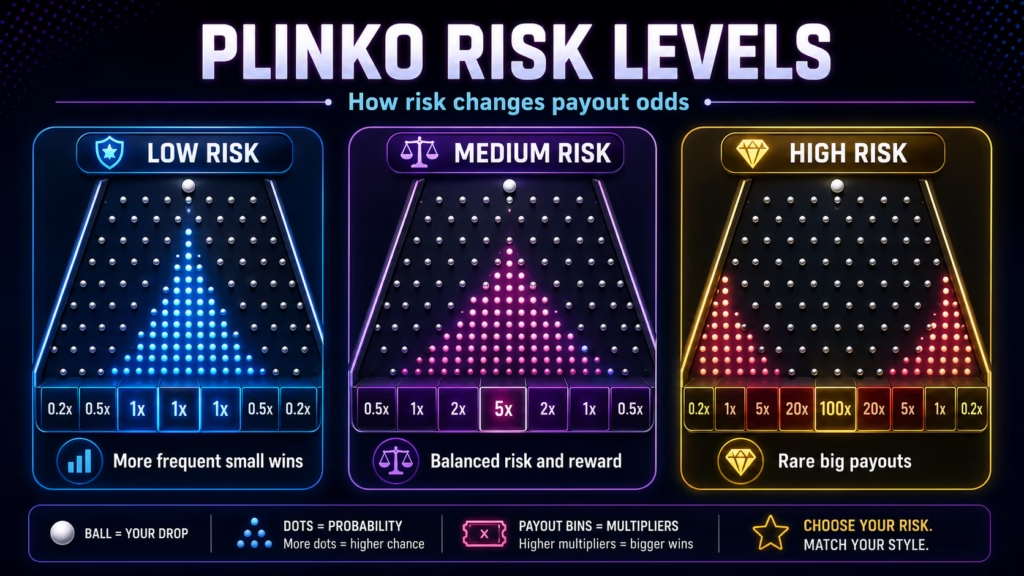
- Higher risk settings typically place larger multipliers on rare outcomes and smaller multipliers on common outcomes.
- Low risk settings usually compress the payout range and reduce short-term swings.
- Plinko probability by rows can be estimated mathematically for a symmetrical board, but the exact payout odds depend on the specific game’s rules and multiplier table.
Plinko may appeal to players who prefer a simple game with visible risk settings and fast rounds. Players who dislike large bankroll swings should be especially cautious with high risk settings, because rare large multipliers are normally balanced by less favorable payouts across more common landing positions.
How Plinko Odds Work
Plinko odds can be understood by treating each row as another left-or-right movement. On an ideal symmetrical board, every peg creates two possible directions. If both directions are equally likely and independent, the final landing distribution follows a binomial pattern.
For a theoretical symmetrical Plinko board, the probability of reaching landing position k after n rows is:
P(k) = C(n,k) / 2ⁿ
Here:
- n is the number of rows.
- k is the number of movements in one direction.
- C(n,k) is the number of different paths that produce that final position.
The formula explains why balls cluster around the center. There are many different combinations of left and right movements that reach a central pocket, but only one path reaches each extreme edge.
This theoretical calculation is useful for understanding Plinko probability by rows. It should not automatically be treated as the exact probability model of every online Plinko game. Digital games may use an RNG or provably fair system, and their precise implementation should be checked in the official game rules.
Plinko Probability by Number of Rows
Adding rows changes the probability distribution even before multipliers are considered. A board with more rows provides more landing positions and far more possible paths.
The following table shows theoretical probabilities for an ideal symmetrical board:
| Rows | Landing Pockets | Chance of Exact Center* | Chance of One Specific Edge |
| 8 | 9 | 27.34% | 0.390625% |
| 10 | 11 | 24.61% | 0.097656% |
| 12 | 13 | 22.56% | 0.024414% |
| 14 | 15 | 20.95% | 0.006104% |
| 16 | 17 | 19.64% | 0.001526% |
*For boards with an even number of rows and one central landing pocket.
The important pattern is not simply that the center becomes less likely as rows increase. The probability is spread across a larger number of pockets. Extreme pockets become dramatically harder to reach because an extreme outcome requires the ball to move in the same direction at every stage.
For example, reaching one exact edge on an eight-row theoretical board requires eight identical directional movements, giving a probability of:
1 / 2⁸ = 1 / 256 = 0.390625%
With 16 rows:
1 / 2¹⁶ = 1 / 65,536 = approximately 0.001526%
That is roughly one theoretical occurrence per 65,536 drops for one specific extreme pocket under the ideal 50/50 model. It is a probability, not a schedule. An edge result could occur twice within a short sequence or fail to occur across far more than 65,536 drops.
Does Risk Level Change Plinko Probability?
Risk level usually changes the relationship between landing probabilities and payouts rather than making the ball more likely to travel toward an edge.
A standard Plinko game may offer settings such as low, medium, high, or similar volatility levels. The common central pockets can receive relatively forgiving multipliers in a low risk configuration, while a high risk configuration may assign much smaller multipliers to those same common positions and reserve much larger rewards for rare edge outcomes.
This distinction matters because there are two different questions:
- What is the probability that the ball lands in a particular pocket?
- What is the probability that the result produces a net profit?
Those are not necessarily the same.
A central pocket may be highly probable but pay less than 1x the stake on a high risk table. An edge pocket may be extremely unlikely but carry the highest multiplier. Changing the multiplier table can therefore change the probability of finishing a round in profit even when the underlying landing distribution remains similar.
Low Risk Plinko Odds
Low risk Plinko generally uses a narrower range of multipliers. Common central outcomes tend to be less damaging, while rare edge outcomes usually provide smaller maximum multipliers than higher risk configurations.
Low risk may suit players who:
- prefer smaller differences between individual outcomes;
- want fewer extreme bankroll swings;
- are learning how rows affect the board;
- care more about smoother session behavior than maximum multiplier potential.
Low risk does not remove the house edge or guarantee that a session will remain close to the starting balance. Random variation still applies, and repeated small negative results can accumulate.
Medium Risk Plinko Odds
Medium risk usually sits between the compressed payout structure of low risk and the highly concentrated rewards of high risk.
A medium setting often makes the central region less favorable than low risk while increasing payouts farther from the center. Because most theoretical Plinko paths still finish somewhere near the middle of the board, the player accepts greater variance in exchange for stronger payouts in less common pockets.
Medium risk may appeal to players who want noticeable payout variation without concentrating as much value in extremely rare results as a high risk configuration.
The exact distribution should always be checked in the game’s visible payout table. “Medium” is a volatility label, not a universal mathematical standard shared by every Plinko provider.
High Risk Plinko Odds
High risk Plinko normally concentrates more payout value in rare outer pockets.
This can create an important psychological trap. A large edge multiplier may appear attractive when viewed by itself, but its probability can be extremely small.
On a theoretical 16-row symmetrical board, one exact edge has a probability of approximately 0.001526%. Even combining both extreme edges produces only approximately 0.003052%, or about 1 theoretical occurrence per 32,768 drops.
High risk Plinko may therefore suit players who knowingly accept long sequences of low multipliers in exchange for access to rare high multipliers. It is a poor choice for anyone interpreting a high maximum payout as evidence that a large win is likely.
How Rows Change Plinko Odds
8 Rows
Eight rows create relatively few landing pockets and a less extreme distribution.
The probability of one specific edge is theoretically about 0.39%, while the central pocket represents about 27.34% of outcomes under the symmetrical model.
An eight-row game therefore makes extreme positions much more accessible than a 16-row board, although the multiplier attached to those positions may also be much lower.
12 Rows
Twelve rows create 13 theoretical landing positions.
The exact center has a probability of approximately 22.56%, while one extreme edge falls to roughly 0.0244%.
This configuration creates a clearer distinction between common central outcomes and rare outer outcomes.
16 Rows
Sixteen rows produce 17 theoretical landing pockets and a much wider distribution.
The central pocket remains the single most likely outcome at about 19.64%, but one exact edge drops to approximately 0.001526%.
More rows do not make the game inherently better or worse. They change the distribution available to the payout table and usually allow developers to create more pronounced differences between common and rare multiplier positions.
Risk Level vs Number of Rows
Risk level and rows affect Plinko in different ways.
| Setting | Main Effect |
| Fewer rows | Fewer landing positions and less extreme edge probabilities |
| More rows | More landing positions and much rarer extreme pockets |
| Lower risk | Usually smaller differences between common and rare payouts |
| Higher risk | Usually concentrates larger payouts in less likely pockets |
The number of rows primarily explains where probability is distributed. Risk level primarily explains how payout value is assigned to those outcomes.
This is why comparing maximum multipliers alone can be misleading. A 1,000x or 10,000x multiplier tells you nothing useful about its value unless you also know how likely the associated landing position is and what happens across the much more common outcomes.
Are More Plinko Rows Better?
More Plinko rows are not automatically better.
Players choosing more rows normally gain access to a broader range of possible outcomes. This can support larger maximum multipliers, especially on high risk payout tables, but the outer pockets also become significantly less probable.
Players who prefer less extreme distributions may find fewer rows easier to understand. Players interested in highly volatile payout structures may prefer more rows, provided they understand that the biggest multipliers can correspond to exceptionally rare positions.
The correct comparison is therefore not “more rows versus fewer rows” alone. It is:
rows + risk setting + multiplier table + RTP or house edge
All four should be considered together.
Common Mistakes When Reading Plinko Odds
Assuming Every Pocket Has the Same Probability
Plinko pockets are not equally likely on the standard symmetrical model. Central positions can be reached through many paths, while an extreme edge requires the same directional result repeatedly.
Treating a 1,000x Multiplier as a 1-in-1,000 Chance
Multiplier size and probability are different quantities. A 1,000x payout does not imply a 0.1% probability.
Believing More Rows Improve Expected Returns
Increasing the number of rows changes the shape of the outcome distribution. It does not automatically improve RTP or reduce the house edge.
Assuming Past Drops Affect the Next Result
Independent random rounds do not become more likely to produce an edge result simply because many previous balls landed near the center. Long losing or winning sequences are possible without changing the probability of the next independent outcome.
Comparing Risk Levels Without Checking the Payout Table
Labels such as low, medium, high, hard, or expert are provider-specific. Compare the actual multipliers rather than relying only on the name of the setting.
How to Compare Plinko Settings
Before choosing a Plinko configuration, check:
- Number of rows. More rows make the rarest landing positions substantially less probable in the standard model.
- Risk level. Determine how aggressively payouts are concentrated toward the edges.
- Central multipliers. These correspond to the most common region of the board.
- Edge multipliers. Large numbers should be considered together with their probability.
- RTP or house edge. These describe long-term mathematical expectations, not the outcome of a particular session.
- Game rules. Confirm whether the online version follows a standard symmetrical distribution or uses a different RNG mapping.
- Stake size. Higher volatility combined with large bets can produce rapid bankroll swings.
A demo mode, when available, may help players understand the interface and payout structure without risking money. It does not reveal a pattern that can predict future independent results.

How This Information Was Reviewed
The Plinko odds in this guide separate mathematical landing probability from provider-specific payout settings. The probability examples use a symmetrical left-or-right binomial model.
Exact RTP, risk labels, multipliers and game logic can vary between providers and casinos, so the official rules and payout table should be checked before playing.
RTP, volatility, rows and multiplier values describe statistical properties. They cannot predict the next result or guarantee a profitable session. Plinko should be treated as paid entertainment rather than a way to make money, and players should set spending and time limits before gambling.
FAQ
What Are the Odds in Plinko?
Plinko odds depend on the number of rows, the final pocket being measured, and the game’s payout structure. On a symmetrical board, central pockets are much more likely than extreme edge pockets because many more ball paths lead toward the center.
How Does the Number of Rows Affect Plinko Probability?
More rows create more possible paths and make extreme landing pockets progressively less likely. In the theoretical symmetrical model, one exact edge has a probability of about 0.3906% with 8 rows but only about 0.001526% with 16 rows.
What Is the Probability of Hitting the Edge in 16-Row Plinko?
Under an ideal symmetrical 16-row model, one specific extreme edge has a probability of 1 in 65,536, approximately 0.001526%. Either of the two extreme edges would have a combined theoretical probability of about 0.003052%. A real game’s implementation should still be checked in its official rules.
Does High Risk Increase the Chance of Hitting an Edge?
High risk does not necessarily make the ball more likely to reach an edge. It usually changes the multipliers assigned to common and rare outcomes. Higher risk typically puts more payout value on less probable outer pockets.
Which Plinko Risk Level Has the Best Odds?
There is no universally best risk level. Low risk normally produces smaller payout swings, while high risk concentrates larger multipliers in rarer outcomes. The underlying house edge or RTP is more relevant to long-term mathematical expectation than the size of the maximum multiplier alone.
Are 8 Rows Better Than 16 Rows in Plinko?
Eight rows are not inherently better than 16 rows. Eight rows make extreme pockets less rare, while 16 rows support a wider probability distribution and can be paired with larger edge multipliers. The preferable configuration depends on the player’s tolerance for volatility, not on a guaranteed advantage.
Can Plinko Odds Predict When a Big Multiplier Will Hit?
No. Probability describes how outcomes behave across many independent rounds, not when a particular result must occur. A theoretically rare result can happen immediately or fail to appear across a very long sequence.
Does Changing Rows Improve Plinko RTP?
Changing rows does not automatically increase RTP. Rows change the distribution of possible landing positions, while the payout table determines how those probabilities translate into expected return. Check the RTP and rules of the exact Plinko version being played.
Is There a Strategy That Changes Plinko Probability?
Changing risk level or rows changes the type of payout distribution you select, but it does not create a reliable method for predicting random results. Betting systems can change stake size and bankroll exposure, but they do not guarantee profitable outcomes.
Short Conclusion
Plinko odds are driven by the combination of landing probability, number of rows and multiplier structure. Central pockets are statistically much more common than extreme pockets, while adding rows makes the edges dramatically rarer. Risk level usually changes how strongly payouts reward those rare outcomes rather than providing better control over the ball.
For meaningful Plinko probability comparisons, examine rows, risk level, payout multipliers and RTP together. Large maximum multipliers should never be evaluated without their probability, and no Plinko configuration guarantees a winning session.