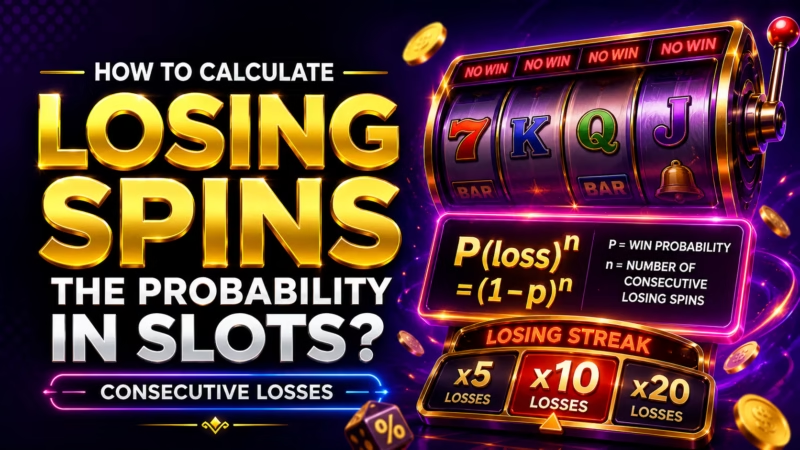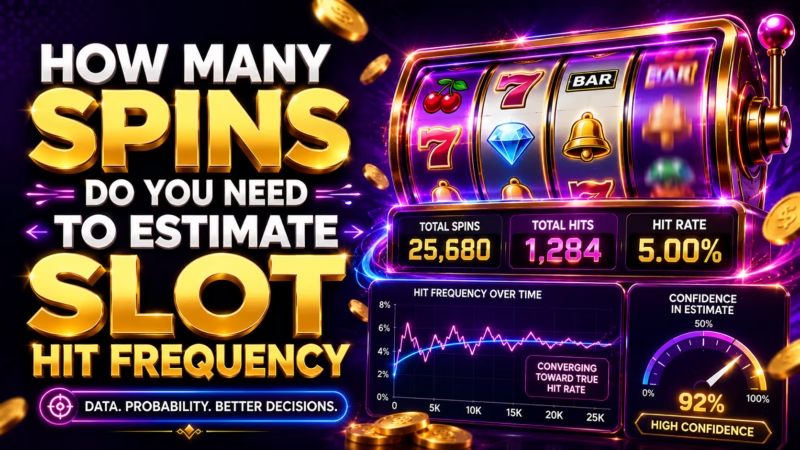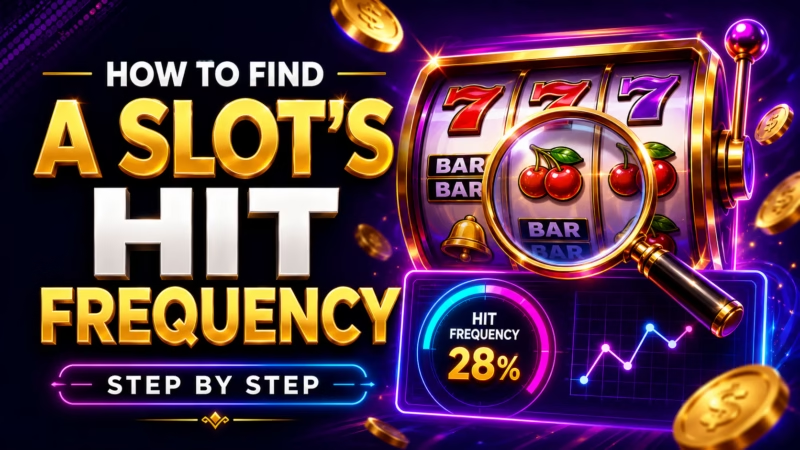
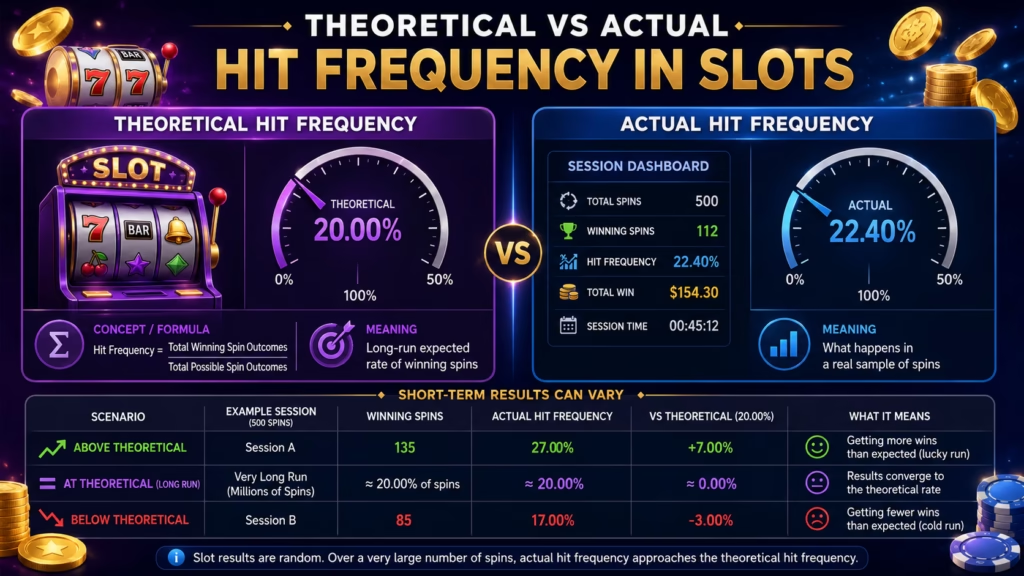
Theoretical hit frequency is the mathematically expected percentage of spins that produce a qualifying win over a very large number of plays. Actual hit frequency is the percentage of winning spins observed during a specific real session or sample of spins. The two numbers can differ substantially in the short term because slot outcomes are random and real samples are much smaller than the mathematical model behind the game.
Quick Takeaways
- Theoretical hit frequency describes the long-run probability of a winning spin.
- Actual hit frequency describes what happened in a specific sample of spins.
- A short session can produce an actual hit frequency far above or below the theoretical figure.
- Hit frequency does not show how large the wins will be and should not be confused with RTP.
- A higher hit frequency does not automatically mean a slot is more profitable or safer to play.
Players who prefer frequent visual feedback may find hit frequency useful when comparing slot mechanics. Players trying to estimate future winnings from a short session should be more cautious because actual hit frequency cannot reliably predict what will happen on the next spins.
What Is Theoretical Hit Frequency?
Theoretical hit frequency is the probability that a slot will produce a qualifying winning result on any individual spin according to its mathematical model.
If a slot has a theoretical hit frequency of 25%, the model implies that approximately 25% of spins would qualify as wins across a sufficiently large number of trials. It does not mean that exactly one out of every four consecutive spins will win.
A theoretical hit frequency can be expressed as:
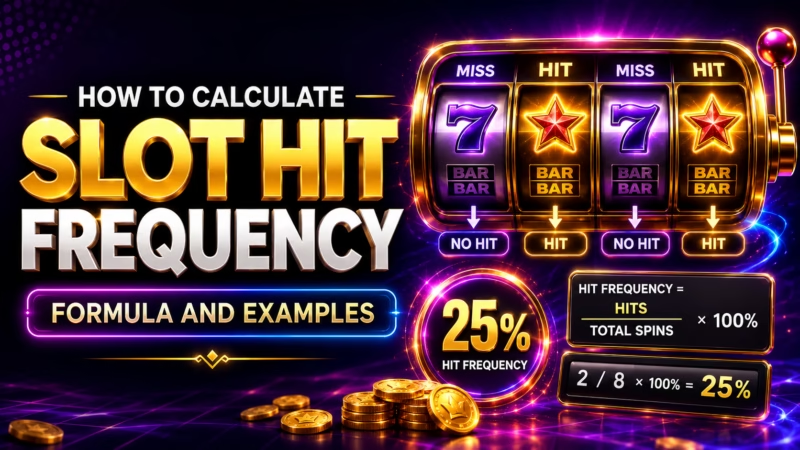
Theoretical Hit Frequency = Expected Winning Spins / Total Spins x 100
For example, a mathematical model that produces 250,000 winning outcomes across 1,000,000 simulated spins would have a theoretical hit frequency of:
250,000 / 1,000,000 x 100 = 25%
The important point is that this percentage describes probability across a long run. Randomness can create clusters of wins, long stretches without wins, or sequences that look very different from the theoretical average.
What Is Actual Hit Frequency?
Actual hit frequency is the percentage of spins that produced qualifying wins in a specific observed sample.
The formula is:
Actual Hit Frequency = Observed Winning Spins / Observed Spins x 100
Suppose a player makes 100 spins and 31 of them produce winning combinations. The actual hit frequency for that session is:
31 / 100 x 100 = 31%
If the same slot has a theoretical hit frequency of 25%, the session’s actual hit frequency is six percentage points higher. That difference does not mean the mathematical model has changed. It simply means the observed sample produced more winning spins than the long-run probability would suggest.
A different 100-spin session could produce 17 winning spins and an actual hit frequency of 17%. Both results can occur normally in a random game.
Theoretical vs Actual Hit Frequency Compared
| Factor | Theoretical Hit Frequency | Actual Hit Frequency |
| Meaning | Expected long-run frequency of winning spins | Observed frequency of winning spins |
| Source | Mathematical game model | Real or simulated sample |
| Sample size | Designed around very large numbers of spins | Can be any number of spins |
| Stability | Relatively stable for a fixed game configuration | Can fluctuate significantly |
| Predicts next spin? | No | No |
| Changes after winning or losing streaks? | Not because of the streak itself | Yes, because the observed percentage changes |
| Useful for | Understanding game design | Describing what happened in a sample |
The main difference is therefore expectation versus observation. Theoretical hit frequency tells you what the game mathematics predicts in the long run, while actual hit frequency records what has already occurred.
Why Actual Hit Frequency Can Differ So Much
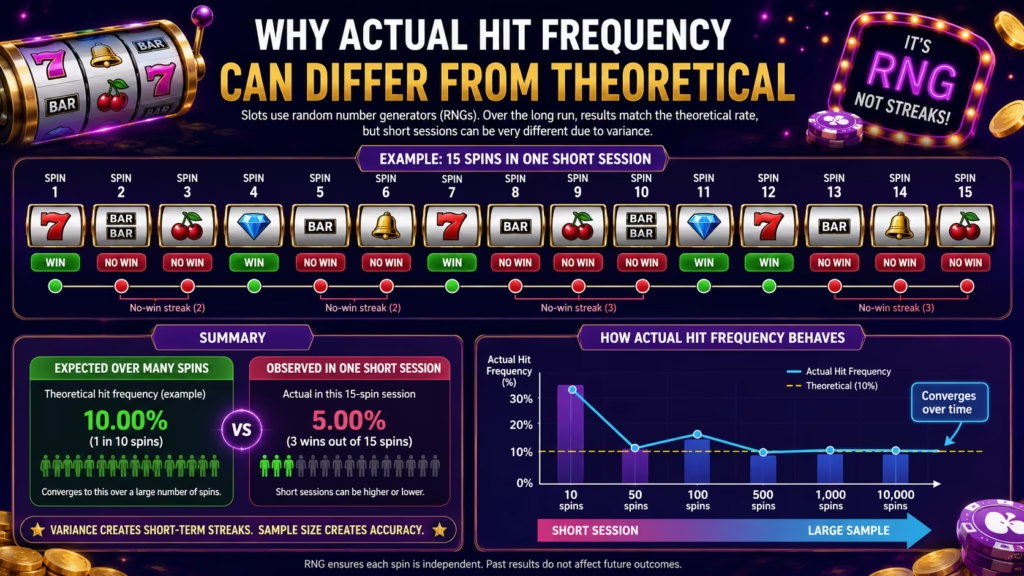
Actual hit frequency can differ from theoretical hit frequency because random variation has a large effect on small samples.
- 2 wins, producing a 10% actual hit frequency
- 4 wins, producing a 20% actual hit frequency
- 7 wins, producing a 35% actual hit frequency
Imagine a slot with a theoretical hit frequency of 20%. Over only 20 spins, any of those results can occur. None of these short results alone proves that the theoretical value is wrong.
As the number of observations increases, the measured hit frequency will generally have more opportunity to settle closer to the underlying probability. This statistical tendency does not guarantee that a particular sample will reach the exact theoretical number.
Theoretical probabilities should therefore never be interpreted as schedules. A 20% hit frequency does not mean a slot must produce a win after four losing spins.
How Sample Size Affects Actual Hit Frequency
Sample size is one of the most important factors when comparing actual and theoretical hit frequency.
Ten, fifty, or even several hundred spins can produce a noisy estimate because each additional win or loss changes the measured percentage noticeably.
If 5 of 20 spins win: 5 / 20 = 25%. One additional winning spin would move the result to 6 / 21, or about 28.6%.
By contrast, one additional win in a sample containing hundreds of thousands of spins barely changes the overall percentage.
This is why professional game mathematics and testing rely on much larger datasets than an ordinary playing session. A player’s personal history is generally too limited to establish whether a slot’s long-run mathematical probabilities match a published figure.
Does Actual Hit Frequency Eventually Equal Theoretical Hit Frequency?
Actual hit frequency may move closer to theoretical hit frequency as the sample becomes very large, but there is no point at which the two values are required to become exactly identical.
This distinction matters because the law of large numbers is often misunderstood. It describes long-run statistical behavior. It does not force previous deviations to be corrected by future spins.
If a slot with a theoretical 25% hit frequency has produced an unusually low actual hit frequency so far, the game does not become “due” for extra wins. Assuming each spin is independently generated according to the game’s rules, the next spin follows the same underlying probabilities regardless of the previous sequence.
Hit Frequency Is Not the Same as RTP
Hit frequency measures how often qualifying wins occur. RTP measures the theoretical proportion of wagered money returned to players across a very large number of plays.
A slot can therefore have frequent wins while still returning relatively small amounts on many of those winning spins.
Simplified example
- Slot A: 35% hit frequency, many small wins, relatively few large payouts.
- Slot B: 15% hit frequency, fewer wins, potentially more value concentrated in less frequent outcomes.
Those differences alone do not reveal which slot has the higher RTP.
A spin can also count as a “win” even when the payout is smaller than the original stake, depending on how hit frequency is defined. A $0.50 payout from a $1 spin may technically be recorded as a winning event while still producing a $0.50 net loss.
Players should therefore avoid using hit frequency as a substitute for RTP.
Hit Frequency vs Volatility
Hit frequency and volatility describe different aspects of a slot’s mathematical behavior.
Hit frequency asks how often a qualifying win occurs. Volatility asks how widely results can fluctuate and how payout value is distributed.
A high-hit-frequency slot can still have meaningful volatility if many wins are small while a limited number of outcomes account for much larger prizes. A lower-hit-frequency game can also vary depending on the size and distribution of its payouts.
Players looking for frequent on-screen wins may pay attention to hit frequency. Players concerned about bankroll swings and payout distribution should also consider volatility, RTP, maximum win structure, bonus mechanics, and the paytable.
No single metric describes the complete risk profile of a slot.
What Counts as a Hit?
The definition of a “hit” must be checked before comparing hit-frequency figures.
- any spin returning a payout
- only winning combinations
- base-game wins
- bonus-triggering spins
- wins including feature outcomes
- wins of at least the original stake
This matters because two percentages calculated using different definitions are not directly comparable.
For example, a provider could count a small 0.2x stake payout as a hit, while another statistic might count only spins returning at least 1x the wager. Both calculations could be mathematically correct but answer different questions.
The game rules, official documentation, or paytable should be checked whenever an exact published hit-frequency figure is being evaluated.
Can Bonus Features Change Observed Hit Frequency?
Bonus features can influence how players experience winning frequency, but the effect depends on how the slot defines and calculates a hit.
Free spins, respins, cascading reels, multipliers, wild transformations, and other features can create several winning events from a single paid spin. A statistic based on paid spins may therefore look different from a statistic based on every individual game event.
Cascading slots are a good example. One paid spin may create an initial winning combination followed by several consecutive cascades. Counting the paid spin as one hit produces a different metric from counting each cascade separately.
For meaningful comparisons, the measurement method must stay consistent.
Can You Calculate a Slot’s Theoretical Hit Frequency Yourself?
A player usually cannot derive the exact theoretical hit frequency from ordinary gameplay alone.
- reel strips or virtual reel mappings
- symbol probabilities
- paylines or ways-to-win rules
- weighted symbols
- feature-trigger probabilities
- bonus-state mathematics
- game-state transitions
Much of this information may not be visible in the interface.
Recording thousands of spins can produce an actual hit frequency, but it does not automatically reveal the exact theoretical probability. Statistical estimation becomes more informative with larger samples, yet uncertainty remains.
If a provider publishes an official hit-frequency specification, that figure is generally more relevant to the mathematical design than a percentage calculated from one player’s session.
Common Myths About Actual Hit Frequency
“The slot has not hit recently, so a win must be coming”
Previous losses do not make an independent random outcome due for a win. A low recent actual hit frequency is a description of the past, not a prediction of the next spin.
“My hit frequency is higher than advertised, so the slot is paying better”
A high actual hit frequency does not necessarily mean higher returns. The wins could be small, and RTP depends on payout value rather than just the number of winning events.
“A 30% hit frequency means exactly three wins every ten spins”
A hit-frequency percentage is a probability, not a schedule. Ten spins could contain no wins, three wins, or many more.
“A higher hit frequency is always better”
Higher hit frequency usually means winning events occur more often under the selected definition, but it says nothing by itself about average payout size, RTP, volatility, or long-term losses.
“I can find the true hit frequency by playing a few hundred spins”
A few hundred spins provide an actual sample, not definitive proof of the theoretical probability. Random variation can remain substantial.
How to Use Hit Frequency When Comparing Slots
Hit frequency is most useful as one part of a wider comparison rather than as a stand-alone quality score.
- Theoretical hit frequency to understand how frequently winning events are expected.
- RTP to understand the theoretical long-run return percentage.
- Volatility to understand how unevenly payouts may be distributed.
- Paytable structure to see the value of common and rare combinations.
- Bonus mechanics to understand whether a large portion of potential value is concentrated in features.
- Definition of a hit to make sure percentages from different games are actually comparable.
A player who prefers frequent feedback may find a higher hit frequency more appealing. Someone interested in a different payout profile may prioritize other characteristics. Neither preference changes the randomness of individual outcomes.
Why Session Results Should Not Be Used to Predict Future Spins
Actual hit frequency should be treated as a historical statistic, not a predictive tool.
Suppose a slot has produced only 12 wins during the last 100 spins even though its theoretical hit frequency is 25%. It may be tempting to assume the next spins should contain more wins to “catch up.” That conclusion is unreliable.
Random games do not need to balance themselves within a player’s session. A statistical model can approach its expected proportions over extremely large samples while still producing significant short-term deviations.
The practical lesson is simple: do not increase bets because a slot appears overdue for a win, and do not interpret an unusually good session as evidence that a game has entered a permanently favorable state.
How This Information Was Reviewed
The distinction between theoretical and actual hit frequency is based on three separate concepts: mathematical probability, observed sample results, and payout distribution.
When evaluating a specific slot, players should verify the provider’s game rules or paytable because the exact definition of a winning hit may vary. RTP, volatility, bonus features, and hit frequency should also be evaluated separately because none of these metrics guarantees the result of an individual spin or session.
Slot outcomes should be treated as entertainment rather than a source of income. Set spending and time limits before playing, avoid chasing losses, and stop if gambling is no longer enjoyable or remains within the limits you intended to follow.
FAQ
What is theoretical hit frequency in slots?
Theoretical hit frequency is the mathematically expected percentage of spins that produce qualifying winning outcomes over a very large number of plays. A theoretical hit frequency of 25% represents a long-run probability, not a guarantee that exactly one in every four consecutive spins will win.
What is actual hit frequency?
Actual hit frequency is the percentage of observed spins that produced qualifying wins during a specific sample. If 22 of 100 spins win, the actual hit frequency for that sample is 22%.
Why is my actual hit frequency lower than the theoretical percentage?
Actual hit frequency can be lower because short-term random variation can produce fewer winning spins than the long-run mathematical expectation. A low percentage during one session does not necessarily indicate that the slot’s theoretical model has changed.
Does hit frequency affect RTP?
Hit frequency and RTP are related to different parts of the game’s mathematics. Hit frequency measures how often wins occur, while RTP measures the theoretical value returned relative to total wagers across a very large sample. Frequent wins can still be small.
Is a slot with higher hit frequency better?
A higher hit frequency is not automatically better. It may suit players who prefer more frequent winning events, but payout size, RTP, volatility, bonus distribution, and the definition of a hit also matter.
Can hit frequency predict when a slot will pay?
No. Hit frequency cannot reliably predict when the next winning spin will occur. Theoretical probability describes long-run behavior, while actual hit frequency describes previous results.
How many spins are needed to measure hit frequency accurately?
There is no universal number of spins that guarantees an exact estimate. Larger samples generally reduce the influence of short-term randomness, but the required sample depends on the underlying probability and desired statistical precision. A normal playing session should not be treated as proof of a slot’s theoretical hit frequency.
Do free spins count toward hit frequency?
They may, depending on how the statistic is defined. Some calculations may measure winning paid spins, while others may include bonus rounds, respins, cascades, or other game events. Check the game’s documentation before comparing figures.
Can actual hit frequency be higher than theoretical hit frequency?
Yes. A particular sample can produce an actual hit frequency above the theoretical percentage because of normal random variation. Another sample of the same size may produce a lower percentage.
Does a losing streak increase the probability of the next win?
Not simply because a losing streak occurred. In a properly functioning random slot, previous results do not create a requirement for the next spin to compensate for earlier losses. Players should not chase losses or increase stakes because a game appears “due.”
Brief Conclusion
Theoretical hit frequency describes how often a slot is mathematically expected to produce qualifying wins over the long run. Actual hit frequency records how often wins occurred in a specific sample. The two can differ sharply during normal sessions because random variation is strongest in small samples.
Hit frequency is useful for understanding how a slot may feel, but it should be considered alongside RTP, volatility, payout structure, and bonus mechanics. It does not predict the next spin, guarantee returns, or indicate that a losing streak is about to end.