Slot hit frequency is the percentage of spins that produce a winning result. If a slot has a 30% hit frequency, the theoretical model suggests that about 30 out of every 100 spins will return some type of win over a sufficiently large sample. However, hit frequency does not tell you how large those wins will be, whether the result is profitable, or when the next winning spin will occur.
Finding a slot’s exact hit frequency is not always straightforward because many game providers publish RTP and volatility but do not disclose hit frequency. The best places to check are the official game information screen, paytable, provider documentation, casino game details, and trusted technical reviews that identify their source.
Quick answers:
- Hit frequency measures how often a slot produces winning spins.
- The exact percentage may be listed in the paytable, help screen, game rules, or provider documentation.
- Many slots do not publicly disclose hit frequency.
- RTP, volatility, and hit frequency describe different parts of a slot’s mathematical model.
- A high hit frequency does not automatically mean a better slot or better long-term returns.
- Observing a few hundred spins cannot reliably reveal the true mathematical hit frequency.
Hit frequency is particularly useful for players comparing how different slots may feel during play. Players who prefer frequent small wins may be more interested in higher-hit-frequency games, while players comfortable with longer periods without wins may accept a lower hit frequency. In either case, every spin remains random, and the statistic cannot predict future outcomes.
What Is Slot Hit Frequency?
Slot hit frequency, sometimes called hit rate or win frequency, represents how frequently a slot produces a winning spin.
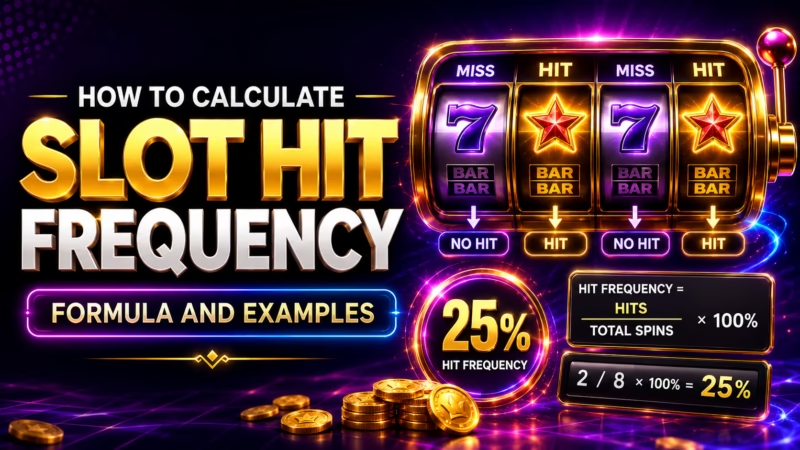
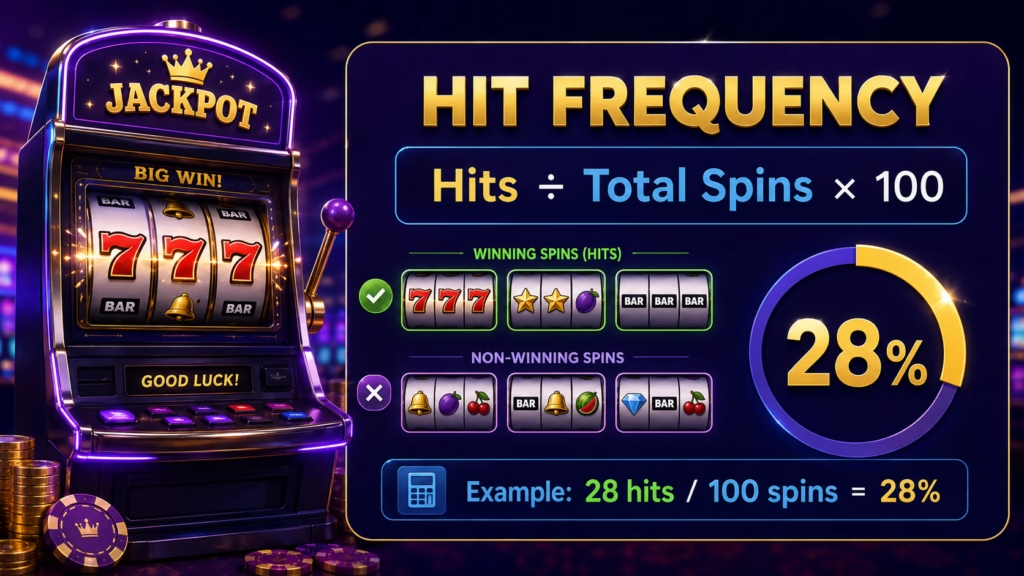
The basic formula is:
Hit Frequency = Winning Spins ÷ Total Spins × 100
For example, if a theoretical model produces 28 winning spins during 100 spins, the hit frequency would be:
28 ÷ 100 × 100 = 28%
A 28% hit frequency does not mean that every sequence of 100 spins will contain exactly 28 wins. Random variation can create shorter sessions with substantially more or fewer winning spins.
The percentage normally describes the mathematical probability across a very large number of spins rather than a guarantee for an individual session.
How to Check Slot Hit Frequency
The most reliable way to check slot hit frequency is to look for information supplied by the game developer or inside the game itself.
1. Open the Slot Information or Help Menu
Start with the information button inside the slot. Depending on the developer, it may appear as an ‘i’ symbol, a question mark, a menu button, ‘Help’, ‘Rules’, ‘Game Info’, or ‘Paytable’.
The information screen often explains paylines, ways to win, symbols, bonus mechanics, RTP and other mathematical characteristics.
If hit frequency is officially disclosed, this is one of the strongest places to find it.
Look for terms such as Hit Frequency, Hit Rate, Win Frequency, Win Rate or Winning Spin Frequency.
Do not confuse these terms with RTP.
2. Check the Paytable and Game Rules
A slot paytable mainly explains winning combinations and their payouts, but some developers also include technical information about the game’s mathematical model.
Read beyond the symbol values. Useful details may appear near the bottom of the rules, inside a separate technical information section, or under RTP information.
If the game offers multiple RTP configurations, remember that other mathematical settings may also depend on the version supplied by the casino. Do not assume a statistic found for one configuration automatically applies to every version of the slot.
3. Check the Game Provider’s Website
The slot developer is usually the best external source for technical specifications.
Search for the game’s official product page, game sheet, specification sheet or documentation. Depending on the provider, it may include RTP, volatility, maximum win, reels and rows, paylines or ways to win, bonus mechanics, and hit frequency.
The amount of information disclosed varies considerably between developers.
If hit frequency is absent from official documentation, that does not necessarily mean the game has an unusual hit rate. It normally means the provider has chosen not to publish the figure.
4. Check the Casino’s Game Information
Some online casinos display detailed specifications for individual games.
A casino game page may list RTP, volatility, provider, release information and occasionally hit frequency.
Treat the casino’s value as secondary to official developer information. If the casino and provider show different numbers, check whether the casino is running a different RTP configuration or game version.
5. Use Independent Slot Reviews Carefully
A detailed slot review can help when official documentation is difficult to locate, but the number should ideally be traceable to an identifiable source.
A useful review should distinguish between officially published hit frequency, an estimated hit rate, and observed results from a test session.
These are not equivalent.
If a review states an exact percentage without explaining where it came from, do not automatically treat that number as part of the official game mathematics.
What If the Hit Frequency Is Not Published?
If a slot’s hit frequency is not disclosed by the provider, you usually cannot determine the exact theoretical figure simply by playing the game.
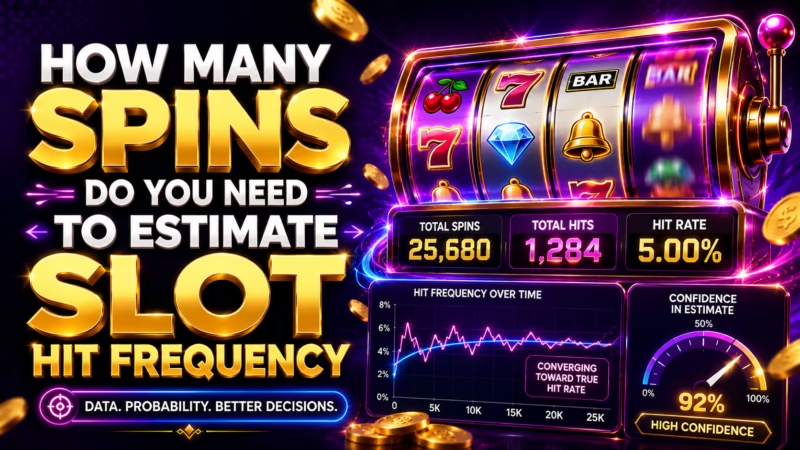
You can calculate an observed hit frequency, but that only describes your sample.
For example, suppose you record:
- 1,000 total spins
- 287 winning spins
Your observed hit frequency would be:
287 ÷ 1,000 × 100 = 28.7%
That does not prove that the slot’s theoretical hit frequency is 28.7%.
Random variation remains significant over short samples. A much larger simulation may move the observed percentage closer to the game’s underlying mathematical probability, but ordinary player sessions are generally too limited to establish the exact theoretical value confidently.
For practical comparison, an officially published figure is therefore far more useful than trying to reverse-engineer a slot from a short session.
Hit Frequency vs RTP
Hit frequency and RTP answer different questions.
| Metric | What It Measures | What It Tells You |
| Hit Frequency | Percentage of spins producing a win | How often winning spins occur theoretically |
| RTP | Percentage of wagered money theoretically returned over the long term | Long-run expected return built into the game |
| Volatility | Distribution and variation of payouts | How uneven or concentrated wins may be |
A slot can theoretically have frequent winning spins while still having a relatively modest RTP if many of those wins are small.
For example, a $1 spin that returns $0.40 may count as a winning combination under the game’s statistical definition even though the player has lost $0.60 relative to the original stake.
This is why hit frequency should never be interpreted as the percentage of spins that produce a net profit.
Hit Frequency vs Volatility
Hit frequency describes how often wins occur. Volatility describes how payouts are distributed.
The two metrics are related to the playing experience, but one cannot reliably be calculated from the other.
A lower-volatility slot may often produce smaller or more regular payouts. A higher-volatility slot may concentrate more of its return into less frequent and potentially larger wins. However, individual game mathematics differ, so volatility alone does not reveal an exact hit-frequency percentage.
If you want frequent feedback from the reels, hit frequency may be particularly relevant. If you are primarily interested in the size and variability of potential payouts, volatility is the more useful metric.
Neither statistic predicts what will happen during your next session.
What Counts as a Hit?
A ‘hit’ generally means a spin that creates a qualifying winning result under the game’s rules.
The definition can become complicated in modern slots because one paid spin may trigger several events.
- a normal line win
- a ways-to-win payout
- a cluster win
- a scatter payout
- a bonus trigger
- a jackpot-related result
- a cascading sequence
This is one reason percentages from different sources should not always be compared without context.
If one developer calculates hit frequency using a particular mathematical definition and another reports a different type of win-rate statistic, the numbers may not represent precisely the same thing.
Does a Higher Hit Frequency Mean a Better Slot?
No. A higher slot hit frequency only indicates more frequent winning outcomes according to the game’s mathematical model.
It does not tell you:
- how large those wins are
- whether most wins exceed the original stake
- how valuable the bonus round is
- the maximum potential payout
- the RTP
- the volatility
- whether you will win during a particular session
Consider two hypothetical slots.
Slot A: 40% hit frequency with many small payouts.
Slot B: 20% hit frequency with less frequent but more concentrated payouts.
Slot A may feel more active because wins appear more often. Slot B may feel more uneven. Neither is automatically superior.
The better choice depends on the type of playing experience you prefer, not on hit frequency alone.
Can You Estimate Hit Frequency by Playing a Slot?
You can measure your session’s observed hit frequency, but you should not confuse it with the theoretical hit frequency programmed into the game.
To calculate your observed figure:
- Record the total number of paid spins.
- Record every spin counted as a win.
- Divide winning spins by total spins.
- Multiply the result by 100.
For 162 winning spins from 600 spins:
162 ÷ 600 × 100 = 27%
The calculation accurately describes that 600-spin sample.
It does not establish that the slot has a true 27% hit frequency.
A short sequence can deviate substantially from long-term probabilities because slot outcomes are random.
Can Hit Frequency Predict the Next Win?
No. Hit frequency cannot tell you when a slot will produce its next winning spin.
If a slot has a theoretical hit frequency of 25%, that does not mean it must win once every four spins.
You could see several winning spins close together or a considerably longer sequence without one.
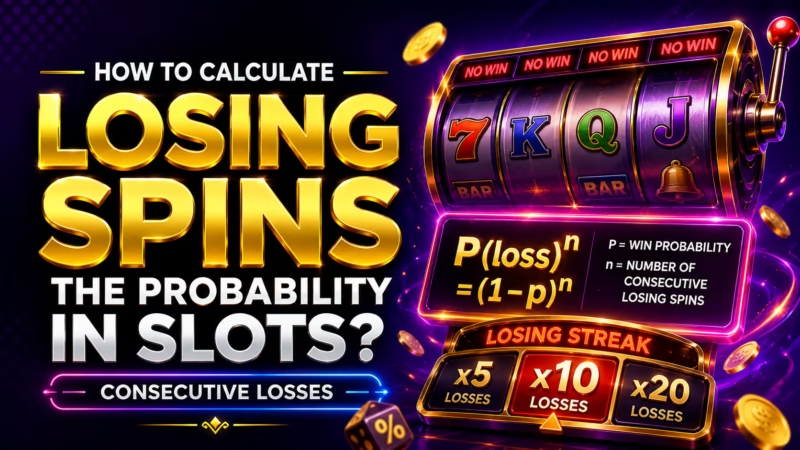
Random slot outcomes do not need to ‘correct’ themselves after a losing streak within your session. A run of losing spins therefore does not mean a winning spin has become due simply because the historical hit rate appears lower than the theoretical percentage.
This is one of the most important limitations to understand when using hit-frequency data.
Common Mistakes When Checking Slot Hit Frequency
Confusing Hit Frequency With RTP
RTP measures theoretical long-term monetary return. Hit frequency measures how often winning outcomes occur.
A 96% RTP does not mean a slot wins on 96% of spins.
Treating Every Win as Profit
A winning combination may pay less than the original wager.
A $0.30 return from a $1 spin can still be recorded as a hit depending on the game’s definition while producing a net loss of $0.70 on that spin.
Assuming a Published Percentage Predicts a Session
Hit frequency is a probability-based mathematical characteristic.
It does not create a schedule of winning spins.
Estimating the Exact Number From a Small Demo Session
Demo play can help you understand mechanics, animation, bonus features and the general style of a game, but a small number of spins does not reliably reveal the theoretical hit frequency.
Trusting an Unsourced Exact Percentage
If a site lists ‘hit frequency: 31.47%’ but provides no indication that the number comes from the provider or game rules, treat it cautiously.
Precision does not automatically mean accuracy.
How to Use Hit Frequency When Choosing a Slot
Slot hit frequency is most useful when combined with other game characteristics rather than used as a standalone ranking metric.
Hit frequency: How frequently does the mathematical model generate wins?
RTP: What theoretical percentage of total wagers is returned over the long term?
Volatility: How unevenly are payouts distributed?
Paytable: How valuable are normal symbol combinations?
Bonus mechanics: How much of the game’s payout potential is concentrated in free spins, multipliers or other features?
Maximum win: What is the game’s stated maximum payout potential?
Players who dislike long stretches without winning combinations may prefer games with a higher published hit frequency and lower or medium volatility.
Players who are comfortable with less frequent results may be more interested in games with lower hit frequency or higher volatility.
These characteristics describe the game experience. They do not turn a slot into a predictable or profitable activity.
Where Should You Look First?
When checking a slot’s hit frequency, use this order:
1. Game information and paytable
2. Official provider website or game documentation
3. Casino technical information
4. Reliable independent game databases or reviews
5. Your own observed statistics only as a session-level measurement
If the exact value cannot be verified, it is better to state that the hit frequency is undisclosed than to present an estimate as an official percentage.

How This Information Was Reviewed
Hit frequency should be evaluated together with RTP, volatility, paytable structure and the game’s rules because no single statistic completely describes how a slot behaves.
Exact mathematical specifications should be checked in the official game information, paytable or provider documentation whenever available. Casino operators may sometimes offer different game configurations, so technical values should be verified for the version actually being played.
RTP, volatility and hit frequency are long-term mathematical characteristics. None of them guarantees a particular result, predicts the next spin or removes the randomness of slot outcomes.
Slots should be treated as entertainment rather than a way to make money. Set spending and time limits before playing, and stop if gambling stops being enjoyable or begins affecting money reserved for normal expenses.
FAQ
What is a good hit frequency for a slot?
There is no universally good slot hit frequency. A higher percentage generally means winning combinations occur more frequently, while a lower percentage means wins occur less frequently according to the mathematical model. The size of those wins, RTP and volatility must also be considered before comparing games.
Where can I find a slot’s hit frequency?
Check the slot’s information menu, help section, paytable, official provider page and technical game documentation first. Casino game pages and independent reviews can also provide the statistic, but official developer information is preferable when available.
Do all slot providers publish hit frequency?
No. Many slot providers publish RTP and volatility without revealing an exact hit-frequency percentage. If the provider and game rules do not disclose the number, the theoretical hit frequency may not be publicly available.
Is hit frequency the same as win rate?
The terms are sometimes used interchangeably, but definitions can vary between developers and websites. Before comparing percentages, check whether ‘win rate’ means all winning combinations, profitable spins, bonus triggers or another statistic.
Does a 30% hit frequency mean I win three times every ten spins?
No. A 30% hit frequency represents a theoretical probability across a large sample. Any particular sequence of ten spins may contain zero wins, several wins or another result because individual outcomes remain random.
Does higher hit frequency mean higher RTP?
No. Hit frequency and RTP measure different characteristics. A game can produce frequent small wins while having a lower RTP than another game that produces less frequent but larger payouts.
Can I calculate a slot’s hit frequency myself?
You can calculate the observed hit frequency of your own sample by dividing winning spins by total spins and multiplying by 100. The result measures your session only and should not be presented as the slot’s official theoretical hit frequency.
Are bonus rounds included in hit frequency?
It depends on how the developer defines and calculates the statistic. Bonus triggers, scatter wins, cascades and other features may be treated differently between games, so check the provider’s rules before comparing exact percentages.
Does hit frequency help predict when a slot will pay?
No. Hit frequency does not predict the timing of future wins. A losing streak does not make a winning spin ‘due,’ and several recent wins do not determine what happens next.
Should I choose slots based on hit frequency?
Hit frequency can help you choose the type of playing experience you prefer, but it should not be the only criterion. Compare hit frequency with RTP, volatility, paytable structure and bonus mechanics, and remember that none of these statistics guarantees a winning session.
Brief Conclusion
The most reliable way to find a slot’s hit frequency is to check the game’s official information, paytable and provider documentation. If the percentage is not published, you can calculate an observed hit rate from your own spins, but it should not be treated as the game’s true mathematical value.
Hit frequency tells you how often winning results theoretically occur, not how much you will win or when the next win will happen. Use it together with RTP and volatility to understand a slot’s playing style, not to predict random outcomes.