There is no single number of spins that guarantees an accurate slot hit frequency estimate. For a practical estimate, several thousand spins are usually far more informative than a few hundred. At a 95% confidence level, if the true hit frequency is around 30%, about 2,000 spins are needed for an error margin of roughly ±2 percentage points, while about 8,000 spins are needed for roughly ±1 percentage point.
If the expected hit frequency is unknown, a more conservative sample-size calculation gives about 2,400 spins for ±2 percentage points and about 9,600 spins for ±1 percentage point at 95% confidence. These figures come from standard statistical methods for estimating a binomial proportion.
Quick Takeaways
- 100 to 500 spins can give a very rough impression, but the uncertainty is large.
- Around 1,000 spins can provide a useful preliminary estimate.
- Around 2,000 to 2,500 spins can often estimate a moderate hit frequency within roughly ±2 percentage points.
- Around 8,000 to 10,000 spins provide a much tighter estimate, often around ±1 percentage point for moderate hit frequencies.
- More spins improve precision, but no finite sample reveals the theoretical hit frequency with certainty.
This type of calculation is useful for players, reviewers, researchers and analysts trying to understand how often a slot produces a defined winning event. It should not be used to predict when a future win will occur or as a strategy for making money from slots. Random game outcomes remain uncertain, and short-term results can differ substantially from long-term probabilities.
What Is Slot Hit Frequency?
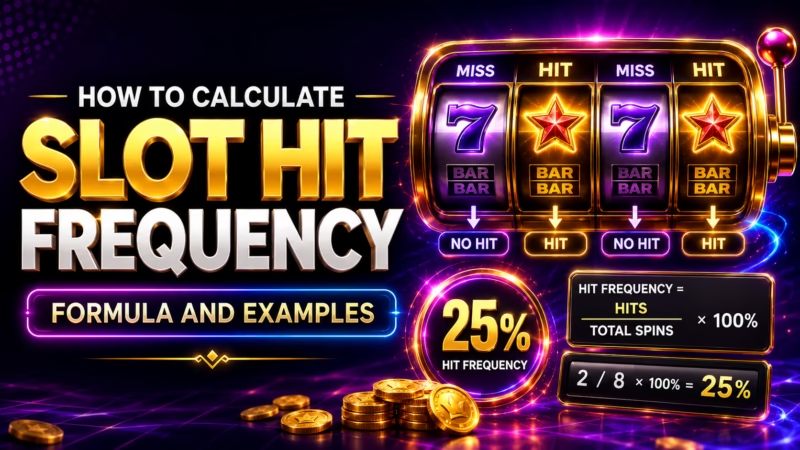
Slot hit frequency is the proportion of spins that produce whatever outcome has been defined as a “hit.”
Hit Frequency = Number of Hits / Total Spins × 100
For example, if 286 of 1,000 recorded spins meet your definition of a hit:
286 / 1,000 × 100 = 28.6%
The important part is defining a hit before collecting the data.
One test might classify every spin with a positive payout as a hit. Another might count only spins where the payout exceeds the wager. A separate test could measure how often a bonus round or specific feature triggers. These are different statistics and should not be mixed.
A binomial proportion is simply the number of defined successes divided by the number of trials. Standard binomial methods assume that every observation can be classified consistently as a success or failure and, for the basic model, that trials have a stable event probability and are independent.

How Many Spins Are Needed to Estimate Slot Hit Frequency?
The required number of spins depends mainly on three factors:
1. Expected hit frequency
2. Desired margin of error
3. Confidence level
The tighter the required estimate, the larger the sample must be.
For example, estimating a slot at 30% ±5 percentage points requires far fewer observations than estimating it at 30% ±1 percentage point.
Using the standard large-sample approximation for a proportion at a 95% confidence level produces the following approximate requirements.
| Desired precision | If hit frequency is about 30% | Conservative estimate if frequency is unknown |
| ±5 percentage points | 323 spins | 385 spins |
| ±3 percentage points | 897 spins | 1,068 spins |
| ±2 percentage points | 2,017 spins | 2,401 spins |
| ±1 percentage point | 8,068 spins | 9,604 spins |
The conservative column assumes a 50% probability because a binomial proportion has its maximum variance around 50%. This gives a useful sample-size target when the approximate hit frequency is not known beforehand.
Is 1,000 Spins Enough to Estimate Hit Frequency?
One thousand spins can give a reasonable preliminary estimate, but it normally is not enough for high precision.
Suppose the underlying hit frequency is approximately 30%. With 1,000 independent observations, the approximate 95% margin of error is about ±2.8 percentage points.
A measured hit frequency close to 30% after 1,000 spins therefore should not be interpreted as proof that the theoretical value is exactly 30%.
Approximate uncertainty at an assumed 30% hit frequency looks like this:
| Spins | Approximate 95% margin of error |
| 100 | ±9.0 percentage points |
| 500 | ±4.0 percentage points |
| 1,000 | ±2.8 percentage points |
| 2,500 | ±1.8 percentage points |
| 5,000 | ±1.3 percentage points |
| 10,000 | ±0.9 percentage points |
| 25,000 | ±0.6 percentage points |
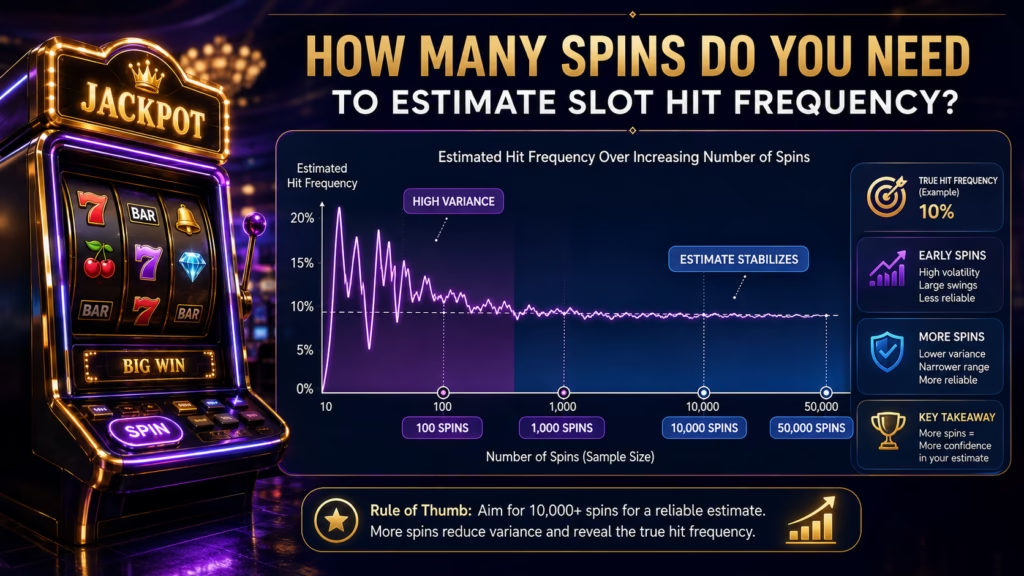
These figures illustrate an important statistical principle: precision improves with the square root of sample size rather than in direct proportion to sample size. Increasing a sample from 1,000 to 2,000 spins helps, but halving the statistical error requires roughly four times as much data under the same assumptions.
Why 100 Spins Can Be Misleading
One hundred spins are normally too few to make a precise claim about slot hit frequency.
If the true probability were around 30%, the approximate 95% sampling error after only 100 observations would be close to ±9 percentage points.
That means results such as 22%, 30% or 37% would not automatically demonstrate that different versions of the slot have genuinely different theoretical hit frequencies. Ordinary random variation can produce substantial differences in small samples.
This is why statements such as “the slot hit only 21 times in my last 100 spins, so its hit frequency is 21%” confuse observed hit frequency with theoretical hit frequency.
The 21% figure correctly describes that particular sample. It does not establish that 21% is the game’s underlying mathematical probability.
How to Calculate the Required Number of Spins
For a large-sample estimate of a proportion, a common approximation is:
n = z² × p × (1 – p) / E²
Where:
- n = required number of spins
- z = statistical value for the chosen confidence level
- p = expected hit frequency as a decimal
- E = desired absolute margin of error
For a 95% confidence level, the commonly used normal critical value is approximately 1.96.
Example: Estimating a 30% Hit Frequency Within ±2%
Assume:
- p = 0.30
- E = 0.02
- z = 1.96
Then:
n ≈ 1.96² × 0.30 × 0.70 / 0.02²
n ≈ 2,017 spins
So approximately 2,017 observations are required for a 95% confidence interval with an expected margin of about ±2 percentage points under those assumptions.
This does not mean spin number 2,017 suddenly makes the estimate correct. Statistical precision improves gradually as additional observations are collected.
What If You Do Not Know the Slot’s Expected Hit Frequency?
If the hit frequency is unknown, using 50% in the sample-size formula gives the most conservative standard estimate.
At p = 0.50, the expression p × (1 – p) reaches its maximum. This produces the largest required sample under the basic binomial approximation.
At 95% confidence, that gives approximately:
- 385 spins for ±5 percentage points
- 1,068 spins for ±3 percentage points
- 2,401 spins for ±2 percentage points
- 9,604 spins for ±1 percentage point
Another approach is to run a preliminary sample, such as 500 or 1,000 spins, calculate the observed hit rate and then use that approximate value when planning a larger test.
The second method is more efficient, but the initial estimate is still uncertain and should not be treated as the game’s official mathematical hit frequency.
Rare Bonus Hits Need Different Thinking
Estimating the frequency of a rare feature is harder than simply reporting the overall slot hit rate.
Suppose a particular bonus appears on approximately 5% of qualifying spins. A ±1 percentage point margin would represent a relative uncertainty of about 20% around that 5% rate.
For rare events, researchers should pay attention not only to absolute percentage-point error but also to relative error and the number of actual events observed.
Simple normal confidence intervals for proportions also become less reliable when sample sizes are small or the estimated proportion is close to zero or one. Alternative binomial confidence-interval methods may be preferable in such cases.
This matters when measuring:
- free spins trigger frequency
- jackpot frequency
- rare bonus rounds
- specific symbol combinations
- uncommon modifiers
- maximum-win events
A sample that is adequate for measuring ordinary winning spins may be nowhere near large enough to estimate a very rare feature precisely.
Hit Frequency Is Not the Same as RTP
Hit frequency measures how often a defined event occurs, while RTP measures the proportion of wagered money theoretically or actually returned as prizes over extensive play.
A slot could produce frequent small payouts while allocating relatively little probability to large payouts. Another game could hit less frequently but place more of its return in larger prizes.
Therefore, two games can have similar RTP values and different hit frequencies, or similar hit frequencies and different payout distributions.
RTP is a long-run measure rather than a prediction of what an individual player will receive in a session.
Hit frequency should therefore be analyzed separately from:
- RTP
- volatility
- average payout size
- bonus frequency
- maximum win
- jackpot frequency
No single one of these metrics fully describes how a slot will feel during a short session.
Should You Include Bonus Spins in the Sample?
Bonus and base-game observations should only be combined when the definition of the statistic makes that combination meaningful.
If the goal is to estimate how frequently paid base spins produce any prize, counting individual free spins as additional paid-spin observations can distort the question being measured.
If the goal is to evaluate the behavior of the entire game, bonus activity may need to be tracked separately and then analyzed as part of the complete game structure.
Before recording the first spin, define:
1. What counts as one trial?
2. What counts as a hit?
3. Are free spins separate observations?
4. Are bonus triggers counted as hits?
5. Are payouts smaller than the wager considered hits?
6. Are different bet settings being mixed?
7. Is the same game configuration being used throughout?
Without consistent definitions, a large sample can still produce a misleading statistic.
Common Mistakes When Estimating Slot Hit Frequency
Treating Observed Frequency as the Official Hit Frequency
A sample estimate describes observed results. The theoretical hit frequency comes from the game’s mathematical model, if the developer publishes or otherwise provides that value.
Using Too Few Spins
Several dozen or a few hundred spins can show what happened during that sample, but they normally leave a wide confidence interval.
Changing the Definition of a Hit
A bonus trigger, any payout and a net-positive spin are not automatically the same event.
Stopping When the Result Looks Convincing
Deciding in advance how many observations you plan to record reduces the temptation to stop because the current percentage matches an expectation.
Comparing Slots With Unequal Samples
A result based on 300 spins should not be treated as equally precise as a result based on 10,000 spins.
Using Hit Frequency to Predict the Next Spin
Observed frequencies do not create a schedule for future wins. For genuinely random games, previous wins and losses do not make a specific future result “due.”
A Practical Testing Method
For a useful informal hit-frequency estimate, use a predefined process:
1. Define a hit precisely.
2. Choose the required precision before starting.
3. Use at least several thousand spins when a difference of a few percentage points matters.
4. Record hits and total valid spins separately.
5. Keep game settings and the measured event consistent.
6. Calculate both the observed percentage and an uncertainty range.
7. Separate rare bonuses and special features when necessary.
8. Do not use the sample to predict future wins.
For general editorial comparisons, approximately 2,500 to 5,000 consistently recorded spins can provide a much more defensible estimate than a few hundred spins. If the goal is to distinguish values separated by only about one percentage point, a sample closer to 10,000 spins may be more appropriate.
Professional game validation is a different task. Operators, developers and testing laboratories can use game mathematics, simulations and much larger operational datasets rather than relying on one player’s manual sample.
How This Information Was Reviewed
The estimates in this guide are based on standard statistical methods for estimating binomial proportions, including sample size, confidence intervals and the relationship between sample size and uncertainty.
Casino-specific distinctions between short-term results, theoretical game characteristics and long-run monitoring were considered when framing the practical recommendations.
The exact theoretical hit frequency of an individual slot should be checked in official game information when the developer provides it. A manually observed sample cannot guarantee the underlying probability, and hit frequency does not predict the outcome of the next spin.
Slots should be treated as entertainment rather than a source of income. Set spending and time limits before playing, and stop if gambling stops being recreational.
FAQ
How many spins do you need to estimate slot hit frequency?
Around 2,000 to 2,500 spins can provide a useful estimate with approximately ±2 percentage points of precision at 95% confidence for moderate hit frequencies. Around 8,000 to 10,000 spins may be required for approximately ±1 percentage point. The exact number depends on the underlying hit probability and the required precision.
Are 100 spins enough to calculate slot hit frequency?
One hundred spins can calculate the observed hit frequency for those 100 spins, but the estimate of the underlying probability will be imprecise. At an assumed 30% hit frequency, the approximate 95% sampling error is about ±9 percentage points.
Are 1,000 spins enough to test a slot?
One thousand spins can provide a useful preliminary hit-frequency estimate. At an underlying frequency around 30%, the approximate 95% margin of error is about ±2.8 percentage points. More spins are needed when smaller differences matter.
How do you calculate slot hit frequency?
Divide the number of defined hits by the total number of eligible spins and multiply by 100. If 275 of 1,000 spins are hits, the observed hit frequency is 27.5%.
Does hit frequency tell you how often you will win money?
No. Hit frequency only measures how often the defined hit event occurs. Depending on the definition, a hit does not necessarily mean the payout exceeds the wager. Hit frequency also does not predict when the next payout will occur.
Is hit frequency the same as RTP?
No. Hit frequency measures event frequency, while RTP measures the percentage of stakes returned as prizes over long-run play. A game can have frequent small hits without having a higher RTP.
Can 10,000 spins reveal the exact hit frequency?
No. Ten thousand spins can produce a relatively precise estimate, but it is still a sample. If the underlying hit frequency is about 30%, 10,000 observations correspond to an approximate 95% sampling error of about ±0.9 percentage points.
Do rare bonus features require more spins?
Rare bonus features can require very large samples if you want a precise relative estimate. The fewer times an event occurs, the more sensitive its estimated frequency is to a small number of additional or missing events. Standard normal approximations also need extra caution when probabilities are close to zero.
Can previous spins help predict the next hit?
No reliable prediction of the next random spin follows from the observed hit frequency. For random games, previous wins or losses do not make a particular future outcome due.
Should free spins count when calculating hit frequency?
Only if they fit the definition of the statistic being measured. For paid-spin hit frequency, it is usually clearer to keep paid base spins, bonus triggers and individual free spins as separate measurements rather than combining unlike events.
Short Conclusion
There is no universal minimum number of spins for estimating slot hit frequency. About 2,000 to 2,500 spins can be enough for a useful ±2 percentage-point estimate, while roughly 8,000 to 10,000 spins may be needed to approach ±1 percentage-point precision at 95% confidence. Small samples can describe what happened, but they cannot reliably reveal the slot’s theoretical hit frequency. Define a hit consistently, calculate uncertainty alongside the observed percentage, separate rare features when necessary and never use hit frequency to predict future random outcomes.