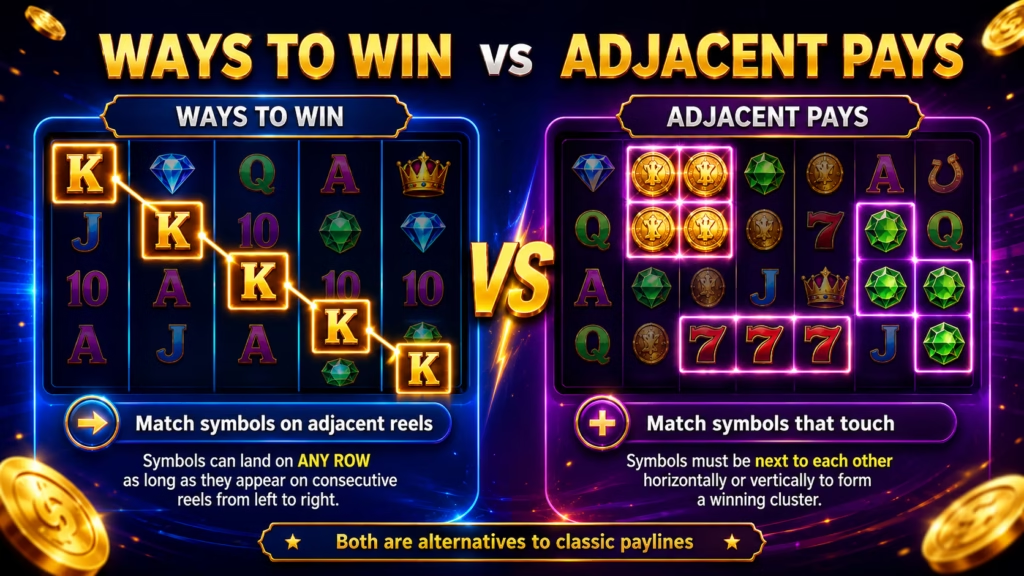
Ways to Win and Adjacent Pays are two slot payout systems that determine where matching symbols must land to create a winning combination. In a standard Ways to Win slot, matching symbols usually need to appear on consecutive reels, commonly starting from the leftmost reel. Adjacent Pays can remove that starting-reel requirement, allowing qualifying combinations to form on other sets of neighboring reels or positions, depending on the specific game rules.
The most important difference is not the number of symbols on the screen. It is where a valid combination is allowed to start and how matching symbols must connect.
Quick takeaways
- Ways to Win normally replaces fixed paylines with combinations across consecutive reels.
- Adjacent Pays focuses on matching symbols appearing next to each other according to the game’s adjacency rules.
- Some Any Adjacent Pays games allow a winning combination to begin away from reel 1.
- Adjacent does not always mean the same thing. Some games use reel-to-reel adjacency, while grid-based games may define horizontal, vertical or other connections.
- Neither mechanic guarantees more winnings, a higher RTP or more profitable play. The paytable and mathematical model determine the actual payout behavior.
Players who find fixed paylines restrictive may prefer either mechanic because both can make the winning pattern easier to understand visually. However, the exact paytable should always be checked because similar labels can describe different rules in different slots.
What Does Ways to Win Mean in Slots?
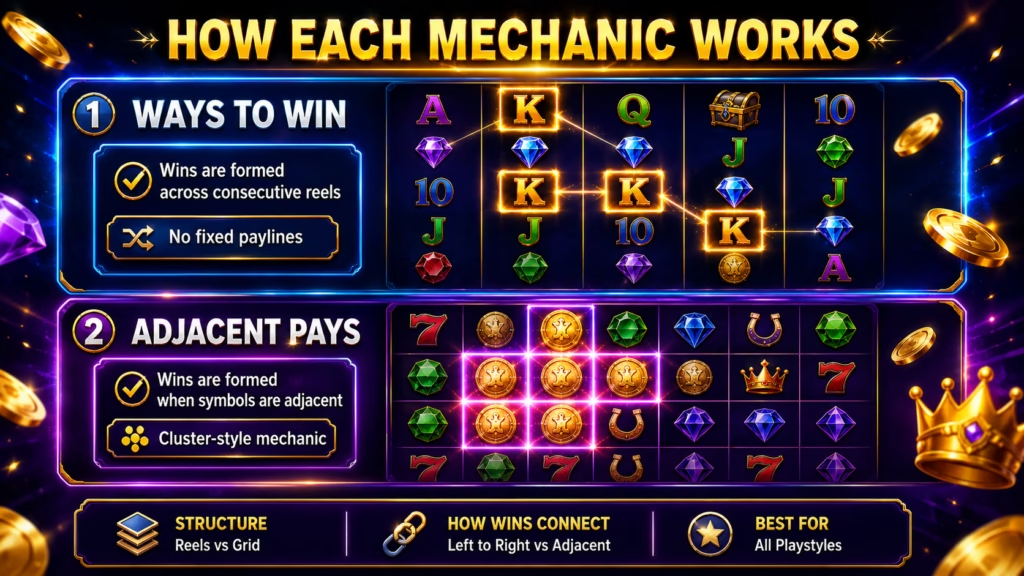
Ways to Win is a payout mechanic where symbol positions create winning combinations without following predetermined paylines. A typical Ways to Win game pays when matching symbols appear on consecutive reels in qualifying positions.
For example, imagine a five-reel slot where a matching symbol appears:
- twice on reel 1
- once on reel 2
- three times on reel 3
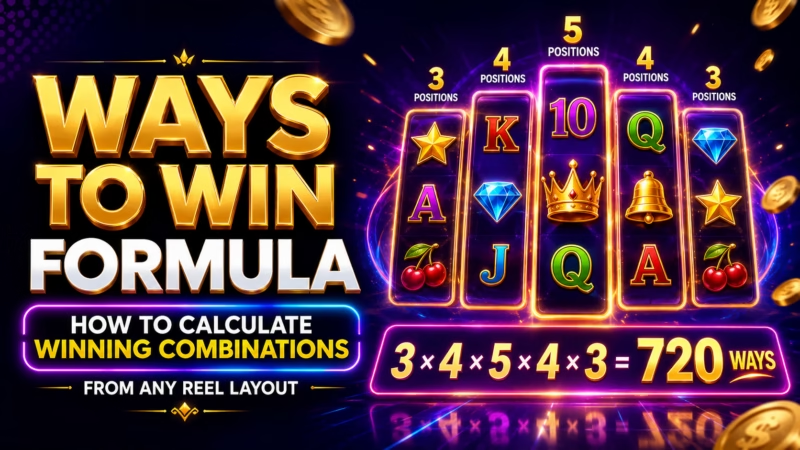
If three matching reels are enough to pay, those symbol positions can create multiple separate winning ways. The game calculates the combinations from the qualifying symbols rather than checking whether they sit on a specific diagonal, horizontal or zigzag payline.
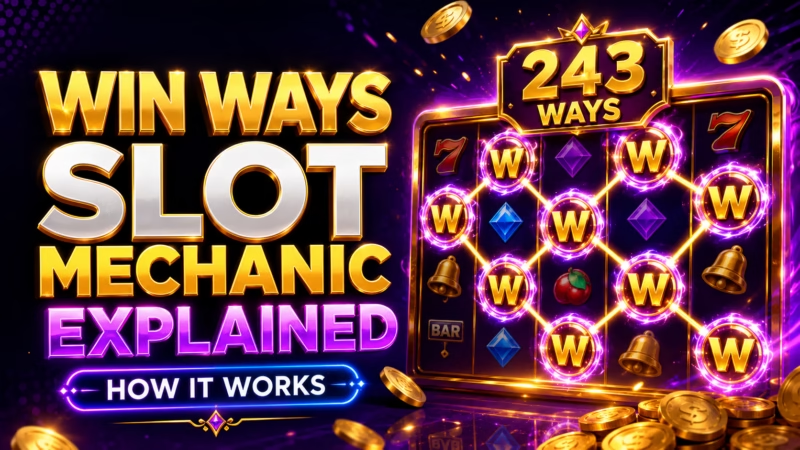
This is why games can advertise figures such as 243, 576, 1,024 or thousands of ways to win.
The important detail is that the advertised number describes possible symbol combinations under that game’s rules. It does not mean the slot will produce that many wins, nor does a larger number automatically mean a higher RTP or better odds during an individual session.
What Does Adjacent Pays Mean in Slots?
Adjacent Pays means matching symbols must occupy neighboring reels or positions instead of following a conventional fixed payline. The exact definition of “adjacent” depends on the slot.
In a reel-based Adjacent Pays game, three matching symbols might qualify when they appear on reels 2, 3 and 4, even though none appears on reel 1. Some Adjacent Pays games can pay matching symbols on adjacent reels from left to right, right to left or across the center reels.
This is a major distinction from many conventional Ways to Win systems, where a regular symbol win normally begins from the left side of the grid.
Some games use the more specific Any Adjacent Pays format. In this format, winning combinations may be formed by three or more matching symbols on adjacent reels and can sometimes occur away from the leftmost reel.
However, players should not assume every game labeled Adjacent Pays uses exactly those rules. In some grid designs, adjacency can refer to symbols touching horizontally or vertically, and individual games may introduce their own conditions.
Ways to Win vs Adjacent Pays at a Glance
| Feature | Ways to Win | Adjacent Pays |
| Fixed paylines required | Usually no | Usually no |
| Matching symbols required | Yes | Yes |
| Consecutive positions required | Usually consecutive reels | Neighboring reels or positions |
| Must normally start from reel 1 | Often yes | Not necessarily |
| Can a win start in the middle | Usually not in standard left-to-right Ways | Often possible in Any Adjacent Pays |
| Number of possible combinations advertised | Common | May also be shown |
| Exact rule varies by game | Yes | Yes |
The safest way to compare the two mechanics is therefore to ask one question: where is the first qualifying symbol allowed to appear?
If a three-symbol combination must occupy reels 1, 2 and 3, the mechanic behaves like a conventional left-to-right Ways system. If reels 2, 3 and 4 or reels 3, 4 and 5 can independently form the same win, the game is using a broader adjacent-pays rule.
Example of the Difference Between Ways to Win and Adjacent Pays
Consider a five-reel slot and the following result:
Reel 1: no matching symbol
Reel 2: Diamond
Reel 3: Diamond
Reel 4: Diamond
Reel 5: another symbol
In a conventional Ways to Win game that requires regular wins to begin on reel 1, the three Diamonds on reels 2, 3 and 4 would not create a normal three-of-a-kind win.
In an Any Adjacent Pays game where matching symbols can start on any reel, the same Diamonds could qualify because they occupy three neighboring reels.
Now consider:
Reel 1: Diamond
Reel 2: Diamond
Reel 3: Diamond
Both systems may award the combination because the symbols appear consecutively from the first reel.
This example shows why two slots with visually similar reel layouts can behave differently even when neither uses traditional paylines.
Does Ways to Win Always Start From the Left?
Many Ways to Win slots calculate standard symbol combinations from the leftmost reel, but this is not a universal rule that should be assumed without checking the paytable.
A Ways system defines how combinations are counted, while the individual game rules define the direction and starting position required for a payout. Some games may introduce both-way payouts or other modified rules.
That wording matters. A player should not infer the direction of payment solely from a label such as 576 Ways, 2,000 Ways or Megaways.
Can Adjacent Pays Start on Any Reel?
Some Adjacent Pays systems allow wins to start away from reel 1, but “Adjacent Pays” should not automatically be interpreted as “any symbols anywhere on the screen.”
The symbols must still satisfy the game’s connection rules.
For example, if a game requires three matching symbols across adjacent reels, symbols on reels 1, 3 and 5 would normally fail because gaps separate them. By contrast, identical symbols on reels 2, 3 and 4 could qualify under an Any Adjacent Pays system that permits combinations to begin anywhere.
The correct interpretation should always come from the game’s own rules screen or paytable.
Is Adjacent Pays the Same as Cluster Pays?
Adjacent Pays and Cluster Pays should not automatically be treated as the same mechanic. Both involve neighboring symbols, but the structure used to evaluate a win can be very different.
A reel-based Adjacent Pays slot may still evaluate matching symbols across consecutive reels. Cluster Pays normally evaluates groups of touching matching symbols on a grid and may require a minimum cluster size.
For example, a cluster-style slot may use a 7×7 grid where five or more matching adjacent symbols are required for a win.
That is structurally different from a five-reel Any Adjacent Pays slot where three matching symbols on consecutive neighboring reels can pay.
Players should therefore separate three concepts:
- Ways to Win, combinations across reels without fixed paylines.
- Adjacent Pays, matching symbols connected according to adjacent-position rules.
- Cluster Pays, groups of connected symbols evaluated as clusters.
The names can sound similar because all three remove or reduce dependence on conventional paylines, but their winning rules are not interchangeable.
Is Adjacent Pays the Same as Megaways?
No. Megaways and Adjacent Pays describe different aspects of a slot’s mathematical structure.
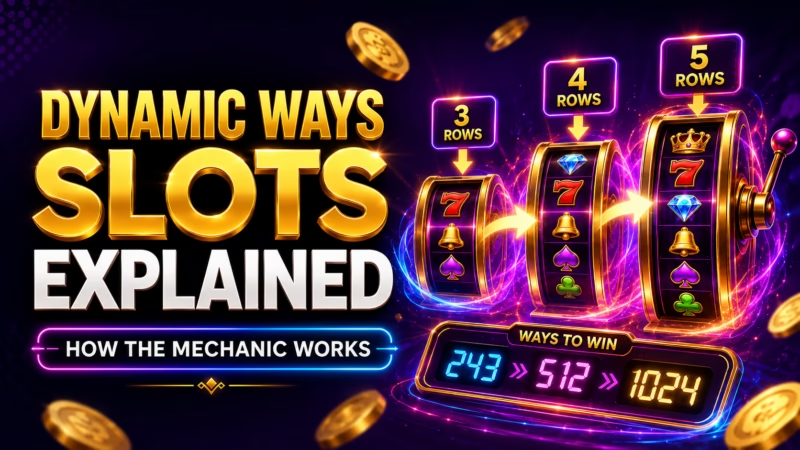
Megaways commonly changes the number of symbols appearing on reels from spin to spin, which changes the number of available winning ways. Some Megaways games can provide very large numbers of possible combinations.
Adjacent Pays instead describes where matching symbols are allowed to connect or begin.
A game can therefore combine a variable-reel system with specific adjacency rules. Seeing “Megaways” in the title does not tell you everything about where a regular symbol win is allowed to start.
Does Adjacent Pays Give You a Better Chance of Winning?
Adjacent Pays may create more locations where a combination can qualify compared with an otherwise identical left-to-right rule, but that does not mean an Adjacent Pays slot is automatically more favorable to the player.
Slot mathematics can compensate for a flexible winning rule through symbol probabilities, payout values, bonus frequency, volatility, reel configuration and other variables.
The same principle applies to Ways to Win. A game advertising thousands of ways is not necessarily more generous than one advertising hundreds.
Do not judge a slot by the number of ways alone. Check:
- RTP, if disclosed for the version being played
- volatility
- symbol payouts
- minimum symbols required for a win
- whether wins begin from reel 1 or anywhere
- wild behavior
- bonus and free-spin rules
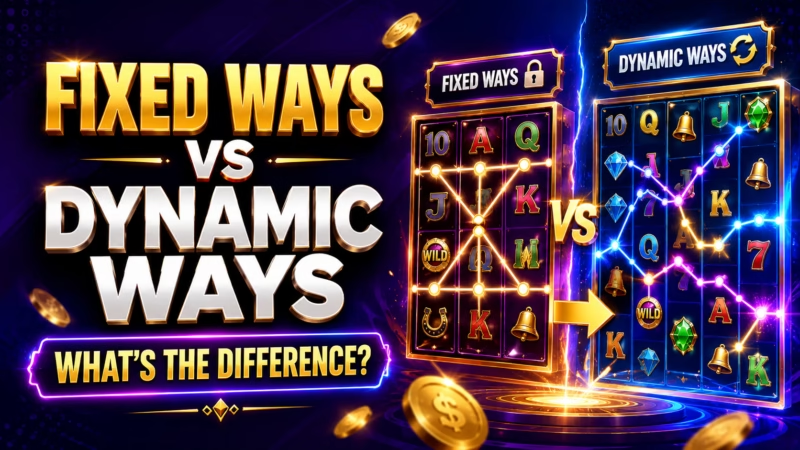
- whether the number of ways is fixed or variable
RTP represents a theoretical long-term return built into a specific game configuration. It does not predict whether a particular spin or session will end in a win.
Which Mechanic Is Easier to Understand?
Ways to Win is usually easier for players familiar with traditional reel slots, while Adjacent Pays may require closer attention to the exact connection rules.
A basic Ways game can often be understood as: match the same symbol across consecutive reels without worrying about a visible payline.
An Any Adjacent Pays game adds another question: where can that sequence begin?
That additional freedom may make the grid feel less restrictive because a matching group in the center of the reels may still matter. However, the mechanic can also become more complex when a provider combines adjacency with expanding grids, cascades, mystery symbols, wilds or special features.
For beginners, the simplest approach is to open the paytable before playing and find the section titled Winning Combinations, Ways, Adjacent Pays or similar wording.
Common Misconceptions About Ways to Win and Adjacent Pays
“More ways means a higher RTP”
Not necessarily. The number of possible winning combinations and RTP are different mathematical properties. A provider can alter payout values and probabilities while keeping the same basic Ways format.
“Adjacent Pays means every pair of touching symbols pays”
No. The game can require three, four, five or another number of matching symbols, and it may restrict the permitted direction of connection.
“Adjacent Pays is just another name for Cluster Pays”
Not reliably. Some Adjacent Pays games evaluate neighboring reels, while Cluster Pays games generally evaluate groups of connected symbols on a grid.
“If a slot has more winning positions, I should win more money”
That conclusion cannot be made from the payout mechanic alone. Win frequency and payout size depend on the complete game model, not simply the number of valid patterns.
How to Compare a Ways to Win Slot With an Adjacent Pays Slot
The best comparison is based on the actual paytable rather than the marketing name of the mechanic.
Before playing, check these five points:
- Starting position: Must a regular win begin on reel 1?
- Direction: Does the game pay left to right, both ways or from any neighboring reel set?
- Minimum match: Are three matching symbols enough, or are more required?
- Connection rule: Must symbols occupy consecutive reels, directly touching positions or a larger cluster?
- Payout calculation: Does each individual way pay separately, or does the game calculate the connected group using another formula?
These questions reveal more about how a slot actually behaves than the headline number of paylines or ways.
How This Information Was Reviewed
This comparison is based on how Ways to Win and Adjacent Pays rules are described in game documentation, with particular attention to the required starting position, direction of payment and connection between matching symbols.
Individual slots may implement these systems differently, so the paytable and official game rules should take priority over a general definition. RTP, volatility, ways to win and bonus features describe different parts of the game’s mathematical design and cannot guarantee the result of a spin or session.
Slots should be treated as paid entertainment rather than a way to generate income. Set spending and time limits before playing, and stop if gambling stops being enjoyable or affordable.
FAQ
What is the main difference between Ways to Win and Adjacent Pays?
The main difference is where matching combinations are allowed to form. Standard Ways to Win commonly requires matching symbols across consecutive reels beginning from the left, while some Adjacent Pays systems allow the sequence to begin on other neighboring reels. Exact rules vary by game.
Can a Ways to Win combination appear anywhere on the reels?
Not necessarily. Removing fixed paylines does not automatically remove the starting-reel requirement. Many Ways games still require a winning combination to begin from the leftmost reel.
Can Adjacent Pays create a win on reels 2, 3 and 4?
Yes, some Any Adjacent Pays games can allow a combination across reels 2, 3 and 4. Whether it qualifies depends on the game’s specific rules.
Does Adjacent Pays mean symbols can appear anywhere?
No. The symbols still have to meet the game’s adjacency requirement. Matching symbols separated by nonmatching reels or positions may not form a valid combination.
Are 243 Ways slots Adjacent Pays slots?
Not automatically. A 243 Ways slot usually counts combinations of matching symbols across its reel positions without fixed paylines. Whether combinations can begin away from the first reel depends on the specific rules.
Is Megaways a type of Adjacent Pays?
No. Megaways primarily refers to a variable reel configuration that can change the number of possible winning ways. Adjacent Pays describes how neighboring matching symbols qualify for payouts.
Is Cluster Pays the same as Adjacent Pays?
Not necessarily. Cluster Pays normally requires a group of connected matching symbols on a grid, while Adjacent Pays may evaluate matching symbols across neighboring reels. Always check the game’s definition of adjacency.
Does having more ways to win improve RTP?
No direct relationship can be assumed. RTP depends on the complete mathematical model, including symbol probabilities and payout values. A slot with thousands of ways can have a lower, similar or higher RTP than a game with fewer ways.
Which is better, Ways to Win or Adjacent Pays?
Neither mechanic is inherently better. Ways to Win may appeal to players who want a simple reel-based structure without fixed paylines, while Adjacent Pays may appeal to players who like combinations that can start in more areas of the grid. The paytable, RTP, volatility and overall game design matter more than the mechanic’s name.
Short Conclusion
Ways to Win and Adjacent Pays both move beyond traditional fixed paylines, but they change the winning rule in different ways. Ways to Win usually counts combinations across consecutive reels, often from the leftmost reel. Adjacent Pays focuses on neighboring matching symbols and can allow combinations to start elsewhere on the grid.
The practical rule is simple: never rely on the mechanic’s name alone. Check where a combination may start, which positions must be adjacent and how many matching symbols are required. Those details determine what actually counts as a win, while the outcome of every spin remains random.