Random wilds in slots are Wild symbols that appear or are added to the reels through a random game event rather than through a fixed position or predictable sequence. Their main purpose is usually to substitute for eligible regular symbols and create or improve winning combinations, although the exact behavior depends on the individual slot’s rules.
The important point is that random wilds do not appear according to a pattern a player can predict. In regulated online slots, outcomes are determined by the game’s random number generation system, while the slot rules define when and how the Random Wild feature can be applied.
Quick takeaways:
- Random wilds can appear without a separate bonus round.
- They usually substitute for normal paying symbols, but exclusions may apply.
- A random wild may land naturally or be added after the reels stop.
- Some games place one wild, while others can place several.
- Random wilds can improve a spin but do not guarantee a win.
- The exact trigger frequency and behavior depend on the individual slot.
Random wild mechanics are particularly appealing to players who enjoy feature-driven slots where an ordinary base-game spin can suddenly change. Players who prefer completely transparent, predictable reel mechanics may find them less appealing because the timing of the feature is deliberately unpredictable.
What Is a Random Wild in Slots?
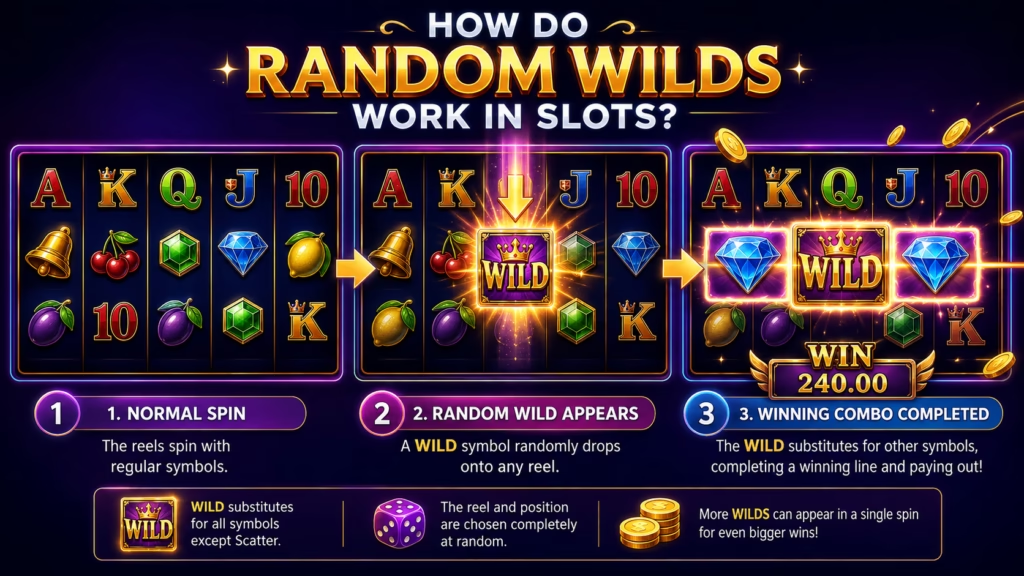
A Random Wild is a Wild symbol that is placed, generated, transformed or activated through a random event defined by the slot’s game logic. Unlike a standard Wild that may simply appear as part of the normal reel layout, a Random Wild feature can modify a spin by adding Wild symbols to selected reel positions.
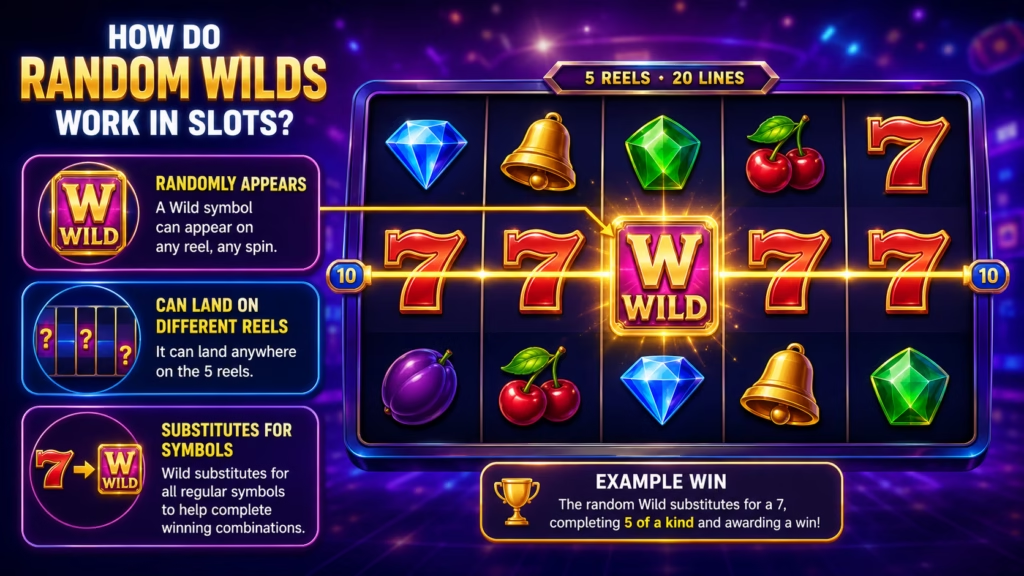
Wild symbols generally substitute for other eligible symbols when the game evaluates winning combinations. For example, if a winning payline requires three matching symbols and the middle position contains a Wild, the Wild may complete that combination.
However, Wild substitution rules are not universal. A Random Wild may be unable to replace Scatter symbols, Bonus symbols, jackpots or other special symbols. The paytable or game rules should always be checked for the exact substitution rules.
How Do Random Wilds Work in Slots?
Random wilds work by activating according to predefined game rules and then selecting one or more eligible positions for Wild symbols. The player normally has no control over whether the feature activates or where the Wild symbols appear.
- The player starts a normal spin.
- The Random Number Generator determines the spin outcome according to the game mathematics.
- The Random Wild feature activates if the conditions for that spin are met.
- One or more eligible reel positions are selected.
- Wild symbols are added or existing symbols are converted into Wilds.
- The game evaluates the final layout and calculates any resulting win.
The visible animation may make it appear that Wild positions are being chosen after the reels stop. The actual technical implementation can vary between games, so the animation should not be interpreted as evidence that a player can influence the selection.
Can Random Wilds Appear on Any Spin?
Random wilds may be available during ordinary base-game spins, bonus rounds or both, depending on the slot.
Some slots allow the feature to trigger apparently without warning during regular gameplay. Others activate Random Wilds only after another condition has been satisfied, such as landing a particular symbol or entering Free Spins.
The distinction matters because the phrase “Random Wild” describes how the Wild is generated or positioned, not necessarily when the feature is available.
- during normal paid spins;
- before the reels begin spinning;
- after the reels have stopped;
- during Free Spins;
- as part of another bonus feature;
- after a special symbol lands;
- as part of a modifier selected for that spin.
The game’s official rules are the reliable source for determining which version applies.
Do Random Wilds Guarantee a Winning Spin?
Random wilds do not guarantee a winning spin. A Wild is useful only when its position contributes to a valid winning combination under the slot’s pay system.
For example, imagine a five-reel slot where a Random Wild is placed on reel four. If the symbols on reels one through three do not form the beginning of an eligible combination, the added Wild may have no effect at all.
- create a new winning combination;
- extend an existing combination;
- increase the value of a combination;
- contribute to multiple wins simultaneously;
- appear without creating any additional payout.
Wild symbols can improve the potential of an individual reel layout, but they do not turn every affected spin into a winner.
How Are Random Wild Positions Selected?
Random Wild positions are normally selected according to the game’s programmed random mechanics. Players cannot determine which reel or symbol position will receive a Wild by changing spin timing, stopping reels manually or following previous results.
The number of eligible positions can also be restricted. A game might allow Random Wilds only on reels two through four, for example, or prevent Wilds from replacing certain special symbols.
Because implementations differ considerably, players should not assume that Random Wild behavior in one slot applies to another.
Random Wilds vs Standard Wilds
The main difference between Random Wilds and standard Wilds is how they enter the game.
| Wild type | Typical behavior |
| Standard Wild | Appears as part of the normal reel outcome |
| Random Wild | Added or activated through a random feature |
| Expanding Wild | Expands to cover additional positions |
| Stacked Wild | Multiple Wild symbols appear together in a stack |
| Sticky Wild | Remains in position for additional spins |
| Walking Wild | Moves between positions or reels |
| Multiplier Wild | Adds a multiplier when involved in a qualifying win |
A slot can also combine these mechanics. For example, a randomly placed Wild could subsequently expand, become sticky or carry a multiplier.
Because of these hybrid designs, “Random Wild” should not automatically be interpreted as a simple single-symbol Wild.
Different Types of Random Wild Features
Randomly Placed Wilds
The most straightforward version places one or more Wild symbols onto randomly selected eligible positions.
The number of Wilds may be fixed or may vary by activation. Players should check the rules rather than assuming that every trigger adds the same quantity.
Random Wild Transformations
Some slots select ordinary symbols already visible on the reels and convert them into Wilds.
This can be particularly noticeable when several positions are transformed at once because the final reel layout may look substantially different from the original result.
Random Wild Reels
Instead of selecting individual positions, a feature may turn an entire reel or a large part of a reel Wild.
This can potentially affect several combinations at the same time, although its actual value depends on the surrounding symbols and the game’s payout system.
Random Wilds During Free Spins
Free Spins may use Random Wilds as an additional modifier. Depending on the game, Wilds could be added on every free spin, selected free spins or only after another trigger.
A feature being available during Free Spins does not mean that each free spin will produce a payout.
Random Wilds With Multipliers
Some Wilds carry multipliers that increase qualifying wins involving the Wild.
The multiplier rules can differ significantly. Multiple Wild multipliers might be added together, multiplied together or handled using another calculation defined by the game. The paytable should be checked before assuming how several multipliers interact.
Are Random Wilds Truly Random?
Random Wild features in online slots are generally tied to the game’s random outcome generation and programmed mathematical rules. What players see on screen is the visual representation of that underlying game logic.
Random does not mean that every possible outcome has the same probability. Slot developers can design different symbols, events and bonus mechanics with different probabilities while still using random outcome generation.
This distinction is important. A Random Wild feature can be genuinely unpredictable from the player’s perspective without having an equal chance of appearing on every reel position or every spin.
Unless the provider publishes detailed mathematical information, players generally cannot determine the exact Random Wild activation probability from ordinary gameplay.
How Often Do Random Wilds Appear?
There is no universal Random Wild frequency across slots. The probability is determined by the mathematics of each individual game.
A feature that appears frequently in one slot could be relatively rare in another. Even when a Random Wild seems common during a short session, that observation does not establish the long-term probability of the feature.
Short-term results are particularly unreliable because random games naturally produce clusters and gaps. Several Random Wild activations can occur close together, followed by a long period without one.
If the provider publishes a feature frequency or similar statistic, that information is more useful than estimating frequency from a limited number of spins.
Do Random Wilds Affect RTP?
Random Wild mechanics can form part of a slot’s overall mathematical model and therefore contribute to how the game’s theoretical RTP is distributed across different outcomes.
However, a player cannot determine a slot’s RTP simply by counting how many Wild symbols appear. RTP reflects the theoretical long-term return built into the entire game, including base-game wins, symbols, bonuses, Wild features and other mechanics.
A slot with frequent Random Wilds does not automatically have a higher RTP than one with fewer Wilds.
The exact RTP may also differ between approved game configurations or operators in some markets. Players should check the information displayed in the specific version of the game they are playing.
Do Random Wilds Change Slot Volatility?
Random Wilds can influence how a slot distributes payouts, but the existence of the mechanic alone does not reveal whether a game has low, medium or high volatility.
A developer could use frequent modest Wild enhancements in one mathematical model or rare but powerful Wild combinations in another.
The practical difference is substantial. A slot where Random Wilds regularly create small improvements may feel very different from a game where several Wilds occasionally combine with multipliers for much larger potential outcomes.
Volatility should therefore be evaluated at the game level rather than inferred from the name of a single feature.
Example of How a Random Wild Can Change a Spin
Consider a simplified five-reel slot where a winning combination needs matching symbols on consecutive reels from left to right.
Suppose the spin produces: A – A – K – A – Q
Without a Wild, the sequence may stop after the first two matching A symbols.
If the game randomly transforms the K on reel three into a Wild, the result becomes: A – A – WILD – A – Q
The Wild may substitute for A and allow the game to evaluate a four-symbol combination.
This example illustrates what the mechanic does, but it does not represent the rules of every slot. Ways-to-win games, cluster-pay slots and other formats can evaluate Wild symbols differently.
Common Myths About Random Wilds
“Random Wilds appear when the slot is ready to pay”
Random Wilds should not be interpreted as a signal that a larger win is approaching. Previous spins do not provide a reliable method of predicting future random outcomes.
“More Random Wilds means a better RTP”
A visible feature does not determine RTP by itself. Two games can use similar Wild mechanics while having different mathematical models.
“A Random Wild always improves the spin”
A Random Wild may appear in a position that does not contribute to a valid winning combination.
“Stopping the reels can change where the Wild lands”
Visual reel stopping should not be treated as a method of controlling a Random Wild outcome. The mechanics are governed by the game’s programmed outcome system.
“A long period without Random Wilds means one is due”
Random games do not owe the player a feature because it has not appeared recently. A long gap does not prove that the probability on the next spin has increased.
What Should You Check Before Playing a Slot With Random Wilds?
The most useful information is normally found in the slot’s paytable and game rules.
- which symbols the Wild can substitute for;
- which reels can receive Random Wilds;
- whether multiple Wilds can appear;
- whether the feature works in the base game, Free Spins or both;
- whether Wilds can expand, stick or move;
- whether Wilds carry multipliers;
- how several Wild modifiers interact;
- the displayed RTP;
- the stated volatility, when provided;
- Free Spins and bonus rules;
- the betting range.
These details provide more useful information than simply knowing that the game contains Random Wilds.
Who May Like Random Wild Slots?
Slots with Random Wilds may appeal to players who prefer feature-driven games where regular spins can be modified without entering a separate bonus round.
They may be especially appealing to players who enjoy:
- changing reel layouts;
- frequent visual modifiers;
- Wild-based combinations;
- Free Spins with additional mechanics;
- unpredictable bonus events.
Players who prefer simpler slots with fewer modifiers may prefer conventional Wild mechanics instead.
Neither format provides a reliable advantage. The choice is primarily about the style of gameplay a player enjoys.
Practical Tips for Understanding Random Wild Games
Read the paytable before assuming how a Random Wild behaves. The same feature name can represent noticeably different mechanics between providers.
Separate feature frequency from feature value. A Wild that appears frequently is not necessarily more valuable than a rarer Wild mechanic.
Do not judge probabilities from a small number of spins. Random outcomes naturally produce uneven sequences.
Check RTP and volatility separately. Random Wilds are only one component of the game’s mathematical structure.
Set spending and time limits before playing with real money. Feature-heavy slots can create frequent anticipation, but additional features do not remove the underlying risk of losing money.
How This Information Was Reviewed
The Random Wild mechanic should be evaluated through the game’s Wild substitution rules, eligible reel positions, activation conditions, interaction with bonus features, RTP and volatility rather than through the visual appearance of the feature alone.
Because Random Wild implementations vary between slots, exact activation frequency, Wild quantity, multipliers and excluded symbols should be checked in the official paytable or game rules for the specific game.
RTP, volatility and Random Wild frequency describe aspects of a game’s mathematical design. They cannot predict the result of an individual spin or gaming session.
Slots should be treated as entertainment rather than a way to earn money. Players using real money should establish spending limits in advance and stop when gambling is no longer enjoyable or remains within their planned budget.
FAQ
What are Random Wilds in slots?
Random Wilds are Wild symbols that appear, are added or are created through a random game event. They normally substitute for eligible regular symbols and may help form winning combinations, although exact rules vary between slots.
How do Random Wilds work in slots?
Random Wilds work by activating according to the slot’s programmed rules and placing or creating Wild symbols on eligible reel positions. The player generally cannot control the activation or the positions selected.
Can Random Wilds appear anywhere on the reels?
Not necessarily. Some slots allow Random Wilds across most reel positions, while others restrict them to particular reels or prevent them from replacing special symbols. The game’s paytable should specify the restrictions.
Can more than one Random Wild appear?
Yes, some slots can generate multiple Random Wilds during the same feature activation, while others may place only one. The maximum number depends on the individual game’s rules.
Do Random Wilds guarantee a payout?
No. A Random Wild only produces additional value if its position contributes to a valid winning combination or another qualifying mechanic. A Wild can appear without creating a win.
How often do Random Wilds appear?
There is no standard frequency. Random Wild probability varies between games and usually cannot be estimated accurately from a short playing session. Published game information should be used when a provider makes the frequency available.
Are Random Wilds predetermined?
The precise technical implementation depends on the game, but Random Wild outcomes are governed by the slot’s programmed random game logic. Players cannot reliably predict the next Random Wild from previous spins.
Are Random Wilds the same as Expanding Wilds?
No. “Random” describes how a Wild is activated or positioned, while “Expanding” describes what the Wild does after appearing. A Wild can potentially be both randomly placed and expanding if the game’s rules combine the two mechanics.
Do Random Wilds increase RTP?
Random Wilds can contribute to the mathematical structure behind a slot’s RTP, but their presence does not automatically mean the game has a higher RTP. The displayed RTP for the specific game version is the relevant figure to check.
Can players predict when a Random Wild will appear?
No reliable strategy can predict the next Random Wild from previous spins. Short winning or losing sequences do not provide dependable information about the next random outcome, so players should not increase bets because they believe a feature is “due.”
Short Conclusion
Random wilds in slots are Wild symbols generated or positioned through a random feature rather than a predictable reel pattern. They can complete or improve winning combinations, appear in the base game or bonuses, and sometimes interact with multipliers, Free Spins or other Wild mechanics.
Their exact behavior differs from slot to slot, so the paytable and game rules matter more than the feature name itself. Random Wilds can make gameplay more varied, but they do not guarantee wins, predict future outcomes or provide a way to overcome the mathematical house advantage. Slots should be played as entertainment with clear time and spending limits.