
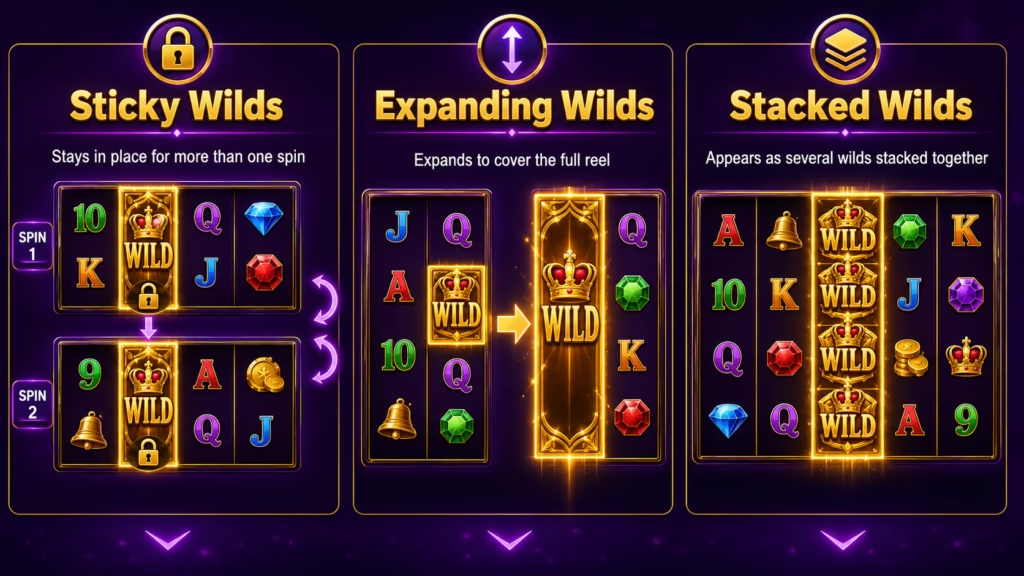
Sticky, expanding, and stacked wilds are three different ways a Wild symbol can behave in a slot. Sticky Wilds remain in position for a defined number of spins or respins, Expanding Wilds grow to cover additional positions, and Stacked Wilds appear as groups of Wild symbols on the same reel.
The main difference is therefore simple: Sticky Wilds are based on persistence over time, Expanding Wilds are based on covering more space, and Stacked Wilds are based on multiple Wild symbols appearing together.
Quick comparison:
- Sticky Wilds: remain fixed for several spins, respins, or part of a bonus feature.
- Expanding Wilds: enlarge after landing, often covering an entire reel or another defined area.
- Stacked Wilds: appear as several adjacent Wild symbols, usually occupying multiple positions on one reel.
- These mechanics can sometimes be combined in the same slot.
- None of these Wild types guarantees a win, and their exact behavior depends on the game’s rules and paytable.
Players who enjoy bonus features and changing reel setups may find Sticky and Expanding Wilds more interesting. Players who prefer a simpler mechanic may find Stacked Wilds easier to understand because the Wild symbols usually appear already grouped together.
What Is a Wild Symbol in Slots?
A Wild is a special slot symbol that usually substitutes for some regular symbols to help form winning combinations. The symbols that a Wild can replace depend on the game, and Wilds often cannot substitute for special symbols such as Scatters, bonus symbols, or jackpots unless the rules specifically allow it.
Wild functionality can be much more complex than simple substitution. Developers may make Wild symbols sticky, expanding, stacked, walking, shifting, multiplier-based, random, or part of a larger bonus mechanic.
For that reason, seeing the word “Wild” in a slot description does not tell you exactly how the feature works. The game’s information screen or paytable should explain what the Wild substitutes for, where it can appear, and whether additional effects are attached to it.
What Are Sticky Wilds?
Sticky Wilds are Wild symbols that remain locked in their positions instead of disappearing immediately after one spin. They normally stay active for a specified number of subsequent spins, respins, or until a particular bonus feature ends.
Imagine a Wild landing on reel 3 during a free spins round. In a standard slot, that Wild would normally disappear when the next spin begins. If the symbol is sticky, it may remain on reel 3 while the remaining symbols continue to spin around it.
This creates a persistent change to the reel layout. Additional Sticky Wilds may sometimes appear during later spins, potentially leaving several fixed Wild positions on the screen.
How Long Do Sticky Wilds Stay?
There is no universal duration for Sticky Wilds. A slot may keep them active:
- for one respin;
- for several respins;
- for a fixed number of free spins;
- until the end of the bonus round;
- until another condition resets the feature.
The exact rule must be checked in the slot’s paytable or feature description.
Sticky Wilds should not automatically be interpreted as a sign that a bonus round will produce a strong payout. They may improve the potential for symbol connections in certain situations, but spin outcomes remain random and the overall mathematical model of the game determines the results.
What Are Expanding Wilds?
Expanding Wilds are Wild symbols that increase in size after appearing on the reels. A common version expands vertically to cover an entire reel, although individual games may use different expansion patterns.
For example, a single Wild may land in the middle position of a three-row reel. The feature can then transform that Wild into a full-reel Wild covering all three positions.
This is fundamentally different from a Sticky Wild. The important characteristic of an Expanding Wild is not how long it remains, but how much reel space it covers after activation.
Do Expanding Wilds Always Cover a Full Reel?
No. Full-reel expansion is common, but an Expanding Wild can behave differently depending on the slot.
- vertical expansion across an entire reel;
- horizontal expansion across a row;
- expansion across selected adjacent positions;
- expansion only during free spins;
- expansion after a specific triggering condition.
Some slots may also require the expanded Wild to contribute to a winning combination before the expansion occurs. Others activate the effect immediately.
Because developers use the term differently, the game’s official rules are more reliable than assuming every Expanding Wild behaves the same way.
What Are Stacked Wilds?
Stacked Wilds are groups of Wild symbols positioned next to each other on the same reel. Instead of one isolated Wild appearing on a reel, several Wild symbols can land as a vertical stack.
For example, a slot with four visible rows might display Wild symbols across three or four consecutive positions on one reel. If multiple reels land Wild stacks at the same time, they may create more opportunities for matching symbols to connect across the reels.
The defining characteristic is the stack itself. A Stacked Wild does not necessarily expand after landing and does not necessarily remain for another spin.
Are Stacked Wilds the Same as Expanded Wilds?
No. Stacked Wilds and Expanding Wilds can look almost identical after the feature has finished activating, but they reach that result differently.
A Stacked Wild may already exist as several Wild positions when the reel stops. An Expanding Wild normally starts as a smaller Wild symbol and then grows according to the feature rules.
This distinction matters when reading a game’s rules because the activation conditions and probabilities can be different even if the final reel appears fully covered by Wild symbols.
Sticky vs Expanding vs Stacked Wilds
The easiest way to understand the difference between sticky, expanding, and stacked wilds is to compare what happens after the Wild appears.
| Wild Type | Main Mechanic | What Happens | Typical Duration |
| Sticky Wild | Persistence | Wild remains fixed in place | Multiple spins or respins |
| Expanding Wild | Expansion | Wild grows across additional positions | Often the current spin |
| Stacked Wild | Grouping | Multiple Wild symbols appear together | Usually the current spin |
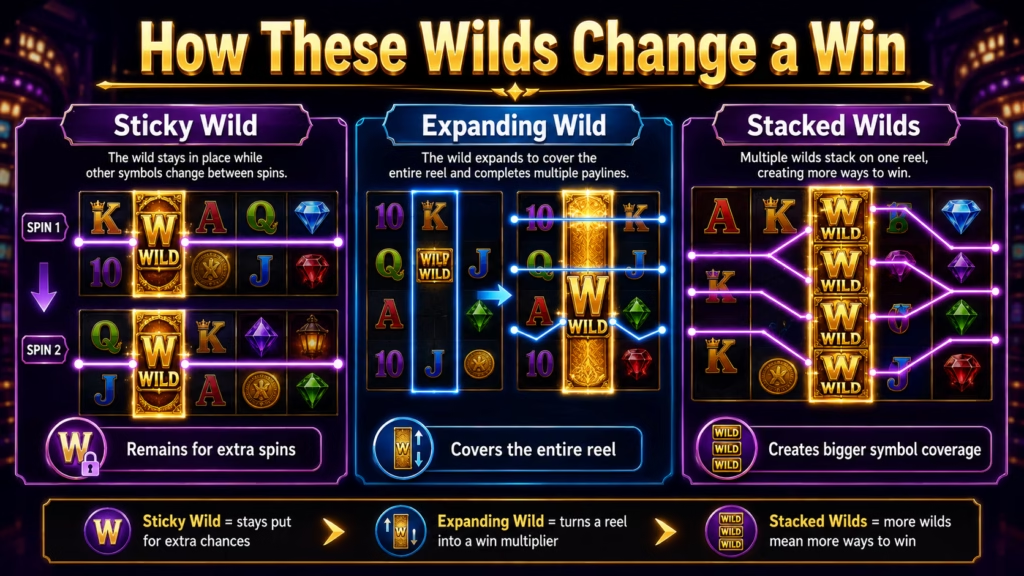
A Sticky Wild changes future spins by remaining on the screen.
An Expanding Wild changes the current reel layout by covering additional positions.
A Stacked Wild changes symbol distribution by placing several Wild symbols together.
These descriptions cover the core mechanics, but individual slots can modify or combine them.
Which Wild Type Creates the Biggest Reel Coverage?
Expanding and Stacked Wilds can both cover large parts of a reel, but the visual result does not determine which mechanic is stronger.
A full-reel Expanding Wild can cover every visible position on a reel. A sufficiently large Wild stack can produce essentially the same visible result. Sticky Wilds may initially cover fewer positions, but their importance comes from remaining active across multiple spins.
The value of any Wild mechanic depends on the full game model, including paylines or ways to win, symbol values, feature rules, reel configuration, volatility, and other modifiers.
A Wild covering more positions should therefore not be treated as automatically better than another Wild type.
Can a Slot Combine Sticky, Expanding, and Stacked Wilds?
Yes. Slot developers can combine different Wild mechanics in the same game or bonus feature.
For example, a Wild might first expand and then remain sticky during subsequent respins. Another game might use stacked Wilds in the base game but introduce Sticky Wilds during free spins.
Hybrid mechanics make the terminology especially important. A symbol can be both expanding and sticky if it first grows and then stays in position.
When several Wild effects are combined, check the feature rules for three things:
- How the Wild appears.
- What happens immediately after it appears.
- How long the Wild remains active.
Those three questions usually make the mechanic much easier to understand.
How Do These Wilds Affect the Playing Experience?
Different Wild mechanics can change how a slot feels even when they all serve the general purpose of helping create symbol combinations.
Sticky Wilds can create progression within a bonus round. When Wild positions remain locked, the reel configuration may gradually change from spin to spin.
Expanding Wilds create an immediate visual transformation. A small symbol can suddenly occupy a much larger part of the grid, making the effect easy to recognize.
Stacked Wilds create concentrated groups of substitution symbols. They can make individual spins look dramatically different when large stacks appear on one or more reels.
These differences affect presentation and feature pacing, but they do not allow players to predict the next result.
Do Wild Types Affect RTP or Volatility?
Wild mechanics can be part of a slot’s overall mathematical design, but the name of the Wild feature alone does not reveal the game’s RTP or volatility.
A slot with Sticky Wilds is not automatically higher RTP than a slot with Stacked Wilds. An Expanding Wild also does not automatically mean lower or higher volatility.
RTP is a theoretical long-term return built into the game configuration. Volatility describes how payouts are distributed in terms of frequency and size. Both depend on the complete mathematical model rather than one feature in isolation.
If RTP or volatility matters when comparing slots, check the information provided for the specific game. RTP may also vary between versions or operators, so the value displayed at the casino should be verified before playing.
Which Wild Type Is Better?
There is no universally better Wild type because Sticky, Expanding, and Stacked Wilds create different types of gameplay.
Sticky Wilds may appeal to players who like features that develop over several spins. Expanding Wilds may suit players who prefer immediate reel transformations. Stacked Wilds may appeal to players who want a straightforward feature that is easy to identify when it lands.
A better comparison is to ask what kind of feature you prefer:
- Choose Sticky Wild-style mechanics if you like persistent bonus progression.
- Look for Expanding Wilds if full-reel or large-area transformations appeal to you.
- Look for Stacked Wilds if you prefer groups of Wild symbols without needing a multi-stage feature.
Preference does not change the random nature of the game. A feature that looks more powerful can already be accounted for in the slot’s mathematics.
Common Myths About Sticky, Expanding, and Stacked Wilds
More Wilds Mean a Slot Has Better RTP
Not necessarily. The number or size of Wild symbols does not by itself determine RTP. Paytable values, reel probabilities, bonus mechanics, jackpots, multipliers, and many other factors can affect the theoretical return.
Sticky Wilds Mean the Next Spin Is More Likely to Win
A Sticky Wild can remain available for the next spin, but that does not guarantee the remaining symbols will form a winning combination. The next spin still follows the game’s random outcome generation.
Expanding Wilds Are Always Better Than Normal Wilds
An Expanding Wild may cover more positions, but the slot’s mathematical model accounts for the feature. Visual coverage should not be confused with guaranteed value.
Stacked Wilds Always Fill the Entire Reel
No. A stack can contain several Wild symbols without covering every visible position. The maximum stack size depends on the game’s reel design and rules.
Wild Features Can Be Used to Predict Wins
Wild mechanics explain how special symbols behave after the game generates an outcome. They do not provide a reliable method for predicting future spins.
What Should You Check Before Playing a Slot With Special Wilds?
The most useful information is usually found in the game’s paytable, help screen, or feature rules.
Check:
- which symbols the Wild can substitute for;
- which reels can contain Wilds;
- whether the Wild works in the base game, bonus game, or both;
- how Sticky Wilds are activated and how long they remain;
- what causes Expanding Wilds to expand;
- how large Stacked Wilds can become;
- whether Wilds carry multipliers or additional effects;
- whether several Wild mechanics can interact;
- the displayed RTP, if available;
- the game’s volatility information, if provided.
Understanding these rules tells you what the feature actually does without assuming that a visually dramatic mechanic produces better results.
How This Information Was Reviewed
The comparison between Sticky, Expanding, and Stacked Wilds is based on the defining behavior of each mechanic: persistence, expansion, and grouped placement.
Individual slot developers can implement these features differently, so the exact behavior should always be checked in the game’s paytable or official rules. This is especially important for duration, reel restrictions, Wild substitutions, multipliers, free-spin interactions, and bonus conditions.
RTP, volatility, Wild frequency, and bonus features do not predict the outcome of an individual spin. Slots should be treated as entertainment rather than a way to make money. If you choose to play, set spending and time limits in advance and stop when gambling is no longer enjoyable or affordable.
FAQ
What is the main difference between Sticky, Expanding, and Stacked Wilds?
Sticky Wilds remain in place across specified spins or respins, Expanding Wilds grow to cover additional positions, and Stacked Wilds appear as multiple adjacent Wild symbols. The exact implementation depends on the slot’s rules.
Do Sticky Wilds stay for the entire bonus round?
Sticky Wilds sometimes remain until a bonus round ends, but this is not a universal rule. Some slots keep them for only one or several respins. Check the feature description to see exactly when Sticky Wilds are removed.
Can an Expanding Wild become a full-reel Wild?
Yes, many Expanding Wild mechanics allow one Wild to cover an entire reel. However, some games use partial, horizontal, or conditional expansion instead, so the game’s paytable should be checked.
Are Stacked Wilds multiple separate Wild symbols?
Yes. Stacked Wilds generally consist of several Wild positions placed consecutively on the same reel. The size of the stack can vary by game and does not always cover the full reel.
Can a Wild be both sticky and expanding?
Yes. A slot can combine Wild mechanics. An Expanding Wild may grow across a reel and then remain sticky for additional spins if the game’s rules include both effects.
Which Wild type gives the highest chance of winning?
There is no reliable answer based only on Wild type. Winning probabilities depend on the complete slot mathematics, including reels, paylines or ways, symbol probabilities, paytable values, bonus mechanics, RTP, and other features.
Do more Wild symbols mean higher RTP?
No. More visible Wilds do not automatically mean higher RTP. RTP is determined by the complete mathematical configuration of the slot, and visually powerful features can already be balanced through other parts of the game.
Are Sticky Wilds better for free spins?
Sticky Wilds can make free-spin rounds feel more progressive because Wild positions may accumulate or remain active, but they do not guarantee a better payout. The actual effect depends on the specific bonus rules and game mathematics.
Can special Wilds make slot outcomes predictable?
No. Sticky, Expanding, and Stacked Wilds describe feature behavior, not a method for predicting future outcomes. Slot spins remain random according to the game’s underlying system.
Where can I check how a slot’s Wild symbols work?
Check the game’s paytable, help menu, information screen, or official feature rules. These should explain Wild substitutions, reel restrictions, expansion rules, sticky duration, bonus interactions, and other conditions that vary between games.
Short Conclusion
Sticky, Expanding, and Stacked Wilds differ mainly in what happens to the Wild symbol after it appears. Sticky Wilds remain active across spins, Expanding Wilds grow across additional positions, and Stacked Wilds appear as groups of adjacent Wild symbols.
None is automatically better or more profitable than the others. The practical difference is in how the feature changes the reels and the playing experience. Always check the specific slot rules because developers can modify or combine these mechanics, and remember that Wild features do not guarantee wins or predict future spins.