
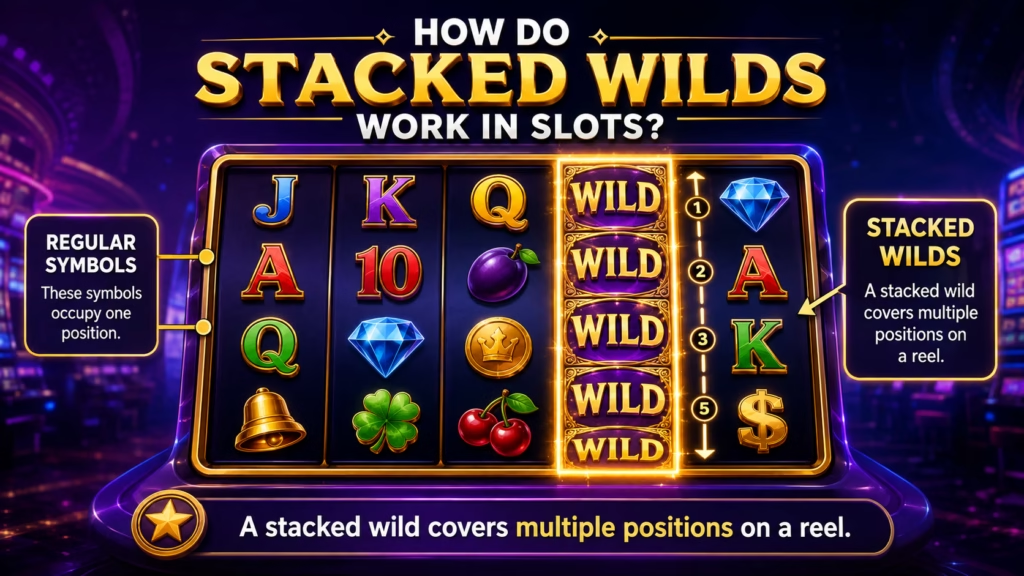
Stacked wilds in slots are wild symbols placed vertically on the same reel, usually covering two or more adjacent positions. Like standard wilds, they can substitute for eligible symbols to help complete winning combinations, but their larger reel coverage can create more opportunities for several paylines or winning patterns to connect on the same spin.
Quick takeaways
- Stacked wilds are groups of wild symbols appearing together on one reel.
- They usually substitute for regular paying symbols, although exact rules depend on the slot.
- A full stack may cover an entire reel and potentially contribute to several winning combinations at once.
- Stacked wilds can appear in the base game, bonus rounds, or both.
- Their presence does not mean a spin is more likely to produce a profit because every spin remains random and the slot’s paytable determines how wins are calculated.
Stacked wild slots are usually more appealing to players who enjoy visible feature-driven mechanics and the possibility of several paylines connecting around the same wild reel. Players who prefer very simple slots may find ordinary wild mechanics easier to follow.
The important point is that stacked wilds change how wild symbols are arranged, not whether a player can predict the next result.
What Are Stacked Wilds in Slots?
A stacked wild is a group of two or more wild symbols positioned consecutively on the same reel. Instead of a single wild occupying one symbol position, several wilds may appear above and below each other as part of the same reel configuration.
For example, consider a five-reel slot with three visible rows. If the third reel lands with wild symbols in all three positions, that reel contains a full stack of wilds. Any active winning pattern that can legally use those wild positions may benefit from the stack.
The exact behavior depends on the game’s rules. Some stacked wilds substitute for almost every regular symbol, while others may exclude special symbols such as scatters, bonus symbols, jackpots, or other feature-specific icons. The game’s paytable should always be checked for the exact substitution rules.
How Do Stacked Wilds Work?
Stacked wilds work by giving several positions on the same reel the ability to act as wild substitutes during one spin. If a winning combination passes through one or more of those positions, the wild may replace a missing eligible symbol.
Imagine a slot where a winning payline requires matching symbols across reels one through five.
Diamond | Diamond | Wild | Diamond | Diamond
If the wild can substitute for the diamond, the combination may qualify as a win according to the paytable.
A stacked wild can create the same substitution effect on several rows simultaneously. If three wild positions land vertically on one reel, different paylines crossing that reel may each use a wild position.
This is the main difference between a standard wild and a stacked wild: a standard wild usually affects one reel position, while stacked wilds may influence several positions at once.
What Is a Full-Reel Stacked Wild?
A full-reel stacked wild occurs when wild symbols cover every visible position on a reel.
On a conventional three-row slot, this could mean three connected wild symbols occupying the entire reel. Games with four, five, or more visible rows may require larger stacks to cover the full reel.
A full wild reel can be visually impressive because many paylines or ways to win may pass through it. However, a full wild reel does not automatically create a winning spin. Matching eligible symbols still need to appear in the required positions according to the game’s payout system.
The practical value of a full stack therefore depends on several factors, including:
- where the wild reel lands;
- which symbols surround it;
- how many reels are required for a winning combination;
- whether the game uses fixed paylines, ways to win, clusters, or another payout system;
- whether the wild substitutes for the relevant symbols.
Stacked Wilds vs Regular Wilds
Regular wilds and stacked wilds perform a similar basic function, but their reel coverage is different.
| Feature | Regular Wild | Stacked Wild |
| Typical size | One position | Two or more adjacent positions |
| Main function | Symbol substitution | Symbol substitution across multiple positions |
| Reel coverage | Limited | Potentially much larger |
| Multiple paylines | May affect one or several | Can potentially affect several simultaneously |
| Full-reel appearance | Usually no | Possible in some games |
| Guaranteed win | No | No |
A stacked wild is therefore not necessarily a stronger version of a regular wild on every spin. Its usefulness depends on where the stack appears and whether the surrounding symbols form valid combinations.
Stacked Wilds vs Expanding Wilds
Stacked wilds and expanding wilds can look similar, but they describe different mechanics.
A stacked wild normally arrives on the reels already occupying several adjacent positions. An expanding wild typically lands in one position and then expands to cover additional positions according to the game’s feature rules.
For example, a wild landing in the middle of a reel may expand upward and downward until the entire reel becomes wild. That is normally considered an expanding wild mechanic rather than a stacked wild that landed fully formed.
Some slots combine the concepts. A stack of wild symbols may land and then expand, or a special feature may turn several reels into full wild reels. The terminology used by the game provider and paytable is the best guide to the exact mechanic.
Stacked Wilds vs Sticky Wilds
Sticky wilds remain in place for additional spins, while stacked wilds describe several wild symbols positioned together.
A stacked wild usually disappears when the spin ends unless another feature changes its behavior. A sticky wild remains locked on the reels for a defined number of respins, free spins, or feature rounds.
A slot can also use both mechanics at the same time. For example, a stacked wild might appear during free spins and remain sticky for subsequent spins. In that case, “stacked” describes its shape or arrangement, while “sticky” describes how long it stays on the reels.
Where Do Stacked Wilds Usually Appear?
Stacked wilds can be used in several different parts of a slot.
Base Game
Some games allow stacked wilds to appear during ordinary paid spins. Their frequency and possible reel positions are determined by the game’s internal design and mathematics.
Free Spins
Stacked wilds are often used as part of free-spin features because providers can combine them with other mechanics such as extra wild reels, multipliers, sticky wilds, or increased wild coverage.
The rules can differ significantly between games, so the presence of free spins does not automatically mean stacked wilds become more frequent or more valuable.
Respins
A stacked wild may trigger or participate in a respin mechanic. In some game designs, the wild remains while other reels spin again. In others, the stack is simply part of the triggering combination.
Special Wild Features
Some slots use random features that add stacked wilds to one or more reels before a spin is evaluated. Other games may transform symbols into wild stacks during a bonus round.
The exact behavior should be verified in the slot’s help section or paytable because stacked wild implementation is not standardized across every provider.
Can Stacked Wilds Create Multiple Wins?
Yes. One stacked wild can potentially contribute to multiple winning combinations if several valid paylines or winning patterns pass through its positions.
Suppose three different paylines cross the same reel at the top, middle, and bottom positions. If that reel contains three stacked wild symbols, each payline may use a separate wild position when forming an eligible combination.
Whether all combinations are paid depends on the slot’s payout system. Fixed-payline games, all-ways slots, cluster games, and other formats calculate wins differently.
This is why the number of wild symbols visible on the screen alone does not determine the final payout.
Do Stacked Wilds Increase RTP?
The presence of stacked wilds does not by itself tell you whether a slot has a high or low RTP.
RTP, or return to player, is a theoretical long-term percentage built into the game’s mathematical model. Stacked wilds are only one mechanic within that model.
Two slots can both use stacked wilds while having different RTP values because their symbol probabilities, paytables, bonus frequencies, maximum payouts, reel configurations, and other mechanics may be different.
Players should check the RTP information supplied for the specific version of the game. Some slots can be offered with different RTP configurations depending on the casino or operator.
Most importantly, RTP describes long-term theoretical behavior. It does not predict whether an individual session will win or lose.
Do Stacked Wilds Affect Slot Volatility?
Stacked wilds can contribute to the way a slot distributes payouts, but the presence of stacked wilds alone is not enough to determine volatility.
Volatility describes how a game’s payout pattern tends to be distributed. A higher-volatility slot may concentrate more of its theoretical return into less frequent but potentially larger payouts, while a lower-volatility game may distribute more of its return through smaller and more frequent wins.
A developer can build stacked wilds into either type of mathematical model.
For this reason, players looking specifically for low, medium, or high volatility should check the game’s published volatility information rather than judging the slot from the wild mechanic.
Why Do Slot Developers Use Stacked Wilds?
Stacked wilds allow developers to create more visible interaction between wild symbols and the reel layout.
A single wild may affect one important position. A large stack can influence several lines or rows, making it easier for players to understand how a feature changed the final combination.
The mechanic also works well with bonus features because stacked wilds can be combined with:
- free spins;
- respins;
- multipliers;
- sticky wilds;
- expanding wilds;
- random wild placement;
- additional wild reels.
These combinations can make a slot more complex, so players should understand how each feature works before assuming that several wild-related mechanics automatically mean better odds.
How to Evaluate a Slot With Stacked Wilds
Players comparing stacked wild slots should look beyond the visual size of the wild symbols.
1. Check Which Reels Can Contain Stacked Wilds
A stack that can appear on several central reels may interact with combinations differently from a wild restricted to one reel.
2. Check Wild Substitution Rules
Confirm whether the wild substitutes for all regular paying symbols or whether some symbols are excluded.
3. Check the Payout System
A stacked wild can behave differently in a fixed-payline slot compared with a ways-to-win or cluster-based game.
4. Check RTP and Volatility Separately
Do not assume a slot has favorable RTP or low volatility simply because it contains large wild stacks. These are separate characteristics.
5. Check Bonus-Round Changes
Some games modify their stacked wild mechanic during free spins or respins. A stack might become sticky, expand, move, gain a multiplier, or appear on additional reels.
6. Check the Paytable Before Playing
The paytable and game rules provide the most relevant information about substitutions, feature triggers, payout calculations, and special restrictions.
Common Myths About Stacked Wilds
“A full reel of wilds guarantees a win”
A full wild reel does not necessarily guarantee a payout. The remaining reels still need to satisfy the slot’s rules for a winning combination.
“More stacked wilds mean higher RTP”
The size or number of wild stacks does not reveal a game’s RTP. RTP depends on the complete mathematical model.
“Stacked wilds make the next spin easier to predict”
Stacked wilds do not provide information about future random results. Previous reel outcomes do not tell the player where wilds will land next.
“A stacked wild is the same as an expanding wild”
The mechanics are different. A stacked wild normally consists of multiple adjacent wild positions, while an expanding wild increases its size after landing or after a feature condition is met.
“Stacked wild slots are always high volatility”
There is no universal volatility level for stacked wild games. The feature can be incorporated into different payout models.
Who May Prefer Slots With Stacked Wilds?
Stacked wild slots may appeal to players who enjoy features that visibly interact with several reel positions at once.
They may be particularly interesting to:
- players who enjoy wild-based bonus mechanics;
- players who like visually clear reel transformations;
- players interested in free-spin features;
- players who understand paylines and want to see how wild substitutions affect several combinations.
Players who prefer simple slots with few special mechanics may instead favor games using basic wild and scatter symbols.
Neither format is inherently better. The more useful choice depends on whether the player understands the rules, accepts the game’s volatility, and treats the game strictly as entertainment.
Practical Tips for Playing Stacked Wild Slots
Understanding stacked wilds can help players read the result of a spin correctly, but it cannot turn a random game into a predictable one.
Before playing, check the paytable to see how the wild substitutes, which reels can contain stacks, and whether the mechanic changes in bonus rounds.
If RTP information is available, verify the RTP for the specific game version rather than assuming every casino uses identical settings.
Set a spending limit before starting and avoid increasing bets simply because several spins have passed without stacked wilds. A sequence without a particular feature does not mean that feature is “due” to appear.
Casino slots should be treated as paid entertainment rather than a way to generate income. If playing stops being enjoyable or spending exceeds the limit you intended to use, stopping the session is the practical choice.

How This Information Was Reviewed
This explanation evaluates stacked wilds according to their mechanical role, reel coverage, substitution behavior, interaction with paylines, and differences from related features such as regular, expanding, and sticky wilds.
Specific stacked wild rules can vary between games. Players should therefore verify the paytable, help screen, RTP configuration, volatility information, and bonus rules of the exact slot they are considering.
RTP, volatility, wild frequency, and bonus features describe parts of a slot’s mathematical design, but none can guarantee the result of an individual spin or session. Slot outcomes remain random, and gambling should be treated as entertainment rather than a method of making money.
FAQ
What are stacked wilds in slots?
Stacked wilds are two or more wild symbols positioned next to each other vertically on the same reel. They normally substitute for eligible paying symbols and can potentially help several paylines or winning combinations at the same time.
How do stacked wilds work?
Stacked wilds work by providing multiple wild positions on one reel. Each position may substitute for a missing eligible symbol when the slot evaluates winning combinations, subject to the game’s paytable and payout rules.
Can stacked wilds cover an entire reel?
Yes, some games allow stacked wilds to cover every visible position on a reel. This is commonly described as a full-reel wild or full stack, although terminology can vary between providers.
Does a stacked wild guarantee a winning spin?
No. A stacked wild does not guarantee a payout because the surrounding symbols must still create a valid winning combination according to the game’s rules.
What is the difference between stacked and expanding wilds?
A stacked wild normally consists of several adjacent wild symbols that appear together, while an expanding wild typically grows after landing to cover additional positions. Some slots combine both mechanics.
Are stacked wilds the same as sticky wilds?
No. “Stacked” describes several wild symbols arranged together, while “sticky” means the wild remains in position for additional spins or part of a bonus feature. One wild can sometimes be both stacked and sticky.
Do stacked wilds increase RTP?
Not necessarily. Stacked wilds are only one part of a slot’s mathematical model. RTP depends on the complete combination of symbol probabilities, payouts, bonus mechanics, and other game rules.
Are stacked wild slots more volatile?
Not automatically. Stacked wilds can appear in games with different volatility profiles. Players should check the published volatility of the specific slot rather than using the wild mechanic as a substitute for that information.
Can stacked wilds appear during free spins?
Yes, stacked wilds can appear during free spins in some slots, and bonus rounds may modify them with features such as sticky behavior, multipliers, expansion, or additional wild reels. Exact rules depend on the game.
Can you predict when stacked wilds will appear?
No. Players cannot reliably predict when stacked wilds will land in a random slot. Previous spins do not provide a dependable method for forecasting the next reel outcome.
Brief Conclusion
Stacked wilds are groups of wild symbols that occupy several adjacent positions on the same reel. Their main advantage as a game mechanic is broader reel coverage, which can allow one stack to contribute to several winning combinations.
The feature should not be confused with expanding or sticky wilds, and it does not automatically indicate higher RTP, lower volatility, or better winning chances. The most reliable way to understand stacked wilds in a particular slot is to check its paytable, substitution rules, RTP, volatility, and bonus conditions before playing.
Stacked wilds can make a slot more visually dynamic, but they do not change the basic reality of slot play: individual outcomes are random, no feature guarantees a win, and slots should be played only as entertainment within predetermined spending limits.