
Yes, more active paylines can increase your chance of landing a paying combination on a single spin, but they do not automatically make a slot more profitable or improve its RTP. The effect depends on how the slot handles paylines, how much you bet per line, and whether increasing the number of lines also increases your total stake.
The key distinction is between winning more often and winning more money. Playing additional paylines gives more possible routes for matching symbols to form a payout, but each extra line may also cost money. A higher hit frequency can therefore come with a higher total bet.
Quick takeaways:
- More active paylines usually give more opportunities to form winning combinations.
- More paylines do not guarantee a winning spin.
- Activating additional lines may increase the total cost of each spin.
- Payline count alone does not determine RTP or volatility.
- Winning on one or several paylines does not necessarily mean the spin produced a net profit.
- Modern slots may use fixed paylines, ways-to-win systems, clusters, or other mechanics where traditional payline selection does not apply.
For players comparing slot structures, paylines are useful for understanding how wins are evaluated. They should not be treated as a strategy for overcoming the mathematical advantage built into the game.
What Are Paylines in Slots?
A payline is a predefined pattern across the reels that determines where symbols must appear to create a winning combination. Traditional paylines can run horizontally, diagonally, in zigzag patterns, or through several positions on the reels.
For example, a five-reel slot might pay when three matching symbols appear from left to right along an active payline. If the same symbols appear in positions that do not belong to an active line, they may not produce a payline win.
Some older and classic-style slots allow players to select the number of active paylines. A game might offer 1, 5, 10, 20, or more selectable lines.
Many modern slots instead use fixed paylines, meaning every available line is active on every spin. In these games, players adjust the total bet rather than choosing how many paylines to activate.
Do More Paylines Increase Your Chances of Winning?
Activating more paylines generally increases the number of possible winning patterns covered by a spin. If a slot allows you to choose between 5 active lines and 20 active lines, playing all 20 means more symbol positions can qualify for payline payouts.
That does not mean the probability of the reels producing favorable symbols has changed. The random number generator still determines the spin independently according to the game’s mathematical design.
What changes is how many of the available symbol arrangements your bet covers.
Consider a simplified slot with 20 possible paylines.
If you activate only five lines, a combination appearing on one of the other 15 lines may not produce a payline payout.
If you activate all 20 lines, any qualifying combination on those lines can potentially pay according to the game’s paytable.
More paylines therefore increase coverage, not control over the random outcome.
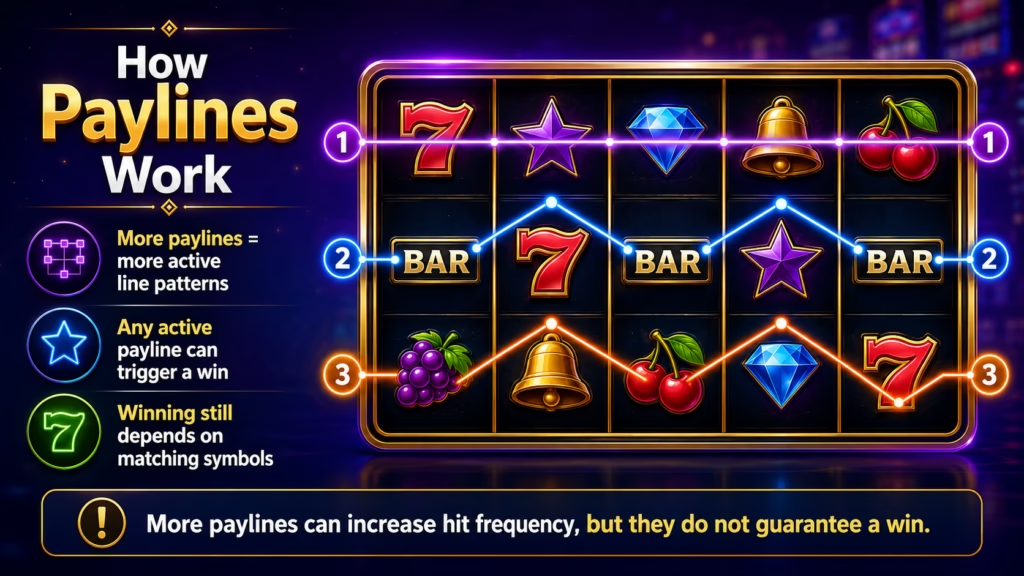
More Paylines vs Higher Chances of a Profitable Spin
A winning combination and a profitable spin are not the same thing.
Suppose you wager $0.01 on each payline.
| Active Paylines | Bet Per Line | Total Bet |
| 5 | $0.01 | $0.05 |
| 10 | $0.01 | $0.10 |
| 20 | $0.01 | $0.20 |
Playing 20 lines gives you four times as many active lines as playing five, but it also costs four times as much per spin when the bet per line remains unchanged.
A spin might produce several small line wins totaling $0.12. That would be a winning spin in the sense that the game awarded payouts, but against a $0.20 total wager, the player would still have lost $0.08 overall.
This distinction is important when looking at hit frequency statistics. A slot can produce frequent payouts while still returning less than the original stake on many of those spins.
What Happens If You Keep the Total Bet the Same?
The effect changes when a slot allows the same total stake to be distributed across different numbers of paylines.
Imagine a player wants to wager $1 per spin.
One configuration could be:
- 10 paylines at $0.10 per line
- 20 paylines at $0.05 per line
The second configuration covers more paylines, so more symbol patterns may qualify for a payout. However, only half as much money is placed on each individual line.
As a result, a winning line may produce a smaller payout because paytable awards are commonly linked to the stake placed on that line.
In this scenario, more paylines can provide broader coverage without increasing the total bet, but the tradeoff is a lower stake on each line.
The exact calculation depends on the game’s rules and should be checked in the paytable before playing.
Do More Paylines Increase RTP?
More paylines do not automatically increase a slot’s RTP.
RTP, or return to player, is a theoretical percentage representing how much of all money wagered a game is designed to return to players over a very large number of rounds.
A slot with 20 paylines is not automatically better than one with five paylines, and a game with hundreds of paylines is not automatically better than either.
RTP depends on the entire mathematical model, including factors such as:
- symbol probabilities;
- payout values;
- reel configuration;
- bonus features;
- jackpot contributions;
- special mechanics;
- available RTP configurations.
Some slots may also have multiple RTP versions depending on the casino or game configuration.
Payline count should therefore be treated as a game mechanic rather than an indicator of long-term value.
RTP also cannot predict the result of an individual session. A player can finish far above or below the theoretical percentage over a limited number of spins.
Do More Paylines Change Slot Volatility?
The number of paylines alone does not determine slot volatility.
Volatility describes how a game’s payouts are distributed. Lower-volatility slots generally concentrate more of their return in smaller, more frequent payouts, while higher-volatility games may produce less frequent but potentially larger payouts.
A slot could have 100 paylines and still be highly volatile.
Another slot could have only 10 paylines and produce frequent smaller wins.
The size and frequency of payouts depend on the game’s complete probability model, not simply the number of paylines shown on the screen.
Players interested in bankroll swings should therefore look at volatility information separately from the payline count.
Fixed Paylines vs Adjustable Paylines
Understanding whether paylines are fixed or adjustable is more important than simply counting them.
Adjustable Paylines
Adjustable-payline slots allow the player to choose how many lines are active.
Activating fewer lines generally reduces the number of combinations covered. Depending on the game, it can also reduce the total cost per spin.
Activating more lines provides greater coverage but may increase the total wager.
These games make the relationship between paylines and betting particularly visible.
Fixed Paylines
Fixed-payline slots automatically activate every available payline.
If a game has 20 fixed paylines, all 20 are evaluated on every spin. The player normally chooses the total stake rather than switching individual paylines on or off.
In this situation, asking whether more paylines should be activated is irrelevant because the game activates them automatically.
The important factors become total bet, RTP, volatility, paytable values, and bonus mechanics.
Are 243 Ways or Megaways the Same as Paylines?
No. Ways-to-win systems are different from traditional paylines.
A 243-ways slot typically awards wins when matching symbols appear on consecutive reels, often starting from the leftmost reel, without requiring them to follow a predefined line.
Megaways games use a variable number of symbols on each reel, which can cause the number of possible winning combinations to change from spin to spin.
Cluster-pay slots use another structure entirely. Wins may depend on groups of matching symbols touching each other rather than appearing along lines.
Because these mechanics evaluate wins differently, comparing a 20-payline slot directly with a 243-ways or Megaways slot based only on the number of combinations can be misleading.
The paytable and mathematical model matter more than the headline number of paylines or ways.
Is It Better to Play All Paylines?
Playing all paylines provides maximum payline coverage, but whether it is suitable depends on the betting structure and your budget.
When additional paylines increase the total bet, activating every line also increases how quickly money can be wagered.
For example, doubling the number of active paylines while keeping the same stake per line can double the cost per spin.
A player with a fixed session budget should consider total wager per spin rather than focusing only on how many paylines are active.
If a slot requires all paylines to be active, reducing the total bet is usually the practical way to control spending.
The objective should not be to find a line configuration that supposedly guarantees better results. No payline setting can guarantee a winning outcome on a random slot.
Common Payline Myths
Myth 1: More Paylines Mean Higher RTP
Payline count and RTP are separate characteristics. A game can have many paylines and a lower RTP than another game with fewer paylines.
Myth 2: More Paylines Guarantee More Money
Additional paylines can create more opportunities for payouts, but they may also increase the total stake. More frequent payouts do not guarantee a positive result.
Myth 3: Fewer Paylines Make Big Wins More Likely
Reducing active paylines does not make the RNG more likely to generate valuable symbol combinations. It simply means fewer available winning patterns may be covered by the wager.
Myth 4: A Winning Spin Always Means Profit
A payout can be smaller than the original wager. A $0.50 payout from a $1 spin is technically a payout but still represents a $0.50 net loss.
Myth 5: Paylines Can Be Used to Predict Wins
Payline selection does not reveal when a slot is about to pay. Random outcomes cannot be reliably predicted from recent spins or payline patterns.
How to Compare Slots With Different Numbers of Paylines
Instead of selecting a slot based only on its number of paylines, compare the complete game structure.
- Payline system: Check whether the game uses adjustable lines, fixed lines, ways to win, clusters, or another mechanic.
- Total bet: Determine the actual cost of one spin rather than looking only at the bet per line.
- RTP: Check the RTP shown in the game’s official information because different versions may exist.
- Volatility: Consider whether the payout pattern suits the amount you are prepared to spend on entertainment.
- Paytable: Review how individual symbol combinations are rewarded.
- Bonus mechanics: Free spins, multipliers, wilds, jackpots, and other features can influence how the game’s theoretical return is distributed.
- Betting limits: Confirm that the minimum total stake fits your intended budget.
This approach provides much more useful information than assuming that a larger payline number automatically means a better slot.
How Paylines Affect Bankroll Usage
Paylines can affect how quickly a bankroll is used because some adjustable-payline games calculate the total wager as:
Number of active paylines × bet per line = total bet
For example:
20 paylines × $0.05 = $1 per spin.
If the same game allows 40 active paylines at the same $0.05 stake per line:
40 paylines × $0.05 = $2 per spin.
The second configuration provides more line coverage but also doubles the amount wagered on each spin.
Players should therefore check the total bet displayed before starting a spin. A small-looking line bet can become a much larger total wager when multiplied across dozens of paylines.
Setting a session budget and deciding on an affordable total bet before playing is more useful than trying to maximize the number of active lines.

How This Information Was Reviewed
The relationship between paylines and winning chances should be evaluated using four separate factors: payline coverage, total wager, paytable structure, and the game’s mathematical model.
Payline rules can differ between slots, so players should check the official game information or paytable to confirm whether paylines are adjustable, how the bet is calculated, and which combinations qualify for payouts.
RTP and volatility describe mathematical characteristics of a game over many outcomes. They do not predict whether the next spin, the next 100 spins, or an individual session will result in a win.
Slots should be treated as paid entertainment rather than a way to earn money. Set spending and time limits before playing, and stop if gambling is no longer enjoyable or begins to exceed the limits you intended.
FAQ
Do more paylines increase your chances of winning?
Yes, activating more paylines generally covers more possible winning patterns, which can increase the chance that a qualifying symbol combination produces a payout. However, more paylines do not guarantee a win and may increase the total cost of each spin.
Is it better to play 20 paylines instead of 10?
Twenty active paylines provide greater line coverage than 10 in a game with selectable paylines. Whether that is preferable depends on the total bet and stake per line. If additional lines increase your wager, the extra coverage also costs more.
Do more paylines mean bigger wins?
No. More paylines mainly affect how many patterns are covered. The size of a payout depends on the symbols, paytable, stake, bonus mechanics, and mathematical design of the game.
Can I win more often by playing every payline?
Playing every available payline can increase the number of combinations eligible for payouts compared with activating only some lines. However, it cannot change the random symbols produced by the game or guarantee that the overall result will be profitable.
Does playing fewer paylines improve the odds on active lines?
No. Reducing the number of paylines normally does not make the remaining lines more likely to produce winning symbols. It simply reduces the number of payline patterns covered by the wager.
Do paylines affect RTP?
Paylines are part of the overall game design, but the number of paylines alone does not determine RTP. RTP depends on the complete mathematical model and should be checked in the game’s information or paytable.
Are fixed paylines better than adjustable paylines?
Neither system is automatically better. Fixed paylines evaluate every available line on each spin, while adjustable paylines may let players control how many lines are covered and sometimes how much the spin costs. RTP, volatility, paytable structure, and total wager remain more important comparison factors.
Is a 243-ways slot better than a 20-payline slot?
Not necessarily. A 243-ways game evaluates winning combinations differently from a traditional payline slot. A higher number of advertised ways does not automatically mean better RTP, lower volatility, or better winning chances in practical play.
Can changing paylines help me beat a slot?
No. Changing paylines cannot overcome the mathematical design of a random slot or guarantee profitable results. Payline selection changes wager coverage, while outcomes remain random.
Brief Conclusion
More paylines can increase the number of winning patterns covered on each spin, so they may increase the chance of receiving a payout in slots with selectable paylines. However, additional paylines can also increase the total wager, and a payout does not necessarily mean the spin was profitable.
Payline count does not automatically improve RTP, reduce volatility, or create a strategy for winning. The most useful approach is to compare total bet, RTP, volatility, paytable rules, and the type of winning system before playing. Slots should be treated as entertainment, with predetermined spending limits and no expectation of guaranteed returns.