
Single-line slots use one active payline, while multi-payline slots use several fixed or selectable paylines to evaluate winning symbol combinations. The main difference is not that one format is automatically more profitable, but that multi-payline slots can produce winning combinations across more patterns and often require a larger total stake when every line is activated.
Quick takeaways:
- Single-line slots usually have one simple left-to-right winning pattern.
- Multi-payline slots may use 5, 10, 20, 25, 50 or more paylines, depending on the game.
- More paylines create more possible winning combinations, but they do not guarantee profit.
- The total cost of a spin may increase when the same stake is placed on many paylines.
- RTP and volatility matter more than the number of paylines when evaluating the mathematical behavior of a slot.
Single-line slots may appeal to players who want simple mechanics and easy-to-read results. Multi-payline slots are usually more appealing to players who prefer more possible symbol combinations, additional features and a more active visual experience.
What Is a Single-Line Slot?
A single-line slot is a slot game in which winning combinations are evaluated on one payline. Traditionally, that payline runs horizontally through the center of the reels, although the exact pattern should always be confirmed in the game’s paytable.
For example, a classic three-reel slot may require three matching symbols to land across its single active line. Symbols outside that line normally do not contribute to a standard line win unless the game includes a separate feature or special symbol rule.
This format makes the outcome easy to understand. A player only needs to check one line instead of determining whether symbols connect across several patterns.
Single-line slots are commonly associated with classic slot design, but a classic visual style does not automatically mean that a game has only one payline. The paytable is the reliable place to verify the actual payout structure.
Who May Prefer Single-Line Slots?
Single-line slots may suit players who prefer:
- simple game rules;
- fewer winning patterns to track;
- classic reel layouts;
- straightforward bet calculations;
- less visual complexity.
A single payline does not mean that a slot has lower risk or better odds. RTP, symbol probabilities, payout values and volatility still determine how the game behaves mathematically.
What Is a Multi-Payline Slot?
A multi-payline slot evaluates combinations across several predetermined paylines. These paylines may run horizontally, diagonally, vertically or in zigzag patterns across the reels.
A five-reel slot, for example, might contain 10, 20, 25 or more paylines. A winning combination can potentially form on any active qualifying line according to the game’s rules.
Some slots activate all paylines automatically. Others allow players to select how many paylines they want to play. Modern slots also sometimes use alternative systems such as ways-to-win, cluster pays or all-ways mechanics, which are different from traditional paylines.
Multi-payline slots can feel more active because symbols can create wins in several locations on the reel grid. However, a larger number of paylines should not be confused with a mathematical advantage over the casino.
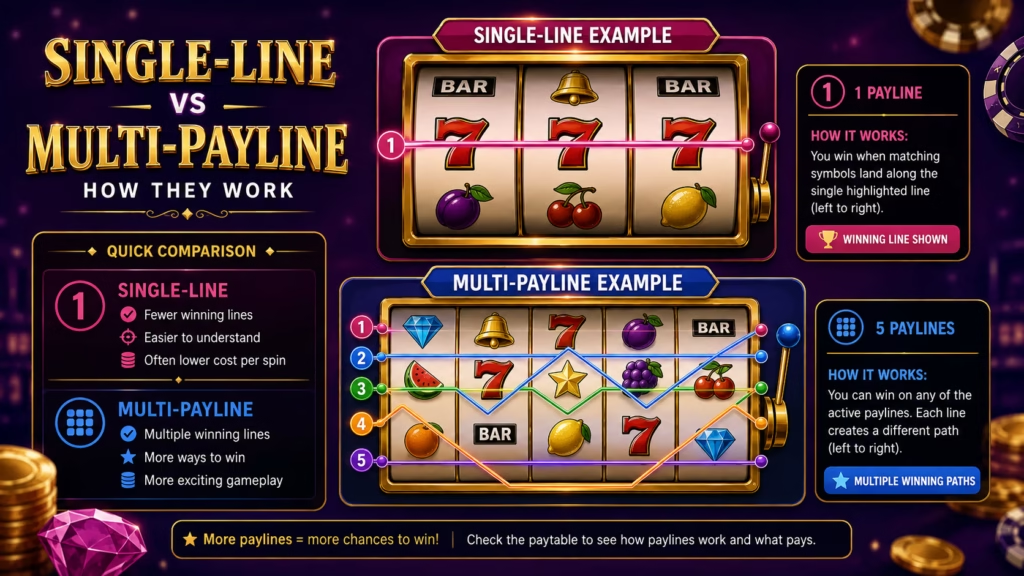
Single-Line vs Multi-Payline Slots Compared
| Feature | Single-Line Slots | Multi-Payline Slots |
| Number of paylines | Usually 1 | Several to many |
| Complexity | Low | Low to high |
| Winning patterns | One primary pattern | Multiple patterns |
| Bet structure | Usually simple | May depend on bet per line and active lines |
| Visual activity | Usually lower | Usually higher |
| Best suited to | Players who prefer simplicity | Players who prefer more combination patterns |
| Guaranteed better RTP | No | No |
| Guaranteed more profit | No | No |
The most important point in a single payline vs multi payline slots comparison is that the number of paylines describes how winning combinations are evaluated. It does not, by itself, reveal whether one slot offers a better mathematical return.
How Paylines Affect the Cost of a Spin
Paylines can affect the total cost of a spin when a game calculates the wager as:
Bet per line × Number of active paylines = Total bet
If a slot has 20 active paylines and a player stakes $0.05 per line, the total wager would be:
$0.05 × 20 = $1.00
If the same game allowed only 10 paylines to be activated, a $0.05 bet on each active line would cost $0.50 per spin.
However, not every modern slot uses a visible bet-per-line system. Many games display only the total stake while automatically activating every payline. Always check the betting controls and paytable instead of assuming that paylines can be individually selected.
Do More Paylines Mean More Wins?
More paylines create more potential patterns on which a winning combination can appear, but they do not guarantee more profitable results.
A multi-payline slot might display small line wins more frequently because several patterns are evaluated on each spin. At the same time, the player may also be wagering across more lines.
This creates an important distinction between win frequency and profitability. A spin that produces several winning lines can still return less than the amount originally wagered.
For example, a $1 spin might generate line payouts totaling $0.60. The interface may display a win, but the player’s balance has still decreased by $0.40 on that spin.
Payline count should therefore be viewed as part of the game’s payout structure, not as a shortcut for predicting whether a session will end in profit.
Do Multi-Payline Slots Have Better RTP?
Multi-payline slots do not automatically have higher RTP than single-line slots. RTP is determined by the game’s mathematical model, including symbol probabilities and payout values, rather than simply by the number of paylines.
A single-line slot could theoretically have a higher RTP than a 20-payline slot, while another multi-payline game could have the higher value. The comparison must be made using the RTP specified for each individual game.
RTP also represents a theoretical long-term percentage calculated across a very large number of game rounds. It does not predict how much a player will receive during a particular session.
Some slot titles can also be configured with different RTP versions. Check the game’s information screen or official paytable for the version available at the casino where the game is being played.
Paylines and Hit Frequency Are Not the Same Thing
The number of paylines and hit frequency describe different characteristics of a slot.
Paylines determine which symbol positions can create qualifying combinations.
Hit frequency describes how often the game is mathematically expected to produce a qualifying win over a large sample of spins.
A game with many paylines might have frequent small wins, but that behavior depends on its entire mathematical design. Another multi-payline slot could produce less frequent wins because its symbols and payout model are configured differently.
Players should not estimate hit frequency only by counting paylines.
Paylines and Volatility Are Also Different
Payline count does not determine slot volatility.
Volatility describes how payouts are distributed. Lower-volatility slots generally concentrate more of their theoretical return into relatively frequent smaller payouts, while higher-volatility slots tend to distribute more value through less frequent but potentially larger wins.
Both single-line and multi-payline games can use different volatility models.
A 20-payline slot is therefore not automatically safer or less volatile than a one-line slot. Players who care about bankroll swings should examine the game’s volatility information alongside RTP, maximum payouts and bonus mechanics.
Fixed vs Adjustable Paylines
Multi-payline slots can use either fixed or adjustable paylines.
Fixed Paylines
Fixed-payline slots automatically activate every available payline on every paid spin. Players choose a total wager, but cannot usually disable individual lines.
This structure is common in many modern video slots because it ensures that all displayed winning patterns remain active.
Adjustable Paylines
Adjustable-payline slots allow players to choose how many lines they want to activate.
Reducing the number of paylines may reduce the total stake when the game uses a bet-per-line system. However, combinations appearing on inactive paylines normally do not receive standard line payouts.
The exact behavior depends on the slot. Players should verify the paytable before changing paylines because bonus eligibility or other mechanics can sometimes depend on the betting configuration.
What Happens If a Winning Combination Appears on an Inactive Payline?
A standard winning combination appearing entirely on an inactive payline normally does not pay.
This is one reason adjustable-payline slots require attention. A combination may visually appear to match a winning pattern, but the game only evaluates paylines that were active for that spin.
Special symbols can operate differently. Scatters, for example, may pay or trigger features regardless of their exact payline positions in some games.
Because these rules vary, the slot’s paytable should be treated as the final reference.
Are More Paylines Better for a Small Bankroll?
More paylines are not automatically better for players using a small bankroll.
The important factor is the total cost per spin, not simply the number of active lines. A 25-payline slot costing $0.25 per spin could be cheaper to play than a single-line slot with a $1 minimum stake.
Players comparing games should therefore check:
- minimum total bet;
- whether the stake is shown per line or per spin;
- whether all paylines are fixed;
- RTP;
- volatility;
- bonus rules;
- maximum and minimum betting limits.
Setting a session budget before playing is more useful than choosing a slot solely because it has fewer paylines.
Paylines vs Ways to Win
Paylines and ways-to-win systems should not be treated as the same mechanic.
Traditional paylines require matching symbols to land on specific predefined patterns. A ways-to-win slot typically evaluates matching symbols across adjacent reels without requiring them to follow one exact line.
For example, a game advertised with hundreds or thousands of ways to win is not necessarily using hundreds or thousands of traditional paylines.
Cluster-pay slots use another system entirely. They generally reward groups of matching symbols touching according to specific rules rather than evaluating traditional paylines.
Checking the paytable is particularly important when comparing modern slots because terms such as paylines, ways and clusters describe different payout systems.
Common Myths About Single-Line and Multi-Payline Slots
Myth 1: More Paylines Mean Better Odds
More paylines create additional possible winning patterns, but the overall mathematical return depends on the full game model.
Myth 2: Single-Line Slots Pay More
A single payline does not guarantee larger prizes. Payout size depends on the paytable, symbol probabilities, wager and game design.
Myth 3: Activating Fewer Lines Makes the Slot Easier to Beat
Reducing active paylines may change the cost of a spin and the number of eligible winning combinations, but it does not create a reliable strategy for overcoming the game’s mathematical edge.
Myth 4: A Win on Several Lines Means the Spin Was Profitable
Multiple line wins can still return less than the total stake. Always compare the total payout with the total amount wagered.
Myth 5: Payline Patterns Can Predict the Next Win
Paylines determine where qualifying combinations are evaluated. They do not reveal what symbols will appear on the next random spin.
How to Choose Between Single-Line and Multi-Payline Slots
Choose based on game structure and personal preference rather than assuming one payline format provides better winning chances.
A single-line slot may be more suitable if you prefer:
- simple mechanics;
- classic gameplay;
- easy-to-follow payouts;
- fewer visual distractions.
A multi-payline slot may be more suitable if you prefer:
- more possible winning patterns;
- modern video-slot layouts;
- combinations appearing across different sections of the grid;
- games with more complex bonus systems.
Before playing either format, check the total stake, RTP, volatility and paytable. These factors provide more useful information about the game’s mathematical structure than payline count alone.
Practical Example
Consider two hypothetical slots.
Slot A has one payline and costs $0.50 per spin.
Slot B has 20 paylines and also costs $0.50 per spin because the game displays a fixed total bet rather than requiring $0.50 on every individual line.
Slot B does not necessarily cost 20 times more simply because it has 20 paylines. The betting system determines the actual cost.
Now imagine another 20-payline game where the player selects a $0.05 bet per line. Activating all 20 lines would produce a $1 total stake.
This is why players should look at the total bet displayed before spinning, rather than judging cost from the number of paylines alone.

How This Information Was Reviewed
This comparison focuses on the mechanics that determine how single-line and multi-payline slots evaluate winning combinations, including active paylines, total bet structure, RTP, volatility and alternative payout systems.
Exact rules vary between games. The game’s paytable should be checked for the number of paylines, required symbol combinations, direction of payouts, scatter behavior, bet settings and RTP version.
Paylines, RTP, volatility and bonus features cannot guarantee a winning session. Slot outcomes are random, and casino games should be treated as entertainment rather than a way to generate income. Set spending limits before playing and stop if gambling is no longer enjoyable or remains within your planned budget.
FAQ
What is the difference between single-line and multi-payline slots?
A single-line slot evaluates standard winning combinations on one payline, while a multi-payline slot evaluates combinations across several predefined patterns. The number of paylines changes where wins can occur but does not automatically determine RTP or profitability.
Are multi-payline slots better than single-line slots?
Multi-payline slots are not mathematically better simply because they contain more paylines. They provide more possible winning patterns, while single-line slots offer simpler gameplay. RTP, volatility, payouts and total stake should be compared separately.
Do I have to bet on every payline?
It depends on the game. Fixed-payline slots automatically activate every line, while adjustable-payline slots may let players select the number of active lines. Check the betting controls and paytable for the specific slot.
Does playing more paylines increase my chances of winning?
Activating more available paylines can increase the number of patterns eligible to produce a line win on that spin, but it may also increase the total wager. It does not guarantee profit or change random outcomes into predictable ones.
Can a slot pay on more than one payline at once?
Yes. In many multi-payline slots, several paylines can produce qualifying combinations on the same spin. The game generally adds the eligible line payouts together according to its paytable.
What happens if symbols match on a payline I did not activate?
A standard line combination on an inactive payline normally does not receive a payout. Special symbols such as scatters may follow different rules, so the game’s paytable should be checked.
Do single-line slots have higher payouts?
Not necessarily. Single-line slots can have large or small payouts depending on their paytable and mathematical model. The number of paylines alone does not determine maximum payout or RTP.
Are 20 paylines better than 10 paylines?
Neither number is inherently better. A 20-payline slot provides more predefined winning patterns, but bet size, RTP, volatility and payout distribution are more important when comparing two games.
Are ways-to-win slots the same as multi-payline slots?
No. Traditional multi-payline slots use predefined lines, while ways-to-win games generally evaluate combinations across adjacent reels without requiring symbols to follow a specific payline pattern.
In short
Single-line slots use one primary winning line and are usually easier to understand, while multi-payline slots evaluate combinations across several patterns and can create a more active style of gameplay.
Neither format automatically offers better RTP, lower volatility or better winning chances. Compare the total bet, paytable, RTP, volatility and payout rules of the individual game instead of choosing a slot only by its number of paylines. Every spin remains random, so slots should be played for entertainment with clear spending limits.