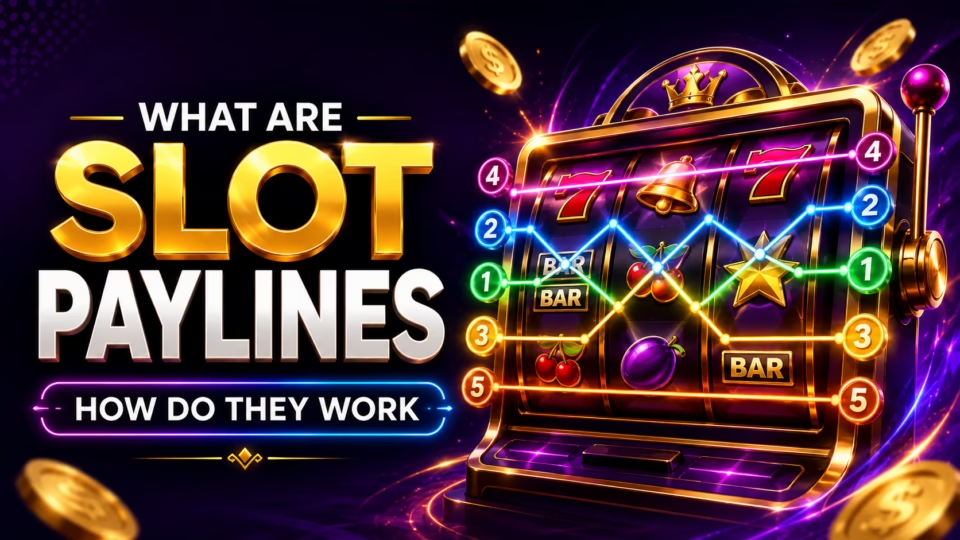
Slot paylines are predefined patterns across a slot’s reels that determine where matching symbols must land for a winning combination to count. In traditional online slots, a payline may run straight across the reels, diagonally, or in a more complex pattern. A spin only produces a payline win when the required symbols appear on an active line according to the game’s paytable and rules.
The exact way paylines work depends on the slot. Some games use a single fixed payline, while others have 10, 20, 25, 50, 100, or more. Modern slots may also replace traditional paylines with systems such as ways to win, Megaways, cluster pays, or all-ways mechanics.
Quick takeaways:
- A payline is a specific path across the reels where matching symbols can create a payout.
- Most payline wins require matching symbols to appear on consecutive reels, usually starting from the leftmost reel.
- Fixed-payline slots activate every available payline automatically.
- Adjustable-payline slots may allow players to choose how many lines are active.
- More paylines create more possible winning patterns, but they do not guarantee more profit or a winning session.
Payline slots may appeal to beginners because their win conditions are relatively easy to understand once the paytable is checked. Players should still pay close attention to the total bet, because activating many paylines can change how much is wagered per spin.
What Is a Payline in Slots?
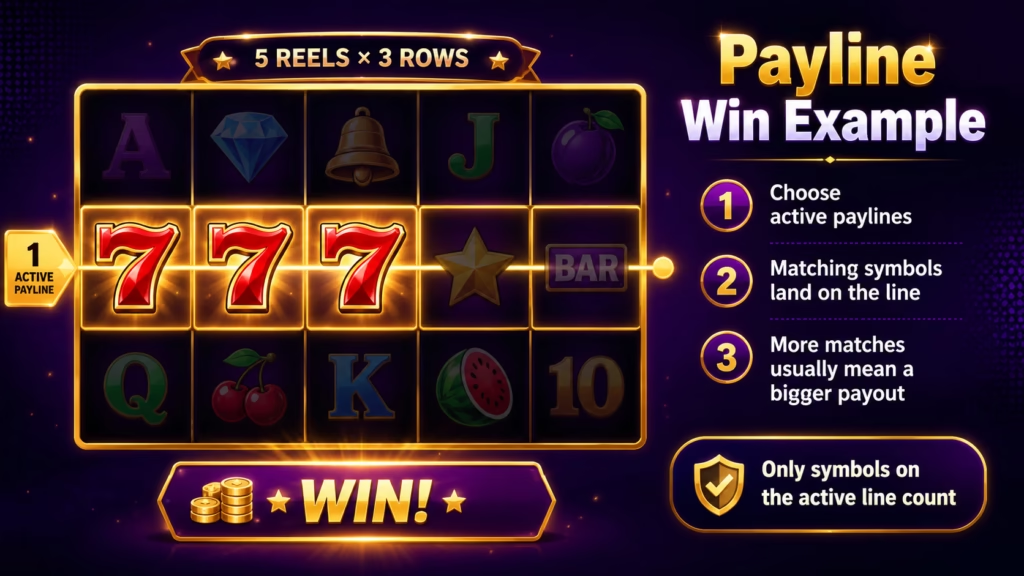
A slot payline is a sequence of reel positions that the game checks after each spin to determine whether a qualifying combination has landed. If the symbols on that line meet the requirements listed in the paytable, the game awards the corresponding payout.
Consider a traditional five-reel slot with three symbol positions visible on each reel. A basic horizontal payline might look like this:
Reel 1 -> Reel 2 -> Reel 3 -> Reel 4 -> Reel 5
If five matching symbols land along that active line, the player may receive the five-symbol payout listed in the game’s paytable. Some games also pay for combinations containing only three or four matching symbols.
Paylines do not have to be horizontal. A slot may include diagonal, zigzag, V-shaped, inverted V-shaped, or other predefined patterns.
The important point is that the symbol positions must follow an active pattern recognized by the slot. Five identical symbols appearing somewhere on the reels do not necessarily create a win in a traditional payline game.
How Do Slot Paylines Work?
Slot paylines work by giving the game a set of predefined symbol positions to evaluate after each spin. The random number generator determines the spin outcome, and the game then checks the result against its paytable and active paylines.
A typical payline win works in several steps:
- The player selects a stake and starts the spin.
- The slot’s RNG generates the spin outcome.
- The reels display the resulting symbols.
- The game checks each active payline.
- Qualifying combinations are compared with the paytable.
- Any valid payouts are calculated automatically.
In many slots, matching symbols must appear on consecutive reels starting with the first reel on the left. For example, three matching symbols on reels 1, 2, and 3 may produce a payout, while the same symbols on reels 2, 3, and 4 may not.
This is not a universal rule. Some slots pay in both directions, use special wild mechanics, or apply different conditions. The game’s paytable and rules are the authoritative source for the exact winning pattern.
What Does a Slot Payline Look Like?
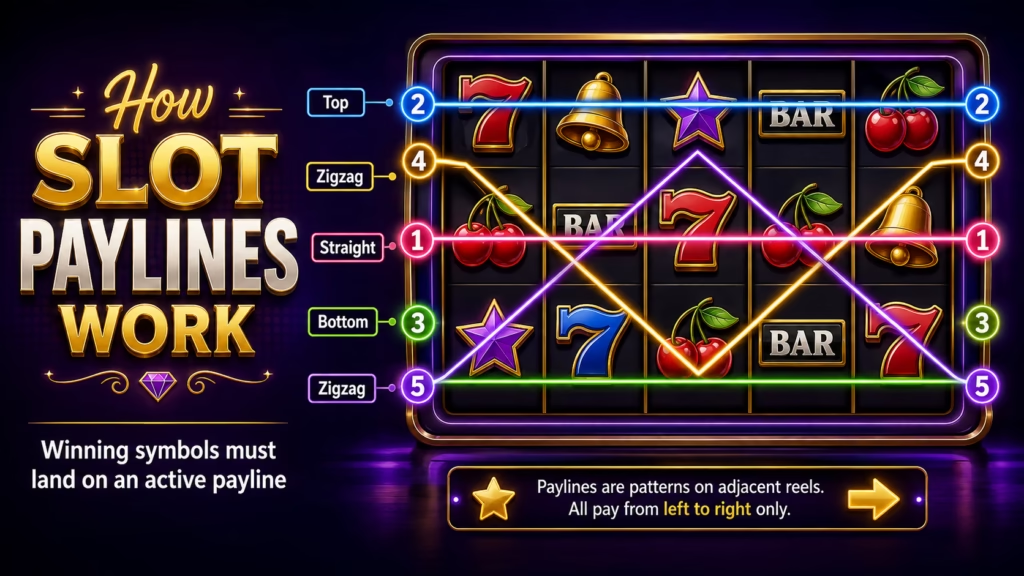
A slot payline connects one symbol position from each relevant reel. Older mechanical slots often had one horizontal line through the center, but video slots can support many different patterns.
For example, a five-reel slot might include:
- a straight line through the middle row;
- a straight line through the top row;
- a straight line through the bottom row;
- a diagonal running from top left to bottom right;
- a diagonal running from bottom left to top right;
- a V-shaped pattern;
- an inverted V-shaped pattern;
- multiple zigzag patterns.
The paytable or help screen usually contains a diagram showing every available payline. Checking this diagram is particularly useful on slots with unusual line patterns because visual proximity between matching symbols does not automatically mean they form a valid combination.
Fixed vs Adjustable Paylines
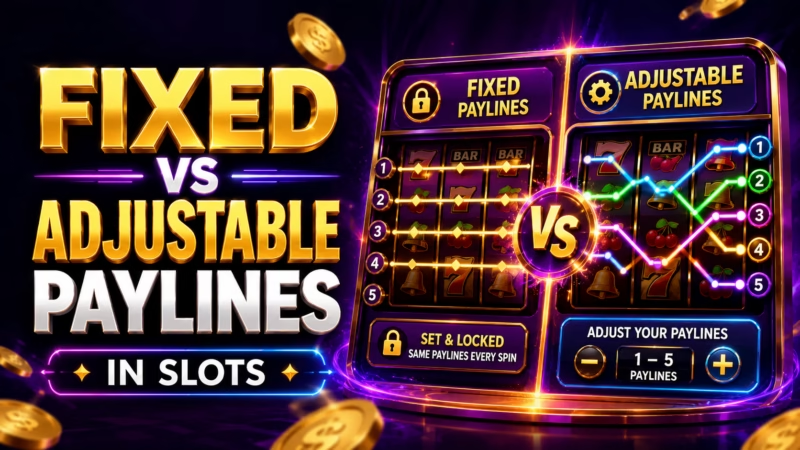
The main difference between fixed and adjustable paylines is whether the player can control how many lines are active.
| Payline type | How it works | What to watch |
| Fixed paylines | All paylines remain active on every spin | Check the total stake before spinning |
| Adjustable paylines | The player may select the number of active lines | Inactive lines normally cannot produce regular line wins |
| Single payline | Only one pattern is evaluated | Wins may appear less frequently than in games with many overlapping lines, depending on the game math |
Fixed Paylines
Fixed-payline slots require every available line to remain active. A 20-payline fixed slot, for example, evaluates all 20 paylines after every spin.
This format is common because it prevents players from accidentally disabling a line that could otherwise have produced a winning combination.
The tradeoff is that the betting structure may be less flexible. Players should look at the total bet per spin, not just the displayed coin or line value.
Adjustable Paylines
Adjustable-payline slots allow players to activate or deactivate some of the available paylines. A slot with 20 possible paylines might allow play on 1, 5, 10, 15, or all 20 lines.
Reducing the number of active lines may reduce the total wager if the bet per line remains unchanged. However, combinations appearing exclusively on inactive paylines usually do not receive their standard line payout.
Exact betting rules vary between games, so the total stake should always be checked before the spin.
How Is the Total Bet Calculated With Paylines?
In many traditional payline slots, the total wager can be calculated using:
Bet per line x number of active paylines = total bet
For example, if a player wagers $0.05 on each of 20 active paylines:
$0.05 x 20 = $1.00 total stake
This calculation is useful because a small displayed line bet can become a substantially larger total wager when many paylines are active.
Not every modern slot uses this exact interface. Some games display only the total bet and automatically distribute the stake through their internal payout structure. The amount shown as the final bet before the spin is therefore the figure players should verify.
Do More Paylines Mean More Wins?
More paylines create more patterns that can potentially produce a winning combination, but more paylines do not guarantee a profitable result.
A 50-payline slot evaluates more line patterns than a five-payline slot, so a single spin may have more opportunities to contain a qualifying combination. However, this does not tell you whether the game will return more money over a particular session.
Several other factors matter, including:
- symbol probabilities;
- paytable values;
- wild symbols;
- bonus mechanics;
- RTP;
- volatility;
- total stake;
- the game’s overall mathematical model.
A slot can produce relatively frequent small payouts while still returning less than the amount wagered during a session. The number of winning lines should therefore not be confused with profitability.
Paylines vs Ways to Win
Paylines and ways-to-win systems use different rules for determining winning combinations.
Traditional paylines require symbols to land on specific predefined paths. Ways-to-win slots generally remove those fixed patterns and instead check whether matching symbols appear on consecutive reels in qualifying positions.
For example, a 243-ways slot with three rows and five reels may count matching symbols across adjacent reels without requiring them to follow a particular diagonal or horizontal line.
This makes ways-to-win games visually different from traditional payline slots because symbols can form winning combinations in many positions.
Neither system is automatically better. Players who want clearly defined patterns may prefer paylines, while players who prefer less emphasis on line diagrams may find ways-to-win mechanics easier to follow.
Paylines vs Megaways
Megaways is a variable ways-to-win mechanic rather than a traditional fixed-payline system. The number of symbols displayed on individual reels may change from spin to spin, which can change the number of available ways to form combinations.
Traditional paylines remain fixed patterns regardless of what symbols appear. If a slot has 20 paylines, those same 20 patterns normally apply to every standard spin unless the game rules change them during a special feature.
Megaways games can therefore create substantially more potential symbol combinations than conventional payline slots, but a larger number of possible combinations does not guarantee a winning spin or profit.
Paylines vs Cluster Pays
Cluster pays do not use traditional lines. Instead, they award payouts when enough matching symbols form a connected group, usually by touching horizontally or vertically according to the game’s rules.
This difference matters because a player looking for diagonal or horizontal paylines in a cluster slot may misunderstand why a particular group of symbols did or did not pay.
The paytable should identify the mechanic clearly. If a game describes wins in terms of clusters, connected symbols, or minimum cluster sizes, traditional payline rules probably do not apply.
How Wild Symbols Affect Paylines
Wild symbols can help complete payline combinations by substituting for certain regular symbols. For example, if a line contains two matching regular symbols followed by a wild, the wild may act as the third matching symbol and create a qualifying combination.
Wild behavior varies significantly between slots. A wild may:
- substitute for standard symbols;
- expand across an entire reel;
- move between positions;
- become sticky during a bonus;
- carry a multiplier;
- appear only on selected reels.
Some symbols, particularly scatters or bonus symbols, may not be replaceable by wilds.
Players should check the paytable instead of assuming every wild works the same way.
Do Scatter Symbols Need to Be on a Payline?
Scatter symbols often do not need to appear on a traditional payline. Many slots award scatter payouts or trigger bonus features based on the number of scatter symbols visible anywhere on eligible reels.
For example, three qualifying scatters may trigger free spins even when the symbols are located on completely different rows.
However, scatter rules vary by game. Some titles require specific reels, positions, or numbers of symbols. The paytable should state exactly how the scatter feature works.
Do Paylines Affect RTP?
Paylines are part of a slot’s mathematical design, but the number of paylines alone does not tell you the RTP.
RTP, or return to player, is a theoretical long-term percentage built into a game configuration. A slot with 20 paylines can have a higher or lower RTP than a slot with 100 paylines because RTP depends on the complete mathematical model, including symbol probabilities, payout values, bonuses, and other features.
RTP also does not predict what will happen during one session. A slot with a stated theoretical RTP can still produce a wide range of short-term results because individual spins are random.
If RTP is important when comparing games, check the game’s information screen because the exact RTP configuration may vary between operators.
Do Paylines Affect Volatility?
The number of paylines does not by itself determine a slot’s volatility. Volatility describes the general distribution and size of payouts, while paylines describe where qualifying symbol combinations can form.
A slot with many paylines may still be highly volatile if its mathematical model concentrates more of its theoretical return into less frequent larger payouts. Another game with the same number of paylines may be designed around more frequent smaller payouts.
Paylines, paytable values, symbol probabilities, bonus features, and other game mechanics work together to create the overall playing experience.
Common Payline Myths
More paylines automatically mean better odds
More paylines provide more active patterns, but that does not automatically make one game mathematically better than another. RTP, volatility, payout values, and symbol probabilities need to be considered separately.
A symbol combination should pay because it looks connected
Matching symbols only count when they satisfy the game’s stated win conditions. In a traditional payline slot, symbols can appear next to one another visually without being located on the same active payline.
Changing paylines can predict or influence the next spin
Changing the number of active paylines does not allow a player to predict the next random result. In regulated RNG-based online slots, each spin outcome is generated independently according to the game’s design.
A large number of line wins means the player is ahead
Frequent winning combinations do not necessarily mean the session is profitable. A payout can be smaller than the stake used for the spin.
How to Check Paylines Before Playing a Slot
The most reliable way to understand a slot’s paylines is to open its paytable or game information screen before placing a wager.
Check these details:
1. Number of paylines: Find out whether the game uses 1, 10, 20, 50, 100, or another number.
2. Fixed or adjustable lines: Determine whether all lines must remain active.
3. Winning direction: Check whether combinations pay left to right, right to left, or both.
4. Minimum symbols required: Some combinations pay from two symbols, while others require three or more.
5. Wild rules: Confirm which symbols wilds can substitute for.
6. Scatter rules: Check whether scatters pay anywhere or require specific reel positions.
7. Total bet: Confirm the actual amount being wagered per spin.
8. RTP and volatility: Use these as separate characteristics rather than assuming the payline count reveals them.
These checks are especially useful for players moving between traditional line slots and modern mechanics such as Megaways, cluster pays, or ways to win.
Who Are Payline Slots Best Suited For?
Traditional payline slots may suit players who prefer clearly defined winning patterns and want to understand exactly why a particular combination produced a payout.
Single-line and low-line games can also appeal to players who prefer relatively simple mechanics. Slots with dozens of paylines may appeal to players who enjoy seeing several possible combinations evaluated on the same spin.
Players who dislike studying line diagrams may prefer ways-to-win or cluster-pay slots, although those mechanics have their own rules to learn.
Regardless of the format, paylines should be treated as part of the game’s entertainment mechanics, not as a method for generating income or controlling random outcomes.
How This Information Was Reviewed
The explanation of slot paylines is based on the standard distinctions between traditional paylines, fixed and adjustable lines, ways-to-win systems, cluster mechanics, wilds, scatters, RTP, and volatility.
Individual slot rules can differ. Players should verify the paytable, game information screen, RTP configuration, betting limits, winning direction, and bonus conditions for the specific title they are considering.
Paylines, RTP, volatility, and bonus features describe how a slot is structured, but none of them can guarantee the result of an individual spin or gaming session. Slots should be treated as entertainment. Set spending and time limits before playing, and stop if gambling is no longer enjoyable or affordable.
FAQ
What are paylines in slots?
Paylines are predefined patterns across a slot’s reels that determine where matching symbols must appear to create qualifying wins. Traditional slots may use horizontal, diagonal, zigzag, or other line patterns.
How do slot paylines work?
Slot paylines work by checking predefined reel positions after every spin. If matching symbols appear on an active payline according to the paytable, the game awards the corresponding payout. Exact requirements vary between slots.
What does 20 paylines mean on a slot?
A 20-payline slot has 20 predefined patterns that can be checked for winning combinations. If the paylines are fixed, all 20 are normally active. If they are adjustable, the game may allow fewer than 20 to be selected.
Is it better to play more paylines?
Playing more paylines gives the game more active patterns on which qualifying combinations can form, but it does not guarantee better financial results. More active lines may also increase the total wager when betting is calculated per line.
Can you win on a payline that is not active?
In a traditional adjustable-payline slot, a standard line combination appearing exclusively on an inactive line normally does not receive its payline payout. Special features such as scatters may follow different rules, so check the game’s paytable.
Do paylines increase RTP?
A higher number of paylines does not automatically increase RTP. RTP depends on the slot’s complete mathematical configuration, including symbol probabilities, payouts, bonus features, and other mechanics.
Do scatter symbols have to land on a payline?
Scatter symbols often pay or trigger bonuses regardless of paylines, but the exact rule depends on the slot. Some games require scatters on particular reels or positions, so the paytable should always be checked.
What is the difference between paylines and ways to win?
Paylines require matching symbols to follow specific predefined patterns. Ways-to-win systems generally allow matching symbols on consecutive reels to form wins without following a fixed line pattern.
Are paylines random?
The paylines themselves are predefined, but the symbols that land on them are determined by the slot’s random outcome mechanism. Selecting a particular payline does not allow a player to predict or control the next result.
How many paylines should a slot have?
There is no ideal number of paylines for every player. Fewer paylines may provide simpler gameplay, while games with many paylines create more possible winning patterns. The better choice depends on preferred mechanics, betting structure, RTP, volatility, and personal spending limits.
Conclusion
Slot paylines are predefined paths that determine where symbols must land for traditional line-based wins. Fixed paylines remain active automatically, while adjustable paylines may allow players to choose how many lines are used.
More paylines create more possible winning patterns, but they do not guarantee more profit, higher RTP, or a winning session. Always check the paytable, total stake, winning direction, wild and scatter rules, and the specific game’s RTP and volatility before playing. Slot outcomes remain random, so paylines should be understood as a game mechanic rather than a strategy for predicting or controlling wins.