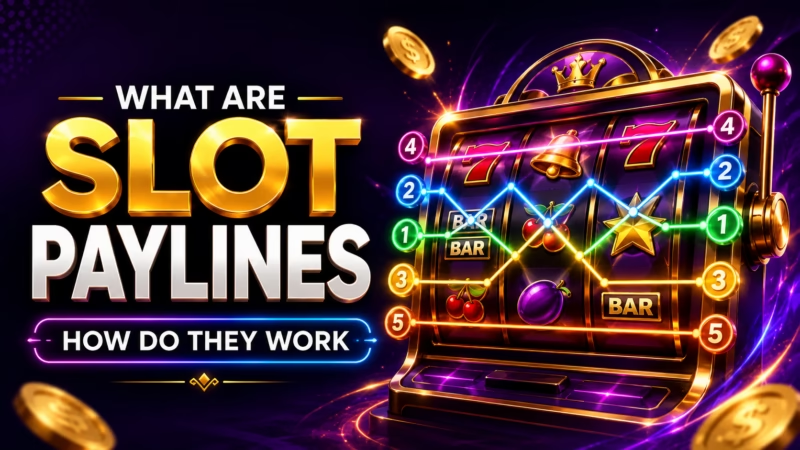
Knowing how to read slot paylines means understanding which reel positions must contain matching symbols for a spin to produce a line win. A payline is a predefined pattern that crosses the reels, while a slot payline diagram shows the exact positions included in that pattern.
The most important points are:
- A payline connects specific symbol positions across the reels.
- Paylines can run horizontally, diagonally, in zigzags, or through more complex patterns.
- Most traditional paylines evaluate matching symbols from the leftmost reel, although individual game rules may differ.
- A slot may have one payline, dozens of paylines, hundreds of paylines, or use a different system such as ways to win or cluster pays.
- The number of paylines does not tell you whether a slot is more likely to produce a profitable session.
Understanding paylines is particularly useful for beginners and players moving from simple classic slots to modern multi-line games. The paytable and game rules should always be checked because two slots with similar reel layouts can evaluate winning combinations differently.
What Is a Payline in a Slot?
A slot payline is a predefined sequence of reel positions used to determine whether symbols form a winning combination. If the required symbols appear in the correct positions along an active payline, the game evaluates the combination according to its paytable.
Consider a traditional five-reel slot with three visible symbol positions on each reel. The simplest payline might run directly through the middle row:
Reel: 1 2 3 4 5
Top: O O O O O
Middle: X – X – X – X – X
Bottom: O O O O O
The five positions marked X form one horizontal payline.
If a game’s paytable awards a prize for three matching symbols from the first reel, three matching symbols appearing on reels 1, 2 and 3 along that line may create a winning combination.
However, the exact rules depend on the slot. Some games require wins to start on the leftmost reel, while others use mechanics that evaluate combinations differently. Always confirm the rule in the game’s paytable rather than assuming every slot works the same way.
How to Read a Slot Payline Diagram
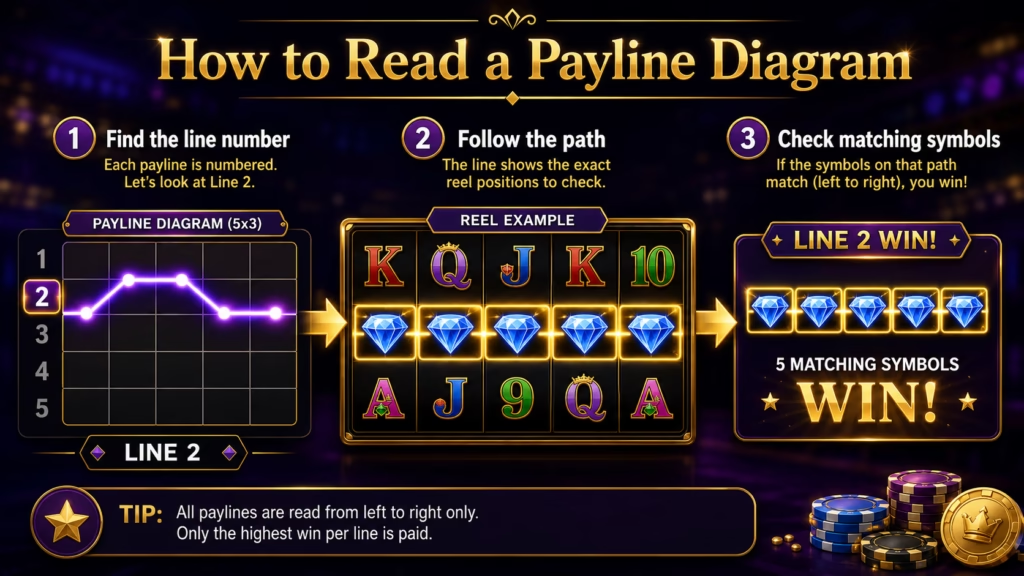
A slot payline diagram identifies the exact reel position selected on each reel for one payline. To read it, follow the highlighted positions from the first reel to the final reel.
For example:
Reel: 1 2 3 4 5
Top: X X X
Middle: X X
Bottom:
This diagram represents a zigzag pattern: top -> middle -> top -> middle -> top.
A winning combination must follow those designated positions. Matching symbols elsewhere on the reels do not automatically count toward that particular payline.
Read a Payline from Reel to Reel
The easiest method is to treat each reel as one step.
1. Identify the highlighted position on reel 1.
2. Move to the highlighted position on reel 2.
3. Continue through reels 3, 4 and 5.
4. Compare the symbols occupying those positions.
5. Check the paytable to see whether the resulting combination qualifies for a payout.
This method works even when a payline looks visually complicated.
Common Types of Slot Paylines
Slot paylines can follow many patterns, but most traditional multi-line slots use variations of a few basic layouts.
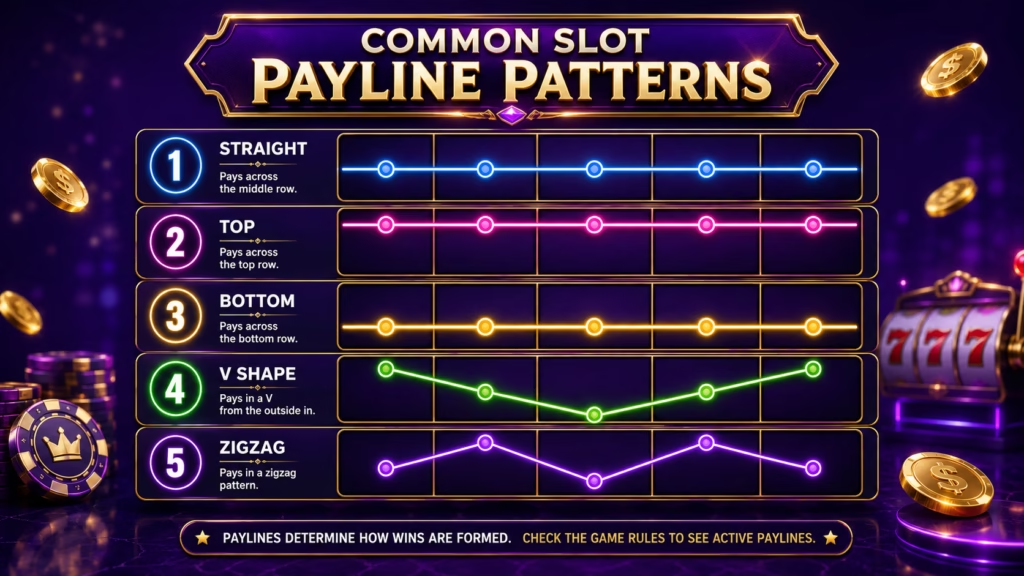
Horizontal Paylines
Horizontal paylines move straight across one row.
X – X – X – X – X
A three-row slot could potentially use separate paylines across the top, middle and bottom rows. Horizontal paylines are usually the easiest patterns for new players to recognize.
Diagonal Paylines
A diagonal payline moves between different vertical positions as it crosses the reels.
X
X
X
X
X
A reverse diagonal can run in the opposite direction. Matching symbols must occupy the positions included in the diagonal. A symbol one position above or below the line normally does not contribute to that particular line win.
Zigzag Paylines
Zigzag paylines move repeatedly between rows.
Top: X X X
Middle: X X
Bottom:
Another pattern could move between the middle and bottom rows. These patterns can appear complicated when several paylines are displayed simultaneously, which is why viewing individual numbered paylines in the game’s information screen is often easier.
V-Shaped and Inverted V Paylines
Some slots use patterns that move toward the center of the reels before returning outward. A V-shaped pattern could use top -> middle -> bottom -> middle -> top. An inverted V might use bottom -> middle -> top -> middle -> bottom.
The shape itself does not change symbol values. It simply specifies which reel positions are evaluated together.
What Do Payline Numbers Mean?
Payline numbers are identifiers assigned to different winning patterns. For example, a 20-payline slot might label its patterns from line 1 through line 20. Payline 1 could represent the middle row, while payline 8 might represent a zigzag across all five reels.
The number assigned to a payline does not normally indicate that the line has a higher payout or better probability than another line. Payout values come from the paytable and the symbols involved.
When several lines produce wins on the same spin, a slot may display the winning paylines one at a time so the player can see which combinations were evaluated.
How Symbols Form a Winning Payline
In many traditional slots, matching symbols must appear consecutively along a payline beginning with the leftmost reel.
Suppose a paytable lists:
- 3 matching symbols: 5x
- 4 matching symbols: 15x
- 5 matching symbols: 50x
If the relevant symbol appears consecutively on reels 1, 2, 3 and 4 along an active payline, the game may award the four-symbol value.
The multiplier or payout should not be interpreted without checking the game’s bet rules. Depending on the slot, displayed paytable values may relate to the total bet, line bet, coin value, or another defined stake unit.
Symbols Must Be on the Same Payline
A common beginner mistake is seeing matching symbols on several reels and assuming they create a win.
Reel 1 Reel 2 Reel 3
A B A
B A B
C C A
There are several A symbols visible, but their presence alone does not necessarily create a winning combination. Their positions must satisfy one of the game’s valid winning patterns.
Active Paylines vs Fixed Paylines
A slot can use adjustable paylines or fixed paylines, and the distinction affects how the total stake is configured.
| Payline system | How it works | What to check |
| Adjustable paylines | The player may be able to select how many lines are active | Bet per line and total stake |
| Fixed paylines | All predefined paylines remain active | Total bet shown before spinning |
| Ways to win | Winning combinations are based on qualifying reel positions rather than conventional lines | Number of ways and combination rules |
| Cluster pays | Adjacent groups of symbols can create wins | Required cluster size and adjacency rules |
Older and simpler multi-line slots are more likely to expose individual line settings. Many modern slots instead use fixed betting structures.
If paylines can be selected manually, reducing the number of active lines can change which patterns are eligible to produce line wins. It does not make inactive lines secretly count if symbols happen to land on them.
How Paylines Affect the Total Bet
In slots that use a bet-per-line structure, the total stake can be calculated by multiplying the number of active paylines by the amount wagered on each line.
For example: 20 active paylines x $0.05 per line = $1 total bet.
If the line stake were increased to $0.10: 20 active paylines x $0.10 per line = $2 total bet.
Modern games do not always expose betting this way. Some display only a total bet while keeping all paylines permanently active. The betting panel should therefore be checked before spinning. Do not assume that changing a displayed coin value or bet level affects every slot in the same way.
Paylines vs Ways to Win
Paylines use specific patterns, while ways-to-win systems usually evaluate matching symbols based on their appearance on consecutive reels without requiring one predefined line.
For example, a conventional payline might require a symbol to occupy middle -> top -> middle -> bottom -> middle. A ways-to-win slot may instead count several qualifying positions on each reel, producing multiple combinations from a single symbol arrangement.
This distinction matters because a slot advertised with hundreds or thousands of ways to win should not automatically be described as having hundreds or thousands of paylines. The underlying mechanics are different.
Paylines vs Cluster Pays
Cluster pays do not normally depend on traditional left-to-right paylines. Instead, wins are formed when enough matching symbols touch each other according to the game’s adjacency rules.
A cluster game may require matching symbols to connect horizontally, vertically, or according to another rule specified by the developer.
Players should therefore distinguish among:
- fixed paylines
- adjustable paylines
- ways to win
- all-ways systems
- cluster pays
They can produce very different reel layouts and winning patterns even when the games look visually similar.
Do More Paylines Mean More Wins?
More paylines create more patterns that can potentially be evaluated, but they do not guarantee more money won or a better long-term result.
A slot with 50 paylines evaluates more predefined patterns than a comparable one-line format, but game mathematics involve more than the line count. Symbol probabilities, paytable values, RTP, volatility, reel configuration and bonus mechanics can all affect the playing experience.
The total stake also matters. If a game’s wager increases when more paylines are activated, comparing raw win counts without considering how much was wagered can be misleading.
Payline count should therefore be treated as a description of the game’s mechanics, not as a strategy for guaranteeing better results.
Are Paylines Related to RTP?
Paylines are part of a slot’s payout structure, but the number of paylines alone does not reveal its RTP.
RTP, or return to player, is a theoretical long-term percentage calculated from the complete mathematical model of the game. Paylines are only one component of that model.
A slot with 20 paylines could have a higher or lower RTP than a slot with 50 paylines. You need the game’s published RTP information rather than the payline count to compare theoretical return.
RTP also does not predict what will happen during an individual session. Short-term results can differ substantially from the theoretical percentage because each spin remains random.
Paylines and Wild Symbols
A wild symbol may substitute for certain other symbols on a payline, potentially helping complete a qualifying combination.
A – A – WILD – A – A
If the game’s rules allow the wild to substitute for A, this sequence may be evaluated as a five-symbol combination.
Wild behavior varies significantly between slots. A wild may have restrictions, appear only on certain reels, expand, move, carry multipliers, or behave differently during a bonus feature. The game’s paytable should specify exactly how its wild symbols work.
Paylines and Scatter Symbols
Scatter symbols often work independently of ordinary paylines, although the exact rules are game-specific.
A slot might trigger a feature when enough scatter symbols appear anywhere on the reels rather than requiring them to align along one payline. This is why a spin can sometimes trigger free spins or another bonus even though the relevant symbols are not positioned on the same line.
Players should check the scatter section of the paytable for the required number of symbols, eligible reel positions and feature rules.
Common Mistakes When Reading Payline Diagrams
Counting Symbols That Are Not on the Same Line
Matching symbols visible across multiple reels do not necessarily create a payline win. Trace one numbered payline from reel to reel before evaluating the combination.
Assuming Every Win Starts on Reel 1
Many conventional slots evaluate line wins from the leftmost reel, but this is not universal. Some games may pay in both directions or use entirely different winning mechanics. Check the game’s rules rather than applying one slot’s system to another.
Confusing Paylines with Ways to Win
A game advertising 243 ways to win is not necessarily a 243-payline slot. Ways-to-win mechanics calculate combinations differently from traditional predefined paylines.
Assuming More Lines Mean Better RTP
Payline count does not provide enough information to determine RTP. The theoretical return depends on the complete mathematical design of the slot.
Ignoring the Total Stake
A low amount displayed beside a line setting may not represent the complete cost of the spin. Verify the total bet before playing, especially when individual paylines and coin values can be adjusted.
How to Check Paylines Before Playing a Slot
The most reliable way to understand a slot’s paylines is to open its paytable, help screen, or game rules before placing a wager.
Look for:
1. Reel and row configuration.
2. Number of paylines or ways to win.
3. Whether paylines are fixed or adjustable.
4. A numbered slot payline diagram.
5. The direction in which combinations are evaluated.
6. Minimum symbols required for a line win.
7. Wild substitution rules.
8. Scatter rules.
9. Bet-per-line and total-bet information.
10. Special mechanics that change during bonus rounds.
If a slot uses an unfamiliar winning system, reading these rules is more useful than trying to infer the mechanics by watching a few spins.
A Simple Method for Reading Any Payline
Step 1: Identify the numbered payline.
Step 2: Find the highlighted position on reel 1.
Step 3: Follow the highlighted position across each subsequent reel.
Step 4: Note which symbols occupy those positions.
Step 5: Check whether the required symbols are consecutive.
Step 6: Compare the combination with the paytable.
Step 7: Confirm whether wilds, scatters or special symbols alter the result.
Step 8: Check how the payout relates to the current total bet.
This approach separates the visual pattern from the game’s payout rules and makes even complex slot payline diagrams easier to interpret.
How This Information Was Reviewed
This guide treats a payline as one component of a slot’s broader rules and payout system rather than as an isolated indicator of winning potential.
For any specific slot, the game’s own paytable and help screen should remain the primary reference for its exact paylines, winning direction, wild behavior, scatter rules, bet structure and alternative mechanics. RTP and volatility also describe mathematical characteristics of a game rather than predicting the result of a particular spin or session.
Slots involve random outcomes and should be treated as entertainment rather than a way to generate income. Set spending and time limits before playing, and stop if gambling is no longer enjoyable or remains within your planned limits only with difficulty.
FAQ
What is a payline in a slot machine?
A payline is a predefined pattern of reel positions used to evaluate a potential winning combination. A traditional payline may run horizontally, diagonally or in a zigzag across several reels. Matching symbols usually need to occupy the specified positions and satisfy the game’s paytable rules.
How do I read a slot payline diagram?
Read a slot payline diagram by following the highlighted position from the first reel through every subsequent reel. Each highlighted position belongs to the same numbered payline. Then compare the symbols on those positions with the game’s paytable to determine whether they form a qualifying combination.
Do matching symbols have to be on the same payline?
In a traditional payline slot, matching symbols generally need to occupy positions belonging to the same active payline. Simply seeing several identical symbols on different parts of the reels does not automatically create a line win. Alternative mechanics such as ways to win and cluster pays use different rules.
Do paylines always pay from left to right?
No. Left-to-right evaluation is common in conventional slots, but it is not universal. Some games can evaluate combinations differently, including both directions or through non-payline mechanics. The exact rule should be confirmed in the game’s paytable or help section.
Is a 243-ways slot the same as a 243-payline slot?
No. A 243-ways slot generally evaluates combinations through qualifying symbol positions on consecutive reels rather than through 243 predefined line patterns. Paylines and ways to win are different mechanisms even though both determine how winning combinations are recognized.
Are more paylines better?
More paylines mean that more predefined patterns may be evaluated, but they do not guarantee better returns or profitable results. RTP, volatility, symbol probabilities, payout values and bonus mechanics also influence the game’s mathematical structure.
Can I choose how many paylines to play?
Some slots allow players to activate or deactivate paylines, while many modern games use fixed paylines that remain permanently active. If line selection is available, check how changing the number of active lines affects the total bet before spinning.
What happens if I win on multiple paylines?
A slot can potentially register more than one qualifying line combination on the same spin when its rules allow multiple paylines to be evaluated simultaneously. The game normally calculates the applicable line wins according to its paytable and displays the resulting total. Exact calculation rules should be checked for the specific game.
Do wild symbols have to land on a payline?
For a wild to contribute to a traditional line win, it normally has to occupy one of the positions used by that winning payline. Wild substitution rules vary between games, so the paytable should be checked for excluded symbols, reel restrictions, multipliers and other special behavior.
Do paylines affect my chances of winning?
The number and structure of active paylines affect which predefined symbol patterns can qualify as line wins, but payline count alone does not reveal the overall probability of winning or the game’s RTP. Slots use broader mathematical models, and the outcome of each spin remains random.
Brief Conclusion
To understand how to read slot paylines, follow each highlighted payline from reel to reel and compare the symbols occupying those positions with the game’s paytable. A slot payline diagram shows where a valid line runs, but the paytable determines what actually qualifies as a payout. Always distinguish traditional paylines from ways to win and cluster pays, confirm the total stake before playing, and remember that more paylines do not guarantee better results.