Cluster pays slots replace traditional paylines with groups of matching symbols. Instead of needing symbols to land across a fixed line from left to right, a win forms when enough identical symbols touch each other in a connected cluster. The required cluster size and connection rules depend on the individual game, so the paytable should always be checked before playing.
Quick takeaways:
- Cluster pays slots award wins for connected groups of matching symbols rather than fixed paylines.
- Matching symbols usually need to touch horizontally or vertically, although exact rules vary by slot.
- Larger clusters commonly produce higher payouts than the minimum qualifying cluster.
- Cascades, multipliers and expanding grids are often combined with cluster pays, but they are separate mechanics.
- Cluster pays do not make a slot easier to beat or guarantee more frequent wins.
Cluster mechanics are usually most appealing to players who prefer visual, grid-based slots and do not want to follow dozens of paylines. Players who prefer simple three-reel or classic five-reel games may find traditional paylines easier to read.
What Are Cluster Pays Slots?
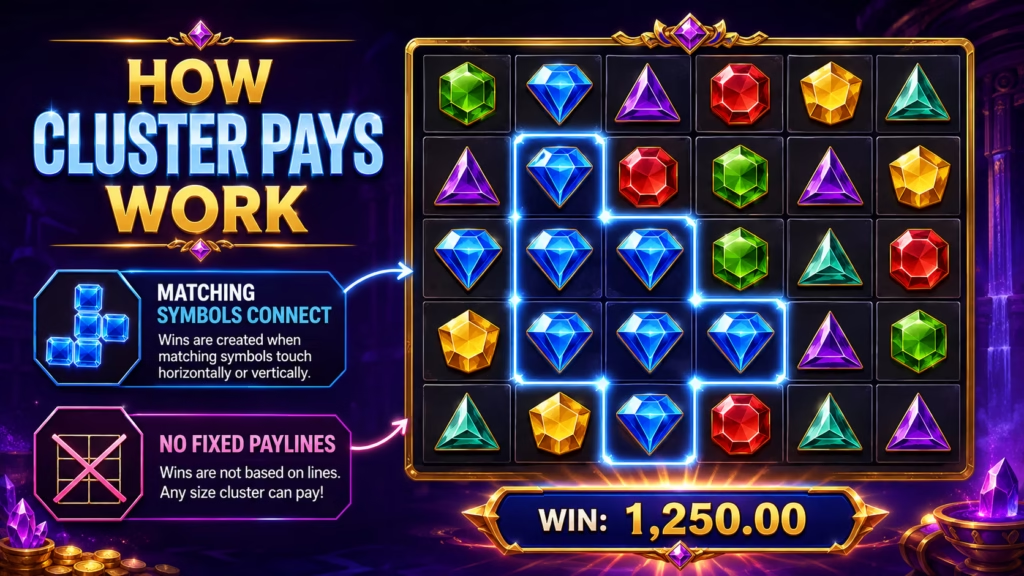
A cluster pays slot is a slot game in which matching symbols form winning groups based on their position next to one another. A typical cluster might require five or more identical symbols, although some games use different minimum sizes or special conditions.
Traditional slots evaluate predetermined paylines or defined ways to win. Cluster pays slots instead examine the grid for connected matching symbols.
For example, imagine six matching symbols positioned like this:
A A B C
A A A D
E A F G
If the game’s rules count horizontally and vertically connected symbols, the six “A” symbols could form one qualifying cluster.
The exact payout would depend on the game’s paytable and the number of symbols in that cluster.
How Do Cluster Pays Slots Work?
Cluster pays slots work by scanning the game grid after each spin and identifying groups of identical symbols that satisfy the minimum cluster requirement.
The process generally follows four steps:
- Symbols land across the grid.
- The game identifies connected matching symbols.
- Clusters meeting the minimum size qualify for a payout.
- The payout is calculated according to the paytable and cluster size.
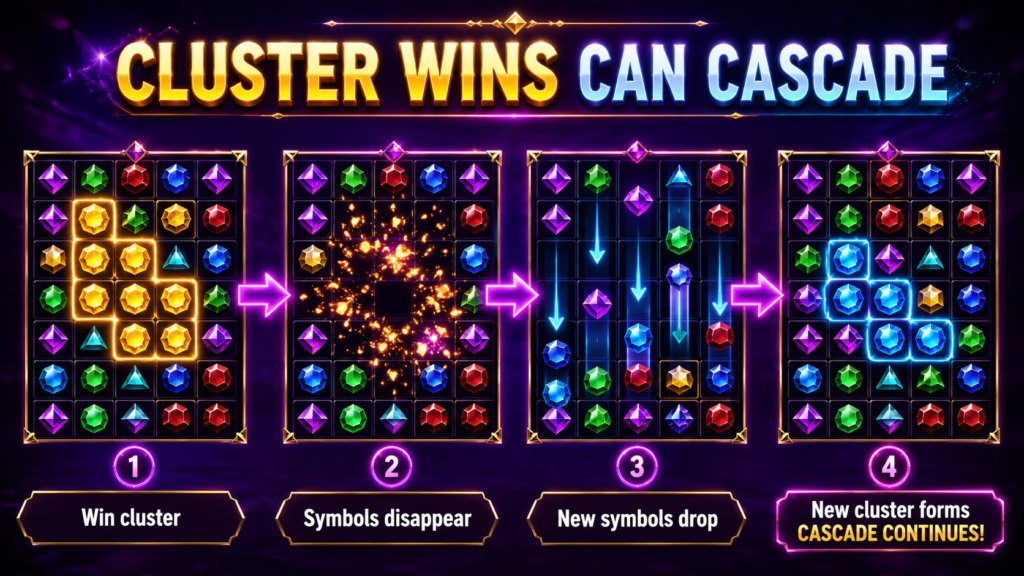
Some slots stop at this point. Others remove winning symbols and allow new symbols to fall into the empty positions, creating a cascade or tumble.
The important distinction is that cluster pays determines how a winning combination is created. Cascades, multipliers, free spins and other features determine what may happen after or alongside that win.
How Do Symbols Need to Connect?
Most cluster pays slots require matching symbols to touch horizontally or vertically. Symbols touching only at a corner generally do not belong to the same cluster unless the game’s rules specifically allow diagonal connections.
Consider this arrangement:
A B A
B A B
A B A
Although several “A” symbols appear close together, they may not form a cluster because they only touch diagonally.
Now compare it with:
A A B
B A B
B A A
These matching symbols are connected by their sides and may therefore be treated as one cluster.
Connection rules are game-specific. The official paytable or help menu is the reliable place to confirm whether horizontal, vertical or diagonal connections count.
How Many Symbols Are Needed for a Cluster Win?
There is no universal minimum number of symbols required for every cluster pays slot. Many games begin paying when approximately five matching symbols connect, but the threshold can be higher or lower depending on the game’s mathematical design.
The payout usually increases as the cluster becomes larger.
A hypothetical paytable could look like this:
| Cluster Size | Example Payout |
| 5 symbols | 0.5x bet |
| 6 symbols | 0.8x bet |
| 7 symbols | 1.2x bet |
| 8 symbols | 2x bet |
| 9+ symbols | Higher game-specific payout |
These figures are only an illustration. Actual cluster thresholds and payouts must be checked in the slot’s paytable.
This scaling system is one reason cluster slots can feel different from paylines. Instead of simply asking whether a line has been completed, the game may also evaluate how large the connected winning group becomes.
Cluster Pays vs Paylines
Cluster pays and paylines are two different methods for defining winning combinations.
| Feature | Cluster Pays | Traditional Paylines |
| Winning structure | Connected groups | Predetermined lines |
| Typical layout | Larger grid | Often reels and rows |
| Direction | Based on adjacency rules | Often left to right |
| Win size | Can depend on cluster size | Depends on symbols across a line |
| Need to track lines | No | Sometimes |
| Cascades | Common but optional | Also possible |
A payline slot may require three matching symbols across a specific line. A cluster pays game may instead require several matching symbols anywhere within a connected section of the grid.
Neither system is automatically better. Cluster pays usually suit players who prefer more visual mechanics, while paylines can be easier for players familiar with traditional slots.
Cluster Pays vs Ways to Win
Cluster pays should also not be confused with ways-to-win systems.
In a ways-to-win slot, matching symbols typically need to appear on consecutive reels in qualifying positions. The exact location on each reel may not matter, which removes the need for fixed paylines.
Cluster pays take this concept further by focusing on adjacent symbols within a grid rather than consecutive reels.
A cluster can therefore have an irregular shape. It might extend upward, downward and sideways instead of forming a straight combination across the screen.
Why Cascades Are Common in Cluster Pays Slots
Cascading mechanics work particularly well with cluster pays because removing a large group of connected symbols creates substantial empty space on the grid.
After a winning cluster disappears, symbols above the empty positions may fall downward and new symbols can enter the grid. If another qualifying cluster forms, another payout may occur before the sequence finishes.
This process may be called:
- cascades;
- tumbles;
- reactions;
- avalanches;
- symbol drops.
The terminology differs between providers.
A cascade is not automatically part of every cluster pays slot. It is an additional feature that must be described in the game’s rules.
How Multipliers Work With Cluster Pays
Multipliers can increase the value of qualifying cluster wins, but multiplier systems differ substantially between slots.
One game might increase a multiplier after every consecutive cascade. Another may place multipliers on specific grid positions. A third might activate multipliers only during free spins.
For example, a cluster worth 2x the stake combined with a 3x multiplier could theoretically become worth 6x the stake if the game’s rules multiply those values directly.
That example does not represent every game. Players should check how multipliers are applied because some slots calculate individual symbol wins, cascades and bonus multipliers differently.
Do Bigger Clusters Pay More?
Larger clusters commonly pay more than smaller qualifying clusters of the same symbol because cluster size is often part of the paytable calculation.
A six-symbol cluster, for example, may pay less than a cluster containing ten matching symbols.
Symbol value also matters. A large cluster of a low-value symbol may still pay less than a smaller cluster of a premium symbol.
The relevant variables can include:
- symbol type;
- cluster size;
- current stake;
- active multiplier;
- bonus mode;
- other game-specific modifiers.
Players should therefore avoid judging a cluster only by how much of the screen it covers.
Can Multiple Clusters Win on the Same Spin?
Some cluster pays slots can produce several winning groups during the same spin or cascade, provided each group satisfies the game’s rules.
Whether separate groups of the same symbol are counted independently depends on the game’s mathematical and paytable rules.
A single spin can also become a sequence of several evaluations when cascading symbols are involved. The original grid may create one or more clusters, those symbols disappear, and replacement symbols may create additional wins.
This can make cluster slots feel more active than conventional paylines even though every outcome remains governed by the game’s underlying random system.
Do Cluster Pays Slots Have Better RTP?
Cluster pays do not inherently provide a higher RTP than paylines, Megaways or ways-to-win slots.
RTP, or return to player, is a theoretical long-term percentage determined by the specific game’s mathematical model. Cluster pays merely describe the way combinations are formed.
For example, two cluster pays games could have different RTP settings even though their basic winning mechanic looks similar.
The exact RTP should be checked in the game’s information or paytable because some slots may also be offered with different RTP configurations depending on the casino.
RTP does not predict what will happen during an individual session. A game with a higher theoretical RTP can still produce a losing session because individual outcomes remain random.
Are Cluster Pays Slots More Volatile?
Cluster pays mechanics alone do not determine volatility.
Volatility describes how the size and frequency of payouts are distributed. A cluster slot can theoretically use low, medium or high volatility depending on its mathematical design.
Several features can influence how the game feels, including:
- payout values for large clusters;
- frequency of qualifying clusters;
- multiplier potential;
- free-spin mechanics;
- cascading wins;
- maximum payout structure.
Players who want to understand the risk profile of a particular game should examine its stated volatility and paytable instead of assuming that all cluster slots behave similarly.
Common Features in Cluster Pays Slots
Cluster pays games are frequently combined with additional mechanics designed around their larger grid layouts.
Cascading Symbols
Winning symbols disappear and are replaced, creating opportunities for additional combinations within the same sequence.
Increasing Multipliers
Some games increase a multiplier after consecutive winning cascades. The multiplier may reset when the sequence ends.
Persistent Multipliers
Certain slots attach multipliers or other modifiers to grid positions. New symbols landing on those positions may receive the modifier.
Expanding Grids
Some games increase the number of available positions during a bonus or after particular events.
Free Spins
Free-spin rounds may introduce enhanced multipliers, persistent modifiers or alternative grid behavior.
These features are not guaranteed simply because a game uses cluster pays. Each slot should be evaluated according to its own rules.
Common Cluster Pays Mistakes and Myths
“More symbols on the grid means better odds”
A larger grid does not automatically mean better winning odds. The mathematical model accounts for the grid size, symbol distribution, payout values and other mechanics.
“A cluster that almost connects is close to winning”
An incomplete cluster has no predictive value for the next spin. Random slot outcomes do not become more likely because previous symbols nearly formed a winning combination.
“Cluster pays slots pay more than paylines”
There is no general rule that cluster pays produce better returns. RTP and payout distribution depend on the individual game.
“Cascades mean free extra spins”
A cascade may create another evaluation without an additional wager, but it is part of the original game sequence rather than necessarily being a conventional free spin. Terminology and rules vary by slot.
“A large cluster means a huge payout”
Cluster size is only one factor. Symbol value, multipliers, stake and paytable rules can all affect the final payout.
How to Choose a Cluster Pays Slot
A useful way to compare cluster pays slots is to examine their mechanics rather than choosing purely by theme or graphics.
Check these factors before playing:
- Minimum cluster size: Find out how many connected symbols are required.
- Connection rules: Confirm whether symbols connect horizontally, vertically or diagonally.
- RTP: Check the version offered by the casino.
- Volatility: Consider how much payout variation you are comfortable with.
- Cluster paytable: See how rewards increase with cluster size.
- Cascading rules: Determine whether wins can trigger additional symbol drops.
- Multipliers: Check when multipliers activate and when they reset.
- Bonus features: Review free spins and other special mechanics.
- Maximum win: Check the game’s official limits if this matters to you.
- Bet range: Make sure the available stake fits the limits you have set.
Players with smaller entertainment budgets should pay particular attention to volatility and stake size. A visually busy cluster system does not change the financial risk associated with repeated wagering.
Who Might Prefer Cluster Pays Slots?
Cluster pays slots may suit players who enjoy modern grid-based games, cascading combinations and mechanics that are easier to recognize visually than dozens of individual paylines.
They can be particularly appealing to players who like watching combinations grow across the grid or who enjoy bonus systems built around cascades and multipliers.
Traditional slot players may prefer paylines if they want simple reels, clearly defined combinations and fewer interacting mechanics.
Neither format improves a player’s ability to predict future results.
Practical Tips Before Playing
Start by opening the paytable rather than relying on assumptions from other cluster games. Two visually similar slots may use different minimum cluster sizes, payout values, RTP configurations and bonus rules.
Use a stake that allows you to remain within a predetermined entertainment budget. High-volatility games can produce long periods without meaningful payouts, regardless of whether they use clusters, paylines or another system.
Do not increase bets because a large cluster appears “due.” Previous spins do not provide a reliable way to predict the next random result.
If a casino promotion is involved, check wagering requirements, maximum-bet restrictions and other conditions separately. Bonus terms belong to the casino offer and should not be confused with the slot’s own cluster mechanic.
How This Information Was Reviewed
The explanation of cluster pays is based on the mechanics that should be checked when evaluating this type of slot: cluster requirements, symbol adjacency, paytables, RTP, volatility, cascades, multipliers and bonus rules.
Individual games can implement these features differently. The game’s official rules and paytable should therefore take priority when determining minimum cluster size, payout values, RTP configuration, volatility, maximum win and feature behavior.
RTP and volatility describe mathematical characteristics over many game rounds. They cannot guarantee a result during a specific session. Cluster pays also do not provide a method for predicting future symbols.
Casino games should be treated as paid entertainment rather than a source of income. Set spending and time limits before playing and stop if gambling stops being enjoyable or begins affecting money needed for other purposes.
FAQ
What does cluster pays mean in slots?
Cluster pays means a slot awards qualifying wins when enough identical symbols form a connected group on the game grid. Unlike traditional paylines, the symbols normally do not need to appear across a predetermined line.
How do cluster pays slots work?
Cluster pays slots identify groups of matching symbols that touch according to the game’s adjacency rules. When a group reaches the required minimum size, the slot awards the payout shown in its paytable. Larger qualifying clusters may receive higher payouts.
How many matching symbols are needed for a cluster win?
The required number depends on the individual slot. Many cluster games require several connected matching symbols, but there is no universal minimum. Check the paytable for the exact requirement.
Do diagonal symbols count in cluster pays slots?
Diagonal symbols usually do not count unless the game’s rules specifically allow diagonal connections. Many cluster systems require symbols to touch horizontally or vertically, but implementations vary between games.
Are cluster pays better than paylines?
Cluster pays are not mathematically better simply because they use clusters. They provide a different way of forming winning combinations. RTP, volatility and payout potential depend on the individual game’s mathematical model.
Do all cluster pays slots use cascading reels?
No. Cascades are commonly combined with cluster pays, but they are a separate feature. A cluster slot can theoretically award a win without removing the winning symbols or creating another cascade.
Can cluster pays slots have multipliers?
Yes, many cluster slots use multipliers, but the way they work varies. Multipliers may increase during cascades, remain attached to specific grid positions or become active only during bonus rounds. The exact rules should be checked in the paytable.
Do bigger clusters always pay more?
Larger clusters commonly increase the payout for the same symbol, but total value can also depend on symbol type, stake, multipliers and bonus modifiers. The paytable determines the actual payout.
Are cluster pays slots more likely to win?
Not necessarily. The cluster mechanic determines how winning combinations are recognized, not whether a game has better winning odds. Hit frequency, RTP and volatility depend on the individual game’s mathematical design.
Can you predict when a cluster will appear?
No. Previous clusters, near-misses and losing spins cannot reliably predict the next result. Slot outcomes are random, and cluster patterns should not be treated as signals that a win is due.
In short
Cluster pays slots create winning combinations from connected groups of matching symbols instead of traditional paylines. Cluster size, connection rules, cascades, multipliers, RTP and volatility vary between games, so the paytable should always be checked before playing. The mechanic changes how wins are displayed and calculated, but it does not guarantee more frequent wins or give players control over random outcomes.