
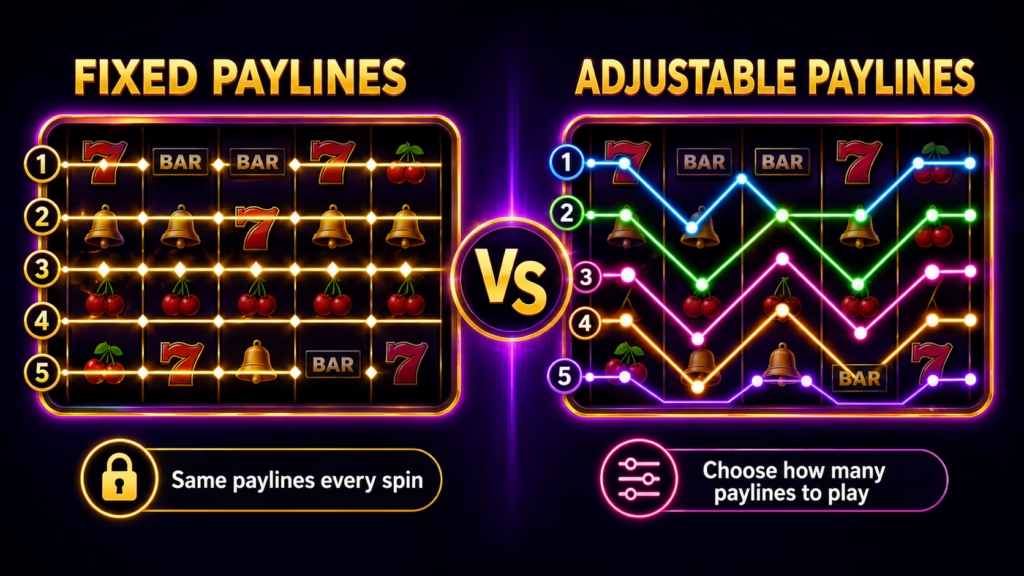
Fixed vs adjustable paylines refers to whether a slot lets you choose how many paylines are active on each spin. Fixed-payline slots require all listed paylines to remain active, while adjustable-payline slots let you activate fewer or more lines within the game’s allowed range. The main difference is control over bet structure, not control over the random outcome of a spin.
Quick takeaways:
- Fixed paylines are always active and cannot normally be switched off individually.
- Adjustable paylines let players select how many available lines they want to activate.
- Activating fewer paylines can reduce the total stake when the slot uses a bet-per-line structure.
- Fewer active paylines also mean fewer possible line combinations can produce a line win on that spin.
- Changing the number of paylines does not make a random slot predictable or create a guaranteed winning strategy.
Fixed paylines are generally easier for players who want a simple betting setup. Adjustable paylines may appeal more to players who want greater control over how their total stake is distributed. In either case, the game’s paytable and betting rules should be checked because slot implementations vary.
What Are Fixed Paylines in Slots?
Fixed paylines are predetermined winning patterns that remain active on every spin. If a slot has 20 fixed paylines, all 20 are normally evaluated whenever the reels stop.
The player does not choose whether to play 5, 10 or 20 of those lines. Instead, betting controls usually change the overall stake, coin value, bet level or another betting parameter while the full payline structure remains active.
For example, imagine a slot with:
- 5 reels
- 3 rows
- 20 fixed paylines
- a minimum total bet of $0.20
If the game is designed around all 20 lines, placing the minimum permitted wager activates the entire 20-line structure rather than letting the player disable individual paylines.
The exact way the stake is calculated depends on the slot. Players should therefore check the bet panel and official paytable instead of assuming that every 20-payline game uses the same bet-per-line formula.

What Are Adjustable Paylines?
Adjustable paylines allow the player to select how many of the available paylines are active for a spin. A game might offer 20 possible lines but let the player activate 1, 5, 10, 15 or all 20, depending on its design.
Only active paylines are normally eligible for standard line-based payouts. If a winning symbol combination forms entirely on a payline that was not activated, that line would generally not produce its normal line payout.
Consider a hypothetical 20-payline slot where the stake is calculated as:
Total bet = active paylines × bet per line
| Active Paylines | Bet Per Line | Total Bet |
| 5 | $0.01 | $0.05 |
| 10 | $0.01 | $0.10 |
| 20 | $0.01 | $0.20 |
This example shows why adjustable paylines were traditionally useful for players who wanted direct control over the number of combinations they were paying to activate.
However, not every adjustable-payline slot follows exactly this betting system. The rules shown inside the specific game should be treated as the final reference.
Fixed vs Adjustable Paylines: Key Differences
The difference between fixed and adjustable paylines is primarily how much control the player has over line activation.
| Feature | Fixed Paylines | Adjustable Paylines |
| Can paylines be disabled? | Usually no | Usually yes |
| Are all lines active? | Yes | Only selected lines |
| Betting setup | Generally simpler | More configurable |
| Control over number of lines | No | Yes |
| Can fewer active lines reduce total stake? | Not through line selection | Often, depending on bet structure |
| Do paylines affect random outcomes? | No | No |
| Can inactive lines pay standard line wins? | Not applicable | Normally no |
Neither system is automatically better. Fixed paylines emphasize simplicity and full-line coverage, while adjustable paylines emphasize betting flexibility.
How Fixed Paylines Affect Your Bet
Fixed-payline slots simplify betting because the player does not need to decide how many lines to activate. Every available line remains part of the spin.
This can make the interface easier to understand, especially for beginners. Instead of managing line count and line stake separately, the player typically selects a total wager or chooses from the game’s available betting levels.
The tradeoff is reduced flexibility. If the minimum permitted stake is higher than a player’s preferred amount, disabling paylines is not normally available as a way to lower it.
For players using strict session limits, the important number is therefore the total cost per spin, not simply how many fixed paylines the game displays.
How Adjustable Paylines Affect Your Bet
Adjustable paylines can change both the number of active winning patterns and, in some games, the total amount wagered per spin.
Suppose an adjustable game has 25 possible paylines. Activating only 5 lines means only those selected line patterns participate in ordinary line-win evaluation. Activating all 25 provides coverage across the complete payline set.
This creates an important tradeoff:
- fewer active lines may allow a smaller total stake;
- more active lines provide more active patterns on which line combinations can qualify;
- activating more paylines usually requires a higher total wager when the bet per line stays unchanged.
This does not mean that activating every payline makes a spin profitable or improves the player’s chances of making money over time. Slot outcomes remain random, and the mathematical rules of the game still apply.
Does Playing More Paylines Increase Your Chance of Winning?
Playing more paylines increases the number of active line patterns that can potentially qualify for line-based payouts, but it does not guarantee a win or a profitable session.
For example, activating 20 out of 20 available paylines gives the player more active line coverage than activating only 5. A symbol combination appearing on one of the other 15 lines can only produce its standard line payout if that line is active.
However, the player is often paying more to obtain that additional coverage.
This distinction matters because win frequency and profitability are not the same thing. More active paylines can expose the wager to more qualifying combinations while simultaneously increasing the amount risked per spin.
The exact mathematical effect depends on the game’s rules, paytable and betting model.
Do Fewer Paylines Mean Better Value?
Using fewer paylines does not automatically provide better value. It usually means the player is purchasing fewer active line combinations.
The benefit can be a lower cost per spin when the slot’s betting system links total stake to the number of active lines. That may allow a fixed entertainment budget to cover more spins.
The disadvantage is that a combination appearing on an inactive payline normally cannot award its standard line payout.
Therefore, reducing paylines should be viewed as a bet-sizing decision, not as a method for improving or predicting random outcomes.
Are Fixed Paylines Better for Beginners?
Fixed paylines are often easier for beginners because there is one less betting variable to manage. The player does not need to decide whether to activate 5, 10, 20 or another number of lines.
A fixed-payline game may be suitable for someone who wants:
- a simple betting interface;
- every listed line active on every spin;
- fewer decisions before pressing spin;
- an easier way to see the total cost of each wager.
Beginners should still check the total bet carefully. A slot with fixed paylines is not necessarily cheap to play simply because the betting interface is simpler.
Who Might Prefer Adjustable Paylines?
Adjustable paylines may appeal to players who want more control over stake construction. Instead of accepting the game’s full set of lines, the player can choose a smaller or larger active selection where the slot permits it.
This format can be useful when someone wants to:
- experiment with different bet configurations;
- reduce the total stake without changing the bet per line;
- understand how individual paylines work;
- choose between broader line coverage and a smaller wager.
The practical value depends on the specific slot. Many modern games use different structures, such as ways-to-win, cluster pays or other payout systems, so adjustable paylines are not available in every slot.
Fixed Paylines vs Ways to Win
Fixed paylines and ways-to-win systems are different methods of determining winning combinations.
A traditional payline follows a specific pattern across reel positions. For example, one line might run horizontally through the middle row, while another follows a zigzag pattern.
A ways-to-win slot usually does not require symbols to follow one predefined line. Instead, matching symbols generally need to land on consecutive reels in qualifying positions according to the game’s rules.
Because of this difference, a slot advertised with hundreds or thousands of “ways” should not automatically be compared with a 20-payline slot as though each way were simply another conventional payline.
Always check the game’s payout rules to understand what its advertised number actually represents.
Do Paylines Change RTP?
Changing the number of active paylines does not automatically mean that a slot’s RTP changes. Whether different betting configurations affect theoretical RTP depends on the mathematics and rules programmed into that particular game.
RTP, or return to player, is a theoretical long-term percentage calculated across a very large number of game rounds. It does not predict what will happen during a short session.
Players should not assume that selecting fewer paylines increases RTP or that activating every line produces a higher return. If a game offers different RTP configurations or special betting conditions, those details should be stated in the paytable, help screen or operator information.
Do Paylines Affect Volatility?
The number of active paylines can change the player’s experience of individual spins, but it should not be confused with the slot’s underlying volatility classification.
Slot volatility describes the general distribution and size of payouts within the game’s mathematical model. A high-volatility slot may produce less regular but potentially larger payouts, while a lower-volatility design may distribute payouts differently.
Activating fewer lines can mean fewer line combinations are eligible on each wager. That may make individual sessions feel different, but it does not justify assuming that the game’s fundamental volatility has been transformed into another category.
RTP and volatility also do not predict the outcome of a specific spin or session.
Common Myths About Fixed and Adjustable Paylines
Myth 1: Fixed paylines are rigged against the player
Fixed paylines simply define which line patterns are active. They do not, by themselves, show whether a slot is fair or unfair. The game’s mathematical model and random outcome generation are separate issues.
Myth 2: One active payline gives the best chance to make money
Reducing the number of lines can reduce the stake in some games, but it also reduces active line coverage. There is no guaranteed payline setting that turns a random slot into a reliable source of profit.
Myth 3: Maximum paylines guarantee more wins
More active paylines provide more active winning patterns, but they can also increase the total wager. They do not guarantee that qualifying symbols will land.
Myth 4: A winning combination should pay even on an inactive line
In a conventional adjustable-payline slot, standard line wins normally require the relevant payline to be active. Special symbols or features may follow different rules, so the paytable should always be checked.
How to Choose Between Fixed and Adjustable Paylines
Choose based on betting flexibility, simplicity and total cost per spin rather than trying to predict which system will win more often.
Before playing, check:
- Total bet per spin. Know exactly how much one spin costs.
- Number of active paylines. Confirm whether all lines are mandatory or selectable.
- Bet-per-line rules. Determine whether changing line count changes the total wager.
- Paytable. Check how winning combinations are formed and paid.
- Special feature rules. Scatters, bonuses or jackpots may follow rules that differ from standard paylines.
- RTP information. Check whether the operator or game provides an RTP value and whether different configurations exist.
- Personal limits. Decide the maximum amount and session length before playing.
For someone who values simplicity, fixed paylines are usually easier to manage. For someone who specifically wants to customize line coverage and stake distribution, adjustable paylines provide more flexibility when the game supports them.
Neither option changes the fundamental fact that slot outcomes are random.
How This Information Was Reviewed
This comparison is based on the functional differences between fixed paylines, selectable paylines, bet-per-line structures and standard line-based payout rules. Because individual slots can implement these mechanics differently, the paytable, help screen and betting panel of the specific game should always be checked before playing.
Players should also verify whether special symbols, bonus rounds, jackpots or other features require particular betting conditions. RTP, volatility, active paylines and bonus features describe aspects of a game’s mathematics or structure, but none of them guarantees a particular result in an individual session.
Slots should be treated as entertainment rather than a way to earn money. Set spending and time limits in advance, and stop playing if gambling stops being recreational.
FAQ
What is the difference between fixed and adjustable paylines?
Fixed paylines are always active, while adjustable paylines allow the player to select how many available lines participate in a spin. Adjustable paylines can provide more control over the total stake in games where the wager depends on the number of active lines.
Can you change fixed paylines?
No, fixed paylines normally cannot be activated or deactivated individually. The complete payline set remains active for each qualifying wager. Players can usually change the total bet using the controls provided by the slot instead.
Is it better to play all paylines on a slot?
Playing all paylines gives full coverage of the game’s available line patterns, but it is not automatically better financially. In adjustable-payline games, activating more lines may increase the total wager. There is no line setting that guarantees winning results.
Can I win on a payline that is not active?
A standard line combination normally does not pay if it appears on an inactive payline. However, scatters, bonus symbols and other special features may use different rules, so the game’s paytable should be checked.
Do more paylines mean a higher chance of winning?
More active paylines create more active patterns on which line wins can potentially occur. However, the player may also be wagering more money per spin, and additional paylines do not guarantee a win or profit.
Do adjustable paylines lower the cost of playing?
Adjustable paylines can lower the total wager when the game calculates the bet from the number of active lines and the stake per line. The exact calculation varies between slots, so check the betting controls before assuming fewer lines will reduce the stake.
Do fixed paylines have better RTP?
Fixed paylines do not automatically have better or worse RTP than adjustable paylines. RTP depends on the mathematical configuration of the specific game. It is a theoretical long-term measure and does not predict short-term results.
Are adjustable paylines still common in modern slots?
Adjustable paylines exist in many traditional line-based slots, but modern games can also use fixed paylines, ways-to-win systems, cluster pays and other payout structures. The available system depends on the individual game.
Can changing paylines help me beat a slot?
No. Changing paylines cannot make random slot outcomes predictable or provide a guaranteed winning strategy. Payline selection changes wager structure and active line coverage, not the random outcome of the reels.
Brief Conclusion
Fixed paylines prioritize simplicity, while adjustable paylines prioritize betting flexibility. Fixed-payline slots keep every listed line active, whereas adjustable-payline slots allow selected lines to be switched on or off where the game permits it.
The better choice depends on how much control you want over your wager, not on which system appears more likely to produce profit. Check the paytable, understand the total cost per spin, set limits before playing and remember that every slot spin remains random.