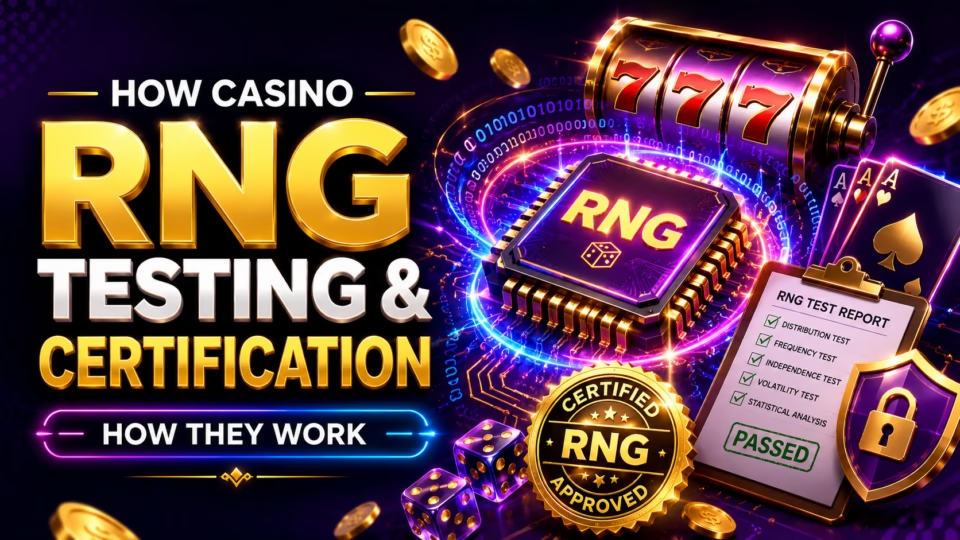
Casino RNG testing is the process used to determine whether a Random Number Generator produces outcomes that are sufficiently unpredictable, unbiased and consistent with the mathematical rules of a casino game. Independent testing laboratories examine the RNG implementation, source code, raw number output, scaling or shuffling logic and, where required, the way random numbers are converted into actual game outcomes.
RNG certification does not mean that a player will win, that every short session will match the advertised RTP, or that a casino game has no house edge. It means that the tested system met specified technical requirements under the standards used for that assessment.
Key points about casino RNG testing:
- RNG output is tested statistically for randomness and expected distribution.
- Laboratories may inspect source code, seeding, scaling, shuffling and raw RNG output.
- RNG certification and full game certification are not necessarily the same assessment.
- Requirements differ between gambling jurisdictions.
- Significant changes to an RNG or game can trigger additional testing or certification.
The UK Gambling Commission, for example, requires RNG-driven products to produce outcomes that are acceptably random and allows this to be demonstrated with statistical analysis using generally accepted tests and methods. Its standards also require outcomes to be unpredictable and correctly distributed according to the expected probabilities of the game.
What Is a Casino RNG?
A casino Random Number Generator is a hardware or software system that supplies random values used to determine outcomes in games such as online slots, RNG blackjack, roulette simulations, video poker, bingo and virtual games.
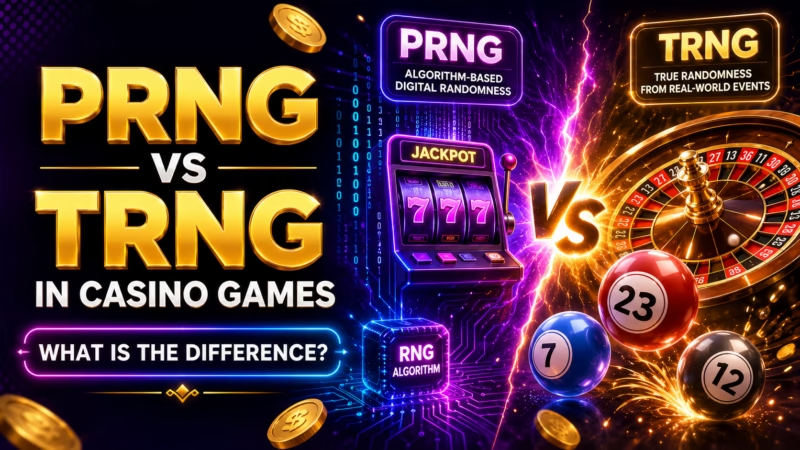
Software casino games commonly use pseudorandom number generators, or PRNGs. A PRNG uses an algorithm and an internal state or seed to generate a sequence of values. Hardware-based generators can obtain randomness through physical processes instead. Testing laboratories can evaluate both approaches, including raw numbers and scaled or shuffled output.
The important question is not simply whether the RNG generates a large quantity of different numbers. The entire process must avoid introducing predictable patterns or statistical bias when those numbers are converted into reels, cards, numbers or other game results.
Why Casino RNG Testing Is Necessary
Casino RNG testing provides independent evidence that the mechanism responsible for determining random outcomes behaves according to applicable technical standards.
A poorly implemented RNG can create several problems. Numbers may be distributed unevenly, sequences may repeat, seed handling may make future values easier to predict, or the conversion of RNG output into game outcomes may introduce bias even when the underlying generator works correctly.
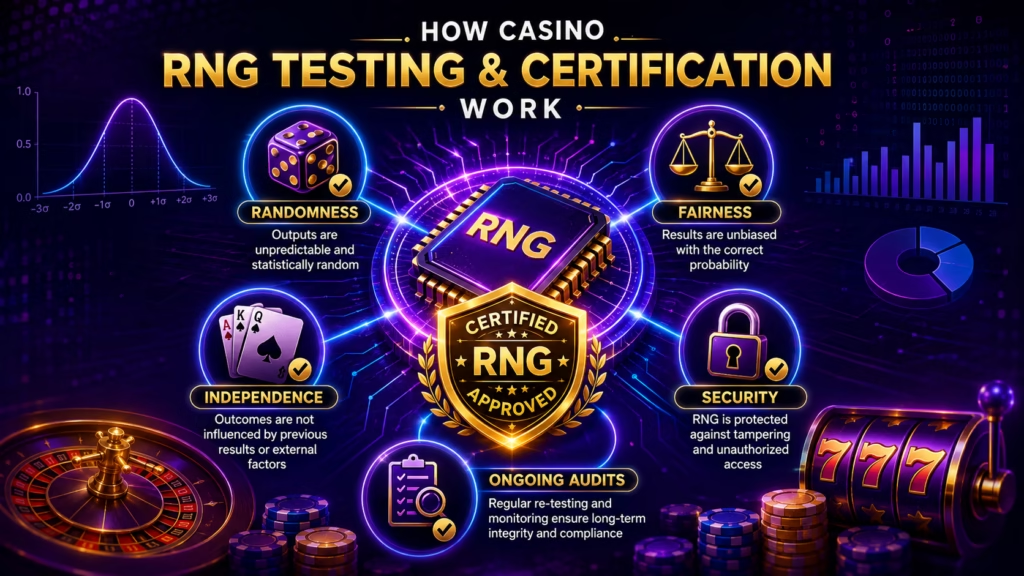
Regulatory RNG requirements commonly focus on several principles. RNG output should be appropriately distributed, future output should be unpredictable, separate instances should not synchronize into identical streams, seeding should not introduce predictability, and scaling should preserve the required randomness characteristics.
That last point is especially important. Testing only the underlying generator is not always enough. An RNG might generate numbers correctly while a mistake in the game’s scaling or mapping logic produces incorrect probabilities.
How Casino RNG Testing Works
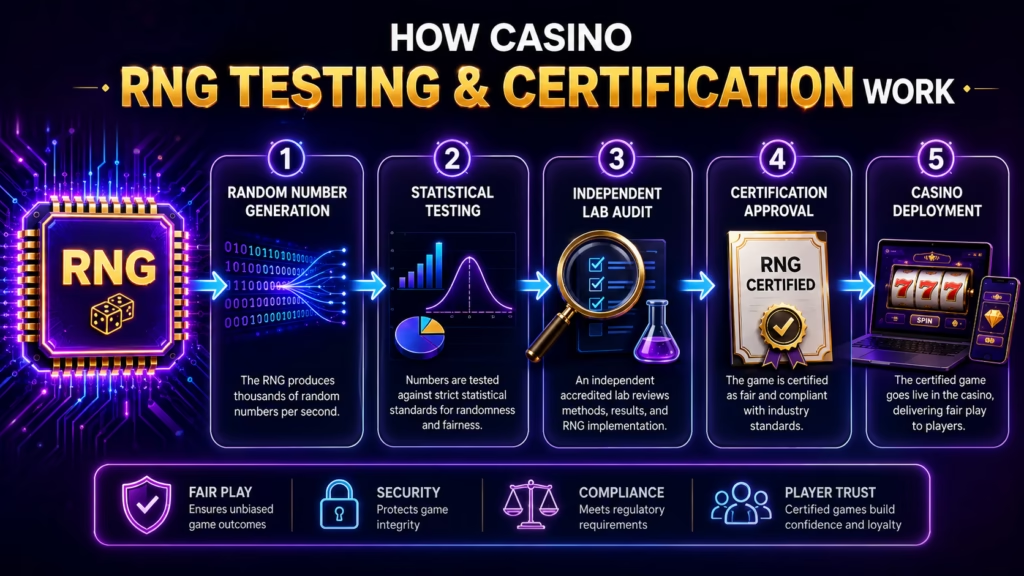
There is no single worldwide certification procedure because gambling regulators establish requirements for their own jurisdictions. However, independent RNG testing commonly involves several layers of technical evaluation.
1. The Testing Scope Is Defined
The developer, operator and testing laboratory first determine what needs to be assessed and which jurisdictional standards apply.
This matters because a certificate or report prepared for one market is not automatically proof that the same product satisfies every other gambling regulator.
In regulated markets, licensees that require third-party testing may need to use a test house approved for the relevant area, and the testing scope must be sufficient to assess compliance with applicable technical standards.
2. The Developer Submits the RNG Implementation
Testing laboratories need enough information to reproduce and understand how random values are generated and used.
A submission can include game parameters and rules, an RNG application implemented as closely as possible to the production version, descriptions of differences between test and production environments, raw output collection tools when required, key files and checksums, hardware specifications and source-code documentation.
Using a production-like implementation matters because testing a separate demonstration RNG would provide limited assurance about the code actually used in a released casino product.
3. Source Code Is Reviewed
RNG testing can include examination of the source code responsible for generating and processing random values.
The review can focus on the algorithm, initialization, seeding, reseeding, calls to the RNG, scaling methods, shuffling procedures and other functions that could affect the final outcome.
This source-code review helps determine whether the implementation corresponds with the documented RNG design and whether the tested code uses the expected randomization logic.
4. Raw RNG Output Is Statistically Tested
Large samples of RNG output can then be analyzed using statistical methods.
The purpose is not to prove that every future result will be random. Instead, statistical testing looks for characteristics that would be inconsistent with the required random model, such as unexpected distributions, relationships or patterns.
Regulatory standards can require the randomness of RNG and game outcomes to be demonstrated to a high degree of confidence using generally accepted statistical tests and methods.
This distinction is important for players. A certified RNG can still generate streaks, repeated symbols or several losses in succession. Random sequences naturally contain clusters and unusual short-term patterns.
5. Scaling and Shuffling Are Tested
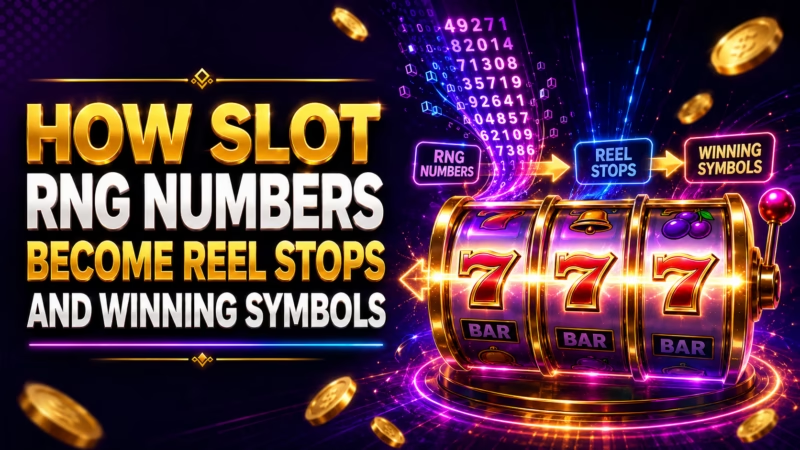
Raw random numbers usually need to be transformed before a casino game can use them.
A generator might produce values over an enormous numerical range while a roulette-style game needs one of a small number of possible results. Card games may need shuffled positions, while slots require values to be mapped to reel positions or other mathematical states.
Testing therefore examines whether scaling, shuffling or other transformations preserve the required statistical properties. Production-equivalent scaling methodology is important because a biased conversion layer can alter game probabilities even when the raw generator performs correctly.
RNG Testing vs Game Certification
RNG certification verifies the random number generation component, while game certification can examine the complete relationship between random numbers, game rules, probabilities and payouts.
This is one of the most important distinctions in RNG testing and certification.
A correct RNG cannot compensate for incorrect game mathematics. For example, a programming error could map random values to slot symbols at the wrong frequencies even though the generator supplying those values passes statistical testing.
A broader game-engine assessment can therefore include RNG testing, game logic and rules verification, mathematical and payout analysis, simulations, and testing of game features and bonuses.
For this reason, seeing that an RNG has been tested should not automatically be interpreted as proof that every game using it has undergone a complete certification process.
| Test area | What is checked |
| RNG | Randomness, distribution and unpredictability |
| Source code | Implementation of RNG and game logic |
| Scaling or shuffling | Conversion of raw RNG values |
| Game mathematics | Probabilities, payouts and RTP calculations |
| Outcome mapping | RNG values correspond to the intended results |
| Rules | Software behaves according to published game rules |
| Bonus features | Special mechanics follow their defined mathematics |
| Simulation | Long-run behavior corresponds with theoretical expectations |
What Does an RNG Laboratory Look For?
A strong RNG assessment is concerned with more than whether numbers look random.
Distribution: Outputs and resulting game outcomes should occur according to their intended theoretical probabilities.
Unpredictability: Knowing previous outputs should not provide a practical method for determining the next result.
Independent streams: Separate RNG instances should not unintentionally reproduce identical sequences.
Safe seeding behavior: Initialization and reseeding should not create predictable output.
Correct scaling: Converting raw numbers into usable game values should not introduce unwanted bias.
Correct outcome mapping: Game results should correspond with the mathematical model and paytable.
What Happens If Testing Finds a Problem?
Failed RNG or game tests normally require the developer to correct the identified problem and submit the affected component for additional testing.
The laboratory can then verify whether the revised implementation meets the required standard.
Certification is therefore better understood as a controlled technical process rather than a one-time statistical experiment. Laboratories can review implementation details, identify non-compliance, test corrections and produce reports documenting the assessed version.
Changes after certification also matter. A significant modification to RNG behavior, game mathematics or other fairness-related functionality may require external retesting.
In regulated environments, new products can require adequate testing before release, while major changes affecting fairness can require independent retesting. Change documentation can also identify affected RNGs or games and classify modifications by their significance.
Who Tests Casino RNGs?
Casino RNGs are commonly tested by independent laboratories specializing in gambling software compliance.
Examples operating internationally include Gaming Laboratories International, eCOGRA and iTech Labs. However, recognition of a testing laboratory depends on the jurisdiction. Operators should use laboratories accepted by the regulator governing the market in which the product will be offered.
Some regulators maintain lists of approved test houses and require appropriately accredited laboratories where independent testing is mandatory. Depending on the jurisdiction and activity, accreditation frameworks can include standards such as ISO/IEC 17025.
There is therefore no single universal casino RNG certificate that automatically authorizes a game everywhere.
Does RNG Certification Guarantee Fair Results for Every Player?
RNG certification does not guarantee favorable results or an even distribution of wins and losses during a player’s individual session.
Randomness operates over probabilities, not promises about short-term results.
A slot with a specified theoretical RTP can produce results far above or below that percentage during a limited number of spins. RTP represents a long-run mathematical characteristic of the game configuration, not the percentage an individual player should expect to receive back.
Likewise, an independently tested RNG does not remove the house edge built into casino games.
RNG testing is intended to verify that the random mechanism behaves according to defined standards and game mathematics, not to make gambling profitable.
Common Myths About Casino RNG Certification
“A certified RNG means I cannot have a long losing streak.”
False. Random systems can naturally produce long sequences of losses, wins, repeated numbers or other apparently unusual patterns.
“Testing the RNG automatically certifies the entire slot.”
Not necessarily. RNG testing can be only one component of game certification. Mathematics, paytables, bonus logic and RNG-to-outcome mapping may need separate assessment.
“RTP testing predicts what I will receive.”
No. RTP describes theoretical or measured long-term behavior under defined conditions. It does not predict the return from a particular session.
“One RNG certificate works in every country.”
Not necessarily. Regulatory standards and accepted laboratories vary between jurisdictions.
How Players Can Check RNG and Game Certification
Players do not need to evaluate source code or statistical datasets themselves. The practical approach is to check the regulatory chain behind the casino and its software.
Look for:
- The casino’s actual gambling licence and the regulator that issued it.
- Whether the regulator requires independent testing for the relevant games.
- Whether the testing organization is recognized by that regulator.
- Information about the game provider and published game rules.
- RTP and probability information where the jurisdiction requires it to be disclosed.
A testing-laboratory logo on a website is useful only when it can be connected to a genuine assessment, approved laboratory or regulatory process. Certification claims should not replace verification of the casino’s licence.
In some regulated markets, game test reports or registration processes provide regulatory evidence that required testing has taken place.
How This Information Was Reviewed
This explanation is based on technical material published by gambling regulators and independent testing laboratories, including regulatory standards for random outcomes, testing strategies and published RNG assessment procedures.
Exact certification requirements should always be checked with the regulator governing the relevant casino or game because testing rules differ by jurisdiction.
RNG certification also says nothing about whether gambling is financially suitable for an individual player. Casino games contain risk and should be treated as entertainment rather than a method of earning money. Setting spending and time limits before playing can reduce the risk of chasing random short-term results.
FAQ
What is casino RNG testing?
Casino RNG testing is a technical assessment of the Random Number Generator used to create random game outcomes. Testing can include source-code inspection, statistical analysis of generated numbers, seed evaluation, scaling and shuffling checks, and verification that RNG output is used correctly by the game.
How is an online casino RNG tested?
An online casino RNG can be tested by reviewing its implementation, generating large datasets of raw output, applying statistical tests, checking unpredictability and distribution, and examining how the raw values are transformed into game outcomes. The exact procedure depends on the testing laboratory and regulatory standard.
What is RNG certification?
RNG certification is evidence that a specified RNG implementation has been evaluated against a defined testing standard. It should be interpreted according to the certificate’s scope because RNG certification may not include complete testing of every game, paytable, bonus feature or RTP configuration using that generator.
Does RNG certification mean a casino game is fair?
RNG certification provides evidence that the random-number component met the applicable assessment criteria, but complete game fairness can require additional testing. Game logic, probabilities, payout calculations and the mapping of RNG values to outcomes may also need verification.
Can a certified RNG be manipulated after testing?
Changes to production software are one reason regulated environments use version controls, change-management procedures and retesting requirements. Significant modifications affecting RNG behavior or game fairness may require another independent assessment. Players should therefore rely on the complete regulatory framework rather than treating an old certificate image as permanent proof.
Are online slot RNGs really random?
Online slot software commonly uses pseudorandom number generators designed to produce unpredictable sequences with appropriate statistical properties. Regulators may require the output to demonstrate acceptable randomness to a high degree of confidence rather than claiming philosophical or absolute randomness.
Do testing laboratories check RTP?
RTP can be examined as part of broader game testing, but RNG certification alone does not necessarily certify RTP. Game-engine testing may separately verify probabilities, payouts, game mathematics and simulated long-term performance.
How often does an RNG need to be retested?
There is no universal worldwide retesting interval. Requirements depend on the jurisdiction, product and type of software change. Major modifications affecting RNG operation or game fairness can trigger independent retesting even when the previous version was already approved.
Can RNG testing guarantee that I will not lose?
No. RNG testing cannot guarantee wins or prevent losing streaks. It evaluates whether the random mechanism operates according to applicable technical requirements. Casino games still contain mathematical risk, and individual results remain unpredictable.
Brief Conclusion
Casino RNG testing examines whether random numbers are generated and converted into game outcomes without unacceptable predictability or bias. Independent laboratories can analyze source code, raw RNG output, seeding, scaling, shuffling, probabilities and game mathematics depending on the scope of certification.
The most important distinction is that RNG certification is not automatically the same as full game certification. A tested generator can still be connected to game logic that requires separate verification. Players should therefore look at the casino licence, regulator, recognized testing laboratory and the certification scope rather than relying on an RNG badge alone.
Certification does not improve a player’s odds or predict individual results. Casino outcomes remain random, and gambling should be treated as entertainment rather than a way to generate income.