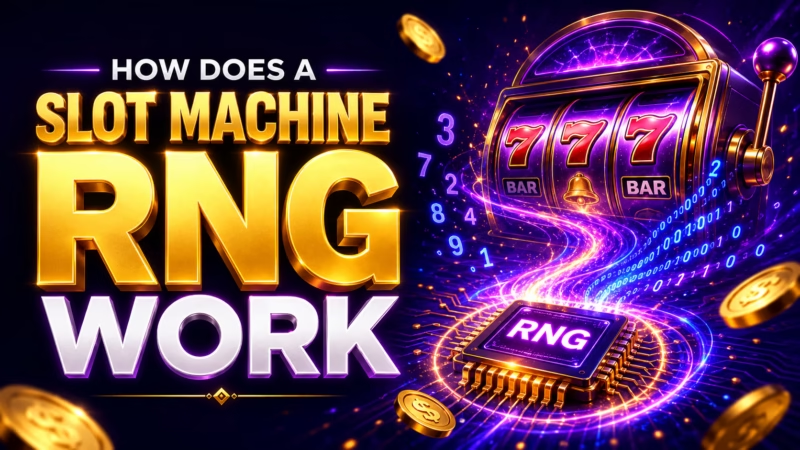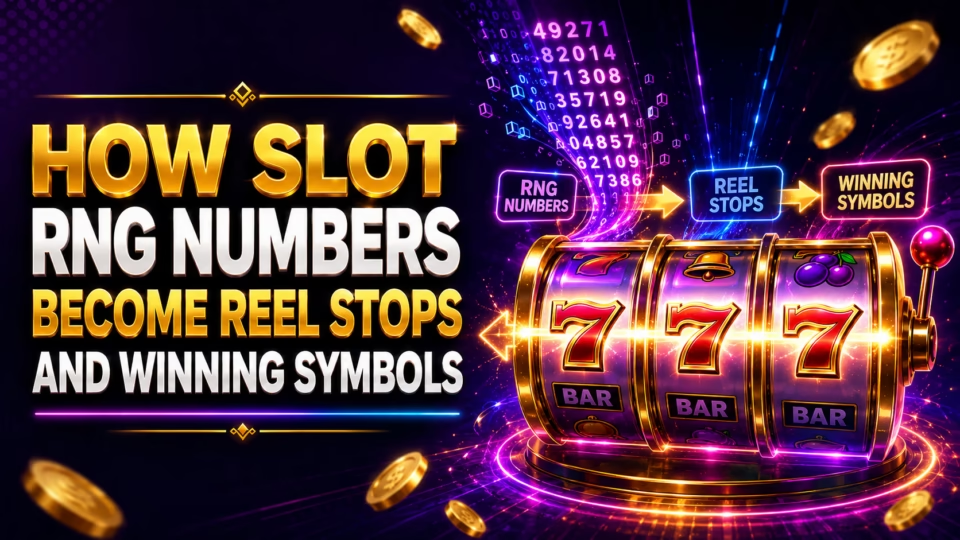
A slot RNG does not usually “pick a winning picture” directly. Instead, the random number generator produces numerical values that the game software maps to reel positions, virtual stops, or another internal outcome structure. The symbols stored at those positions then appear on the screen, and the game’s paytable and rules determine whether the resulting combination is a win.
The exact implementation varies between slot platforms and providers, but the general sequence is similar: RNG value → reel or virtual stop → displayed symbol → payline or ways evaluation → payout calculation.
Key points:
- The RNG generates numbers, not visual symbols such as Wilds, Scatters, or 7s.
- Each reel can have many possible physical or virtual positions.
- A numerical mapping system connects RNG values with those positions.
- Symbol frequency depends partly on how symbols are distributed or weighted in the game mathematics.
- The paytable evaluates the final symbol combination after the reel positions have been determined.
Understanding slot RNG reel stops is useful for players who want to know why some symbols appear frequently while valuable symbols may be much rarer. It is also important to remember that knowing how the system works does not make future spins predictable. A properly implemented slot RNG is designed so players cannot determine the next result from previous outcomes.
How Does a Slot RNG Determine Symbols?
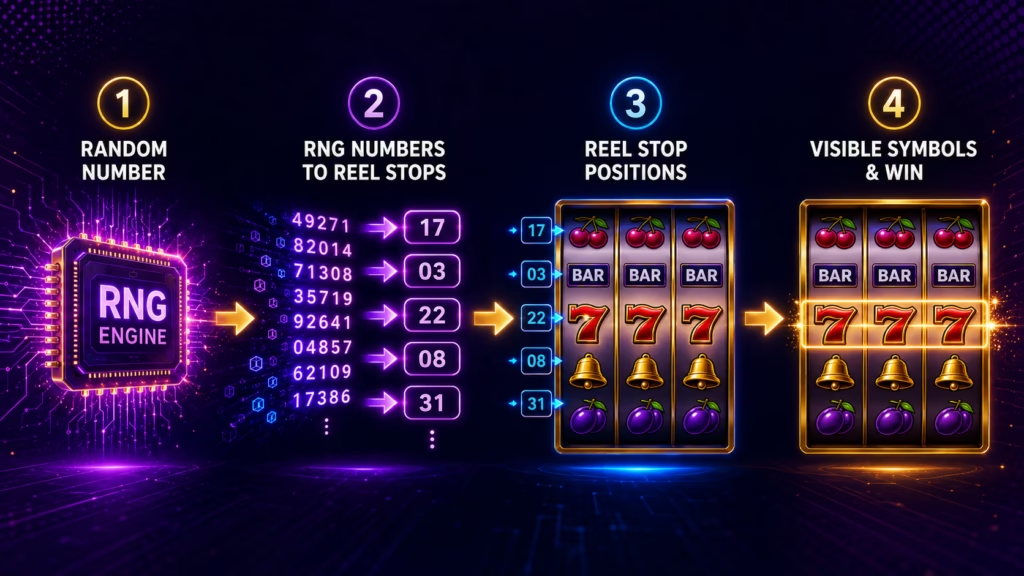
A slot RNG determines symbols by generating random or pseudorandom numerical values and passing those values through the slot’s game logic. The software converts each relevant value into a valid reel position or outcome entry, then displays the symbol associated with that position.
A simplified five-reel spin might work like this:
1. The RNG supplies numerical values.
2. The software maps a value to a stop on reel 1.
3. Another value determines the position of reel 2.
4. The process continues for the remaining reels.
5. The game displays the symbols located at the selected positions.
6. The paytable evaluates paylines, ways, clusters, Scatters, or other winning conditions.
7. Any valid payout is calculated according to the game rules.
The important distinction is that the RNG generates the randomness, while the reel mathematics interprets that randomness.
What Is an RNG Number in a Slot Machine?
An RNG number is an internal numerical value used by the game software as a source of randomness. Online slots commonly rely on pseudorandom number generators, or PRNGs, which produce sequences of values using mathematical algorithms and an internal state.
The raw number can be much larger than the number of available reel positions. The game therefore needs a mapping process that converts the RNG output into one of the allowed outcomes.
For example, imagine a virtual reel containing 100 possible stops. The game needs to transform an RNG value into one of those 100 positions. The exact algorithm is implementation-specific and should be designed so the intended probabilities defined by the game mathematics are preserved.
The RNG itself does not need to understand that position 17 contains a Wild or that position 63 contains a low-paying symbol. It supplies numerical randomness. The game’s reel definition and mathematical model give those numbers meaning.
What Are Reel Stops?
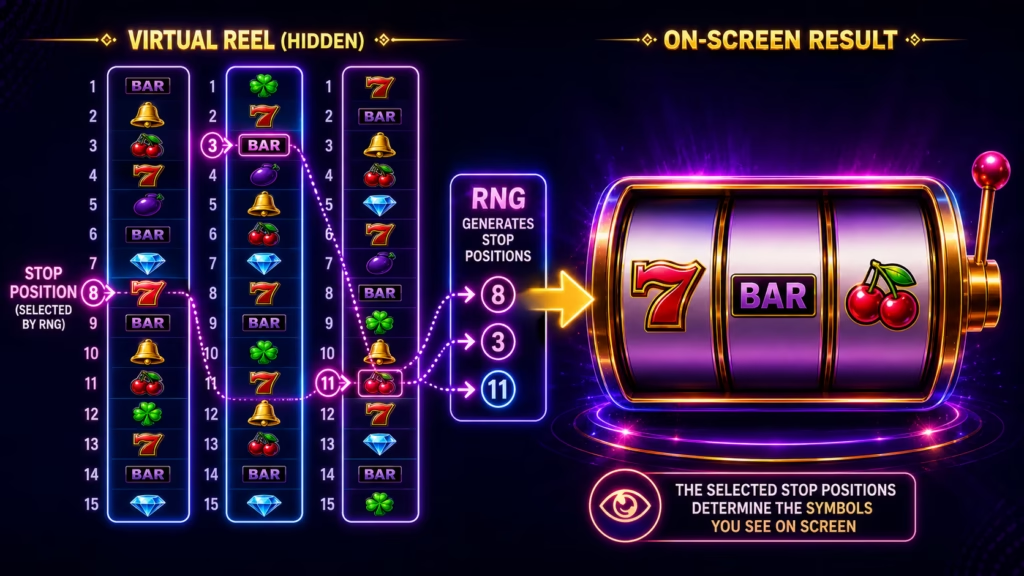
A reel stop is a possible position at which a slot reel can effectively land. Traditional mechanical slots had physical reel strips with symbols printed around each reel. Modern digital slots can simulate this concept using software.
A reel strip might conceptually look like:
Cherry → A → K → Wild → Q → A → 10 → Scatter → K → Q
When the selected reel position corresponds to the Wild location, the Wild can appear in the visible window. When another position is selected, a different symbol or group of neighboring symbols appears.
Modern slot reels can be substantially more complex. They may use virtual reel strips, different reel lengths, weighted positions, expanding layouts, Megaways-style reel heights, or entirely different mathematical structures.
Physical Reel Stops vs Virtual Reel Stops
Physical reel stops are limited by the mechanical dimensions of a real reel. Virtual reel stops exist in software and can provide far more flexibility in determining symbol probabilities.
Virtual reels allow developers to control how frequently different symbols can be selected without requiring every probability relationship to correspond directly to the visible number of symbols.
For example, a visible reel may appear to contain a relatively small symbol set, while the mathematical system behind it can contain many virtual positions associated with those symbols.
This distinction helps explain an important slot characteristic: two symbols that look equally prominent on screen do not necessarily have equal probabilities of appearing.
The probability comes from the underlying game mathematics, not from how large, bright, or visually noticeable a symbol appears.
How RNG Values Are Mapped to Reel Stops
The process of converting RNG numbers into slot symbols usually requires an intermediate mapping layer.
Consider a simplified reel with 20 valid positions. The software needs to take an RNG result and convert it into a position numbered from 0 to 19.
| RNG Result | Selected Reel Stop | Symbol |
| Value A | 3 | K |
| Value B | 11 | Wild |
| Value C | 6 | A |
| Value D | 18 | Scatter |
Real slot implementations can use much larger numerical ranges and more sophisticated mapping methods. The table is only a conceptual example, not a description of a specific commercial game’s source code.
The mapping method matters because the mathematical design must preserve the intended probability distribution. Reputable game implementations should not accidentally make certain positions more or less likely because of poor numerical conversion.
Why Some Slot Symbols Appear More Often Than Others
Slot symbols can have different appearance frequencies because their occurrence is controlled by the reel configuration and mathematical model.
Low-paying symbols are commonly represented more frequently than premium symbols. Wilds, Scatters, jackpot symbols, or other high-value symbols may occupy fewer positions or be assigned lower probability depending on the game design.
Imagine a simplified 100-stop virtual reel containing:
- 18 positions associated with a low-value symbol
- 14 positions associated with another regular symbol
- 7 premium-symbol positions
- 3 Wild positions
- 2 Scatter positions
A symbol associated with 18 eligible positions would naturally be selected more frequently than one associated with only two, assuming the relevant stops themselves are sampled according to the model.
Real games may use more complicated mathematics than this example.
The key point is that symbol probability is determined by the internal probability model, not merely by counting what is visible during a few spins.
Does the RNG Choose a Win First and Then Select Symbols?
There is no universal rule requiring every slot to choose a win first and construct matching symbols afterward.
A common reel-based architecture selects reel positions using RNG outputs and then evaluates the resulting symbol arrangement against the paytable. Other game designs can use different outcome-generation architectures, especially for complex bonus games, instant-win mechanics, or specialized slot systems.
Players therefore should be cautious about claims that every slot follows one exact internal sequence.
For conventional reel-based explanations, the useful model is: Generate random values → determine reel positions → display symbols → evaluate the result.
The exact technical architecture of a particular game can only be confirmed from its documentation, mathematical specification, testing information, or other reliable technical material.
How a Five-Reel Spin Can Be Created
Consider a simplified five-reel video slot.
Suppose the RNG mapping process selects these positions:
- Reel 1: position 42
- Reel 2: position 17
- Reel 3: position 81
- Reel 4: position 9
- Reel 5: position 56
Each position corresponds to part of a predefined reel strip. If the center row becomes: A | A | A | K | Q, the paytable determines whether three A symbols form a valid combination.
If the game pays three matching A symbols from left to right on an active payline, the combination may produce a payout. If the rules require another structure, such as adjacent reels under a ways-to-win system, the evaluation will follow those rules instead.
The RNG generated the positions. The paytable determined what those positions were worth.
Reel Stops and Paylines Are Different Parts of the Game
Reel stops determine which symbols become available on the screen. Paylines determine which symbol positions are compared for potential wins in a traditional payline slot.
These mechanisms should not be confused.
A 20-payline slot does not necessarily have 20 possible outcomes. There can be a very large number of possible screen combinations because each reel can stop in numerous positions.
Modern games may also replace fixed paylines with:
- ways to win;
- all-ways systems;
- cluster pays;
- adjacent-pay systems;
- variable-reel mechanics;
- symbol-collection mechanics.
The RNG remains responsible for random inputs or outcome selection, while the game’s evaluation rules determine which resulting patterns qualify for awards.
Can One RNG Number Control the Entire Spin?
A slot implementation may consume RNG output in different ways, so it is not accurate to assume that every game uses exactly one random number for one complete spin or exactly one number for every reel.
Software can request or derive the random values needed by its game logic. Additional random decisions may also be required for bonus selections, variable reel heights, modifiers, mystery symbols, multipliers, or other mechanics.
What matters from the player’s perspective is that these random selections follow the certified or approved game implementation where applicable and that the resulting probabilities remain consistent with the game’s mathematical design.
What Happens After the Reel Stops Are Selected?
After reel positions have been determined, the slot evaluates the visible result according to its rules.
The evaluation can include:
1. matching symbols on paylines;
2. matching symbols on adjacent reels;
3. counting Scatter symbols;
4. applying Wild substitutions;
5. detecting clusters;
6. activating multipliers;
7. triggering bonus rounds;
8. calculating the resulting payout.
Some features may require further random decisions. A mystery symbol, for example, may need another random selection to determine what it becomes. A bonus wheel might require its own outcome determination.
The exact sequence depends on the game.
How Reel Weighting Affects Symbol Probability
Reel weighting allows different outcomes to occur at different rates while still using random selection.
Suppose a reel model gives regular symbols many eligible positions and a high-value symbol relatively few positions. Random selection can still be fair within that defined probability structure even though the symbols are not equally likely.
“Random” does not mean “every symbol has the same probability.”
It means the outcome is generated according to the game’s defined probability model without the player being able to predict which eligible result will occur next.
This distinction is fundamental to understanding how RNG determines slot symbols.
Why Near Misses Do Not Mean the RNG Almost Produced a Jackpot
A near miss occurs when valuable symbols appear close to a winning configuration, such as two jackpot symbols landing with a third just outside the required position.
The visual proximity of a symbol does not mean the RNG was numerically close to generating the winning outcome. Reel positions, mapping systems, and game mathematics do not translate screen distance into a simple measure of how close the player was to winning.
A symbol appearing immediately above a payline can feel significant because players see the reel visually. Mathematically, however, the next spin remains a separate random event under the game’s RNG process.
Players should not increase bets because a slot appears to be “getting closer” to a win.
Can Previous Reel Stops Predict the Next Spin?
Previous reel stops should not provide a practical method for predicting the next result of a properly functioning RNG slot.
A streak of low-paying symbols does not mean a high-paying combination is due. Likewise, a recent large win does not automatically make another win impossible.
This is one reason concepts such as “hot machines,” “cold machines,” or guaranteed timing systems should be treated skeptically.
RTP, volatility, hit frequency, and reel weighting describe characteristics of a game’s mathematical behavior over many outcomes. They do not reveal the symbols that will appear on the next individual spin.
RNG, Reel Mapping and RTP
RNG mechanics and RTP are connected through the complete game mathematical model, but they describe different things.
The RNG provides unpredictable selections. Reel strips, symbol probabilities, paytable values, bonus probabilities, and game rules determine the mathematical value of those selections.
RTP, or return to player, represents the theoretical percentage of wagered money that a game is designed to return to players over a very large number of plays under specified conditions.
RTP does not mean a player will receive that percentage during one session.
A slot can therefore use a properly functioning RNG while still having a mathematical house advantage built into its paytable and probability structure.
RNG, Reel Stops and Volatility
Volatility describes how a slot tends to distribute its payouts, while RNG reel stops determine individual random outcomes according to the game’s probability model.
A high-volatility slot may place more of its theoretical return into relatively infrequent, potentially larger payouts. A lower-volatility design may distribute more of its return through smaller or more frequent wins.
Neither volatility level changes the basic fact that the next eligible outcome remains random.
Players choosing between volatility levels should therefore focus on entertainment preference and bankroll limits rather than trying to identify which game is “about to pay.”
Common Myths About Slot RNG Reel Stops
Myth 1: The casino can see the next symbols
The normal operation of a regulated RNG-based game should not require a casino employee to manually choose the next reel result. The exact relationship between a casino operator, game server, provider, and RNG depends on the technical architecture.
Myth 2: Every symbol has the same chance
Randomness does not require equal symbol probability. Reel weighting and symbol distribution can make some symbols much rarer than others.
Myth 3: A long losing sequence makes a win due
Previous spins do not create a simple debt that the next spin must repay. RTP is a long-term mathematical characteristic, not a short-session balancing mechanism.
Myth 4: Stopping the reels changes the RNG result
In many digital slots, pressing a stop or quick-stop control mainly changes the animation speed after the relevant outcome has already been determined. Exact behavior depends on the specific game’s implementation.
Myth 5: Watching enough spins reveals the reel pattern
Visual observation usually cannot reveal enough information to predict future RNG outcomes. What appears on screen is only the visible output of a much larger mathematical system.
What Players Should Check Instead of Trying to Predict Reel Stops
Players cannot use RNG knowledge to reliably predict the next winning combination, but understanding slot mathematics can still improve game selection.
Before playing, check:
- the published RTP when available;
- volatility information;
- the paytable;
- Wild and Scatter rules;
- paylines or ways to win;
- bonus-trigger conditions;
- maximum and minimum bets;
- bonus-buy rules where available;
- jackpot conditions;
- whether different RTP configurations exist.
These characteristics explain how the game is structured. They do not provide a strategy for controlling random outcomes.
Set a spending limit before playing and treat slots as paid entertainment. RNG mechanics can explain why results occur, but they cannot turn a negative-expectation casino game into a predictable source of income.
How This Information Was Reviewed
This explanation separates four parts of slot operation: random-number generation, mapping of random values to valid game states, symbol or reel representation, and paytable evaluation. This distinction is important because simplified explanations often incorrectly treat the RNG, reel strip, and payout system as one mechanism.
Exact RNG algorithms, virtual reel configurations, symbol weights, RTP settings, and bonus logic can differ between games. For a specific slot, technical information should be checked against the game’s official rules, paytable, provider documentation, and applicable testing or regulatory information where available.
RTP and volatility describe mathematical properties over many outcomes and do not predict an individual session. Slot play should be treated as entertainment, and players should stop when spending exceeds predetermined limits or gambling is no longer enjoyable.
FAQ
Does a slot RNG generate symbols or numbers?
A slot RNG generates numerical data rather than visually choosing symbols in the way a player sees them. The game software maps the relevant random values to reel positions, virtual stops, outcomes, or other game states, which are then represented by symbols on the screen.
How does an RNG number become a reel stop?
The game uses a mathematical mapping process to convert RNG output into one of the valid reel positions. The exact conversion method depends on the slot implementation, but it must preserve the probability structure intended by the game’s mathematical design.
Are all reel stops equally likely?
Not necessarily. Some implementations can use equally selectable virtual positions while assigning symbols to those positions at different frequencies, while other mathematical structures may implement weighting differently. The important factor is the probability assigned to each possible outcome, not simply the number of symbols visible on the screen.
Why are Scatter and Wild symbols often rarer?
Wilds and Scatters may be assigned fewer eligible positions or lower probabilities because they can have greater mathematical value through substitutions, bonus triggers, or other features. The exact frequency is game-specific and should not be assumed without information about the slot’s rules or mathematical model.
Does the RNG decide whether a spin will win before showing symbols?
There is no single architecture used by every slot. A common reel-based model generates random selections that determine reel positions and then evaluates the resulting symbols. Other game types may use different internal outcome-generation methods.
Can pressing Stop change which symbols appear?
In many digital slots, a stop button primarily shortens the reel animation rather than changing the already determined outcome. However, implementation details vary, so the precise behavior of a specific game should be confirmed from its rules or technical documentation.
Can reel-stop patterns reveal when a bonus is coming?
Reel-stop patterns do not provide a reliable way to predict the next bonus in a properly functioning RNG game. Previous spins cannot tell a player which random outcome will occur next.
Does the casino change reel stops after I increase my bet?
Bet level can affect certain game rules in some slots, such as eligible paylines, jackpots, or feature conditions, but players should not assume that increasing the wager makes the RNG intentionally favor or punish them. The exact effect of bet size should be checked in the game’s paytable and rules.
Is a near miss evidence that the slot is close to paying?
No. A symbol appearing just above or below a winning position does not mean the RNG was mathematically close to producing a win or that the next spin has a higher chance of winning. Visual reel distance and probability are different concepts.
Can understanding slot RNG help me win more often?
Understanding RNG mechanics can help players interpret how slots work, but it cannot predict future spins or guarantee better results. A more practical use of this knowledge is comparing RTP, volatility, paylines, bonus rules, and betting limits while maintaining strict spending limits.
Brief Conclusion
Slot RNG numbers become winning symbols through a chain of game logic: random numerical values are generated, mapped to valid reel positions or outcomes, converted into visible symbols, and then evaluated against the paytable.
The RNG provides randomness, while reel strips, virtual stops, symbol weighting, paylines, bonus rules, and payout values determine what each random result means. Understanding this process explains why some symbols are rarer than others, but it does not make future spins predictable. Slots should be treated as entertainment, not as a method of generating income.