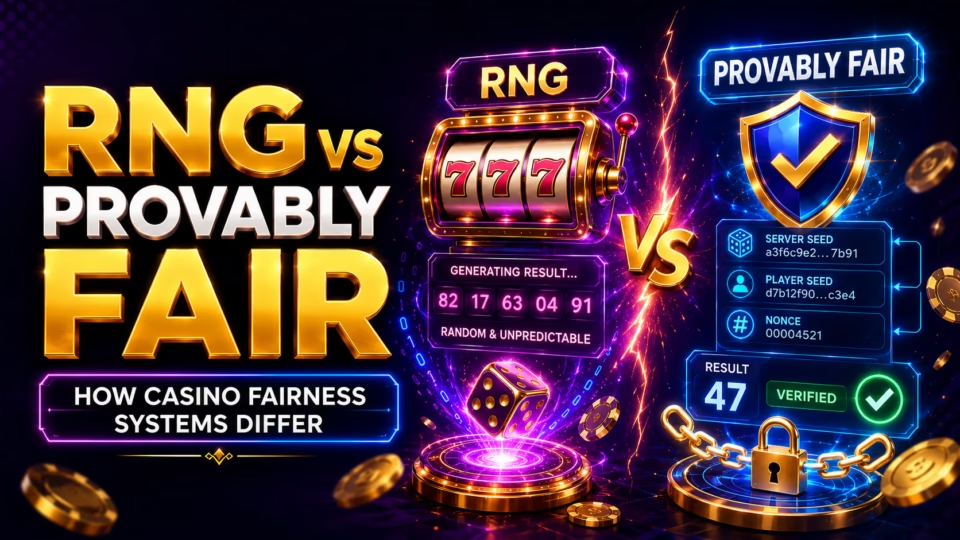
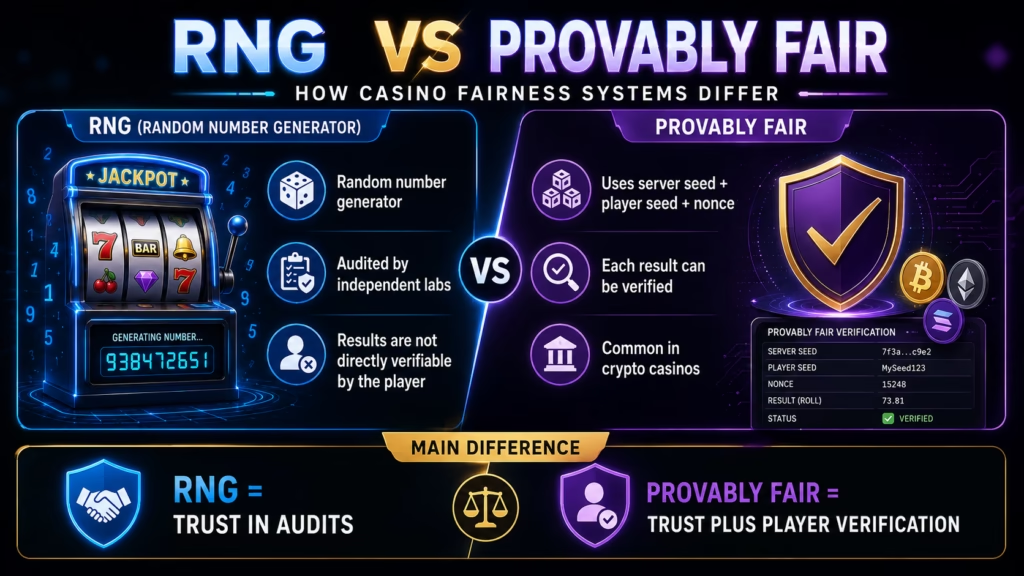
RNG and provably fair systems both aim to produce unpredictable casino game outcomes, but they establish trust in different ways.A traditional RNG generates results internally and is usually evaluated through game testing, operator controls, and regulatory oversight. A provably fair system uses cryptographic methods that allow the player to verify that a specific result was not changed after the bet was placed.
The most important distinction is verification. With a conventional RNG casino game, players generally cannot reconstruct an individual spin themselves. With a provably fair game, players may be able to check the inputs and calculation that produced a particular result.
Quick comparison
- RNG: fairness is primarily established through software design, testing, auditing, and regulatory controls.
- Provably fair: fairness can be checked mathematically using cryptographic seeds and hashes.
- Both systems can use random or pseudorandom number generation.
- Provably fair does not mean guaranteed winnings or better odds.
- Neither system allows a player to predict the next result when properly implemented.
RNG vs provably fair matters most to players who want to understand how casino games determine outcomes and how those outcomes can be checked. Players should be cautious about assuming that a “provably fair” label alone proves that an entire casino is trustworthy. Game verification is only one part of evaluating an operator.
What Is RNG in Casino Games?
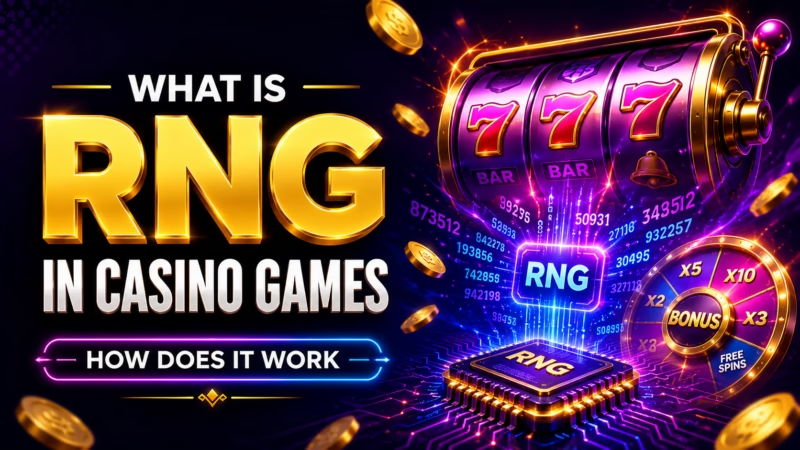
A casino RNG, or Random Number Generator, is a system used to generate unpredictable values that determine game outcomes. Online slots, digital roulette, video poker, blackjack simulations, and many other casino games can rely on RNG technology.
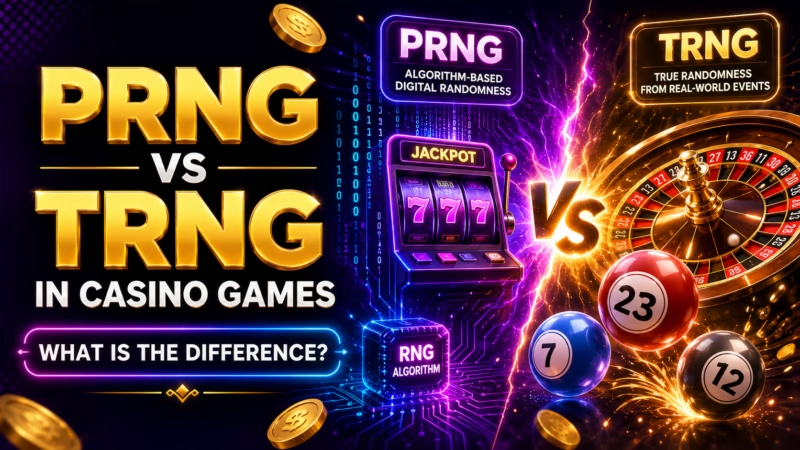
Most software-based casino systems actually use a pseudorandom number generator, or PRNG. A PRNG starts with an internal seed and uses an algorithm to produce a sequence of values that should be computationally unpredictable when the system is implemented correctly.
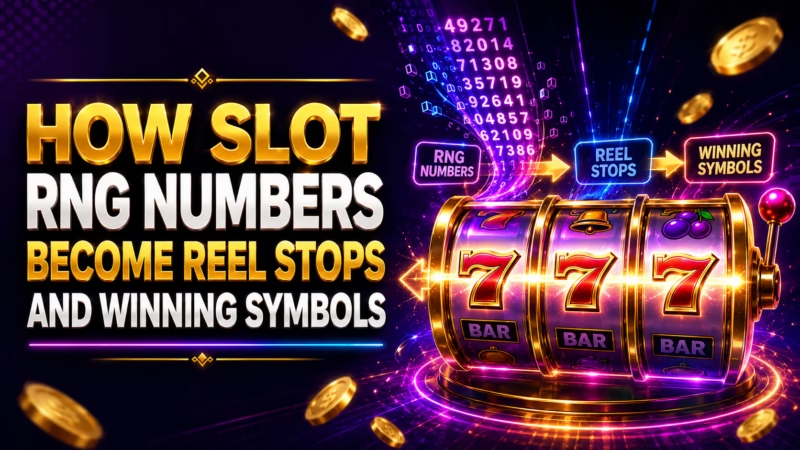
For example, a slot may continuously generate numerical values. When the player presses Spin, the game maps the relevant generated value to a reel position or predefined outcome according to its mathematical model.
The player normally sees the final symbols, cards, numbers, or multiplier rather than the internal random value.
How RNG fairness is normally established
Traditional RNG games usually rely on external and operational controls rather than player-side verification. Depending on the jurisdiction and operator, those controls may include:
- game mathematics testing;
- RNG statistical testing;
- independent testing laboratories;
- software version controls;
- regulatory requirements;
- casino licensing requirements;
- monitoring of deployed game versions.
The exact testing and oversight arrangements depend on the game provider, casino, jurisdiction, and regulator. Players should therefore check the operator’s licensing information and game documentation instead of assuming that every RNG implementation follows the same standards.
What Does Provably Fair Mean?
Provably fair is a cryptographic system designed to let a player independently verify that a casino game result was generated from predetermined inputs and was not secretly changed after the bet.
Provably fair technology is commonly associated with crypto casinos, crash games, dice games, mines-style games, limbo games, and other mathematically simple casino formats.
A typical implementation involves several components:
- Server seed
- Client seed
- Nonce
- Cryptographic hash or HMAC calculation
- A deterministic method for converting the calculation into a game result
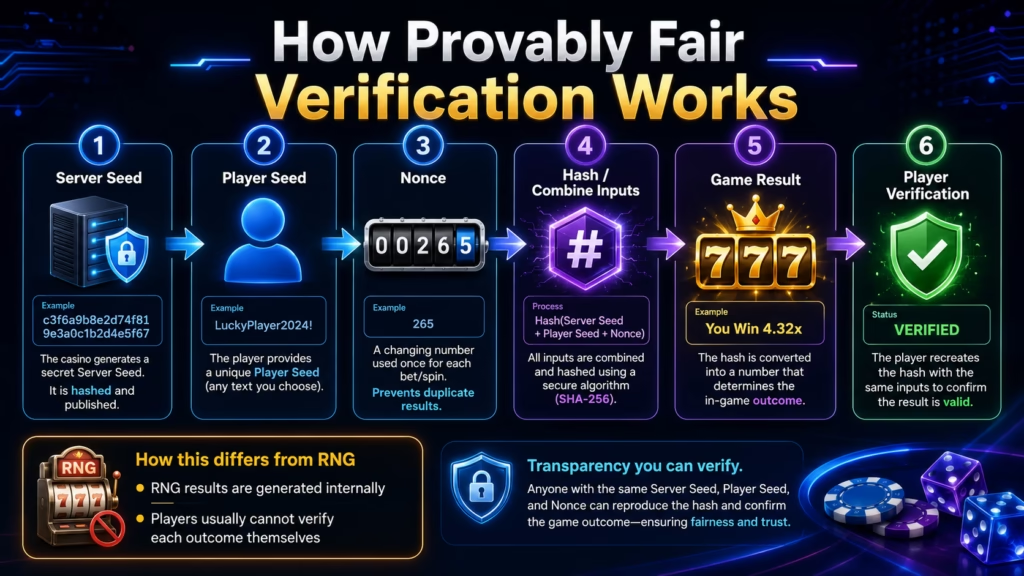
Before the player bets, the casino usually provides a cryptographic hash representing the hidden server seed. The original seed remains secret at this stage so that the player cannot calculate future outcomes.
Once the server seed is later revealed, the player can hash it and compare the result with the previously supplied hash. Matching values can demonstrate that the server seed was committed before the game result was known to the player.
The casino’s published algorithm can then be used to reconstruct the game outcome.
How a Provably Fair Game Works
A simplified provably fair process looks like this:
1. The casino creates a server seed
The server generates a secret value. This value becomes one of the inputs used to calculate game outcomes.
2. The casino publishes its hash
Instead of revealing the server seed immediately, the casino provides its cryptographic hash.
The hash acts as a commitment. If the casino later changes the server seed, the resulting hash would normally be different.
3. A client seed is included
The client seed may be generated by the player’s browser or provided by the casino. Many systems allow the player to replace it with a custom value.
Including a client seed means the final result does not depend exclusively on a hidden casino-controlled input.
4. A nonce separates individual bets
A nonce is usually an incrementing number associated with each bet made under the same seed pair.
For example:
- first bet: nonce 0
- second bet: nonce 1
- third bet: nonce 2
Changing the nonce changes the cryptographic calculation and therefore produces a different potential game result.
5. The result is calculated
The server seed, client seed, nonce, and sometimes additional parameters are processed using the casino’s published cryptographic procedure.
The resulting output is converted into something relevant to the game, such as:
- a dice number;
- a crash multiplier;
- mine positions;
- a roulette result;
- shuffled card positions.
6. The server seed is revealed
After the seed is rotated, the player can compare the revealed server seed with the hash supplied earlier.
The player may also recreate the game’s calculation using a verification tool or the published algorithm.
RNG vs Provably Fair Comparison
| Factor | RNG | Provably Fair |
| Outcome generation | Random or pseudorandom algorithm | Usually cryptographic deterministic calculation using random seeds |
| Player verification | Usually limited | Individual results can often be independently checked |
| Main trust model | Testing, regulation, provider controls | Cryptographic verification |
| Common games | Slots, roulette, blackjack, video poker | Crash, dice, mines, limbo, crypto casino games |
| External audits | Often important | Still useful, even when results are verifiable |
| Can players predict results? | Not with a properly implemented RNG | Not before hidden inputs are revealed |
| Guarantees winnings? | No | No |
| Changes house edge? | Not automatically | Not automatically |
The comparison reveals an important point: provably fair is not the opposite of RNG. A provably fair system may use randomly generated seeds and cryptographic pseudorandom functions internally. The real distinction is that provably fair systems expose enough information for the player to verify how a result was derived.
Is Provably Fair Better Than RNG?
Provably fair is better for result transparency, but that does not automatically make it superior in every aspect of casino fairness.
A conventional RNG game from a regulated operator may rely on independent testing and regulatory oversight. The player may not be able to verify each spin, but external controls can evaluate the software and mathematical model.
A provably fair game provides a different advantage. Players can potentially verify individual outcomes themselves rather than relying entirely on third parties.
The strongest system depends on what the player wants to verify.
If the question is:
“Can I mathematically check this exact bet?”
Provably fair usually provides more transparency.
If the question is:
“Has the entire game, operator, payout model, and software environment been independently assessed?”
Cryptographic verification alone does not answer it.
Can a Provably Fair Casino Still Have a House Edge?
Yes. Provably fair verifies how a result was generated, not whether the game offers favorable odds.
A casino can operate a mathematically fair and verifiable game while still maintaining a house edge.
For example, a game may calculate every outcome honestly but offer payouts slightly below the mathematically fair payout. That difference creates the casino advantage.
Players should therefore separate two questions:
1. Was the outcome generated according to the published process?
2. What are the actual probabilities and payouts?
Provably fair technology primarily helps answer the first question.
RTP, house edge, payout rules, and game probabilities must be evaluated separately.
Does Provably Fair Mean the Casino Cannot Cheat?
Provably fair can make certain forms of result manipulation easier to detect, but it should not be treated as proof that every aspect of a casino is trustworthy.
A verification system may demonstrate that a particular game result followed a committed cryptographic process. It does not automatically verify:
- withdrawals;
- account restrictions;
- bonus conditions;
- customer support;
- identity verification procedures;
- casino solvency;
- displayed RTP information;
- whether the published verification code matches every production component.
Players should evaluate the casino separately from the fairness algorithm.
Can RNG Casino Games Be Manipulated?
Any software system can theoretically be implemented incorrectly or dishonestly, which is why reputable RNG environments rely on testing, controls, and oversight.
A properly implemented RNG should generate outcomes that players and operators cannot predict in advance. The game mathematics then determines how those random values translate into wins, losses, symbol combinations, or other results.
Players should not assume that losing streaks indicate RNG manipulation. Random processes naturally produce clusters, long losing sequences, repeated results, and other patterns that may look unusual over small samples.
RTP also describes a long-term mathematical expectation and does not predict the result of a particular session.
RNG vs Provably Fair for Slots
Traditional online slots are usually better suited to conventional RNG systems because slot mathematics can be substantially more complicated than a simple dice or crash game.
A slot may contain:
- reel strips;
- weighted symbols;
- paylines or ways to win;
- wild transformations;
- bonus triggers;
- free spins;
- multipliers;
- persistent states;
- jackpots;
- different RTP configurations.
Allowing a player to manually verify every stage of this calculation would require significantly more information than verifying a simple numerical result.
This complexity is one reason provably fair technology is more common in games with straightforward mathematical outcomes.
That does not mean a provably fair slot is impossible. It means the operator must publish enough information for the verification process to be meaningful.
RNG vs Provably Fair for Crash and Crypto Games
Provably fair systems are particularly suitable for crash, dice, mines, and similar games because their outcomes can often be expressed using relatively simple cryptographic calculations.
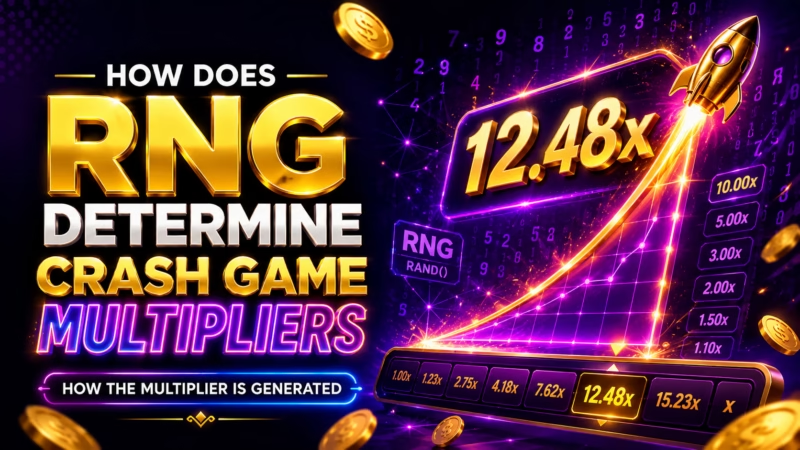
A crash game, for example, may transform a cryptographic output into a multiplier. Once the server seed is revealed, the player can recreate the calculation and confirm whether the displayed multiplier matches the expected result.
This level of verification is one reason provably fair mechanics became strongly associated with crypto casino games.
The presence of verification does not change the fundamental risk. A crash multiplier remains unpredictable before the relevant hidden information becomes available, and there is no betting pattern that guarantees profitable results.
Common Misconceptions About RNG and Provably Fair
“Provably fair games have no house edge”
False. Fair result generation and favorable payout mathematics are different concepts.
“Provably fair means I can predict the next outcome”
False. The server seed is normally hidden before the bet specifically to prevent players from calculating future results.
“RNG means the casino can choose the result”
Not necessarily. In a properly implemented system, the RNG generates outcomes according to the software’s mathematical rules rather than allowing the operator to manually select individual results.
“A losing streak proves the RNG is rigged”
No. Random sequences can naturally contain unusually long losing or winning streaks. Small samples are especially unreliable for judging whether an RNG behaves statistically as expected.
“Provably fair removes the need to evaluate the casino”
No. Provably fair verification covers game-result integrity, not every part of casino operation.
How to Evaluate a Casino Fairness System
Players comparing provably fair vs RNG systems should examine more than the label shown on the game page.
1. How outcomes are generated. Look for documentation explaining whether the game uses an RNG or a cryptographic provably fair system.
2. Whether verification is practical. A provably fair casino should explain how server seeds, client seeds, nonces, and hashes are used.
3. Whether the calculation method is available. Players need enough information to independently reproduce the result.
4. The game’s RTP or house edge. Fair generation does not mean favorable odds.
5. Casino licensing and operator information. Cryptographic verification should not replace basic operator due diligence.
6. Game rules and payout information. Always check the exact rules because mathematics and RTP may differ between games or configurations.
Which System Should Players Prefer?
Players who value direct mathematical verification may prefer provably fair games. The ability to reconstruct individual outcomes provides a form of transparency that traditional RNG games normally cannot offer.
Players interested in conventional slots, table games, and games from established providers will more commonly encounter RNG-based systems supported by software testing and regulatory controls.
Neither system changes the basic nature of casino gambling. Outcomes remain uncertain, the casino may maintain a mathematical advantage, and short-term results cannot be predicted from RTP, previous outcomes, seed history, or betting patterns.
How This Information Was Reviewed
The comparison between RNG and provably fair systems is based on how each method generates outcomes, establishes trust, supports verification, and interacts with casino game mathematics.
Players examining a specific game should verify its published fairness documentation, game rules, RTP, house edge, seed procedure, and casino terms because implementations differ between operators.
Neither RNG certification nor provably fair verification guarantees that a player will win. Casino games should be treated as entertainment, not as a method of earning income. Set spending and time limits before playing, and stop if gambling is no longer recreational.
FAQ
Is provably fair the same as RNG?
No. RNG describes a method of generating unpredictable values, while provably fair describes a verification framework that lets players check how an outcome was produced. A provably fair system can itself use randomly generated seeds and cryptographic pseudorandom functions.
Is provably fair more trustworthy than RNG?
Provably fair offers greater transparency for individual results because players can often verify them independently. Traditional RNG systems instead commonly rely on software testing, regulatory oversight, and operator controls. Neither method alone proves that every aspect of a casino is trustworthy.
Can a casino change a provably fair result?
A properly designed provably fair commitment system makes changing the committed server seed detectable. When the server seed is revealed, its hash should match the hash supplied before the bet. The exact protection depends on how the casino implemented its verification system.
Can you predict provably fair games?
No. Proper provably fair systems hide critical information, usually the server seed, until it can no longer be used to predict upcoming outcomes. Verification is designed to check past results, not reveal future ones.
Does provably fair mean 100% RTP?
No. Provably fair and RTP measure different things. Provably fair concerns the integrity and verification of result generation. RTP describes the theoretical proportion of wagers returned over a very large number of plays. A provably fair game can still have a house edge.
Are online slots provably fair?
Most conventional online slots use RNG-based systems rather than player-verifiable provably fair systems. Some operators may offer provably fair slot-style games, but the player should check exactly what elements of the game can be verified.
How do I verify a provably fair casino game?
A typical verification process requires the revealed server seed, client seed, nonce, and the game’s published calculation method. The server seed can first be hashed and compared with the commitment provided before play, after which the game result can be recalculated.
Can RNG results be checked by players?
Players normally cannot reconstruct individual conventional RNG outcomes because the internal RNG state and generation process are not exposed. Fairness is generally established through testing, certification where applicable, regulatory controls, and the game provider’s implementation rather than player-side reconstruction.
Does RNG or provably fair give better winning chances?
Neither method inherently provides better winning chances. Winning probabilities depend on the game’s mathematical model, payouts, RTP, and house edge. Changing the fairness technology does not automatically change those values.
In short
The key difference in RNG vs provably fair systems is how fairness can be verified. RNG games generally depend on testing, software controls, and regulatory oversight, while provably fair games allow players to reconstruct individual outcomes using cryptographic data.
Provably fair provides stronger player-side transparency, but it does not guarantee better RTP, lower house edge, trustworthy withdrawals, or profitable gambling. RNG and provably fair systems both remain compatible with unpredictable outcomes and a casino mathematical advantage. Players should evaluate the game mathematics and the operator separately and treat casino games as entertainment rather than a way to make money.