A video poker RNG is the random number generator that determines which cards are dealt during a hand. The RNG does not decide whether a player should win or lose. Instead, it generates random values that the game software converts into card selections from the virtual deck.
In a standard video poker hand, the RNG determines the initial five cards and the replacement cards drawn after the player chooses which cards to hold. The player’s decisions can affect the mathematical return of the hand, but they do not change or predict the random numbers generated by the game.
Key points about video poker RNG:
- The RNG determines which cards are selected from the virtual deck.
- Cards are intended to be selected randomly rather than according to previous wins or losses.
- Holding or discarding cards affects strategy, but it does not influence the RNG itself.
- RTP depends on the game’s paytable and player strategy, not on the RNG deliberately balancing payouts.
- Previous hands do not tell you which cards will appear next.
Understanding how RNG works is especially useful for video poker players who want to separate genuine strategy decisions from myths about hot machines, cold streaks, payout cycles or predictable card patterns.
What Is an RNG in Video Poker?
A random number generator in video poker is a software mechanism used to produce values that can be mapped to cards in a virtual deck. Modern casino games generally use pseudorandom number generators, usually called PRNGs, because computers generate randomness through mathematical processes rather than physical card shuffling.
A PRNG maintains an internal state and produces a sequence of values that should be unpredictable to the player. The video poker software then uses those values according to its game logic to determine which cards appear.
The important distinction is that the RNG generates random selections while the paytable determines how much a winning hand pays. These are separate parts of the game.
For example, the RNG may produce a hand containing four aces. The game’s paytable then determines the payout for those four aces. The RNG should not need to check whether the casino has recently paid too many jackpots before allowing that hand to appear.
How Does RNG Work in Video Poker Step by Step?
The exact technical implementation can vary between games, platforms and jurisdictions, but the basic process can be understood in several stages.
1. The RNG Generates Numerical Values
The video poker software continuously or repeatedly generates numerical values using its RNG system.
These numbers are not displayed to the player. They are internal values used by the software to make random selections.
A properly implemented system is designed so that a player cannot reliably determine the next generated value from previous hands.
2. RNG Values Are Mapped to Cards
The game needs to convert RNG output into actual playing cards.
In standard video poker, the virtual deck normally represents a conventional 52 card deck. Variants involving jokers or unusual deck structures may use a different number of cards.
The software maps random selections to specific cards such as:
- Ace of Spades
- Ten of Hearts
- Queen of Clubs
- Five of Diamonds
The exact mapping method is part of the game’s underlying software implementation.
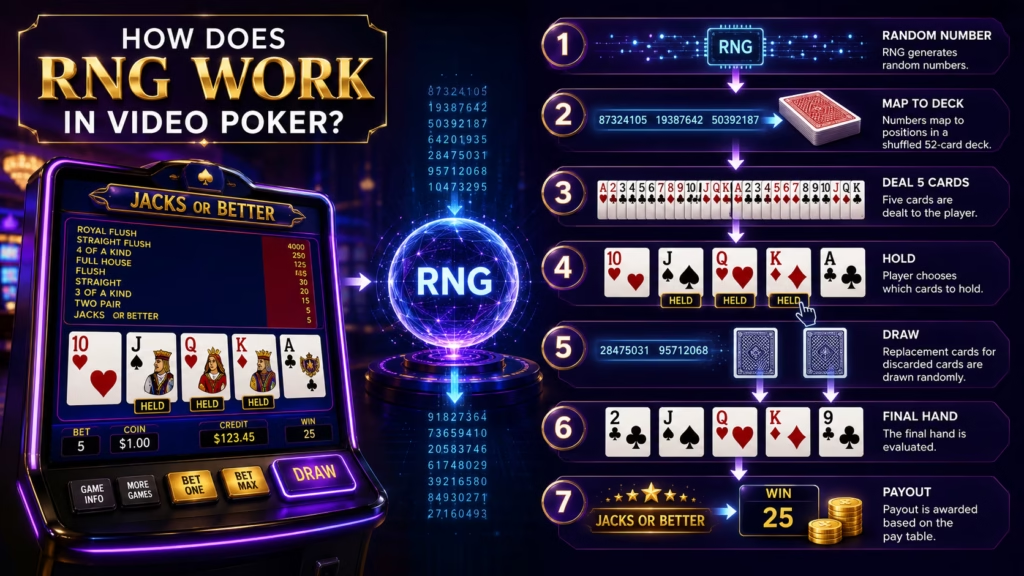
3. The Initial Five Cards Are Dealt
When a player starts a hand, five cards are selected for the initial deal.
Those five cards create the strategic problem the player must solve. The player then decides which cards to hold and which to discard.
This is where video poker differs significantly from games such as slots. A slot player normally cannot make a decision that changes the mathematical value of an already generated spin, while a video poker player can choose which cards remain in the hand.
4. The Player Selects Cards to Hold
The RNG does not normally decide which cards the player should hold.
The player makes that decision.
Suppose the initial hand is:
- 10 of Hearts
- Jack of Hearts
- Queen of Hearts
- King of Hearts
- 3 of Clubs
Holding the four hearts toward a royal flush can have a very different expected value from discarding them and keeping only the king.
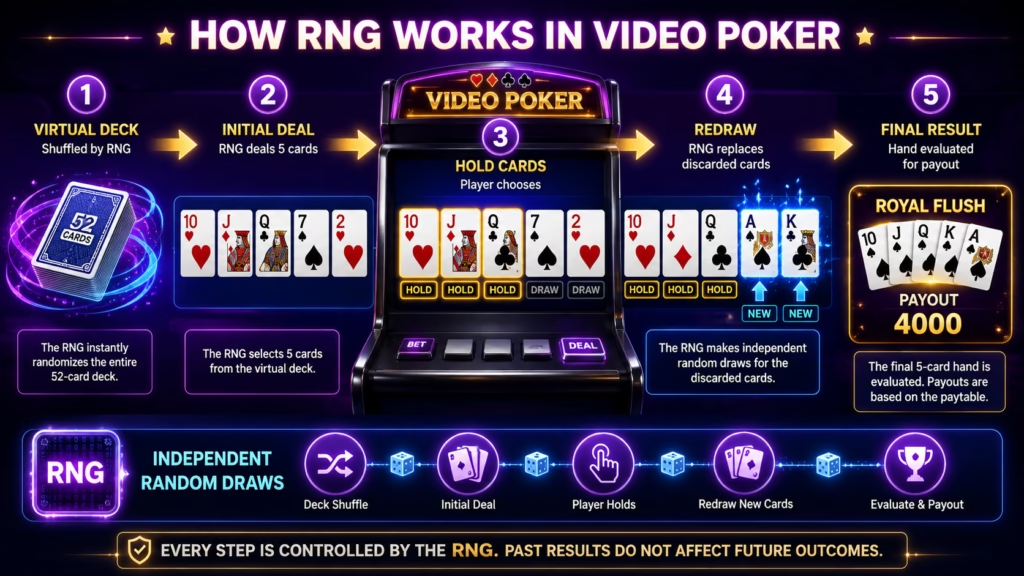
The RNG controls which replacement card or cards become available. The player’s strategy controls which draw is requested.
5. Replacement Cards Are Drawn
After the player presses Draw, discarded cards are replaced according to the game’s random card selection process.
In a conventional virtual deck model, cards already used in the hand are not available again during that same hand. This recreates an important property of physical poker, where the same exact card cannot appear twice in one deck.
The final five card combination is then compared with the paytable.
6. The Paytable Determines the Payout
The RNG’s job is essentially complete once the final cards have been established.
The game evaluates the hand and checks whether it matches a listed winning combination such as:
- Jacks or Better
- Two Pair
- Three of a Kind
- Straight
- Flush
- Full House
- Four of a Kind
- Straight Flush
- Royal Flush
The amount paid depends on the specific game’s paytable and wager.
Is Video Poker RNG Truly Random?
Video poker normally uses pseudorandom rather than physically random computer processes. A PRNG is called pseudorandom because its values are produced mathematically from an internal state, but a properly designed gambling RNG should still make future results impractical for a player to predict.
That distinction does not mean a player can discover a simple pattern by recording previous hands.
A sequence can be generated mathematically while still being sufficiently unpredictable for casino gaming purposes.
In regulated gambling markets, game software and RNG implementations may be subject to technical requirements, independent testing or regulatory approval. The exact testing requirements depend on the jurisdiction, platform and operator, so players should not assume that every video poker game available online has gone through the same review process.
Does the RNG Decide Whether You Win?
The video poker RNG determines cards, not a predetermined win or loss decision in the way players sometimes imagine.
The resulting cards are then evaluated against the paytable.
This distinction matters because video poker outcomes depend on three separate components:
| Component | What It Controls |
| RNG | Which cards are randomly selected |
| Paytable | How much each qualifying hand pays |
| Player strategy | Which cards are held or discarded |
A poor paytable can reduce theoretical RTP even if the card selection is completely random.
Poor strategy can also reduce the player’s expected return because discarding the wrong cards changes the probability distribution of the final hand.
Randomness alone therefore does not determine whether a video poker game offers favorable or unfavorable mathematical conditions.
Can Video Poker Strategy Affect the RNG?
Video poker strategy cannot make the RNG generate better cards, but strategy can influence which random outcomes are available after the draw.
Consider a hand containing four cards to a flush. Keeping all four gives the player a chance to draw one of the remaining cards of that suit. Discarding the entire hand creates a completely different set of possible final hands.
The RNG still selects the replacement cards randomly. Strategy changes the decision being made before those cards are revealed.
This is why video poker strategy can affect theoretical RTP even though the cards themselves remain random.
The correct strategy also depends on the specific paytable. A strategy chart created for one version of Jacks or Better, Deuces Wild or Bonus Poker should not automatically be assumed to be optimal for another version with different payouts.
Video Poker RNG vs Slot RNG
Video poker and slot games can both use random number generators, but the player’s role is different.
A slot RNG determines the random outcome associated with a spin. After the spin begins, there is generally no hold or discard decision comparable to video poker.
Video poker introduces a decision between the initial deal and the final hand. The player receives five cards, evaluates them and chooses which cards to keep.
Slot results primarily depend on the game’s programmed mathematics and random outcome, while video poker results also depend on the quality of the player’s hold and discard decisions.
Neither system allows a player to reliably predict the next random result.
Does the RNG Change When You Increase Your Bet?
Changing the wager should not be treated as a method for forcing the video poker RNG to produce stronger cards.
Bet size can affect the amount won when a paying hand appears, and some video poker paytables may offer different payout relationships at certain wager levels. A well known example is that some games provide a disproportionately larger royal flush payout when the maximum conventional coin wager is used.
That is a paytable issue, not evidence that larger bets generate better cards.
Players should therefore examine the game’s paytable before changing wager size. Increasing the bet solely because a machine appears ready to pay has no reliable mathematical basis.
Can a Video Poker Machine Become Hot or Cold?
Short winning and losing streaks can occur naturally in random games, but a streak does not prove that the RNG has entered a hot or cold mode.
A machine can produce several strong hands close together. It can also produce a long sequence of weak hands.
Randomness does not require results to alternate evenly between wins and losses.
A common mistake is to assume: “The machine has not paid recently, so a good hand must be coming.”
The previous hands do not create a debt that the RNG must repay during the next few hands.
Likewise, a recent royal flush does not automatically make another royal flush impossible.
Can Casinos Adjust the RNG Because Someone Is Winning?
A legitimate RNG based video poker system should not need to change the cards because a particular player has recently won.
The casino’s mathematical advantage, where one exists, comes primarily from the relationship between the probabilities of poker hands, the paytable and the player’s strategy.
This is different from the idea that the game watches individual players and reduces their card quality after a large win.
Players should still distinguish regulated casino games from unknown or unverified gambling software. The technical standards, oversight and testing procedures can vary considerably between operators and jurisdictions.
How RNG Relates to RTP in Video Poker
RNG and RTP are connected, but they describe different things.
RNG determines random card outcomes. RTP describes the theoretical percentage of wagered money a game returns over a very large number of hands under specified assumptions.
Video poker RTP often assumes a particular strategy. That makes strategy especially important when comparing video poker games.
Two players using the same RNG based game can achieve different long term theoretical results if one regularly makes weaker hold decisions.
RTP should also never be treated as a prediction for a single session.
A game with a theoretical RTP close to 100 percent can still produce a substantial loss during a short session because random variation can dominate short term results.
Common Video Poker RNG Myths
“The machine remembers how much I lost”
Previous losses do not mean the next hand must compensate the player. Each new hand should be evaluated independently based on its cards and the relevant strategy.
“Changing machines resets my luck”
Moving to another video poker game does not create a mathematical guarantee of better cards. A different machine may have a better or worse paytable, which is genuinely important, but there is no reliable luck reset.
“Betting more produces better cards”
A higher wager changes financial exposure and may affect the payout structure of certain hands, but it should not be assumed to improve the random card distribution.
“The casino knows when I am about to hit a royal flush”
A correctly implemented RNG system is intended to prevent predictable future card outcomes. A player’s previous results do not provide a reliable method for forecasting the next royal flush.
“A strategy system can predict the RNG”
Video poker strategy calculates the best decision from the cards already visible. It does not predict which exact card the RNG will produce next. That difference is fundamental.
How to Evaluate an RNG Video Poker Game
Players cannot realistically inspect the RNG code before every session, so the more useful approach is to evaluate the game and operator using observable criteria.
Before playing, check:
- The complete paytable. Small differences in payouts can materially change theoretical RTP.
- The exact game variation. Jacks or Better, Bonus Poker, Double Bonus Poker and Deuces Wild use different paytables and strategy.
- The published RTP, if available. Confirm whether the value assumes optimal strategy.
- The operator’s regulatory status. Requirements differ across jurisdictions, so verify the casino rather than relying only on marketing claims.
- The game rules. Check how the deck, draw process and special features work.
- Your strategy source. Use a strategy chart designed for the exact paytable being played.
- Your bankroll limits. Random outcomes can produce extended losing periods even in mathematically strong video poker variants.
The most practical advantage a player has is not predicting the RNG. It is selecting an appropriate paytable, using accurate strategy and controlling the amount risked.
Practical Advice for Playing RNG Video Poker
Treat every new video poker hand as a fresh decision rather than trying to interpret recent wins or losses.
Choose the game based on its rules and paytable. Once the cards appear, use a strategy appropriate to that exact version.
Avoid increasing bets to recover losses. Random card selection does not know that you are behind for the session, and larger bets simply increase the amount exposed to short term variance.
Set spending and time limits before starting. Video poker can combine relatively high theoretical RTP with significant short term fluctuations, so even strong strategy cannot guarantee a profitable session.
Most importantly, video poker should be treated as entertainment rather than a reliable way to earn money.
How This Information Was Reviewed
This explanation separates the main components of video poker mathematics: random card generation, the paytable and player strategy.
Exact RNG implementations can vary between software providers, machines and regulatory environments, so technical details should be checked against the official game rules or documentation when they are available.
Published RTP should also be interpreted carefully because the figure may depend on the exact paytable and an assumed strategy. RTP does not predict what will happen during an individual session.
No betting pattern or hold strategy can guarantee a winning hand. If gambling stops being entertainment or spending limits become difficult to maintain, stopping play is the appropriate decision.
FAQ
How does RNG work in video poker?
A video poker RNG generates random numerical values that the game software uses to select cards from a virtual deck. The player receives an initial hand, chooses which cards to hold and then receives randomly selected replacements for discarded cards according to the game’s rules.
Is video poker completely random?
The card selection in RNG based video poker is designed to be random from the player’s perspective, although computer games normally use pseudorandom algorithms rather than physical randomness. The quality and oversight of the implementation depend on the software and regulatory environment.
Can a player predict video poker RNG?
No reliable strategy allows a player to predict the next RNG generated card. Video poker strategy works by choosing the mathematically preferable hold from cards that are already visible, not by forecasting future RNG values.
Does video poker RNG change after a big win?
A properly implemented RNG system should not need to worsen the cards because a player recently won. Previous wins and losses should not determine whether the next hand receives strong or weak cards.
Does betting maximum coins improve the RNG?
Betting more should not improve the quality of randomly dealt cards. Some video poker games provide a different payout ratio for a royal flush at a particular wager level, but that comes from the paytable rather than the RNG generating better hands.
Are online video poker games predetermined?
RNG based video poker generally determines cards using random selections rather than simply deciding that the player will win or lose a specified amount. Exact game architecture can vary, so the rules and regulatory status of the specific game should be checked when this distinction matters.
Does strategy matter if video poker uses RNG?
Yes. Strategy matters because the player decides which cards to keep before the draw. The RNG determines replacement cards, but choosing the wrong hold can reduce the expected value of the hand and lower the player’s theoretical return over time.
Can a video poker machine be due for a payout?
No hand should be considered due simply because the machine has produced a long losing streak. Random sequences can naturally contain clusters of wins or losses, and previous hands do not guarantee what will happen next.
Does RTP tell me when the RNG will pay?
No. RTP is a long term theoretical measure, not a schedule of upcoming payouts. A game can have a relatively high theoretical RTP and still produce substantial losses over a short period because individual hands remain random.
Brief Conclusion
A video poker RNG determines which cards appear, while the paytable determines their value and player strategy determines which cards are held or discarded. The RNG cannot be reliably predicted through streaks, betting patterns or previous results.
The useful decisions in video poker are therefore choosing the right game and paytable, applying the correct strategy and setting firm spending limits. RNG based video poker remains gambling, so even mathematically strong play cannot guarantee a winning session.