RNG in online poker is the technology used to randomize the virtual deck so that cards are dealt unpredictably. In a properly implemented system, the RNG does not choose which player should win. It supplies randomness to the shuffling process, while the result of a poker hand still depends on the cards dealt and the decisions made by the players.
Gaming standards require RNG-based outcomes to be statistically unpredictable and free from unintended bias. A properly designed system should make future outputs computationally impractical to predict without access to protected internal information such as the algorithm state or seed.
Key points:
- RNG determines the randomization of the virtual card deck.
- A legitimate RNG should not favor individual players.
- Previous hands should not predict future shuffles.
- Player actions should not secretly change the cards already determined by the shuffle.
- RNG testing can include source-code review and statistical analysis.
- A bad beat or unusual sequence of cards is not, by itself, evidence that the RNG is manipulated.
Understanding how RNG works is useful for anyone who plays online Texas Hold’em, Omaha, tournaments, cash games or other digital poker formats. It is especially important for players who wonder whether online cards are truly random or whether the software can alter the deck depending on their actions.
What Is RNG in Online Poker?
A random number generator, or RNG, is a system that produces values used by poker software to randomize cards. The poker platform converts those random values into a shuffled representation of the deck and then deals cards according to the game’s rules.
The RNG is therefore not the same thing as the poker game itself. The poker engine handles blinds, betting rounds, pots, player actions and hand evaluation. The RNG is responsible for providing the randomness needed to create an unpredictable card order.
Gaming technology can use software-based, hardware-based or hybrid random-number generation. Software RNGs derive randomness mainly from computer algorithms, while hardware RNGs can use physical sources such as electrical or thermal noise.
For online poker, what matters to the player is the final shuffled deck. The implementation should make it impractical for a player, employee or attacker to determine which cards will appear next.
How Does RNG Work in Online Poker Step by Step?
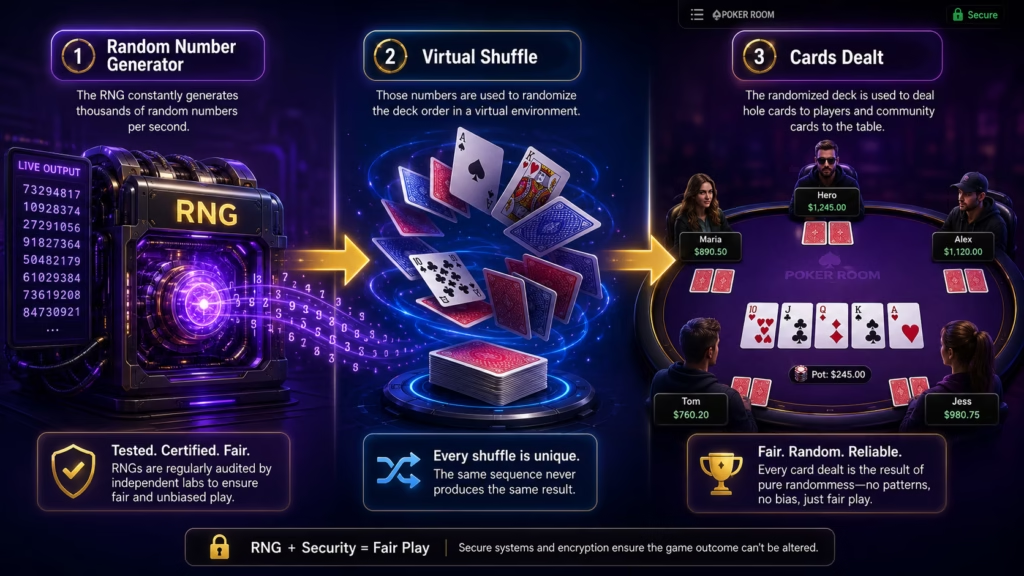
1. The RNG produces unpredictable values
The RNG generates a stream of values. A secure poker system needs enough unpredictability that knowing previous outputs does not allow someone to calculate future outputs.
Modern gaming standards go further than simply checking whether the numbers look random. Secure implementations are expected to resist prediction or compromise even when an attacker has significant technical knowledge.
2. Random values are mapped to the virtual deck
Poker software needs to translate RNG output into card positions.
A standard poker deck contains 52 unique cards. The software therefore needs a shuffling method that produces valid deck arrangements without accidentally favoring particular cards or positions.
This mapping stage is important because a good RNG can still produce biased results if the shuffling algorithm uses its output incorrectly. Proper testing therefore evaluates scaling, mapping and shuffling logic as well as the random-number generator itself.
3. The deck is shuffled
The poker system creates a randomized deck from which hole cards, community cards and any other required cards can be dealt.
Some online poker platforms use a static shuffle in which the deck order is established before the hand develops and remains fixed during play. Other operators may use different technical implementations, so a specific site’s documentation should be checked before assuming that every poker room uses exactly the same process.
4. Cards are dealt according to the shuffled order
Once the deck has been randomized, the poker engine deals the required cards.
In Texas Hold’em, that means distributing hole cards and then revealing the flop, turn and river according to the game rules. The RNG does not need to decide whether a certain flop would create more action. Its job is to support a random card sequence.
Does the RNG Decide Who Wins a Poker Hand?
No. RNG does not normally select a winner and then generate cards to produce that result. It randomizes the cards. The winner is determined later from the cards and the decisions made during the hand.
That distinction separates online poker from many house-banked casino games.
In peer-to-peer poker, players compete primarily against other players. The operator generally earns a rake, tournament fee or another disclosed charge rather than needing a particular individual to lose a specific hand.
RNG controls the random component of poker, but poker outcomes also depend on skill-related decisions such as starting-hand selection, bet sizing, folding, bluffing and responding to opponents.
What Is a Seed and Why Does It Matter?
A software RNG generally maintains an internal state that allows it to generate a sequence of values. Seeding is part of the process used to initialize or update that state.
If the seed or internal state were simple and predictable, an attacker might theoretically reconstruct the sequence and predict future cards. For that reason, secure RNG standards place considerable importance on seed generation and entropy.
Secure systems should not rely on a simple time value alone for seeding and should resist attempts to reconstruct their internal state. Periodic updates from external entropy can also help protect against state-compromise attacks.
For an ordinary player, the important point is simpler: you should not be able to reverse-engineer future cards from previous hands.
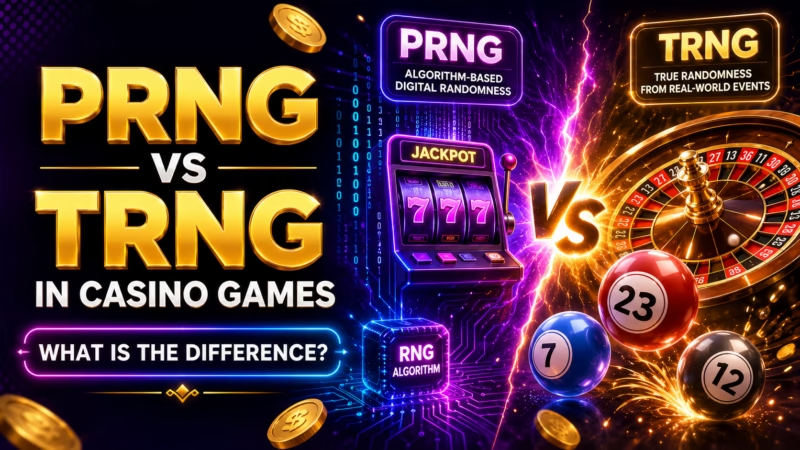
True RNG vs Pseudorandom RNG in Online Poker
The term RNG covers more than one technical approach.
| RNG type | How randomness is produced | Typical characteristic |
| Software RNG | Computer algorithm and internal state | Extremely fast and suitable for large online systems |
| Hardware RNG | Physical phenomena such as electrical or thermal noise | Produces entropy from physical processes |
| Hybrid system | Combines software algorithms with external entropy | Can strengthen seeding or internal-state updates |
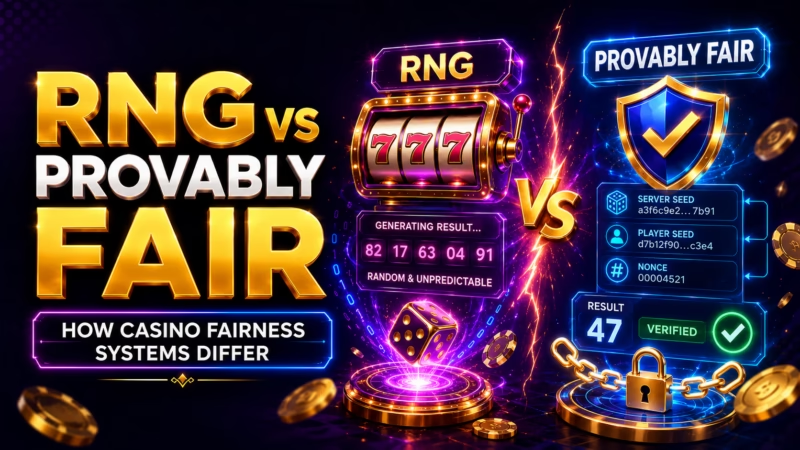
Players sometimes assume that an algorithm cannot be random because computers follow instructions. That oversimplifies the issue. A cryptographically strong pseudorandom generator can create outputs that are computationally impractical to predict when it is seeded and implemented correctly.
For online poker fairness, practical unpredictability, unbiased card selection and secure implementation matter more than whether someone casually labels the system true random or pseudo-random.
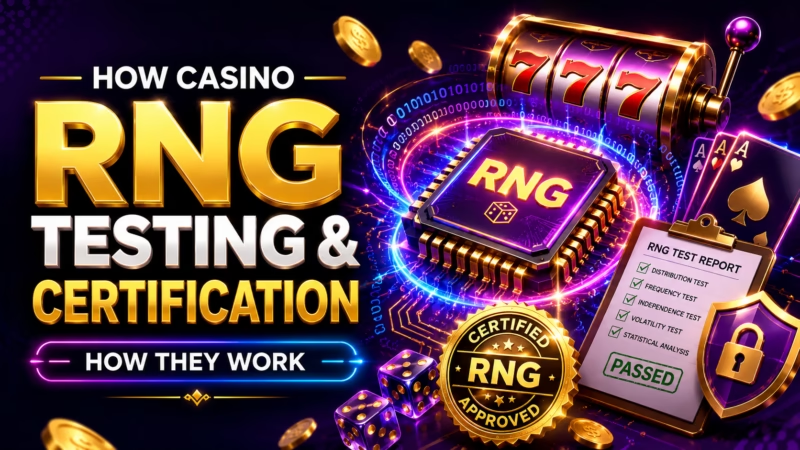
How Are Online Poker RNGs Tested?
A legitimate RNG should be evaluated at several levels rather than judged from a few thousand hands observed by players.
Source-code analysis
Independent testers can inspect the algorithms responsible for randomness, scaling and shuffling. The review can look for possible bias, implementation errors, malicious code and undisclosed parameters that could influence randomness or fair play.
Statistical testing
Large datasets of RNG output can be analyzed for unexpected patterns. Common categories of statistical checks include:
- chi-square or total-distribution testing;
- runs testing;
- serial correlation testing;
- duplicates testing;
- overlap testing;
- other tests appropriate to the RNG implementation.
Distribution testing
When cards are shuffled correctly, no card should receive an unintended advantage merely because of the RNG or mapping algorithm. The output should follow the intended distribution, while scaling, mapping and shuffling logic should avoid introducing bias.
Independence testing
Knowing previous random outputs should not reveal useful information about future outputs. Seeding and reseeding should also avoid introducing predictable patterns.
Can Online Poker RNG Be Rigged?
Software can technically be programmed unfairly, which is why licensing, technical controls and independent testing matter. Simply displaying the letters RNG does not prove that a poker platform is trustworthy.
A stronger indicator is whether an operator works under an appropriate regulatory framework and provides verifiable information about its RNG or testing procedures.
The practical lesson is not to assume that every poker website on the internet has passed equivalent testing. Players should check the operator, relevant regulator, testing information and terms applicable in their jurisdiction before depositing money.
Why Does Online Poker Sometimes Feel Rigged?
Random poker can produce sequences that feel extremely non-random.
You can lose several all-ins in a row as a favorite. Pocket aces can lose repeatedly. The same opponent can appear to hit multiple unlikely rivers. Those events may be frustrating, but improbable events are expected to occur occasionally across a very large number of hands.
Human perception makes the problem worse. Dramatic hands are easier to remember than routine folds and uncontested pots.
A short personal hand history is therefore a poor RNG test. Proper RNG evaluation uses controlled statistical methods and much larger datasets, along with inspection of the algorithms themselves.
Common Myths About RNG in Online Poker
“The site gives action flops to increase rake”
A dramatic board does not prove that the platform generated the flop to encourage betting.
In a static-shuffle system, the deck order is fixed before betting decisions can influence the hand. Not every poker room necessarily uses the same architecture, but the existence of dramatic boards alone is not evidence that the software selected them to increase action.
“If a card has appeared several times, it is less likely to appear next”
Previous hands do not make a particular card due or overdue in a newly shuffled deck.
Proper RNG systems are designed so that previous outputs do not provide information that lets players predict future random selections.
“The RNG changes because I raise or fold”
Player decisions should not secretly alter a random outcome unless such behavior is explicitly part of the game’s rules. In a static-shuffle implementation, the deck order is already fixed and betting decisions do not change it.
“Licensed means I can never lose unfairly”
Regulation and independent testing can reduce integrity risks, but they do not prevent variance. A properly random game can still produce extremely unfavorable short-term results.
How to Evaluate an Online Poker Room’s RNG
Players cannot realistically audit the source code of every poker platform themselves, so the most useful approach is to look for verifiable external evidence.
Check:
- Who regulates the operator. Verify the information with the regulator rather than trusting a logo alone.
- Whether RNG testing is independently documented. Look for the testing laboratory and what was actually evaluated.
- Whether the operator explains its shuffling process. Clear technical information is preferable to vague claims such as 100% fair.
- Whether hand histories are available. Detailed records help players review individual hands and identify what actually happened.
- Whether the platform publishes integrity and security policies. RNG is only one part of poker integrity. Collusion, bots, account security and prohibited software are separate issues.
RNG certification should therefore be treated as one component of evaluating a poker room, not as a substitute for checking the operator itself.
RNG vs Poker Skill
RNG determines which cards become available, while poker skill determines how a player responds to uncertainty.
A player cannot control whether an ace appears on the river. A player can control whether calling a bet makes mathematical and strategic sense given the range of possible hands.
This distinction is fundamental to poker. Randomness creates short-term uncertainty. Decision quality influences how effectively a player handles that uncertainty over repeated situations.
No strategy can guarantee profit from poker, and even strong decisions can produce losing sessions because individual hands remain affected by random card distribution.

How This Information Was Reviewed
This explanation distinguishes the random-number generator from the card-shuffling algorithm, dealing process and player decision-making system. Technical claims are based on commonly used gaming-standard principles concerning unpredictability, distribution, independence, seeding and cryptographic strength.
Specific poker platforms may use different RNG and shuffling implementations. Players should therefore check the operator’s own technical documentation, regulatory status and testing information rather than assuming that every poker room works in exactly the same way.
Poker should be treated as gambling entertainment rather than a guaranteed way to make money. Randomness means short-term results can vary sharply even when decisions are reasonable. Set financial and time limits before playing and stop if gambling begins to cause financial or personal problems.
FAQ
Does online poker use RNG?
Yes. Online poker platforms use random-number generation as part of the process that randomizes virtual cards. The RNG provides unpredictable values that the software can convert into a shuffled deck. The exact implementation depends on the poker platform.
Does RNG control whether I win or lose?
No. RNG primarily controls card randomness rather than selecting a player who must win. Once cards are dealt, the result also depends on hand strength and player decisions. Randomness can still cause significant short-term wins or losses.
Can online poker sites change the river card after I bet?
That depends on the technical design. In a properly implemented static-shuffle system, the deck order is fixed before the hand develops, so later betting actions do not change the river card. A specific poker room’s documentation should be checked for its exact implementation.
Is an online poker RNG truly random?
A software RNG is commonly assessed by whether its outputs are statistically unbiased, independent and computationally unpredictable rather than by a casual definition of true randomness. Strong systems can also undergo source-code review, statistical testing and security evaluation.
Can previous poker hands predict the next cards?
A properly implemented RNG should prevent previous outputs from providing useful information about future outputs. Previous hands therefore should not let a player calculate the next shuffle.
Why do I see so many bad beats online?
Bad beats can cluster naturally because random sequences do not produce perfectly balanced short-term results. Online poker can also expose players to many hands, making unusual events more noticeable. A small collection of memorable hands is not enough to establish RNG bias.
How can I tell whether an online poker RNG is fair?
Look for verifiable regulation, independent RNG testing, clear integrity information and transparent explanations of card shuffling. Do not rely only on a fairness badge displayed by the poker site itself.
Can RNG be hacked?
Poorly designed random-number generators can potentially be vulnerable, which is why secure systems use techniques intended to resist prediction and reconstruction of internal state. The practical risk depends on the quality of the implementation and surrounding security controls.
Does RNG make poker purely a game of luck?
No. RNG creates random card distribution, but players still make strategic decisions about betting, raising, calling and folding. Randomness strongly affects individual hands and short sessions, while decision quality determines how a player responds to the situations produced by those random cards. Poker still involves financial risk and does not provide guaranteed profits.
Brief Conclusion
RNG in online poker provides the randomness needed to shuffle and deal virtual cards. A trustworthy implementation should produce unpredictable, appropriately distributed and independent outcomes while preventing players or attackers from calculating future cards. Independent testing, regulation and transparent technical documentation provide stronger evidence of fairness than individual winning or losing streaks. RNG cannot guarantee a fair poker ecosystem by itself, but it is one of the core technologies required for fair digital card distribution.