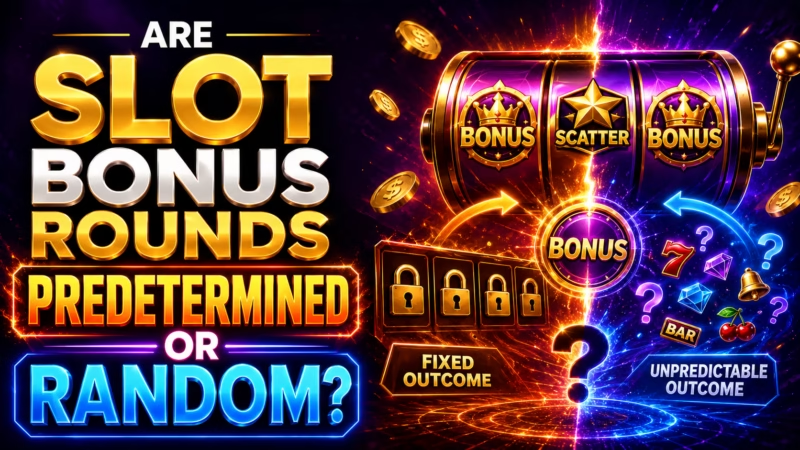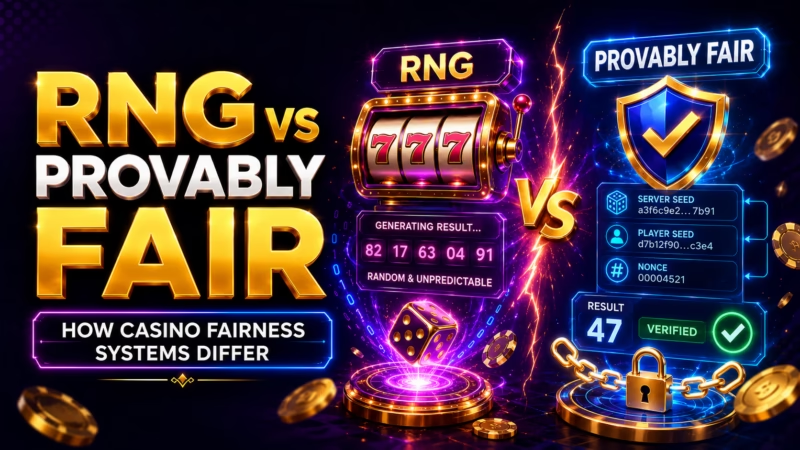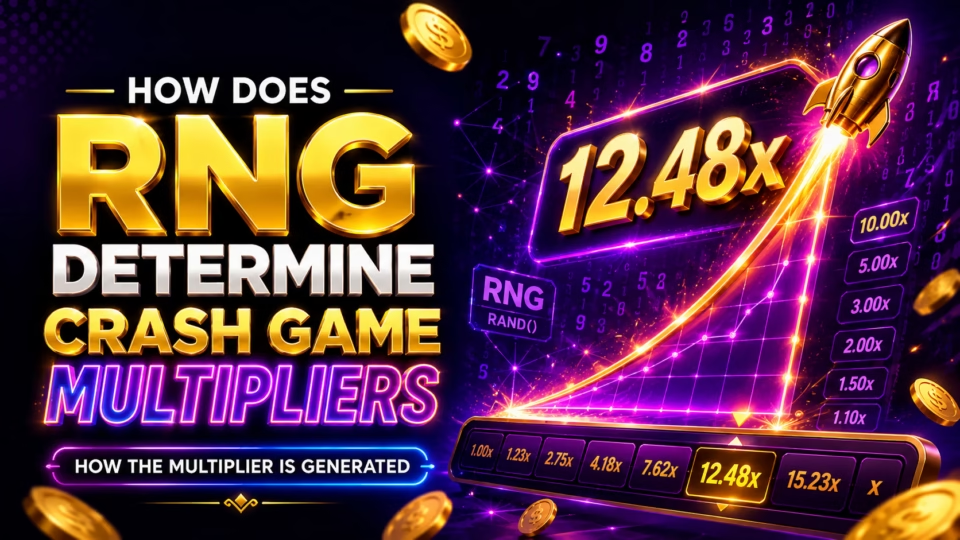
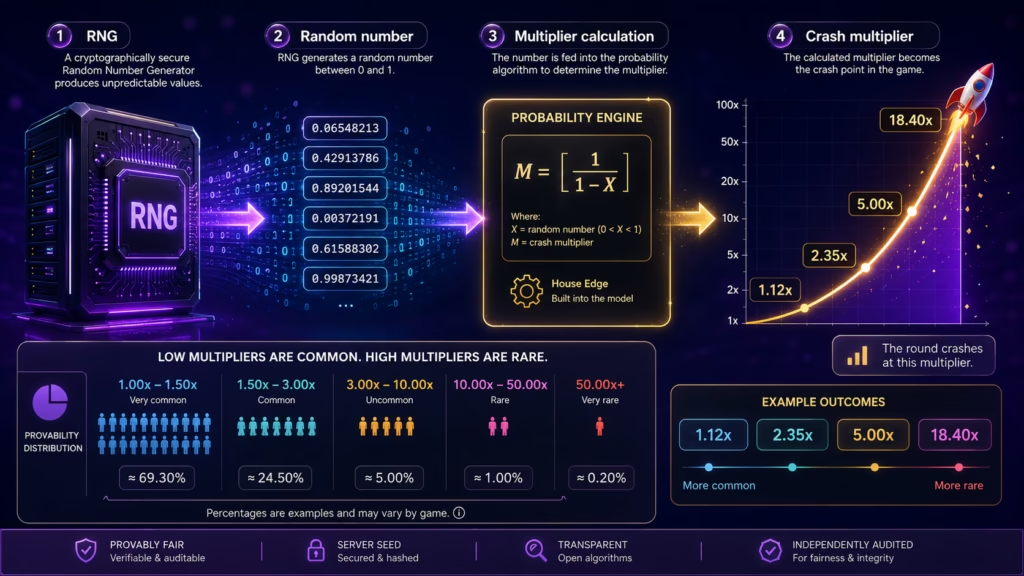
A crash game RNG determines the multiplier by generating an unpredictable numerical result and mapping that result to a crash point, such as 1.07x, 2.43x, 18.60x or a much higher value. In many modern provably fair crash games, the result is derived from cryptographic inputs such as server seeds, client seeds, nonces and hashes rather than from the visible animation itself. Implementations vary by provider, so the exact algorithm and multiplier formula must be checked in the game’s rules or fairness documentation.
Key points:
- The multiplier is normally determined by software before or independently of the visual crash animation.
- Low crash multipliers are generally much more common than extremely high multipliers.
- Provably fair systems can allow completed rounds to be independently verified.
- Previous multipliers do not tell the RNG what the next multiplier should be.
- No betting pattern can guarantee that a future crash point will occur above a chosen cash-out level.
Understanding crash game RNG is most useful for players who want to know what actually happens behind the rising multiplier. It is especially relevant if a game advertises provably fair results or provides access to seeds and verification tools. Players should be more cautious when a game gives little information about how outcomes are generated or verified.
What Is a Crash Game RNG?
A crash game RNG is the random or pseudorandom system used as part of determining where a crash round ends. The game then converts the generated data into the multiplier shown to players.
In regulated gaming systems, random number generators can be software-based, hardware-based or use other approved methods. Industry technical standards distinguish software RNGs from hardware RNGs and require testing of the algorithms that affect the final random outcome.
Most online games rely on software algorithms. A pseudorandom generator is deterministic at the mathematical level, but its output is designed to remain unpredictable when the internal state or seed is unknown. Cryptographic random-bit generation can use seed material together with hash functions or other cryptographic techniques to produce random-looking output.
The important distinction for a player is simple: computer-generated does not automatically mean predictable. A properly implemented cryptographic system can produce outcomes that players cannot realistically calculate in advance.
How Are Crash Game Multipliers Generated?
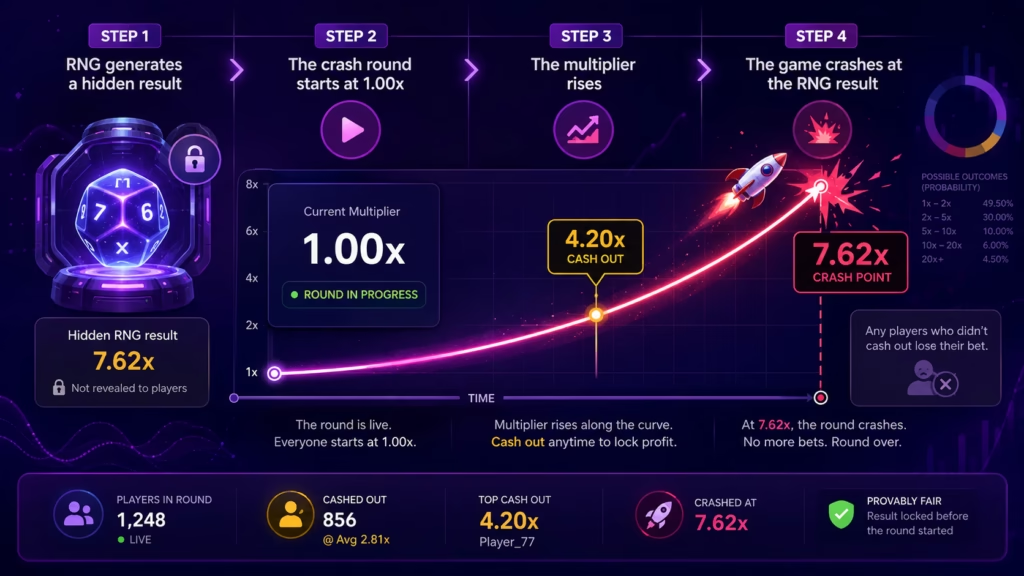
The exact method differs between crash games, but a typical process contains several stages.
1. The Game Generates Random Input
The system first obtains random or pseudorandom data. In a conventional casino implementation, this may come from an approved RNG.
A provably fair crash game may instead derive the round from cryptographic seeds and hashing. A common implementation can use a server seed, client seed, nonce and cryptographic hash or HMAC function. This is one possible architecture and should not be assumed to describe every crash game.
2. The Random Data Is Converted Into a Number
Raw cryptographic output is not displayed directly as “4.32x.” The software converts part of the RNG or hash output into a usable numerical value. Depending on the implementation, that may involve bytes, integers, hexadecimal values or a normalized number within a defined range.
This conversion must preserve the probability distribution intended by the game. In properly designed systems, RNG scaling and mapping should avoid unintended bias and the final output should conform to the game’s intended mathematical distribution.
3. The Number Is Mapped to a Crash Multiplier
The game then applies its mathematical rules to convert the random value into the final crash point.
This is the stage that creates the characteristic crash-game distribution. A large proportion of rounds may end at relatively small multipliers, while progressively larger multipliers become increasingly uncommon.
The precise mapping formula is important because it controls the mathematical probabilities of different crash points. There is no single universal formula used by every crash game. A provider may also incorporate the game’s mathematical advantage into this conversion.
For that reason, a formula found for one crash game should not automatically be applied to another.
4. The Game Displays the Result
After the crash point has been determined, the interface shows the multiplier climbing from its starting value until the predetermined or algorithmically determined stopping point is reached.
The moving rocket, airplane, line or graph is primarily a visual representation of the round.
For example, if the generated result corresponds to 3.74x, the interface may animate:
1.00x
1.20x
1.50x
2.00x
3.00x
3.74x
CRASH
The animation does not necessarily mean the RNG is repeatedly deciding whether the game should continue every fraction of a second. The technical implementation depends on the game, but many digital gambling systems determine the relevant game outcome through their random-outcome logic and then present that result through the interface.
Are Crash Multipliers Predetermined?
A crash multiplier may already be mathematically determined before players see the round finish, particularly in cryptographic and provably fair implementations.
This is not the same as saying that the casino manually chooses the multiplier.
A properly designed random system can determine a result in advance while keeping that result unpredictable to the player and, in a provably fair commitment model, resistant to later manipulation by the operator.
In a typical commitment structure, a hashed server seed is provided before bets are placed. The original server seed can later be revealed and checked against its earlier hash. The purpose is to allow verification that the underlying secret value was not silently changed after the fact.
Players should nevertheless check the fairness documentation for the particular crash game they are using because providers can implement crash mechanics differently.
What Does Provably Fair Mean in a Crash Game?
A provably fair crash game provides cryptographic information that can be used to verify completed outcomes.
A typical system can involve:
- a server seed controlled by the game platform;
- a client seed associated with the player or browser;
- a nonce that changes between bets or rounds;
- a cryptographic hash;
- a documented conversion method.
In one common design, a cryptographic function processes the server seed, client seed and other inputs to generate bytes used for the game outcome. The platform may publish a hashed version of the server seed before it is revealed, allowing the revealed value to be checked later.
Provably fair does not mean that the player can predict the next multiplier.
The cryptographic commitment is specifically designed so that relevant hidden information remains unavailable before the result. Verification normally happens after the required secret data has been disclosed.
Provably fair also does not mean that a game has no house advantage. Fair generation and favorable player odds are separate questions.
Why Do Small Crash Multipliers Appear So Often?
Crash games are normally designed with a probability distribution in which small multipliers have substantially higher probabilities than extreme multipliers.
If 100x or 1,000x occurred as often as 1.20x or 2x, the mathematical payout structure would be completely different.
The conversion algorithm therefore maps random input according to the game’s intended probability model rather than simply selecting every possible displayed multiplier with equal probability.
This distinction is important. An unbiased RNG does not require 1.10x, 10x and 1,000x to occur equally often. The RNG supplies random input, while the game’s mathematical mapping determines the probability assigned to each class of outcome.
Can Previous Multipliers Affect the Next Crash?
Previous crash multipliers should not be treated as predictors of the next multiplier in a properly implemented independent random system.
A sequence such as:
1.14x
1.03x
1.28x
1.09x
1.41x
does not prove that a 10x or 100x round is “due.”
Likewise, several high multipliers do not prove that the next round must crash early.
Independent gaming outcomes should not become predictable simply because a player has observed previous results. This is why pattern systems based only on recent crash history can be misleading. Random sequences naturally contain clusters, streaks and unusual-looking runs.
Does the RNG Know When Players Cash Out?
In a properly implemented RNG-based game, player cash-out decisions should not secretly cause the random crash point to change.
The mathematical result and player decision are separate parts of the game.
In properly controlled RNG systems, events of chance that determine monetary awards should be based on the random values selected by the game, not adjusted in response to individual player behavior.
That does not mean every crash website worldwide follows the same technical standard. Regulation, testing and transparency vary by operator and jurisdiction.
Players should therefore distinguish between a documented or independently tested game and an unknown website that simply displays a rising multiplier.
RNG vs Provably Fair Crash Games
Traditional RNG and provably fair systems can both generate unpredictable game results, but transparency is different.
| Feature | Conventional RNG | Provably Fair System |
| Generates unpredictable results | Yes, if correctly implemented | Yes, if correctly implemented |
| May use cryptographic RNG methods | Yes | Commonly |
| Player can verify individual rounds | Not necessarily | Usually the main purpose |
| Uses server/client seeds | Not required | Common |
| Independent laboratory testing | May be required in regulated markets | Depends on platform and jurisdiction |
| Makes future multipliers predictable | No | No |
Provably fair verification gives players an additional way to inspect the integrity of completed rounds, but it does not change the fundamental risk of gambling.
Common Myths About Crash Game RNG
“A high multiplier must appear after several low rounds”
No. A sequence of low multipliers does not create a debt that the RNG must repay with a high multiplier.
“The graph decides when the game crashes”
Not necessarily. The graph is the visible presentation of the game. The underlying random system and mathematical conversion determine the relevant outcome.
“The casino crashes the game when many players stay in”
That should not occur in a correctly implemented independent or properly certified RNG system. Players should look for technical documentation, regulatory information or provably fair verification instead of assuming every website operates identically.
“Provably fair means I can predict the multiplier”
No. Provably fair systems are intended to make completed outcomes verifiable, not future outcomes knowable.
“Studying the last 100 rounds reveals the RNG pattern”
A short history cannot reliably reveal the next independent random result. Apparent patterns can occur naturally in random data.
How to Evaluate a Crash Game’s RNG
Players who want to understand how crash game multipliers are generated should check the game’s technical transparency rather than relying on visual behavior.
Useful questions include:
- Does the provider explain how the multiplier is generated?
- Does the game disclose whether it uses an RNG or provably fair system?
- Are server seeds, client seeds, hashes or nonces explained?
- Can completed rounds be independently verified?
- Are game rules and payout mechanics publicly available?
- Is RNG testing or regulatory approval documented where required?
- Does the operator clearly explain responsible gambling controls?
A trustworthy explanation should describe enough of the system to understand where randomness enters the process and how that random data becomes a game result.
What Crash Game RNG Means for Players
The practical lesson is that RNG knowledge explains the game but does not provide a reliable way to beat it.
Knowing that a crash point comes from randomized input helps explain why streaks cannot be treated as schedules. Knowing how provably fair verification works can help a player check whether a completed result matches the published cryptographic process.
Neither technique tells a player when the next 20x, 100x or 1,000x multiplier will appear.
Crash games involve monetary risk and should be treated as entertainment rather than a source of income. Players who choose to participate should set spending and time limits before playing and should not increase bets because they believe a large multiplier is overdue.
How This Information Was Reviewed
This explanation separates three components that are often confused: random-number generation, mathematical outcome mapping and visual crash animation.
Technical claims were reviewed against established principles for RNG source-code review, statistical testing, intended distributions and game-outcome selection.
Cryptographic RNG concepts were checked against standard concepts for deterministic random-bit generation, including the use of seed material and cryptographic functions.
Provably fair examples were treated as implementation examples rather than a universal standard for every crash game.
Players should still check the official rules, fairness documentation and operator information for the specific game because multiplier formulas, verification methods and availability can differ.
FAQ
How does RNG determine a crash game multiplier?
A crash game RNG generates unpredictable data that the game’s mathematical algorithm converts into a crash point. The conversion may produce a result such as 1.12x, 3.50x or 75x depending on the random input and the game’s probability model.
Is the crash multiplier decided before the round starts?
In some implementations, particularly provably fair systems, the underlying data can determine the outcome before the visible animation finishes. The exact timing and implementation depend on the provider, so the game’s technical rules should be checked.
Can the casino change the crash multiplier while the round is running?
A properly implemented independent RNG system should not alter a selected random outcome in response to player behavior. The exact protections and testing requirements depend on the operator, game and jurisdiction.
Can crash game RNG be predicted?
A properly implemented cryptographic RNG or provably fair system is designed to make future outcomes impractical to predict without secret input values. Knowing previous multipliers does not reveal the next crash point.
Why are 1x and 2x multipliers more common than 100x?
The random input is mapped through a probability distribution in which extreme multipliers are generally much rarer. An RNG can be unbiased even when the final game outcomes intentionally follow a non-uniform distribution.
Does changing the bet amount change the RNG result?
Bet size should not be assumed to control the underlying random outcome. The exact game mechanics should be confirmed in the rules, but increasing a wager does not provide a reliable method for producing a higher crash multiplier.
What is a server seed in a crash game?
A server seed is a secret input used by some provably fair systems. A cryptographic hash of the seed may be published before play and the original seed disclosed later, allowing players to verify that the committed value was not changed.
Does provably fair mean there is no house edge?
No. Provably fair describes a method for verifying the integrity of game-result generation. It does not mean that the mathematical payout model gives players an advantage or guarantees winning results.
Can crash history help predict the next multiplier?
Crash history can describe what already happened, but it does not reliably predict the next independent RNG result. Streaks of low or high multipliers can occur naturally without changing the probability mechanism of the next round.
Brief Conclusion
Crash game RNG generates unpredictable numerical data that is converted by the game’s mathematical model into a crash multiplier. In provably fair implementations, cryptographic seeds and hashes may also allow completed rounds to be verified.
The important point is that randomness, multiplier distribution and the visual crash animation are separate parts of the system. Previous results do not reveal when the next large multiplier will occur, and understanding the RNG does not create a guaranteed winning strategy. Crash games should be treated as entertainment, with clear spending and time limits.