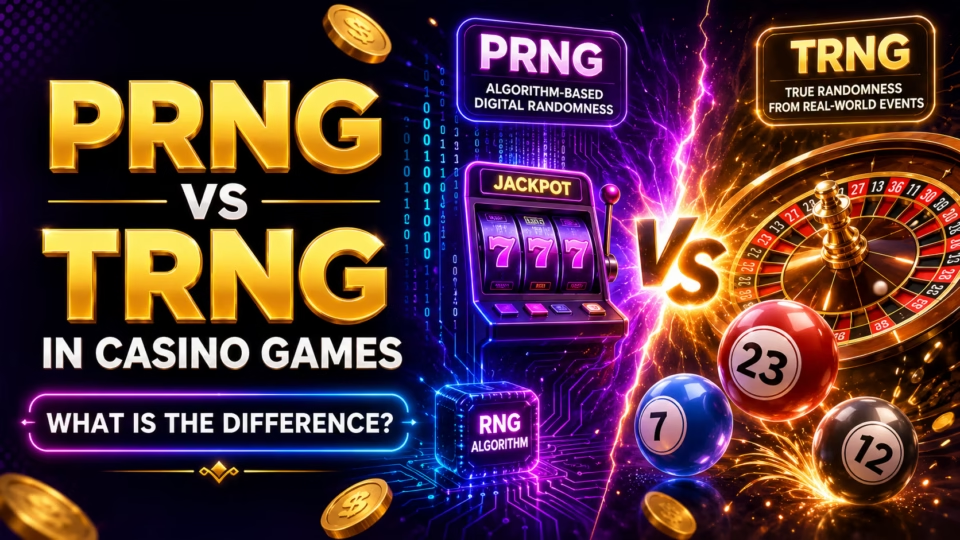
PRNG and TRNG are two different ways of generating random numbers. A PRNG, or pseudorandom number generator, uses a mathematical algorithm and an initial seed to produce a sequence that appears random, while a TRNG, or true random number generator, derives randomness from a physical source of entropy, such as electronic noise or another nondeterministic process.
In casino games, the distinction matters technically, but it does not mean that a game using TRNG is automatically fairer than a game using PRNG. Properly designed gaming systems can use software-based pseudorandom generators, hardware random generators, or combinations of both.
Quick takeaways:
- PRNG uses an algorithm and seed to generate pseudorandom values.
- TRNG obtains entropy from nondeterministic physical processes.
- Many electronic casino games can use software RNG technology.
- A secure PRNG can produce outcomes that are computationally impractical for a player to predict.
- RTP, house edge, and volatility are separate from whether the underlying randomness comes from PRNG or TRNG.
For players, the more important question is usually not simply “PRNG or TRNG?” but whether the game operates under appropriate technical standards and whether its random outcome generation has been properly implemented and tested.
What Is a PRNG?
A pseudorandom number generator is a deterministic algorithm that produces a sequence of numbers designed to behave like random numbers. Deterministic means that the algorithm follows defined mathematical rules. If the exact algorithm, internal state, and required initialization information were reproduced, the resulting sequence could theoretically be reproduced as well.
In technical standards, deterministic random bit generators are mechanisms that generate random-looking bits using deterministic methods. A DRBG is also commonly called a pseudorandom number generator.
The basic concept can be simplified to:
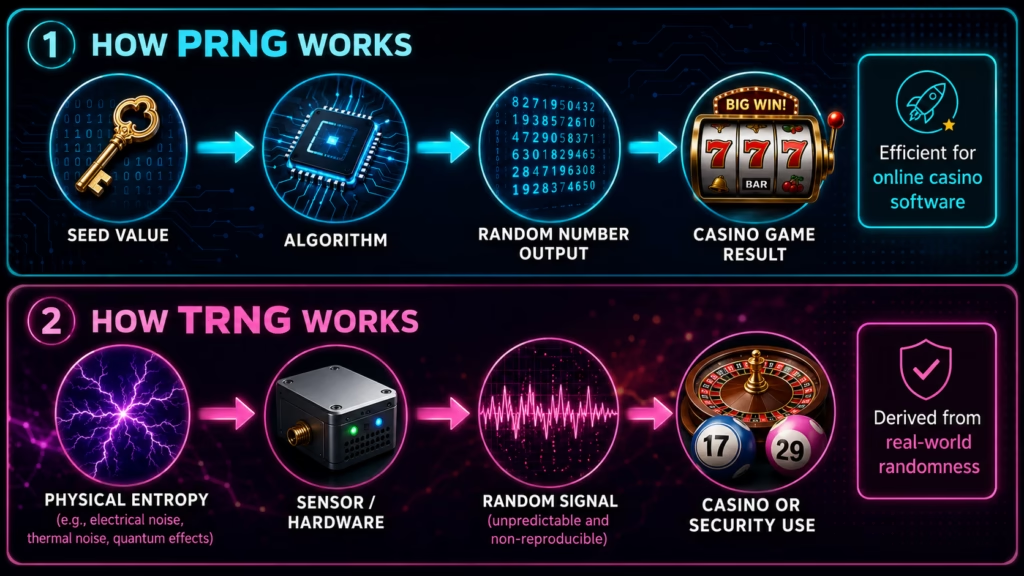
Seed or internal state → PRNG algorithm → pseudorandom numbers → game outcome selection
The seed or internal state initializes the generator. Modern systems may obtain entropy for initialization or reseeding from external sources, so describing every PRNG as a completely isolated mathematical formula would be misleading. Random-bit-generation frameworks can combine deterministic generation mechanisms with entropy sources in broader system designs.
Why Are PRNGs Used in Casino Games?
PRNG technology is suitable for software systems because random-looking values can be generated efficiently and continuously without requiring a separate physical randomness measurement for every result.
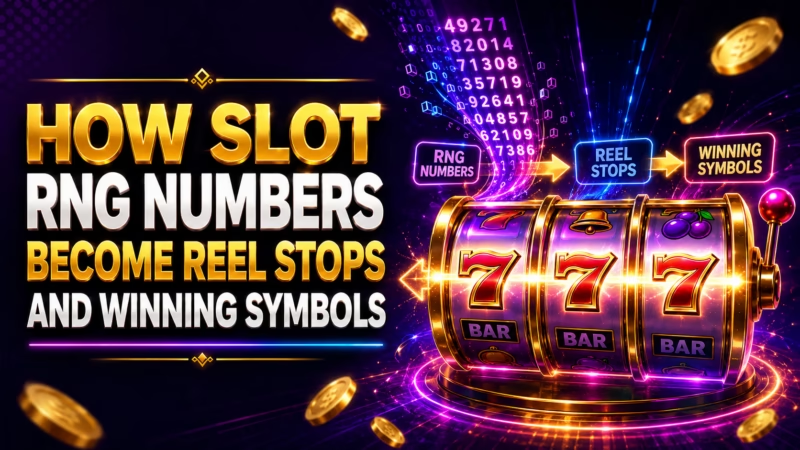
In a casino game, however, generating a number is only one part of determining an outcome. The game also has rules for mapping RNG output to reels, symbols, cards, numbers, multipliers, or other possible results.
For example, a slot’s RNG may generate values that are mapped to reel positions. The displayed symbols then correspond to those selected positions according to the game’s mathematics.
The RNG does not by itself define the slot’s RTP or prize structure.
What Is a TRNG?
A true random number generator obtains randomness from a nondeterministic entropy source rather than producing the sequence solely through a deterministic algorithm.
Depending on the implementation, physical entropy can be derived from phenomena such as electronic noise or other processes whose exact measurements are inherently difficult to predict.
Entropy generation is generally treated as a separate technical area, with specific requirements for entropy sources used in random-bit-generation systems.
A simplified TRNG process looks like:
Physical entropy source → measurement and processing → random values → application or game system
TRNG therefore differs fundamentally from a conventional PRNG. The PRNG expands an internal state through an algorithm. The TRNG derives new uncertainty from a physical process.
That distinction does not mean every device marketed as a “true RNG” automatically produces perfect randomness. Physical entropy sources still require proper design, monitoring, conditioning, and testing.
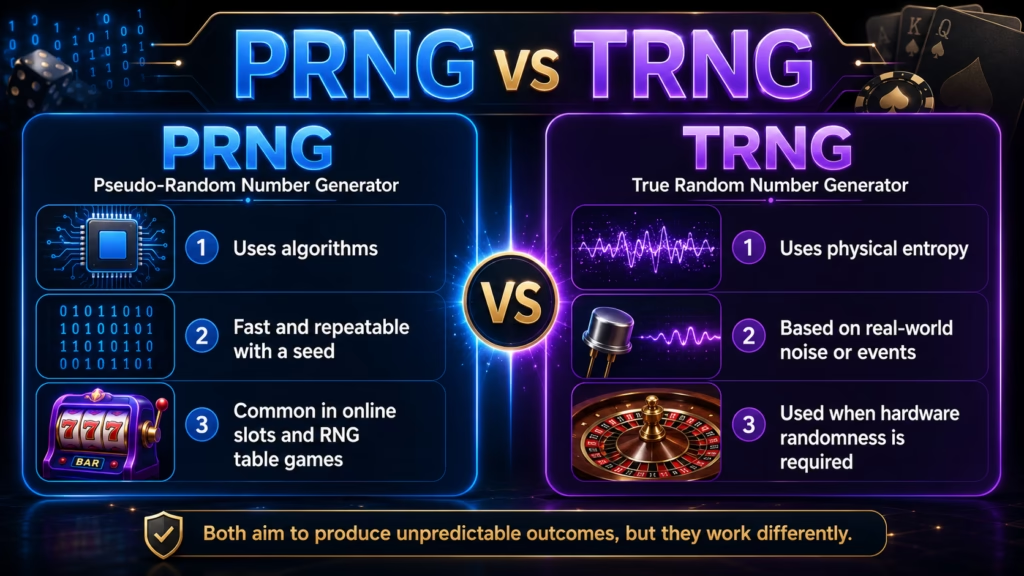
PRNG vs TRNG: Key Differences
| Feature | PRNG | TRNG |
| Randomness source | Mathematical algorithm | Physical entropy |
| Deterministic | Yes | Designed to be nondeterministic |
| Requires internal state or seed | Yes | Not in the same sense as a PRNG |
| Sequence reproducible in principle | Possible with sufficient internal information | Not expected from the physical source |
| Common form | Software RNG | Hardware or physical entropy source |
| Can be used in gaming systems | Yes | Yes |
| Automatically guarantees fair casino results | No | No |
The difference between PRNG and TRNG is primarily how randomness is produced, not whether players win more often.
A well-designed PRNG can be extremely difficult to predict without knowledge of its internal state. Conversely, a poorly implemented physical RNG could contain bias or hardware problems. The technology therefore has to be judged by implementation and testing rather than its label alone.
Are Casino Games Using PRNG Really Random?
Casino games using PRNGs can produce outcomes that satisfy gaming requirements for randomness even though their underlying mathematical process is technically deterministic.
Gaming technical standards can require random number generation and game results to be acceptably random. Software RNG output is generally expected to be unpredictable, and predicting the next number should be computationally infeasible without complete knowledge of information such as the algorithm and seed.
Gaming standards may also examine whether RNG output:
- has the required statistical distribution;
- remains unpredictable;
- avoids unwanted repeating cycles;
- prevents separate RNG instances from synchronizing;
- is correctly mapped into game outcomes.
Some regulatory technical standards require random outcomes to be demonstrably random to a high degree of confidence and prohibit adaptive behavior in relevant remote gaming contexts.
For a player, this distinction is important. “Pseudorandom” does not mean that a normal player can calculate the next slot result by watching previous spins.
Can Players Predict a Casino PRNG?
A properly implemented gaming PRNG should not expose enough information for an ordinary player to predict future results from previous outcomes.
Looking at ten losing spins, for example, does not tell a player that a winning spin is now due. Likewise, observing several bonus rounds does not establish that the game must enter a long losing period.
Regulated random gaming systems are generally expected to prevent this kind of practical predictability and to address unwanted repetition or synchronization of RNG streams.
This also explains why betting systems based on identifying visual “patterns” in independent RNG-driven outcomes are unreliable. Apparent streaks can naturally occur within random sequences.
Does TRNG Make a Casino Game Fairer Than PRNG?
TRNG does not automatically make a casino game fairer than PRNG. Fair outcome generation depends on the complete implementation, including the RNG, game mathematics, outcome mapping, software integrity, and applicable testing requirements.
Gaming RNG testing can cover software-based pseudorandom RNGs, hardware RNGs, and hybrid combinations. Important checks include unpredictability and whether bias exists toward particular outcomes.
A secure PRNG can therefore be appropriate for casino gaming even though the numbers are technically pseudorandom.
Players should be cautious when a casino or game uses phrases such as “true random” purely as a marketing claim. The phrase describes the source of randomness only when it accurately refers to a physical entropy-based system. It does not reveal the RTP, house edge, payout distribution, or whether the entire game has been implemented correctly.
Hybrid RNG Systems Combine Both Approaches
The PRNG vs TRNG comparison is not always a strict either-or choice.
A system can collect entropy from a physical or nondeterministic source and use that entropy to initialize or reseed a deterministic random generator. Random generation frameworks commonly distinguish between deterministic generation mechanisms and entropy sources, and gaming systems can also use hybrid RNG combinations.
This architecture can combine an external source of entropy with the practical advantages of algorithmic random-number generation.
For players, however, knowing that a system is hybrid still does not provide information about the probability of winning a particular bet.
Does RNG Type Affect RTP?
PRNG or TRNG does not determine a game’s RTP by itself.
RTP, or return to player, describes a game’s theoretical long-term payout relationship under its defined mathematics. The RNG provides randomness used to select outcomes, while the game’s probability model and payout structure determine how frequently particular outcomes occur and what they pay.
Consider a simplified game with 100 possible equally likely outcomes. Changing the prizes assigned to those outcomes changes the theoretical return even if the same RNG continues selecting numbers from 1 to 100.
The reverse is also true. Replacing one properly implemented RNG architecture with another does not automatically change the game’s RTP if the same probability model and outcome mapping remain intact.
Most importantly, RTP is a long-term mathematical characteristic. It does not predict what one player will receive during a short session.
Does RNG Type Affect Slot Volatility?
PRNG and TRNG also do not directly define slot volatility.
Volatility describes how a game’s payouts are distributed, such as whether wins tend to be smaller and more frequent or larger and less frequent. Developers create that behavior through the probability model, symbol distribution, paytable, bonus structure, multipliers, and other game mathematics.
The RNG selects among the possible outcomes according to the implemented system. It does not convert a low-volatility game into a high-volatility game merely because the developer uses PRNG instead of TRNG.
Players comparing casino games should therefore examine RTP, volatility, paytable structure, maximum exposure per bet, and bonus mechanics separately from the RNG technology.
PRNG and TRNG Myths
Myth 1: Pseudorandom Means Fake
“Pseudorandom” is a technical description, not evidence that outcomes are secretly controlled.
A PRNG generates values algorithmically rather than measuring a new physical random event for every number. Appropriate gaming implementations are still expected to produce unpredictable and statistically acceptable outcomes.
Myth 2: TRNG Means Better RTP
TRNG does not increase RTP.
RTP depends on game mathematics and payout probabilities. The source used to generate randomness is a separate issue.
Myth 3: A Slot Must Pay After a Losing Streak
Previous losing results do not prove that the next RNG-driven spin must win.
Random sequences naturally contain streaks and clusters. A run of losses should never be interpreted as evidence that a jackpot or bonus is “due.”
Myth 4: RNG Makes Every Prize Equally Likely
Random selection does not necessarily mean every visible outcome has the same probability.
A game can randomly select among outcomes with deliberately different probabilities. Those probabilities are part of the game’s mathematical design.
What Should Players Actually Check?
Most players do not need to choose casino games based specifically on PRNG versus TRNG. More useful checks include:
- Game rules and paytable. Understand how prizes and features actually work.
- RTP information. Check the RTP version offered by the operator when this information is available.
- Volatility. Consider whether the payout pattern fits your budget and preferred style of play.
- Casino and jurisdiction information. Check which regulatory framework applies to the operator.
- Game testing information. Do not assume that an RNG claim alone proves independent testing.
- Bet limits. Set a maximum spending limit before playing rather than changing bets in response to streaks.
None of these checks can make a random game profitable or predict the next result. Casino games should be treated as paid entertainment, and gambling should stop if losses exceed a predetermined limit or play stops being enjoyable.
How This Information Was Reviewed
This comparison separates three concepts that are often incorrectly combined: how random values are generated, how casino outcomes are mapped from those values, and how game mathematics determines RTP and volatility.
The technical distinction between deterministic random generation and entropy sources follows established random-bit-generation principles. Casino-specific explanations are consistent with common regulatory and gaming laboratory approaches to software, hardware, and hybrid RNG testing.
Exact RNG implementations can differ between games, suppliers, systems, and jurisdictions. Players should therefore avoid assuming that every online casino game uses the same algorithm or hardware architecture.
Most importantly, neither PRNG nor TRNG provides a method for predicting casino outcomes. RTP, volatility, and bonus mechanics describe aspects of game mathematics or gameplay, but they do not guarantee the result of an individual session.
FAQ
What is the main difference between PRNG and TRNG?
The main difference between PRNG and TRNG is the source of randomness. A PRNG uses a deterministic mathematical algorithm and internal state, while a TRNG derives entropy from a nondeterministic physical process.
Do online casinos use PRNG or TRNG?
Casino gaming systems can use software-based pseudorandom RNGs, hardware RNGs, or hybrid combinations. There is no single RNG architecture that applies to every online casino game or provider.
Is PRNG less fair than TRNG?
No. PRNG is not inherently less fair than TRNG. A gaming PRNG can produce acceptable random outcomes when it is securely implemented, sufficiently unpredictable, correctly mapped into game results, and tested according to applicable standards.
Can a casino know the next PRNG result?
A PRNG is deterministic at the technical level, but a properly designed gaming system is expected to make future output computationally impractical to predict without the necessary secret internal information.
Can players detect an RNG pattern?
Previous results generally do not provide a reliable way to predict the next result of a properly implemented gaming RNG. Random sequences can contain streaks, repeated-looking patterns, and clusters without those patterns providing information about the next outcome.
Does TRNG give players a better chance of winning?
No. Using TRNG rather than PRNG does not automatically improve a player’s winning probability. Winning probabilities come from the game’s mathematical model, including outcome probabilities and payouts, rather than simply from whether randomness originates from hardware entropy or a pseudorandom algorithm.
Does PRNG determine slot RTP?
No. PRNG does not determine RTP by itself. The RNG supplies random values used in outcome selection, while the game’s mathematical model and payout structure determine its theoretical return. RTP also cannot predict the result of an individual session.
Are slot spins independent?
In properly designed random games, previous outcomes should not create a predictable advantage for future outcomes. A sequence of losing spins therefore does not prove that a win is due.
Is a “true RNG casino” automatically safer or more trustworthy?
No. The phrase “true RNG” alone does not establish that a casino or game is trustworthy. Players should consider the applicable regulatory framework, game rules, technical testing where relevant, and operator information rather than relying on one RNG marketing claim.
In short
PRNG generates pseudorandom values through deterministic algorithms, while TRNG derives randomness from physical entropy. Both approaches, as well as hybrid combinations, can be used in gaming systems. The important issue is not simply whether a casino game says PRNG or TRNG, but whether its RNG is unpredictable, correctly implemented, appropriately tested, and accurately mapped to the game’s probability model.
RNG type does not by itself determine RTP, volatility, or a player’s chance of winning a specific session. No sequence of previous casino results provides a guaranteed way to predict the next random outcome, so casino games should be treated as entertainment rather than a method of earning money.