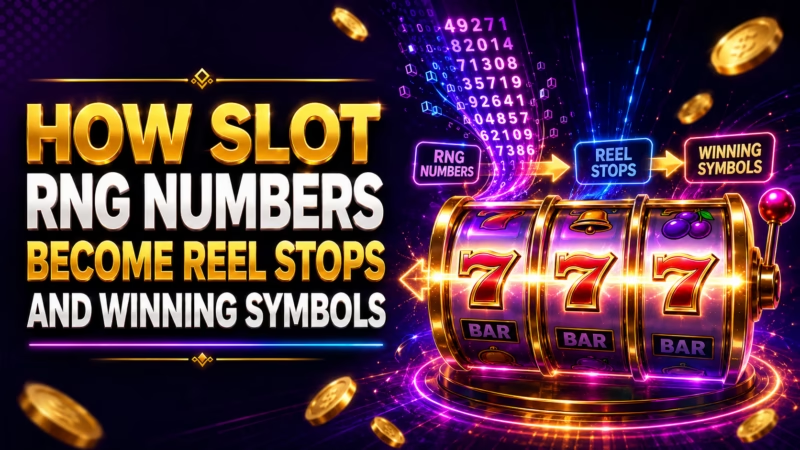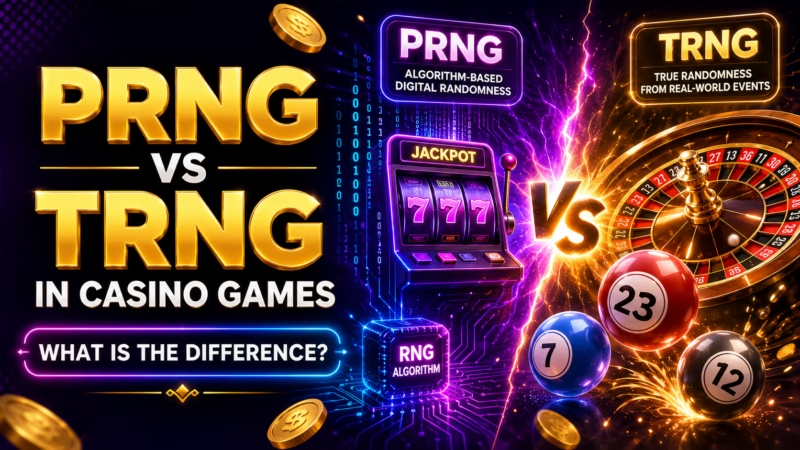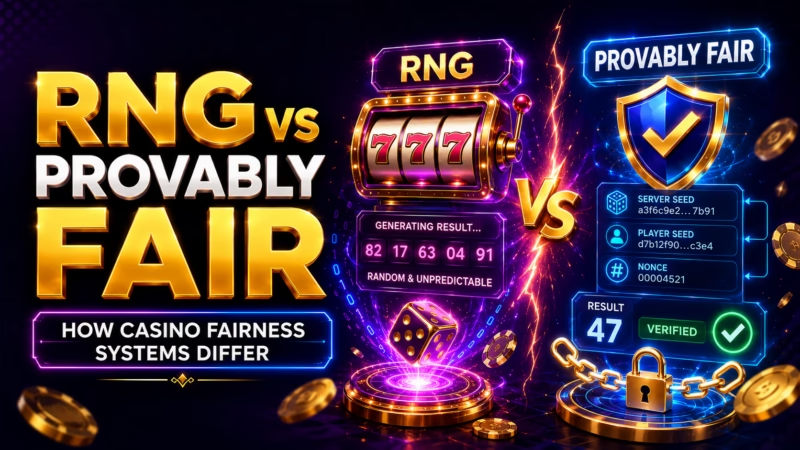
A slot machine RNG, or Random Number Generator, is the system that produces the random values used to determine slot outcomes. In regulated casino games, RNG output is expected to be statistically random and unpredictable, and previous results should not determine what happens on the next independent spin. The UK Gambling Commission, for example, requires RNG-driven outcomes to be acceptably random and prohibits adaptive behavior that changes outcomes in response to previous play.
The confusion starts because random results rarely look random to humans. Ten losing spins can be followed by another loss. Two bonus rounds can appear close together. A large win can occur immediately after a player changes the bet. These events can create convincing patterns even when one spin did not cause the next.
Quick takeaways:
- A legitimate RNG does not know that a slot is “due” for a win.
- Previous independent spins should not make the next spin more likely to win or lose.
- RTP describes a theoretical long-term return, not what one player should receive in a session.
- A near miss does not mean a winning combination is getting closer.
- Higher bets may change eligible prizes or features in some games, but that does not make the RNG “luckier.”
- Random does not mean every possible prize has the same probability.
Understanding slot machine RNG myths is particularly useful for players who find themselves changing bet sizes, switching games or extending sessions because a slot appears hot, cold or close to paying. RNG knowledge cannot improve the next random result, but it can prevent misleading patterns from being mistaken for a strategy.
How Does a Slot Machine RNG Work?
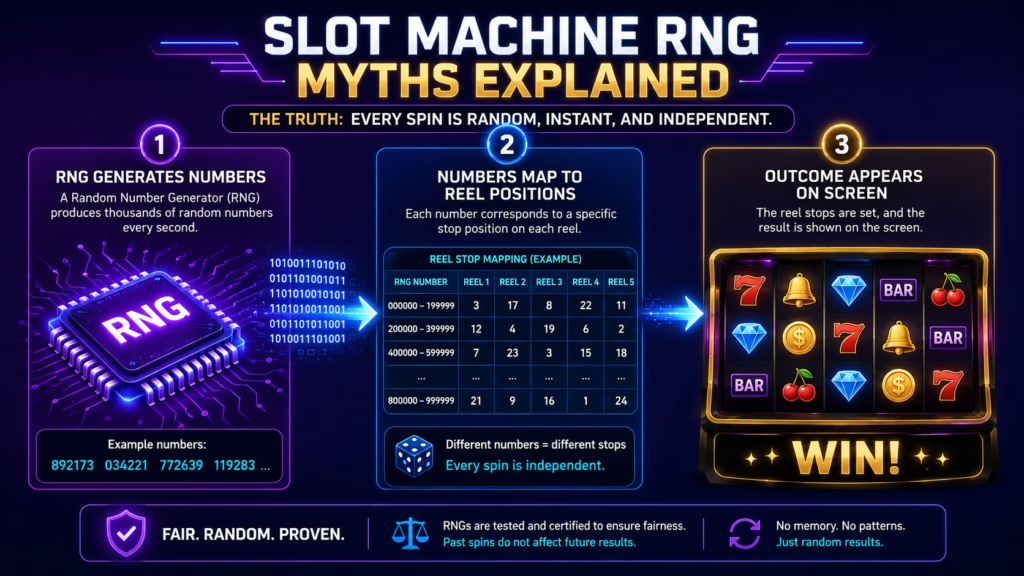
A software-based slot RNG uses an algorithm to produce values that the game converts into outcomes according to its programmed mathematical model. Gaming Laboratories International distinguishes software RNGs, hardware RNGs and physical randomness systems, while requiring appropriate RNG implementations to meet criteria for distribution, independence and unpredictability.
The RNG itself is only part of the process. A game also needs rules that map RNG values to reel positions, symbols, bonus events or other outcomes. A random number does not necessarily correspond directly to one visible symbol.
This distinction explains an important point: random numbers do not mean all slot outcomes are equally likely. Gaming standards allow a game design to use a non-uniform distribution as long as the final results conform to the intended mathematical distribution.
A rare jackpot therefore can remain extremely unlikely even though the RNG system used to select outcomes is functioning randomly.
Myth 1: A Slot Is Due to Pay After a Losing Streak
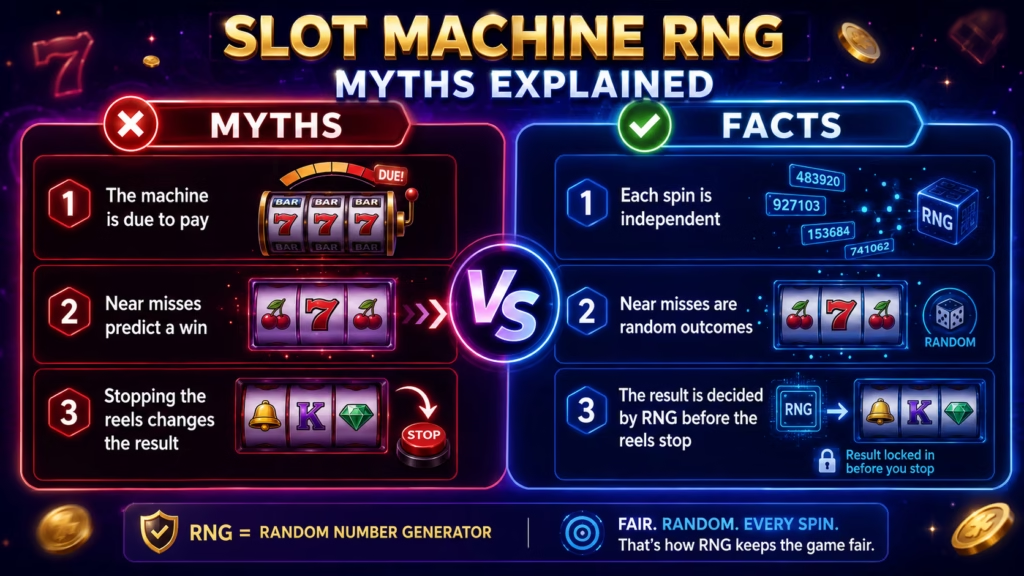
A slot does not become more likely to produce a win simply because many losing spins occurred beforehand when each spin is designed as an independent RNG event.
This misconception is a version of the gambler’s fallacy. A sequence such as loss-loss-loss-loss-loss can feel incomplete, causing the next win to seem overdue. Random systems do not need to balance short sequences that way.
RNG standards commonly require that knowledge of numbers selected in one draw should not provide information about numbers that may be selected in a future draw, except where a game’s explicit design requires otherwise.
A long dry spell can therefore continue, and a large win can also arrive immediately after another win. Neither sequence proves that the RNG has changed state in the player’s favor.
Myth 2: Slots Become Hot or Cold
A “hot slot” is usually a description of recent results rather than evidence that future winning probability has increased.
Players naturally notice clusters. A slot that produces several payouts within a few minutes may appear hot, while another that produces a long losing sequence may appear cold. With independent RNG outcomes, those streaks do not provide a reliable prediction of the next spin.
The practical mistake is continuing to play because a game appears hot or refusing to leave because a cold machine supposedly must recover. Neither assumption creates an advantage.
Myth 3: The Casino Changes the RNG Because You Are Winning
A regulated RNG game should not secretly compensate for a player’s previous results by making the next outcome worse. The UK Gambling Commission specifically states that adaptive behavior, meaning a compensated game that changes outcomes in response to play, is not permitted under its remote RNG requirements.
That does not mean every version of every slot worldwide has identical mathematics. Providers may offer different approved configurations, including different RTP settings, and casino availability can vary by jurisdiction or operator.
The important distinction is between a configured game model and personal manipulation of the next spin. A legitimate slot can have a particular RTP or paytable configuration without dynamically deciding that one specific player has already won enough.
Myth 4: Changing Your Bet Resets the RNG
Increasing or decreasing the stake does not normally create a fresh pool of good outcomes or reset a slot’s random process.
Bet size can still matter to game rules. Depending on the slot, a particular stake may change the total amount won, activate additional paylines, affect jackpot eligibility or interact with specific features. Those conditions should be described in the game’s rules or paytable.
That is different from claiming that a higher bet makes the RNG more generous.
Players should check the paytable whenever stake size changes more than the monetary value of the same underlying result.
Myth 5: Pressing Stop at the Right Time Can Control the Result
A stop button should not be assumed to provide skill-based control over an RNG outcome unless the game’s rules explicitly describe such an interaction.
In many electronic slot designs, reel movement is a visual presentation of an outcome generated through the game’s random selection process. Stopping an animation sooner does not automatically mean the player has intercepted the RNG at a more favorable moment.
There are exceptions when a casino game deliberately contains a genuine skill or player-choice element. Those mechanics should be clearly defined in the game’s rules. A player should not infer skill simply because the interface allows an animation to be accelerated.
Myth 6: RNG Means Every Symbol Has the Same Chance
Random selection does not require every visible symbol or payout to have identical odds.
An RNG may provide values across a defined range, while the game’s mapping system converts those values according to its mathematical model. Gaming standards distinguish RNG distribution from situations where the game intentionally uses a non-uniform distribution.
For example, a common low-value symbol can occupy substantially more mathematical positions than a jackpot-triggering result. Both can be selected through a random process without having the same probability.
This is why counting visible symbols on a digital reel does not reliably reveal the odds of every outcome.
Myth 7: A Near Miss Means the Slot Is Close to Winning
A near miss does not make the next independent spin more likely to produce the combination that almost appeared.
Seeing two jackpot symbols and missing the third by one position can feel mathematically significant because the visual result resembles a win. From the player’s perspective, however, the important question is whether the next random selection depends on that result.
For an independently generated spin, the previous near miss does not move the game toward a jackpot.
Near misses should therefore be treated as completed outcomes, not signals about what comes next.
Myth 8: RTP Forces the RNG to Pay Back a Certain Amount
RTP does not instruct the RNG to return a fixed percentage to one player or to balance the game after a losing period.
Return to Player is a theoretical characteristic of the game’s mathematics over a very large amount of play. Short sessions can deviate dramatically from the theoretical percentage because individual outcomes remain random.
A 96% RTP does not mean that staking $100 should return exactly $96. One player could lose most of the stake, another could finish ahead, and neither result by itself proves that the published theoretical RTP is wrong.
RTP is useful for comparing game mathematics, but it cannot predict the result of a particular session.
Myth 9: Demo Slots Are Always Programmed to Pay More
A play-for-free version should not automatically be assumed to have better odds than the real-money version.
In Great Britain, UK Gambling Commission guidance says play-for-free games should use the same RNG as the corresponding real-money game, another RNG meeting the regulator’s randomness requirements, or another suitable unbiased RNG. Prize distribution should also accurately represent the real-money version.
Rules are not identical worldwide, so players should avoid assuming that every demo on every website is mathematically identical to a real-money version.
Demo mode is best used to understand features, controls and paytable structure, not to estimate how much money a future session will win or lose.
Myth 10: Pseudorandom Means Fake Random
Software slots commonly rely on pseudorandom number generation, but “pseudorandom” does not automatically mean predictable or manipulated.
A software RNG uses an algorithm and an internal state rather than relying purely on physical randomness such as thermal noise. Proper implementations are designed so players cannot feasibly predict upcoming values from previous outcomes.
Gaming standards for software-based RNGs address seeding, independence and unpredictability, while cryptographic RNG standards can impose additional resistance against attempts to infer future values.
The relevant question is therefore not whether software mathematics is involved. The relevant questions are whether the implementation is unpredictable, correctly mapped to the game mathematics and tested under the rules of the applicable jurisdiction.
Myth 11: A Random Slot Cannot Be Tested
Randomness can be statistically tested even though testers cannot predict the next individual result.
Independent laboratories can analyze large sets of RNG outputs for distribution, independence, correlations, implementation errors and other statistical characteristics. Gaming standards describe source-code review and statistical testing of RNG output, including tests designed to identify distribution or independence problems.
Regulators may also require game and RNG test reports. In Great Britain, relevant remote gambling licensees are required to submit applicable game and RNG testing results from approved test houses before certain games are released for play.
Testing therefore does not mean proving which number comes next. It means checking whether the system behaves according to its specified random model and regulatory requirements.
Slot Machine RNG Myths vs Reality
| Myth | Reality | Practical Meaning |
| The slot is due after many losses | Independent spins do not owe the player a win | Do not extend a session because a payout feels overdue |
| A winning streak means the slot is hot | Recent wins do not reliably predict the next spin | Treat every new independent spin as a new event |
| Higher bets improve RNG odds | Bet size may affect rules or prizes, not make randomness luckier | Check the paytable for stake-dependent features |
| Near misses predict wins | A near miss is a completed result | Do not use reel positions as a forecasting tool |
| RTP guarantees session returns | RTP is a long-term theoretical measure | Do not expect a fixed percentage back |
| Pseudorandom means rigged | Proper software RNGs can be statistically random and unpredictable | Focus on regulation, implementation and testing |
| Every prize has equal odds | Random selection can map to unequal outcome probabilities | Rare payouts can remain much less likely |
| Demo games must be easier | Requirements depend on jurisdiction | Use demos to learn mechanics, not predict profits |
What Should Players Check Instead of Looking for RNG Patterns?
Players cannot reliably forecast a legitimate slot’s next RNG result, so useful evaluation should focus on information that can actually be checked.
Before playing, consider:
- Published RTP: Check the exact game version because RTP configurations can differ.
- Volatility: Higher volatility generally means results may be distributed more unevenly across play.
- Paytable: Understand symbol values, bonus triggers and payout rules before staking money.
- Bet-dependent features: Confirm whether jackpots, paylines or bonuses require particular stakes.
- Game provider: Identify who supplies the game rather than relying only on the casino’s branding.
- Casino regulation: Check which jurisdiction regulates the operator and what player protections apply.
- Session limits: Decide the maximum amount and time you are prepared to spend before starting.
None of these criteria predicts the next spin. They help a player understand the game’s rules and risk without relying on false RNG patterns.
Can a Slot RNG Ever Be Faulty?
An RNG implementation can theoretically contain software defects, configuration problems or security weaknesses, which is one reason regulated markets use technical standards, source-code review and statistical testing.
Randomness should not be treated as a claim that requires blind trust. Gaming standards call for review of randomness-related source code for issues such as bias, implementation errors, malicious code or undisclosed parameters that could affect fair play.
Players usually cannot audit the source code themselves. The practical protection is to use appropriately regulated operators and games from established providers whose products are subject to the testing requirements of the relevant jurisdiction.
How This Information Was Reviewed
This explanation separates three concepts that are frequently confused: the RNG itself, the game’s mathematical mapping of RNG values to outcomes, and player-facing statistics such as RTP.
The technical claims were reviewed against established RNG requirements used in regulated gambling markets, with emphasis on unpredictability, appropriate outcome distribution, independence between draws and testing of RNG implementations.
Exact requirements differ between jurisdictions, providers and game types. Players should therefore verify the paytable, RTP, feature rules and operator terms for the specific slot they are considering.
RNG, RTP and volatility cannot guarantee a winning session. Casino games should be treated as paid entertainment, not as a method of earning income. Setting spending and time limits before playing is more useful than trying to identify patterns in random outcomes.
FAQ
Can slot machine RNG be predicted?
A properly implemented slot machine RNG is designed so that future outcomes cannot feasibly be predicted from the information available to a player. Regulatory standards commonly include unpredictability and independence requirements, although the precise technical rules depend on the jurisdiction.
Does an RNG remember previous slot spins?
An independent RNG process should not use previous outcomes to decide that the next spin must compensate for wins or losses. Previous results therefore do not normally make the next independent spin due to win.
Do casinos control when a slot pays?
Casino operators can offer games with particular approved configurations, but that is different from manually choosing the result of an individual RNG spin. In regulated systems, game outcomes must follow the applicable rules and technical standards.
Does increasing the bet improve the RNG?
Increasing the bet does not make an RNG inherently more favorable. Some slots may change prize values, jackpot eligibility or feature access at different stakes, so the game’s paytable should be checked before assuming the odds remain identical.
Is a slot more likely to win after many losses?
No. A long losing streak does not by itself increase the probability of a win on the next independent RNG spin. Continuing because a payout feels overdue is based on a perceived pattern rather than reliable predictive information.
Are online slot RNGs truly random?
Many online casino games use software-based pseudorandom number generators rather than purely physical randomness. Properly designed systems can still meet regulatory standards for statistical randomness, independence and unpredictability.
Does pressing the spin button at a certain time improve the result?
There is no reliable timing technique for selecting favorable outcomes from a properly implemented slot RNG. Unless a game’s published rules explicitly contain a skill element, button timing should not be treated as a strategy for predicting or controlling the next result.
Can a 96% RTP slot still lose my entire bankroll?
Yes. A theoretical RTP such as 96% does not guarantee that an individual player will recover 96% of their stake. Short-term results can vary substantially, and an entire session can finish far above or below the theoretical return.
Are demo slots more generous than real-money slots?
They should not automatically be assumed to be more generous. In regulated markets, play-for-free games may be required to accurately represent the real-money game’s outcome and prize distribution under applicable technical requirements. Rules elsewhere may differ.
Can an RNG tell when I am about to stop playing?
A properly regulated RNG should not need to predict whether a player is about to leave in order to determine an independent random outcome. Claims that a slot deliberately produces a win because a player is about to quit should not be treated as a reliable description of legitimate RNG behavior.
Short Conclusion
Slot machine RNG myths usually come from treating random streaks as meaningful patterns. A properly implemented RNG is designed to produce unpredictable outcomes, and previous independent spins do not make a future win due. RTP, bet size, near misses and recent winning streaks cannot reliably predict the next result. The useful approach is to understand the paytable, RTP, volatility and game rules, set firm limits, and treat slot play as entertainment rather than a way to make money.