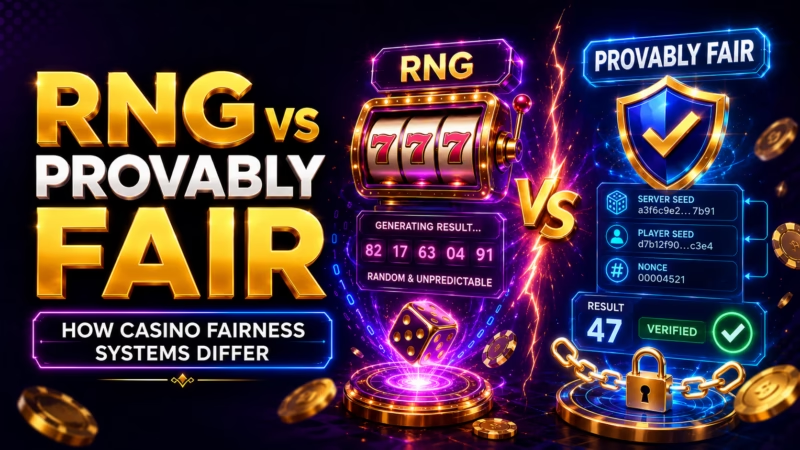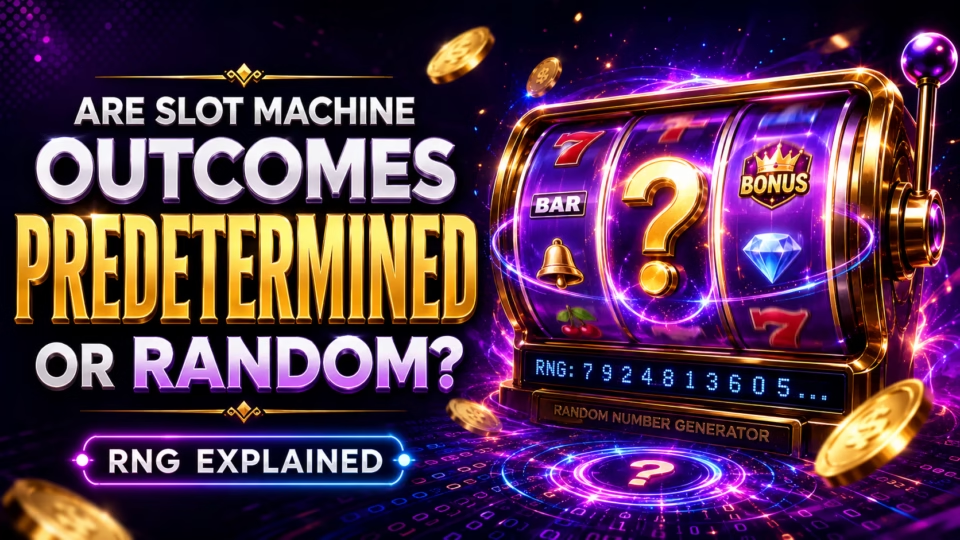
Slot machine outcomes are random in properly operated RNG-based slots, not predetermined to make a particular player win or lose. The game software follows predetermined mathematical rules, such as the paytable, reel configuration, RTP model and bonus logic, but the result of an individual spin is selected through a random number generator.
This distinction matters. The rules are predetermined, but the individual outcome is random.
Quick Answer
- A Random Number Generator, or RNG, determines the outcome of each spin in standard digital slots.
- Previous wins and losses normally do not influence the next independent RNG spin.
- RTP and volatility describe long-term game mathematics, not what will happen during your session.
- A casino cannot make a legitimate RNG slot become “due” for a win simply because it has recently taken many losing bets.
- Some gaming systems use different technical architectures, so players should check the game rules and the regulatory environment when they want to know exactly how a specific game determines results.
Understanding randomness is particularly useful for players who wonder whether losing streaks, near misses, bet changes or bonus timing reveal what the slot will do next. They generally do not provide a reliable way to predict the next RNG-generated outcome.
Are Slot Machines Predetermined?
Standard RNG slot outcomes are not predetermined in the sense that a casino has already scheduled exactly when you personally will win or lose. Instead, the slot operates according to predefined game mathematics while an RNG selects the result used for each valid spin.
Several parts of a slot are predetermined by design:
- winning symbol combinations;
- payout values;
- reel or symbol weighting;
- RTP configuration;
- volatility characteristics;
- bonus rules;
- jackpot conditions;
- maximum win limits;
- feature triggers and restrictions.
Those elements determine how the game works, not the exact sequence of wins and losses a particular player will experience.
For example, a slot may be designed with a theoretical RTP of a certain percentage. That percentage describes expected long-term return under the relevant game configuration. It does not mean the slot must return that percentage during 100 spins, 1,000 spins or any particular player’s session.
Are Slot Machines Random?
RNG-based slot machines use random number generation to determine spin outcomes. When a spin is accepted, the game uses an RNG result and converts it according to the slot’s mathematical model into the symbols, reel positions or other outcome displayed to the player.
The visual spinning reels are therefore not usually physical reels deciding the outcome through momentum. In a digital slot, the animation primarily presents the result generated by the underlying game system.
This is why watching how quickly the reels stop, manually stopping reels or trying to press the spin button at a special moment does not provide a dependable way to control the outcome of a normal RNG-based slot.
How Does a Slot RNG Work?
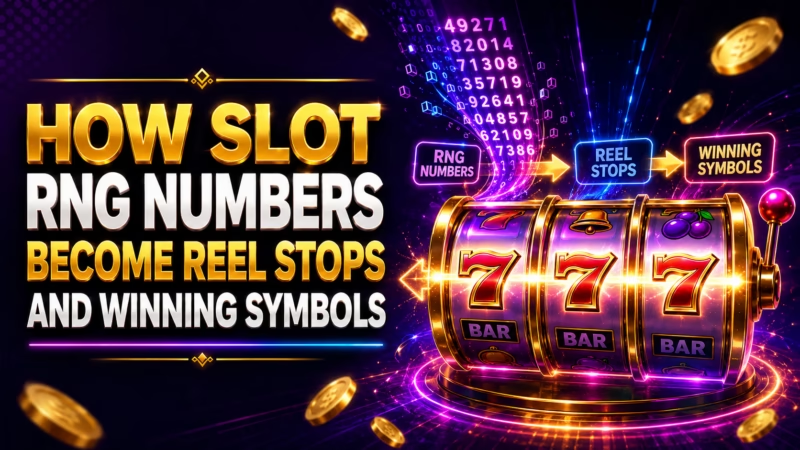
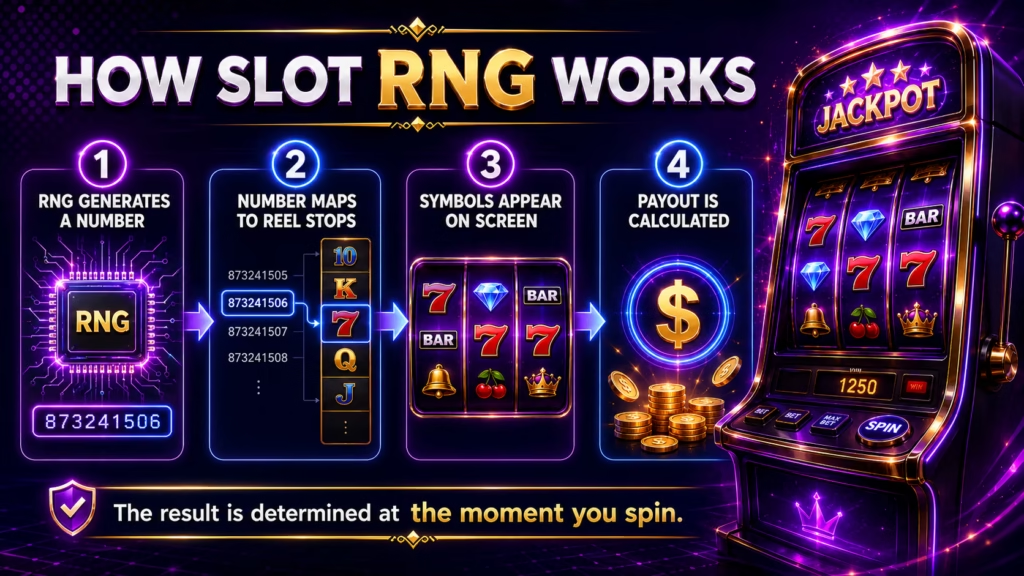
A slot RNG generates numerical values that the game software maps to possible outcomes.
In simplified form, the process looks like this:
- The player initiates a valid spin.
- The game system obtains an RNG value.
- The slot’s mathematical rules map that value to reel positions or symbols.
- The paytable determines whether the resulting combination wins.
- Any applicable bonus or feature rules are applied.
- The game displays the result.
Real slot software can be considerably more complex, particularly when games contain cascading reels, multipliers, jackpots, expanding symbols, bonus rounds or multiple stages of random events.
The important point is that randomness operates inside predefined mathematical rules. Random does not mean the software has no structure.
If RNG Software Is Programmed, Is It Really Random?
This question causes much of the confusion around whether slot machines are predetermined.
Digital gaming systems commonly use pseudorandom number generation. A pseudorandom number generator is an algorithm, so its operation follows mathematical rules. However, that does not mean a player receives a manually scheduled sequence of wins and losses or that the next practical result can be predicted simply by observing previous spins.
From the player’s perspective, the relevant issue is whether the gaming system produces outcomes according to its approved randomization and game rules rather than adapting individual results to force a particular session outcome.
Calling an RNG “programmed” and therefore claiming that every player’s losses are intentionally predetermined mixes up two different concepts: deterministic software instructions and predictable game outcomes.
What Is Predetermined and What Is Random?
| Slot element | Predetermined or random? | What it means |
| Paytable | Predetermined | Winning combinations and payout rules are defined by the game |
| RTP model | Predetermined | The game has a mathematical long-term return model |
| Volatility | Predetermined | The mathematical distribution of wins is part of the design |
| Individual RNG spin | Random | The specific outcome is generated when the game processes the spin |
| Bonus trigger | Usually RNG/rule based | The feature follows the game’s predefined triggering mechanics |
| Previous spin | Already determined | It normally does not tell you what an independent next RNG spin will be |
| Next spin | Unknown | A player cannot reliably infer it from recent results |
This explains the apparent contradiction between a slot having carefully engineered mathematics and still producing random individual outcomes.
Does a Slot Know When You Have Been Losing?
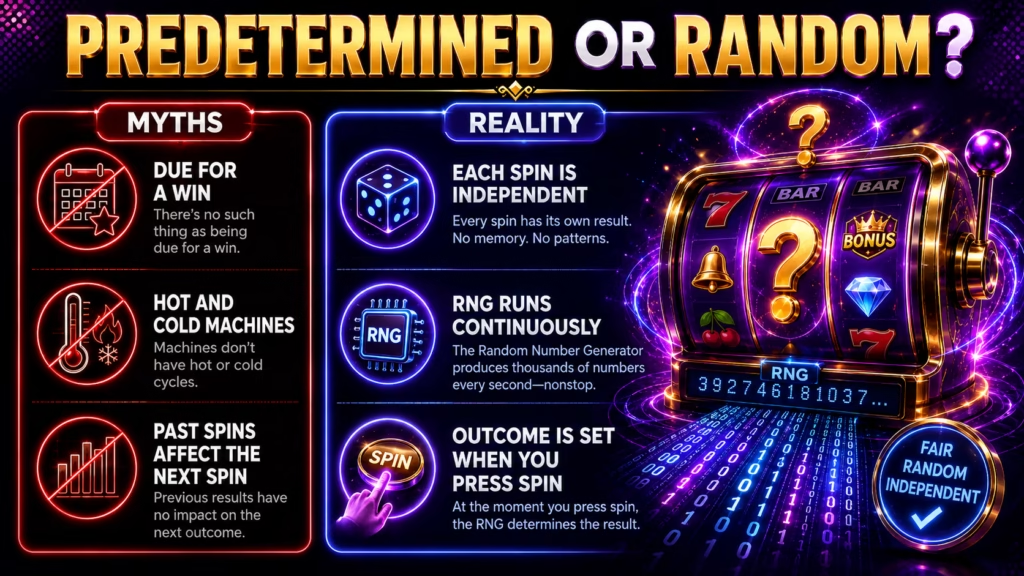
A normal RNG-based slot does not need to make the next spin better simply because you have experienced a losing streak. Each independent RNG event can produce another loss, a small win or a larger win according to the game’s mathematics.
A common mistake is assuming: “I’ve lost ten spins, so a win must be coming.”
That conclusion is a version of the gambler’s fallacy. A previous sequence does not guarantee that the next independent random event will compensate for it.
The opposite assumption is also unreliable. A large win does not automatically mean the slot must enter a period in which winning becomes impossible.
Can Casinos Change Slot Outcomes While You Play?
Players should distinguish between game configuration and manipulation of individual spins.
Depending on the game and operator, a slot may be offered with specific configurations, such as different approved RTP versions or different feature settings. The exact configuration should be checked in the game information, paytable or applicable operator documentation where available.
That is different from assuming a casino employee watches individual players and decides whether their next spin should win.
If the fairness of a specific casino or game is important, check the operator’s regulatory status, the provider information and the rules displayed for the actual version of the game being played.
Does RTP Make Outcomes Predetermined?
RTP does not dictate the result of an individual spin.
Return to Player is a theoretical long-term mathematical measure. For example, a slot with a stated RTP below 100% is designed with a long-term mathematical house advantage, but actual short sessions can vary dramatically from the theoretical figure.
One player might finish ahead after a short session. Another might experience a long sequence without a meaningful win. Neither result proves that the game’s published long-term mathematics have changed.
RTP becomes more meaningful across very large numbers of game rounds. It should never be interpreted as a promise that a player will personally receive a specific percentage of their wagers back.
Does Volatility Control When a Slot Pays?
Volatility influences the statistical character of payouts, but it does not provide a schedule of future wins.
Higher-volatility slots generally concentrate more of their potential return into less frequent or more variable payouts. Lower-volatility games generally distribute outcomes differently, often producing a smoother playing experience.
Two slots can therefore have similar RTP values while feeling completely different during play.
Volatility can help a player understand the type of experience a game is designed to produce. It cannot tell a player which spin will trigger a bonus or when a large win will occur.
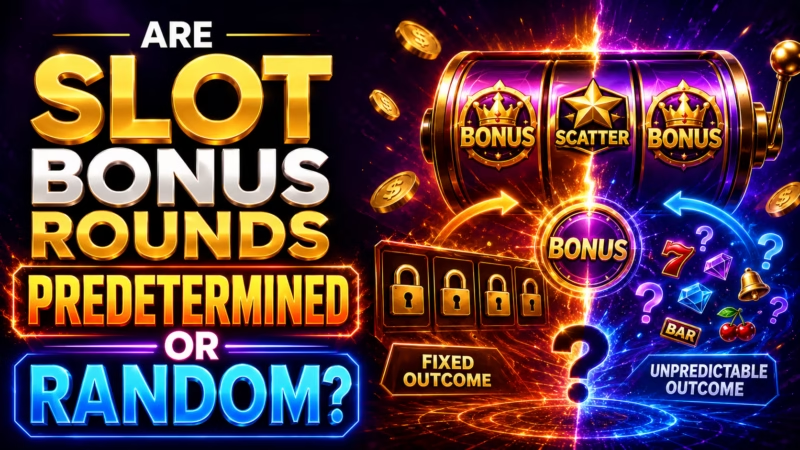
Are Bonus Rounds Predetermined?
Bonus rounds follow predefined rules, but their activation and internal outcomes may involve additional random events.
For example, a game might randomly determine:
- whether qualifying symbols land;
- which bonus modifier is selected;
- the number of free spins awarded;
- multiplier values;
- mystery symbol transformations;
- prize amounts;
- additional respins.
Other elements may be fixed once certain conditions occur.
Because bonus mechanics vary considerably between games, the exact behavior should be checked in the official game rules or paytable rather than assumed from another slot.
Are Near Misses Evidence That a Slot Is About to Pay?
A near miss does not prove that a win is approaching.
Seeing two bonus symbols followed by a third symbol landing just outside the required position can feel significant, but visually close outcomes do not create a reliable prediction of the next RNG result.
The same applies to repeated scatters, almost-completed paylines and several small wins in succession.
Players should evaluate the actual completed outcome rather than treating visual patterns as signals about future spins.
Does Changing Your Bet Change the Randomness?
Changing the bet does not normally provide a method for predicting or controlling RNG outcomes.
However, bet size can affect game rules in some slots. Certain wager levels may change jackpot eligibility, activate additional features or use different payout conditions. The exact effect depends on the individual game’s design.
That means players should check the paytable rather than assuming either of these extremes:
- increasing the bet automatically improves the chance of winning;
- bet size can never affect any game mechanic.
The important question is what the specific game’s documented rules say.
Can You Predict When a Slot Will Win?
There is no reliable strategy for predicting the next result of a properly functioning RNG-based slot from visible previous outcomes.
Patterns such as:
- five losses in a row;
- several small wins;
- a recently triggered bonus;
- a long period without free spins;
- repeated near misses;
- another player’s jackpot;
do not provide enough information to predict the next independent RNG outcome.
Betting systems may change how much money is risked, but they do not turn random slot results into predictable ones.
Common Myths About Predetermined Slot Outcomes
A slot must pay after taking enough money
A slot does not need to compensate an individual player after a particular losing amount. Long-term game mathematics operate across very large numbers of outcomes rather than balancing every short session.
The casino knows exactly when the jackpot will hit
Jackpot mechanics differ between games. Some jackpots use random triggers, while others follow specific game rules. Players should check the relevant jackpot information instead of assuming all jackpot systems work identically.
A cold slot eventually becomes hot
Terms such as “hot” and “cold” describe recent results, not a dependable forecast. A losing streak does not make a future win guaranteed.
Stopping the reels changes the result
In normal digital RNG slots, reel animations are not a reliable method of influencing the generated outcome. A stop button may shorten the animation without giving the player predictive control over the RNG.
RTP tells me how much I will get back
RTP is a long-term theoretical measure, not an individual-session refund percentage. A player’s actual result can be far above or below the theoretical RTP during a limited number of spins.
How to Evaluate a Slot Instead of Trying to Predict It
Players gain more useful information by examining a slot’s documented characteristics rather than searching for patterns in previous outcomes.
Before playing, consider checking:
- RTP – Understand the game’s theoretical long-term return and whether different versions exist.
- Volatility – Choose a payout profile that matches the level of variation you are comfortable with.
- Paytable – Check symbol values, paylines or ways to win and important restrictions.
- Bonus rules – Understand how free spins, multipliers, jackpots and other features work.
- Bet limits – Make sure the minimum and maximum wager fit a predetermined entertainment budget.
- Maximum win – Understand the game’s payout limit rather than assuming unlimited potential.
- Operator information – Use casinos appropriate to your jurisdiction and verify relevant regulatory information.
- Personal limits – Decide spending and time limits before playing instead of changing them because of a losing streak.
These factors help explain the game. None provides a guaranteed method of winning.
How This Information Was Reviewed
The distinction in this article is based on the standard separation between random individual outcomes and predetermined game mathematics such as paytables, RTP models, volatility and bonus rules.
For any specific slot, players should verify the information shown in that game’s paytable, help section or official rules because RTP versions, jackpot conditions, bonus mechanics and other configurations can differ between operators or markets.
RTP, volatility, bonus frequency and previous outcomes do not guarantee the result of a future spin. Slots should be treated as paid entertainment rather than a source of income. Setting spending and time limits before playing is more useful than trying to recover losses by increasing stakes or extending a session.
FAQ
Are slot machines predetermined?
Standard RNG-based slot outcomes are not predetermined for an individual player. The game’s mathematical rules are predefined, but the result of each valid spin is generated through the game’s randomization system.
Are slot machines random?
RNG-based slots use random number generation to select individual outcomes. The slot still follows fixed rules for payouts, RTP, reels and bonuses, so “random” refers to the outcome rather than the entire game design.
Is every spin independent?
Many standard RNG slot spins are designed as independent random events, meaning previous outcomes do not force the next spin to compensate for wins or losses. Specific bonus states or persistent features can carry information between spins, so the game’s rules should be checked when such mechanics are present.
Can a casino make me lose after I win?
A properly operated RNG game should determine results according to its game rules and randomization system rather than changing the next outcome simply because a particular player has just won. Players concerned about fairness should verify the casino’s regulatory status and the game’s published information.
Can a slot become due for a payout?
A losing streak does not make the next independent RNG spin guaranteed to win. The belief that a random game must immediately compensate for previous losses is a gambler’s fallacy.
Can you tell when a slot is about to hit a bonus?
Previous spins do not normally provide a reliable way to predict the next random bonus trigger. Repeated scatters, near misses or a long period without a feature can look meaningful without making the next bonus predictable.
Does increasing the bet improve the chance of winning?
Increasing the wager does not automatically improve the probability of winning. Some games change feature or jackpot eligibility at particular bet levels, so the exact paytable and game rules should be checked before assuming bet size affects probability.
Does RTP mean the slot eventually gives your money back?
No. RTP is a theoretical long-term percentage calculated across a very large number of wagers. It does not guarantee that an individual player will receive that percentage back during a particular session.
Are online slots more predetermined than physical slot machines?
Both online and modern electronic casino slots can use RNG-based systems, although their technical implementation may differ. The relevant question is how the specific game generates outcomes and what rules and regulatory requirements apply to it.
Can any strategy predict the next slot spin?
No betting pattern can reliably predict the next properly randomized slot outcome from previous visible spins. A strategy can control wager size and bankroll exposure, but it cannot guarantee wins or reveal the next RNG result.
Short Conclusion
Slot machine outcomes are random within predetermined mathematical rules. The paytable, RTP, volatility, reel structure and bonus logic are designed in advance, while individual RNG-based spin results are not scheduled according to whether a player has recently won or lost.
That is why losing streaks, near misses, previous bonuses and betting patterns should not be treated as signals of an upcoming win. Check the specific game’s rules, understand its RTP and volatility, set limits before playing and treat slots as entertainment rather than a way to make money.