A jackpot contribution rate is the percentage of qualifying bets that is allocated to a progressive jackpot meter. The higher the contribution rate, the faster the jackpot can grow when betting volume stays the same. The lower the rate, the more wagering activity is required to add the same amount to the prize pool.
For example, if a progressive jackpot uses a 1% contribution rate, every $100 in qualifying wagers would contribute $1 to the jackpot meter. At a 0.5% rate, the same $100 of qualifying wagers would contribute $0.50. This is a simplified example because real jackpot systems may divide contributions between different prize tiers, reserve funds or other accounting components.
Key points:
- A higher progressive jackpot contribution rate generally produces faster meter growth at the same wagering volume.
- Betting volume can matter just as much as the percentage. A heavily played game with a small rate may grow faster than a lightly played game with a larger rate.
- The displayed jackpot increase may not equal the full contribution deducted from wagers because progressive systems can allocate funds differently.
- Jackpot contribution affects the economics of the progressive prize, but it does not tell a player when the jackpot will be won.
- Contribution rates should not be treated as a strategy for predicting wins. Jackpot outcomes remain governed by the game rules and random outcome system.
Understanding contribution rates is most useful when comparing progressive jackpot structures or trying to understand why one jackpot meter climbs much faster than another.
What Is a Jackpot Contribution Rate?
The jackpot contribution rate is the share of eligible wagering that feeds a progressive jackpot or related jackpot pool.
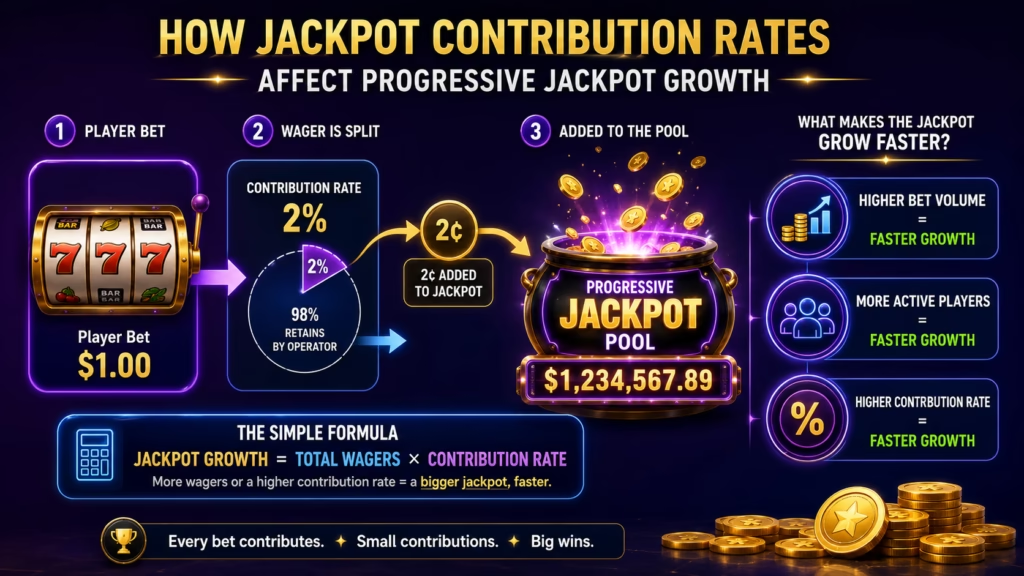
A simplified formula is:
Jackpot contribution = Qualifying wagers × Contribution rate
If players collectively make $50,000 in qualifying wagers and the progressive jackpot contribution rate is 1%, the theoretical contribution would be:
$50,000 × 0.01 = $500
The jackpot meter could therefore receive $500 under a simple one-pool structure.
Real systems can be more complicated. A contribution may be divided between a visible jackpot, secondary prizes, seed funding, reserve accounts or multiple jackpot tiers. For that reason, the exact rules of a specific progressive game should be checked before assuming that the entire percentage flows directly into the displayed top prize.
How Contribution Rates Affect Progressive Jackpot Growth
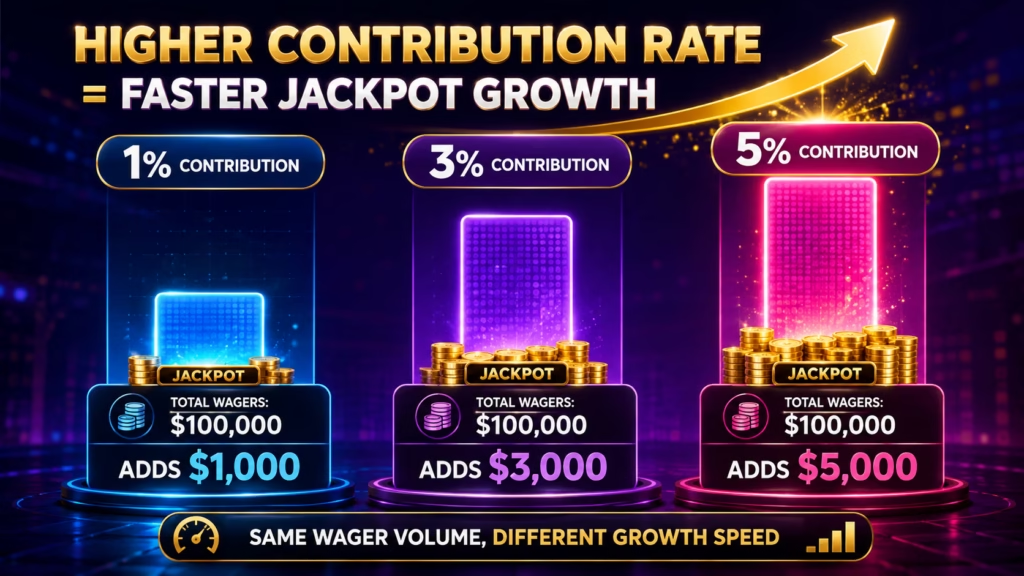
A progressive jackpot grows when qualifying wagers add money to its prize pool. The contribution rate determines how much each unit of eligible betting contributes.
Consider two progressive systems receiving identical wagering volume:
| Progressive Jackpot | Contribution Rate | Qualifying Wagers | Simplified Contribution |
| Jackpot A | 0.5% | $100,000 | $500 |
| Jackpot B | 1.0% | $100,000 | $1,000 |
| Jackpot C | 2.0% | $100,000 | $2,000 |
Under these simplified conditions, Jackpot C grows four times as quickly as Jackpot A because its contribution rate is four times higher.
This does not mean Jackpot C is automatically a better game for players. The contribution rate is only one component of a game’s mathematics. RTP, jackpot probability, base-game payouts, bonus mechanics and jackpot rules can all influence the overall experience.
Contribution Rate vs Jackpot Growth Rate
The contribution rate and jackpot growth rate are related but they are not the same thing.
The contribution rate is normally expressed as a percentage of qualifying wagering. Jackpot growth rate describes how quickly the prize actually increases over time.
A useful simplified relationship is:
Jackpot growth per period = Qualifying wagering volume × Contribution rate
Suppose one game receives $1 million in qualifying wagers per day with a 0.5% contribution rate:
$1,000,000 × 0.005 = $5,000 per day
Another game receives only $100,000 per day but has a 2% contribution rate:
$100,000 × 0.02 = $2,000 per day
The first jackpot grows faster despite having the lower contribution percentage because its betting volume is much higher.
This explains why highly popular networked progressives can accumulate large prizes quickly even when the contribution percentage itself is relatively modest.
Betting Volume Can Matter More Than the Percentage
A progressive jackpot contribution rate cannot be evaluated without considering wagering volume.
A jackpot connected to many casinos or a large network of machines may receive contributions from a much larger pool of players. Even a small amount from each qualifying wager can become substantial when thousands or millions of wagers are combined.
A local progressive connected to only a handful of games may have a larger contribution rate but still grow slowly because far less money passes through the system.
When comparing jackpot growth, consider three variables together:
- Contribution percentage
- Total qualifying wagering volume
- Number of connected games or players
Ignoring any one of these can produce a misleading impression of how quickly a jackpot should increase.
Local vs Wide-Area Progressive Jackpots
Local and networked jackpots can behave very differently because the number of contributing wagers differs.
Local Progressive Jackpots
A local progressive usually receives contributions from a limited group of machines, games or players within one casino or operator environment.
The jackpot may therefore rise more slowly unless the games receive heavy play or use a relatively high contribution rate.
Wide-Area or Networked Progressives
A networked progressive can pool qualifying wagering from multiple games, casinos or jurisdictions, depending on how the system is structured.
Because the wagering base can be much larger, a network jackpot may increase quickly even when the contribution from each individual wager is small.
The important distinction is that jackpot size alone does not reveal the contribution rate. A very large jackpot can result from high wagering volume, accumulated time, seed values and the structure of the progressive network.
Does the Full Contribution Go to the Visible Jackpot?
Not necessarily. A stated or theoretical jackpot contribution does not always mean the same percentage appears immediately on the visible meter.
A progressive system may allocate money to several purposes, such as:
- the current top jackpot;
- smaller jackpot tiers;
- a reserve or reset pool;
- funding for the jackpot’s starting value;
- other progressive prize components.
Imagine that 1% of qualifying wagers is allocated to a jackpot system. The operator or game rules could divide that percentage between the current meter and another pool used to fund the next jackpot after the existing one is won.
The exact arrangement depends on the game’s mathematics and rules. Players should therefore avoid assuming that meter movement alone reveals the complete progressive contribution structure.
What Is a Jackpot Seed Amount?
The seed amount is the starting value of a progressive jackpot after the previous jackpot has been won and reset.
For example, a progressive jackpot might restart at $100,000 rather than zero. Contributions from subsequent qualifying wagers then build the jackpot above that starting level.
The relationship can be represented as:
Current jackpot = Seed amount + accumulated meter contributions
A large seed can make a jackpot look substantial immediately after a reset, while a high contribution rate determines how quickly it grows beyond that starting point.
Seed amount and contribution rate should therefore be treated as separate features.
Contribution Rates in Multi-Tier Jackpots
Some progressive games contain multiple jackpot levels, often with names such as Mini, Minor, Major and Grand.
In a multi-tier system, contributions do not necessarily flow equally to every prize. One tier may receive a greater share while another prize may use a different trigger or funding structure.
For example, a hypothetical 2% overall progressive allocation could theoretically be divided between several jackpot pools rather than being sent entirely to the Grand jackpot.
The exact percentages should be confirmed in official game rules or technical information where available. Players should not infer the distribution simply by watching how quickly each meter changes.
How Jackpot Contribution Can Interact With RTP
Progressive jackpot funding can be part of a game’s overall mathematical return structure, but the relationship between jackpot contributions and RTP depends on the specific game.
If part of a wager funds a progressive prize, that jackpot component may form part of the theoretical return available through the game. However, a player should not assume that a higher contribution rate automatically means higher RTP.
Two games can have different combinations of:
- base-game RTP;
- progressive jackpot return;
- bonus feature return;
- jackpot probability;
- contribution structure.
The total theoretical RTP must be checked from reliable game information where available.
RTP is also a long-term statistical measure. It does not predict what will happen during an individual session or indicate when a progressive jackpot is due to hit.
Why Some Jackpot Meters Grow Much Faster Than Others
Different progressive jackpot meters can grow at dramatically different speeds because their contribution systems and betting activity are different.
The biggest factors usually include:
Contribution Rate
A greater percentage of qualifying wagering produces more jackpot funding per dollar wagered, all else being equal.
Number of Players
A progressive used by more players receives more total wagering and can accumulate contributions more rapidly.
Average Bet Size
Higher average qualifying wagers increase the monetary value generated by the same percentage contribution.
Network Size
A jackpot connected to many games or casinos may have far more betting volume than a standalone progressive.
Jackpot Allocation Structure
Some contributions may be divided among multiple prizes or reserve funds rather than appearing entirely on the main meter.
Because these variables interact, watching the meter for a few minutes is not enough to determine the exact contribution rate.
Can You Calculate a Contribution Rate From Meter Movement?
It may be possible to estimate a progressive jackpot contribution rate if both the exact qualifying wagering volume and meter increase are known, but casual observation is usually insufficient.
A simplified estimate would be:
Contribution rate = Jackpot increase ÷ Qualifying wagers
For example, if verified qualifying wagering totaled $20,000 while the jackpot increased by $100:
$100 ÷ $20,000 = 0.005, or 0.5%
This calculation works only if the entire relevant contribution is reflected directly in the observed meter and no other funding adjustments are involved.
Reserve pools, multiple jackpot tiers, delayed meter updates, seed funding and other rules can make a real progressive system more complicated.
Does a Higher Contribution Rate Improve Your Chance of Winning?
No. A higher jackpot contribution rate does not automatically increase the probability that an individual wager will win the progressive jackpot.
Contribution rate describes how money is added to the jackpot pool. Jackpot probability describes how the prize is triggered.
These are separate mathematical characteristics.
A game could theoretically have a fast-growing jackpot with a very rare jackpot trigger, or a slower-growing jackpot with a different probability structure.
Players interested in jackpot odds should check the game’s rules where probability information is available rather than using meter growth as a substitute.
Does a Faster-Growing Jackpot Become More Likely to Hit?
A larger or faster-growing jackpot is not necessarily more likely to be won on the next spin.
In many progressive games, eligible outcomes remain random and the current meter value does not make a normal random jackpot “due.” Some jackpot systems can use specific threshold, must-hit-by or other special mechanics, but those rules must be explicitly part of the game.
Do not assume that a jackpot that has been growing for a long time must pay soon.
Past meter growth does not by itself predict the next random result.
Contribution Rate vs House Edge
Jackpot contribution rate and house edge measure different things.
Jackpot contribution rate describes how much qualifying wagering is allocated toward a progressive prize system.
House edge describes the casino’s theoretical long-term mathematical advantage under the rules of the game.
A 1% jackpot contribution does not automatically mean the house edge is 1%. The rest of the game’s paytable, base prizes, bonuses and jackpot payouts must also be included in the mathematical model.
This distinction matters because contribution percentage cannot be used by itself to judge whether a game offers a higher or lower theoretical return.
Common Misconceptions About Progressive Jackpot Contributions
A Higher Contribution Rate Means Better RTP
Not necessarily. RTP depends on the entire payout model, not only the amount routed into the jackpot.
A Fast-Growing Jackpot Is About to Hit
Fast growth mainly indicates substantial contributions, which may come from a high rate, heavy wagering volume or both. It does not normally predict the next jackpot result.
Every Dollar Added to the Progressive Is Visible
Not always. Some systems may fund multiple jackpot tiers, reserves or reset amounts.
A Large Jackpot Must Have a High Contribution Rate
Not necessarily. A large jackpot can result from massive betting volume, a large network, a high seed value or long accumulation.
Contribution Rates Can Be Used as a Winning Strategy
They cannot reliably predict individual outcomes. Progressive jackpot games remain games of chance, and contribution data should be used to understand the game’s structure rather than to forecast wins.
What to Check When Comparing Progressive Jackpots
Players comparing progressive games should look beyond the headline jackpot amount.
Useful information includes:
- current jackpot value;
- jackpot starting or seed amount;
- whether the progressive is local or networked;
- qualifying bet requirements;
- jackpot trigger rules;
- RTP, where disclosed;
- whether RTP includes the progressive component;
- number of jackpot tiers;
- contribution information, if published;
- maximum and minimum qualifying bets;
- jackpot eligibility restrictions.
The most important information should come from the official game rules, paytable or operator terms. If the contribution percentage is not published, it is better to treat it as unknown than to estimate it from incomplete observations.
Practical Example of Progressive Jackpot Growth
Assume a hypothetical progressive game receives $2 million in qualifying wagering during one week.
At a 0.25% contribution rate:
$2,000,000 × 0.0025 = $5,000
At a 0.5% contribution rate:
$2,000,000 × 0.005 = $10,000
At a 1% contribution rate:
$2,000,000 × 0.01 = $20,000
The example shows why relatively small percentage differences can create substantial differences once wagering volume becomes large.
It also shows why percentage figures should be interpreted in context. Without knowing the wagering volume, the contribution rate alone does not reveal how many dollars the meter will gain in a day, week or month.
How This Information Was Reviewed
Jackpot contribution rates are best evaluated through the mathematical relationship between qualifying wagering, contribution percentage, jackpot funding and the rules governing the progressive system.
For a specific game, players should verify the paytable, jackpot eligibility requirements, RTP information and progressive rules because implementations can differ between games and operators.
RTP, jackpot size and contribution rates are long-term mathematical characteristics. They do not guarantee a particular result or predict when a jackpot will be won.
Progressive jackpot games should be treated as entertainment rather than a way to generate income. Set spending and time limits before playing, and stop if gambling is no longer enjoyable or affordable.
FAQ
What is a progressive jackpot contribution rate?
A progressive jackpot contribution rate is the percentage of qualifying wagering allocated to a progressive prize pool. For example, a 1% contribution would equal $1 for every $100 in qualifying wagers under a simple single-pool model.
How does jackpot contribution rate affect jackpot growth?
A higher jackpot contribution rate increases the amount added to the jackpot from the same wagering volume. However, actual growth also depends heavily on how much qualifying money is wagered and how the jackpot system allocates contributions.
Is a 1% jackpot contribution rate high?
There is no universal percentage that should automatically be considered high or low because progressive structures vary. The percentage needs to be evaluated alongside wagering volume, jackpot size, seed value, RTP and the number of jackpot tiers.
Does the entire contribution percentage go into the displayed jackpot?
Not necessarily. Some progressive systems may divide funding among the current meter, secondary jackpots, reserve pools or reset funding. The specific game’s rules are needed to determine the exact allocation.
Can jackpot contribution rate change a game’s RTP?
The progressive component can be part of a game’s overall theoretical return, but the effect depends on the complete mathematical model. A higher contribution percentage by itself does not prove that a game has a higher RTP.
Can I calculate the jackpot contribution rate myself?
You can estimate it by dividing jackpot growth by verified qualifying wagering, but the estimate may be inaccurate if contributions are split between pools or if the displayed meter does not show the complete allocation.
Does a higher contribution rate mean better jackpot odds?
No. Contribution rate determines how money enters the progressive pool, while jackpot probability determines how the prize is triggered. A larger contribution rate does not automatically improve the chance of winning on an individual wager.
Why do networked progressive jackpots grow so quickly?
Networked jackpots can grow quickly because qualifying wagers may be pooled from many games, casinos or players. Large wagering volume can generate rapid meter growth even when the percentage contributed by each wager is relatively small.
Is a rapidly growing jackpot more likely to pay soon?
Not necessarily. In a standard random progressive system, faster growth does not make the next wager more likely to trigger the jackpot. Special systems such as threshold-based or must-hit-by jackpots can operate differently, so their individual rules should be checked.
Should players choose games based on contribution rate?
Contribution rate can help explain jackpot growth, but it should not be the only selection criterion. Players should also consider RTP, jackpot rules, qualifying bet requirements, volatility and their entertainment budget. No contribution structure guarantees a win.
Brief Conclusion
The jackpot contribution rate determines how much qualifying wagering is allocated to a progressive jackpot system. A higher percentage produces faster growth when wagering volume is equal, but real jackpot growth also depends on player activity, average wagers, network size, seed values and how contributions are distributed.
Contribution rate explains how a jackpot is funded. It does not reveal when the jackpot will hit, does not guarantee better RTP and should not be used to predict random outcomes. For any specific progressive game, check the official paytable and jackpot rules before drawing conclusions from the displayed meter.