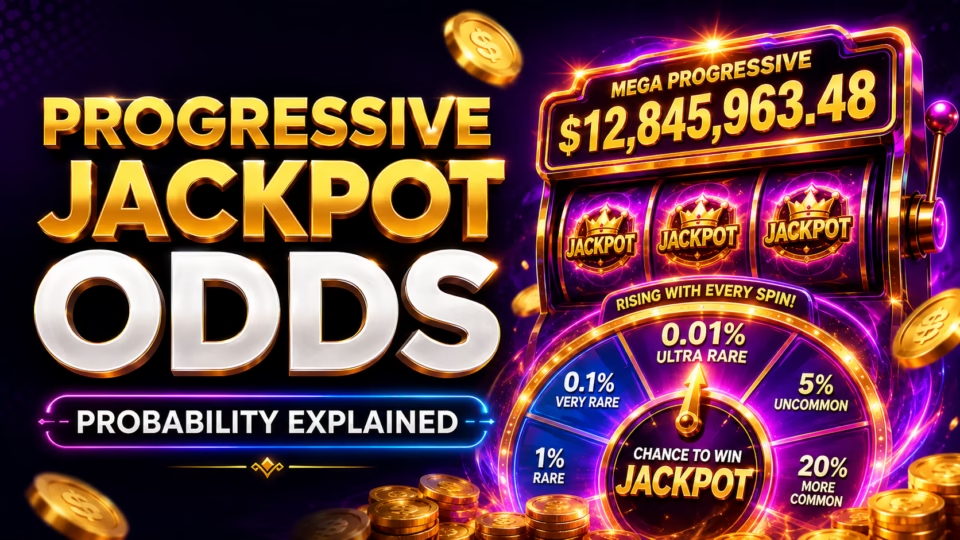
Progressive jackpot odds describe the probability of winning a jackpot whose prize increases as qualifying bets are placed. The exact odds can range from difficult to extremely difficult, and there is no universal probability for all progressive games. Jackpot frequency depends on the game’s mathematical model, trigger mechanism, eligibility rules, and sometimes the size or type of bet.
The most important point is simple: a growing jackpot does not normally mean the jackpot is becoming easier to win. Unless the game rules specifically use a changing probability model, each eligible round follows the probability defined by that game.
Quick takeaways
- Progressive jackpot odds are specific to each game or jackpot network.
- A displayed jackpot amount does not reveal the probability of winning it.
- Previous losses generally do not make the next eligible spin more likely to hit.
- Some jackpots require a specific bet, side wager, or stake level for eligibility.
- RTP and jackpot probability describe different parts of a game’s mathematics.
Progressive jackpots are mainly relevant to players who accept a very small chance of a very large prize. Players working with a limited bankroll should be particularly careful because chasing a jackpot can lead to many losing rounds without materially changing the probability of the next result.
What Are the Odds of Winning a Progressive Jackpot?
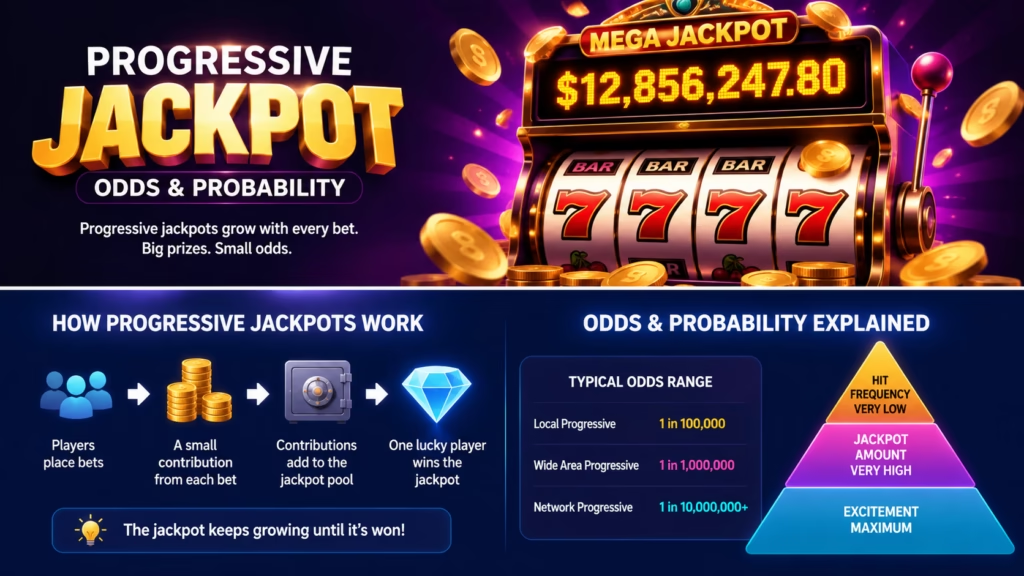
The odds of winning a progressive jackpot depend entirely on the rules and mathematical design of the specific game. One progressive jackpot might theoretically trigger once in hundreds of thousands of qualifying rounds, while another could have odds measured in millions or tens of millions to one. These figures are examples of scale, not universal jackpot odds.
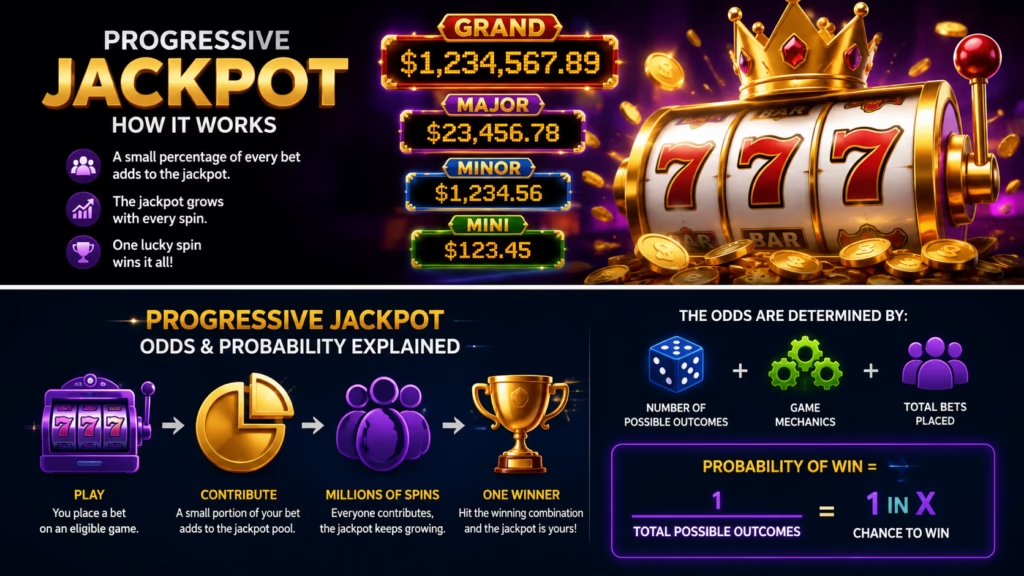
If a provider publishes the jackpot probability, the simplest form looks like this:
Probability per eligible round = 1 ÷ number of possible qualifying outcomes
For example, hypothetical odds of 1 in 5,000,000 mean:
1 ÷ 5,000,000 = 0.0000002
Converted to a percentage:
0.00002% per eligible round
That probability is extremely small, even though someone somewhere on a large jackpot network may eventually win.
The exact odds of winning a progressive jackpot should therefore be checked in the game rules, help screen, paytable, or official provider documentation when available. If the probability is not published, the jackpot amount alone cannot be used to calculate it reliably.
How Progressive Jackpot Probability Works
Progressive jackpot probability is determined by the game’s underlying mathematical model rather than by how long an individual player has been playing. In a properly functioning random game, earlier results do not create a personal sequence that makes a jackpot “due.”
Consider a hypothetical jackpot with a constant probability of 1 in 10,000,000 per eligible spin.
| Eligible spins | Approximate chance of at least one jackpot |
| 1 | 0.00001% |
| 10,000 | 0.10% |
| 100,000 | 1.00% |
| 1,000,000 | 9.52% |
These figures illustrate cumulative probability, not a promise that a jackpot will appear within any number of spins.
For a jackpot with probability p on every independent eligible round, the probability of hitting it at least once within n rounds is:
P = 1 – (1 – p)^n
This formula explains an important distinction. Playing more eligible rounds increases the cumulative chance that a jackpot occurs somewhere within those rounds, but it does not necessarily make the next individual round more likely to win.
Does a Bigger Progressive Jackpot Improve Your Odds?
A larger progressive jackpot usually changes the potential prize, not the probability of triggering it. If the underlying jackpot probability remains constant, a $10 million jackpot can have exactly the same trigger probability per qualifying round as the same jackpot at $2 million.
What may change as the jackpot grows is the mathematical value attached to a successful jackpot outcome. This can affect theoretical return calculations, but it does not automatically mean the game becomes favorable or that a player has discovered a profitable opportunity.
Some progressive systems use more complicated rules. A must-hit-by jackpot, for example, is configured so that the prize must be awarded before reaching a specified upper amount. The probability model can differ from a conventional fixed-probability progressive. Players should not assume how the chance changes without checking the specific rules.
Types of Progressive Jackpots and How Their Odds Differ
The term progressive jackpot covers several different formats, and each format can use a different probability model.
Standalone progressives
A standalone progressive is connected to one game or machine. Bets on that game contribute to the prize pool according to its configuration.
A smaller network does not automatically mean easier odds. Jackpot probability is determined by the game’s mathematics rather than simply by the number of participating players.
Local progressives
Local progressives link several games or machines within a casino, website, or limited network.
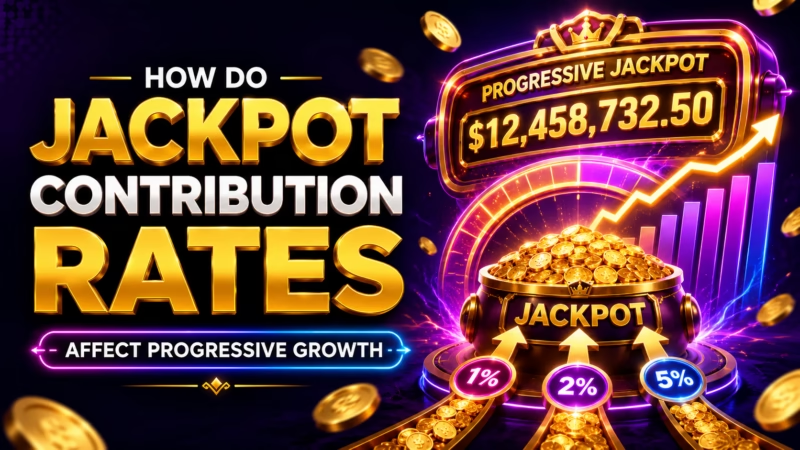
More participating games can make the jackpot appear to grow more quickly because more qualifying wagers are feeding the pool. Faster growth does not by itself change the probability attached to one player’s eligible round.
Wide-area or networked progressives
Networked progressive jackpots can connect large numbers of games across multiple operators or locations.
Because many players may be generating eligible rounds, a network jackpot can be won more frequently somewhere across the whole network even while the odds for one individual qualifying round remain extremely small.
Mystery progressives
A mystery jackpot is generally awarded through a separate trigger rather than through an obvious winning symbol combination.
The trigger may operate within a defined jackpot range or according to another mathematical mechanism. Exact mystery jackpot odds cannot safely be inferred simply by watching previous payouts.
Must-hit-by jackpots
A must-hit-by progressive must award the prize before it reaches a stated upper threshold.
This creates a different structure from an unrestricted progressive jackpot. However, the displayed distance from the upper limit is not enough to calculate exact odds unless the game’s probability rules are also known.
Does Bet Size Affect Progressive Jackpot Odds?
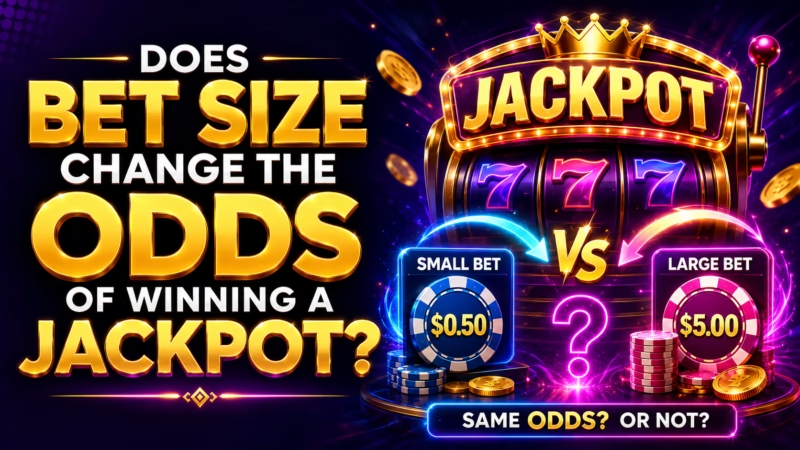
Bet size affects progressive jackpot eligibility in some games, but not all games use the same rules. A progressive may require the maximum bet, a particular number of paylines, a separate jackpot wager, or simply any qualifying paid round.
Three common configurations are possible:
- Bet size changes eligibility. A player must meet a minimum condition before the jackpot can be won.
- Bet size changes the jackpot probability. Some game designs can give different qualifying chances at different wager levels.
- Bet size does not change the probability. Every eligible bet receives the same jackpot chance.
Players should therefore check the actual rules rather than assuming that betting more improves the odds. Increasing a wager solely because a jackpot feels close can increase financial exposure without providing the expected probability advantage.
Progressive Jackpot Odds vs RTP
Progressive jackpot odds and RTP are not the same measurement. Jackpot odds describe how likely the jackpot trigger is, while RTP represents the theoretical proportion of total wagers returned to players across a very large number of game rounds under the game’s mathematical model.
A progressive game’s RTP may include a contribution from jackpot payouts. That does not mean a typical player will receive the advertised RTP during one session.
For example, a game can allocate a small part of its theoretical return to a very rare jackpot. Players who never hit that jackpot can experience results very different from the game’s long-term theoretical average.
This is one reason RTP should not be interpreted as a prediction of short-term results.
Can You Calculate Progressive Jackpot Odds Yourself?
You can calculate progressive jackpot probability when the provider gives you the actual chance of triggering the jackpot. Without that information, estimating exact odds from a short sample of observed results is generally unreliable.
If published odds are 1 in X, the probability of one eligible round is:
p = 1 / X
If you want the chance of winning at least once over multiple independent eligible rounds:
P = 1 – (1 – p)^n
Suppose a hypothetical jackpot has odds of 1 in 2,000,000.
The probability per eligible round is:
1 / 2,000,000 = 0.00005%
The chance over 10,000 eligible rounds would be approximately:
1 – (1 – 1/2,000,000)^10,000 ≈ 0.499%
Even thousands of attempts can therefore leave the cumulative probability very low when the jackpot itself is extremely rare.
Expected Spins Do Not Tell You When a Jackpot Will Hit
If the jackpot probability is constant at p, the mathematical expected number of eligible rounds before a jackpot is 1/p. This is a long-run statistical average, not a countdown.
For theoretical odds of 1 in 5,000,000, the expected value is five million eligible rounds. That does not mean the jackpot must occur after five million rounds.
It could occur immediately. It could also fail to occur within five million rounds.
This distinction is essential because random probability does not create a schedule for individual jackpot wins.
Common Progressive Jackpot Myths
“The jackpot has not paid for a long time, so it is due”
A long period without a jackpot does not normally make the next independent round more likely to win. This belief is a form of the gambler’s fallacy.
“A huge jackpot must be close to hitting”
Jackpot size and jackpot probability are different variables. A larger prize does not prove that the next trigger is more likely unless the game’s rules specifically create that relationship.
“Betting the maximum always gives better odds”
Some jackpots require a maximum or additional wager, but others do not. The eligibility and probability rules should be checked before increasing the stake.
“Playing at a quiet time improves the odds”
Time of day does not normally improve the probability assigned to an eligible random outcome. A network may process fewer total rounds during quiet periods, but that does not automatically make an individual round more favorable.
“A recently won jackpot cannot hit again soon”
Independent jackpot systems can theoretically produce another winning trigger immediately after a previous jackpot. The previous result does not necessarily create a waiting period unless the rules explicitly say otherwise.
How to Evaluate a Progressive Jackpot Game
A progressive jackpot should be evaluated using more than the advertised prize amount.
Before playing, check:
- whether every paid round is jackpot eligible;
- whether a minimum or maximum bet is required;
- whether an additional jackpot wager is necessary;
- whether several jackpot levels use different triggers;
- whether the jackpot odds are published;
- whether the jackpot is standalone, local, or networked;
- the game’s stated RTP and whether different RTP configurations exist;
- the base-game paytable and bonus rules;
- any country or operator restrictions affecting jackpot eligibility.
The key practical rule is to separate jackpot size from jackpot probability. A spectacular headline prize can make a game look more attractive without telling you anything about how difficult the jackpot is to win.
Progressive Jackpots and Bankroll Risk
Progressive jackpots should be treated as entertainment with a small probability of a very large payout, not as a reliable way to make money.
The jackpot can create a strong temptation to continue playing because every losing round may feel like progress toward an eventual win. Mathematically, that interpretation is usually incorrect for independent random outcomes.
Set spending and time limits before playing, and avoid increasing stakes in an attempt to recover losses or chase a growing jackpot. If gambling stops feeling recreational or becomes difficult to control, stopping play is more important than pursuing another qualifying round.
How This Information Was Reviewed
This explanation evaluates progressive jackpots through probability, eligibility rules, trigger mechanisms, cumulative probability, RTP, and common player misconceptions.
Exact progressive jackpot odds should always be verified in the individual game’s rules, paytable, help section, or provider documentation because jackpot mathematics can differ between games and operators. RTP, jackpot size, previous results, and the number of rounds already played do not guarantee a future outcome.
Progressive casino games should be treated as entertainment. No probability formula can predict the next random jackpot result or guarantee that a particular player will win.
FAQ
What are the typical odds of winning a progressive jackpot?
There are no universal progressive jackpot odds. Each game has its own mathematical model, and the probability can differ dramatically between standalone, local, networked, mystery, and must-hit-by jackpots. Check official game information when exact odds are available.
Are progressive jackpot odds worse than regular jackpot odds?
Not necessarily. “Progressive” describes how the prize grows, not automatically how difficult it is to win. A progressive jackpot can have different odds from a fixed jackpot, but the exact comparison requires the probability rules for both games.
Does playing more spins increase my chances of winning a progressive jackpot?
Playing more eligible rounds increases the cumulative probability of experiencing a jackpot across all those rounds. However, if every round has the same independent probability, playing more does not make the next individual round more likely to win than the previous one.
Does betting more increase progressive jackpot odds?
Only if the game’s rules say it does. Some progressives require a certain wager for eligibility, while others provide the same jackpot probability to every qualifying bet. Check the paytable or jackpot rules before assuming a larger stake improves your chance.
Can a progressive jackpot become mathematically worth playing when it gets large?
A growing jackpot can increase the theoretical value of the jackpot component, but determining the complete expected return requires accurate information about jackpot probability, game RTP, bet requirements, and other payouts. A large displayed prize alone is not enough to conclude that a game is profitable.
Can a progressive jackpot hit twice in a row?
Yes, it can be mathematically possible if each jackpot trigger is independent and the game rules do not impose another restriction. A jackpot that has just been won does not automatically prevent another winning trigger soon afterward.
Is a progressive jackpot more likely to hit when it is close to its maximum?
Not for a conventional progressive with constant trigger probability. A must-hit-by jackpot is different because it must award before a specified ceiling, but the exact probability at any displayed amount depends on the particular jackpot system.
Can previous jackpot results be used to predict the next win?
Previous results generally cannot predict the next independent random jackpot outcome. A history of jackpots may describe what happened in the past, but it does not reveal a reliable pattern for the next eligible round.
How do I find the exact odds of winning a progressive jackpot?
Check the game’s rules, help screen, paytable, provider documentation, or jackpot terms. If exact probabilities are not published, do not assume that jackpot size, payout history, or observed spins provide enough information to calculate the true odds.
In short
Progressive jackpot odds are determined by the specific game’s mathematical model, not by how large the prize looks or how long it has been since the last win. The most reliable way to understand a progressive jackpot is to check its eligibility rules, trigger method, published probability, and RTP information separately. More play increases exposure to the jackpot but does not guarantee a win or make an independent random outcome “due.” Progressive jackpots should therefore be approached as entertainment with strict spending limits, not as a predictable way to make money.