A community jackpot is a casino prize system in which multiple eligible players are connected to the same jackpot event. Depending on the rules, one player may trigger the jackpot while other active or qualified players receive part of the prize, or the jackpot may be distributed among a wider group of participants. There is no single universal community jackpot format, so the exact trigger, eligibility rules and prize distribution must be checked for each game or casino.
The main difference from a conventional jackpot is participation. A standard jackpot normally awards the qualifying prize to one player. A community jackpot can involve multiple players in the same event, which creates a shared jackpot experience rather than an entirely individual result. Official implementations vary considerably. Reflex Gaming, for example, describes community bonuses in which active players can participate in a shared event but receive individual winnings, while AGS uses community jackpot functionality that can produce shared wins across a table.
Quick takeaways:
- A community jackpot connects multiple eligible players to one jackpot system or event.
- The player who triggers the event does not necessarily receive the entire prize.
- Some community jackpots split a pool, while others give separate awards to participating players.
- Eligibility may depend on active play, qualifying games, stakes, tickets or other conditions.
- Community jackpots remain games of chance. Participation does not guarantee that you will receive a jackpot award.
Community jackpots usually appeal to players who like progressive prizes and shared bonus events. Players with limited budgets should pay particular attention to qualifying stakes and avoid increasing bets simply to pursue a jackpot.
How Do Community Jackpots Work?
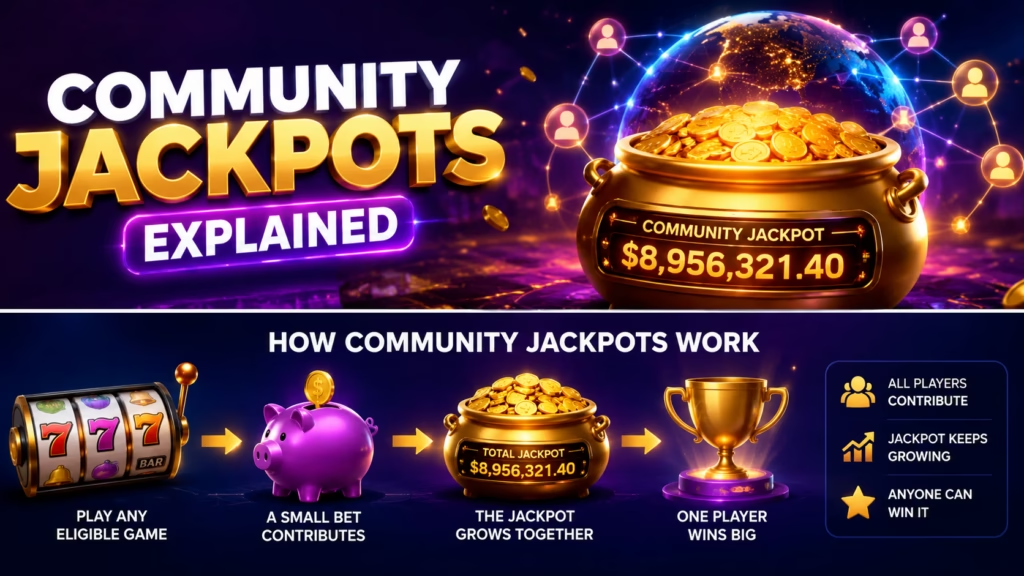
Community jackpots work by linking eligible players to a common jackpot mechanism and defining rules for when the event triggers and who receives an award. The system may operate across several slot machines, online games, tables or an entire group of qualifying games.
A typical community jackpot follows four stages:
- Players qualify for the jackpot. Qualification may require playing an eligible game, remaining active, placing a qualifying wager or collecting entries.
- The jackpot grows or approaches its trigger. Some community jackpots are progressive, while others use fixed amounts or predetermined trigger conditions.
- A jackpot event occurs. The event may be triggered randomly, by a particular game outcome, by a jackpot meter reaching a threshold or according to another rule defined by the operator.
- The prize is distributed. One player may receive the largest portion while other qualified players receive smaller shares, or every eligible participant may receive an individually calculated award.
A current example is bet365’s Dual Drop system. Its Community Jackpot operates through qualifying play and a prize draw that takes place when the Community Jackpot reaches a specified value. This demonstrates why players should not assume that every community jackpot is triggered by landing a particular symbol combination.
Who Actually Wins a Community Jackpot?
Who wins a community jackpot depends entirely on the distribution rules.
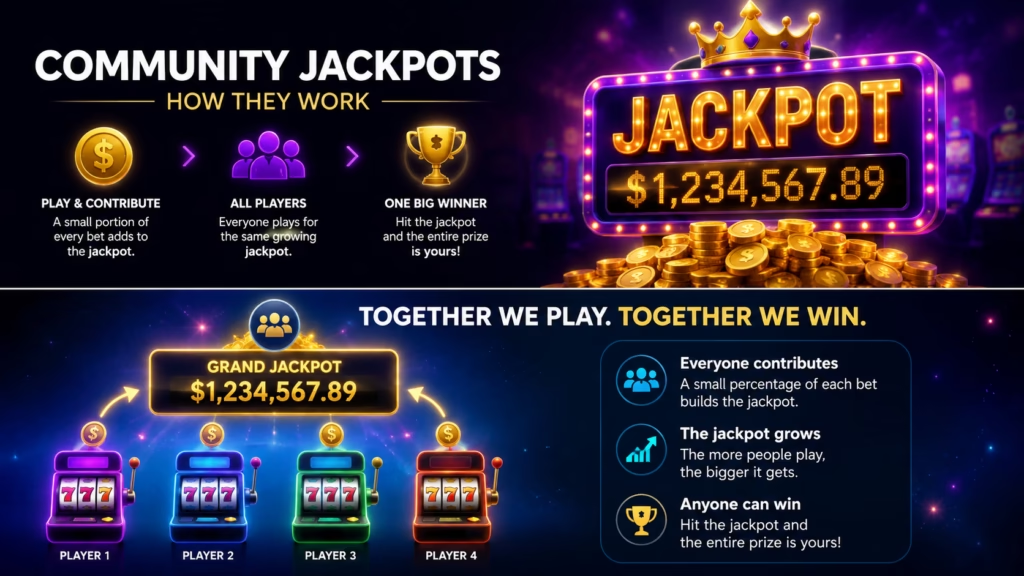
In one common format, a primary winner triggers the event and receives the largest share, while other eligible players receive smaller community awards. In another format, the jackpot can be divided among everyone who qualifies for the winning event. Bingo provides clear examples of this model. Loto-Québec describes a community progressive jackpot where the main winner receives a defined share and other qualifying players share the remainder.
Other systems work differently. Reflex Gaming states that its community bonus winnings are individual to each player rather than simply dividing one identical payout among everyone. Only active players are eligible for that particular community feature.
This distinction matters because the term community jackpot describes a category of mechanics rather than one standardized payout formula.
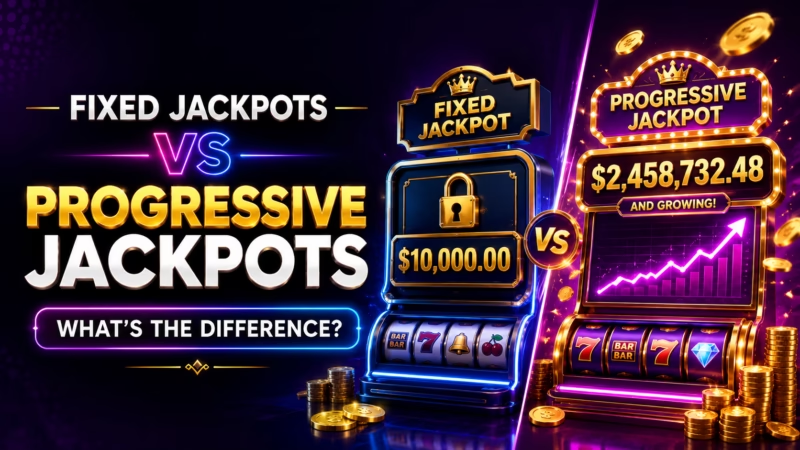
Community Jackpot vs Regular Jackpot
A regular jackpot and a community jackpot can use similar jackpot meters, but the way players participate is different.
| Feature | Community Jackpot | Regular Jackpot |
| Players involved | Potentially multiple eligible players | Usually one winning player |
| Prize distribution | May be shared or individually awarded | Usually paid to the triggering player |
| Trigger | Depends on the system | Depends on the game |
| Progressive meter | Possible | Possible |
| Eligibility requirements | Often important | Usually defined by the individual game |
| Shared event | Common | Usually absent |
The most important point is that community does not automatically mean progressive. A community feature explains how players participate or receive prizes. A progressive feature explains how a jackpot value changes, usually by increasing until it is awarded.
A jackpot can therefore be both community-based and progressive, but the two terms are not interchangeable.
Community Jackpot vs Network Progressive Jackpot
A network progressive jackpot connects multiple games or machines to a common progressive prize pool, but that does not necessarily make it a community jackpot.
Wide-area progressive systems demonstrate the difference. IGT operates progressive jackpots linked across gaming environments, allowing many participating machines to contribute to major jackpot systems. The eventual top jackpot can still be awarded primarily to a single qualifying winner.
A community jackpot focuses more specifically on shared participation or shared rewards. Multiple players may benefit when the community event occurs.
In simple terms:
Network progressive: many players can contribute to or compete for the same jackpot.
Community jackpot: multiple eligible players may participate in or receive rewards from the same jackpot event.
Some systems combine both ideas.
What Types of Community Jackpots Are There?
Shared-Pool Community Jackpots
A shared-pool jackpot divides an available prize among multiple qualifying players. The player responsible for triggering the jackpot may receive a larger percentage, while the remaining amount is divided among other participants.
The exact percentages should always be checked in the official jackpot rules.
Community Bonus Jackpots
A community bonus activates a bonus event for multiple active players. Each player’s final reward may be different rather than being a simple equal split of one jackpot.
Reflex Gaming provides an example where a community bonus can be triggered while multiple active players participate, but the individual player’s award is not simply a shared fraction of another player’s win.
Table Game Community Jackpots
Community jackpots are not limited to slots. AGS describes progressive technology capable of linking table games and supporting community jackpot play with shared wins across a table.
This means blackjack, roulette, baccarat or other eligible table formats can potentially use community-style jackpot systems when the platform supports them.
Threshold or Draw-Based Community Jackpots
Some community jackpots trigger once a meter reaches a defined amount rather than when one specific reel combination lands.
For example, bet365 states that its Community Jackpot prize draw takes place when the jackpot reaches its specified threshold. Players accumulate eligibility according to the system’s terms.
Do All Players Receive the Same Community Jackpot Prize?
No. Community jackpot prizes do not have to be equal.
A jackpot may use:
- equal distribution;
- percentage-based distribution;
- a large main prize plus smaller community prizes;
- individually generated bonus awards;
- separate prize tiers;
- eligibility-based distributions.
The game rules should explain exactly how the payout is calculated. Never assume that seeing a £100,000, €100,000 or $100,000 community meter means every participating player can receive that amount.
The displayed jackpot can represent the total pool, the largest available award or another value defined by the system.
Do You Have to Be Playing When the Jackpot Hits?
Many community systems require the player to be active or otherwise qualified when the jackpot event occurs, but the definition of eligible play varies.
Reflex Gaming explicitly states that only active players qualify for its Community Bonus. Other systems can use tickets, qualifying wagers, specific games or promotional entry requirements.
Before playing, check:
- which games are eligible;
- whether you must opt in;
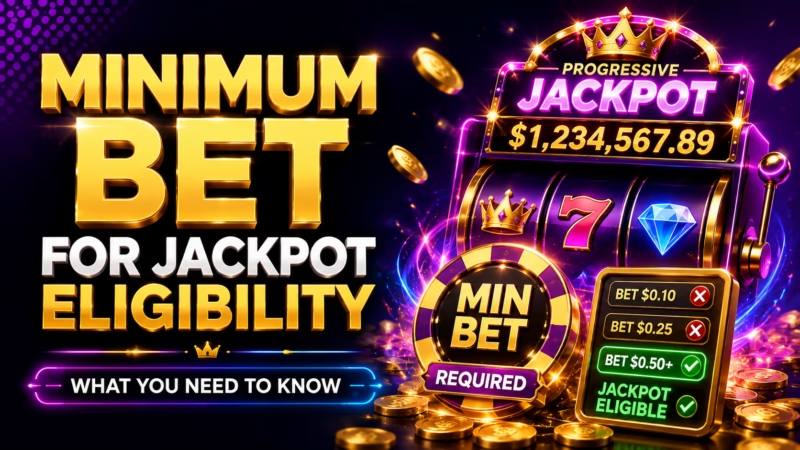
- the minimum qualifying wager;
- what counts as active play;
- whether qualification expires;
- how the jackpot is triggered;
- how winnings are distributed.
These details matter more than the size of the jackpot meter because failing an eligibility condition can mean that a player does not participate in the event.
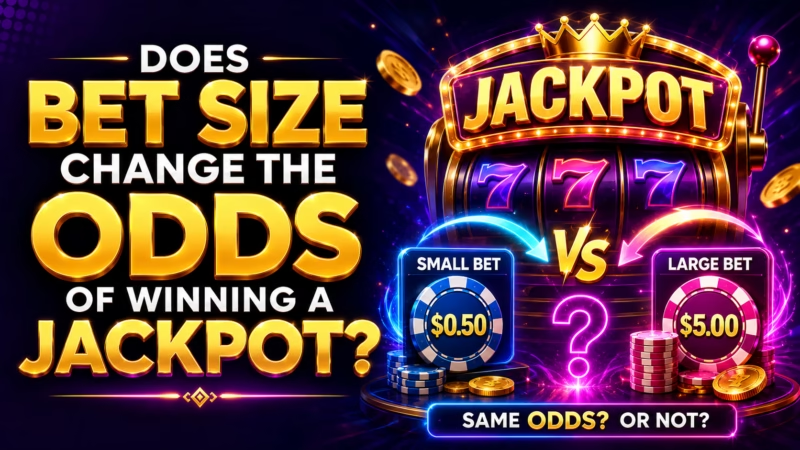
Does Betting More Increase Your Chance of a Community Jackpot?
Not necessarily.
Some jackpot systems use stake-dependent eligibility or award more entries for certain qualifying activity, while others allow qualification at multiple stake levels. Reflex Gaming, for example, states that its Community Bonus can trigger at any stake level within its specified communities.
The correct approach is to check the rules rather than assume a larger wager produces better jackpot odds.
Increasing your stake solely because a jackpot appears close to triggering can increase the amount of money at risk without guaranteeing a better result.
Are Community Jackpots Random?
Many community jackpot systems contain random elements, but not every community jackpot uses the same trigger.
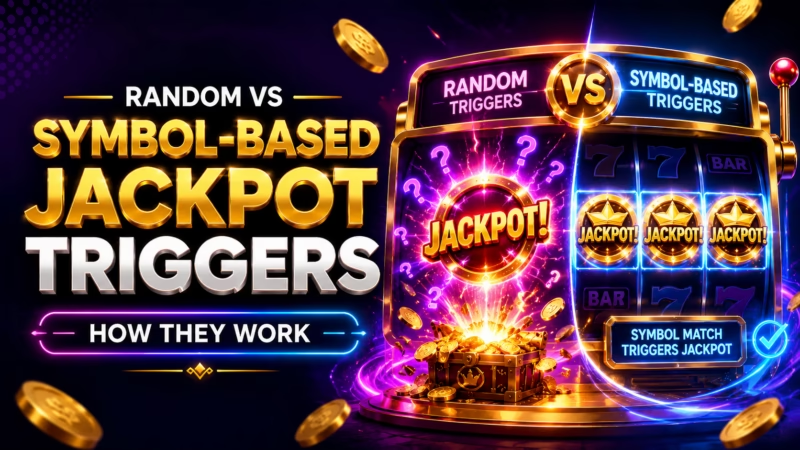
A jackpot might be triggered by:
- a random selection;
- a qualifying symbol or game result;
- a progressive meter reaching a threshold;
- a bonus event;
- a scheduled or timed mechanism;
- a combination of qualification and random selection.
The exact method should be stated in the official game rules or jackpot terms.
A visible meter should not be interpreted as a prediction of when a particular player will win. Even when a jackpot must trigger under certain conditions, that does not tell an individual player which spin, game or participant will receive the main award.
Do Community Jackpots Affect RTP?
A jackpot feature can form part of a game’s overall mathematical return structure, but players should not assume that every community jackpot changes RTP in the same way.
RTP, or Return to Player, describes the theoretical proportion of wagers returned over a very large number of plays. It does not predict the result of a short session. For jackpot games, part of the theoretical return may be connected to jackpot prizes, but the exact structure depends on the game.
Check the game’s official paytable or information screen for:
- stated RTP;
- whether multiple RTP configurations exist;
- jackpot contribution rules;
- qualifying bet requirements;
- jackpot payout structure.
Two games with similar community jackpots can have different mathematical models.
How to Evaluate a Community Jackpot Before Playing
1. Check the eligibility rules
Find out exactly what qualifies you for the community jackpot. A large jackpot has little practical relevance if the required game, bet or participation condition does not suit you.
2. Check how the prize is divided
Determine whether the displayed amount goes to one primary winner, several players or an entire eligible community.
3. Check the trigger
A threshold-based draw, random jackpot, symbol-triggered progressive and community bonus can behave very differently.
4. Check the stake requirements
Avoid assuming that the highest available bet provides the best value. Only use a stake that fits a predetermined entertainment budget.
5. Check the game RTP and rules separately
The jackpot is only one part of the game. Base-game payouts, bonus features, volatility and RTP also influence the overall playing experience.
Common Community Jackpot Myths
“Everyone gets the advertised jackpot”
Usually not. The displayed amount may be divided according to a specific formula or may represent the maximum or main community award.
“The player who triggers it keeps everything”
Not necessarily. Shared payouts are one of the defining possibilities of community jackpot systems.
“A bigger bet always gives better jackpot odds”
This depends on the rules. Some systems have stake-based qualification while others allow participation across multiple bet levels.
“A jackpot that has grown large is due to hit”
A large progressive amount does not by itself tell you when a random jackpot will trigger. Previous spins do not provide reliable information about the next random outcome.
“Community jackpots are only found in slots”
No. Community jackpot technology can also be used with table games, bingo and other gaming formats. AGS, for example, offers community jackpot functionality for linked table-game environments.
How This Information Was Reviewed
Community jackpots were evaluated according to their trigger mechanism, player eligibility, prize distribution, progressive structure and differences from conventional jackpots. Official examples from gaming providers and operators show that there is no universal community jackpot formula.
Players should therefore verify the paytable, jackpot rules, qualifying stakes and operator terms for the specific game they intend to play. RTP, jackpot size and bonus mechanics describe mathematical or structural characteristics of a game, but none guarantees a winning session.
Casino games should be treated as paid entertainment rather than a way to generate income. Set spending and time limits before playing, and stop if gambling is no longer recreational.
FAQ
What is a community jackpot?
A community jackpot is a jackpot system that connects multiple eligible players to the same prize event. Depending on the rules, the jackpot may be split among several players, one player may receive the main award while others receive smaller prizes, or participating players may receive separate individual awards.
How do community jackpots work?
Community jackpots work by defining a group of eligible players, a jackpot trigger and a method for distributing prizes. Qualification can depend on active play, eligible games, wagers, entries or other conditions, so the exact mechanics must be checked for each jackpot.
Does everyone win when a community jackpot is triggered?
Not always. Some community jackpots reward all qualifying players, while others reward only selected participants or give one main winner a larger prize. The jackpot terms determine who receives a payout.
Are community jackpots progressive?
Some are, but a community jackpot does not have to be progressive. “Community” describes how players participate in or share the jackpot event, while “progressive” describes a jackpot whose value can increase until it is won.
Can community jackpots be won on online slots?
Yes. Community jackpot mechanics can be integrated into online casino games as well as land-based gaming systems. Eligibility, available games and payout rules depend on the operator and software platform.
Is a community jackpot the same as a network jackpot?
No. A network jackpot links multiple games or machines to one jackpot system, while a community jackpot involves shared participation or rewards. A jackpot can use both mechanics at the same time.
Do higher bets improve community jackpot odds?
Only if the specific jackpot rules make qualification or entries dependent on stake size. Some systems allow players to participate at several stake levels, so betting more should never be assumed to increase the chance of winning.
Can you predict when a community jackpot will trigger?
Random community jackpots cannot be reliably predicted from previous results. Some systems have defined thresholds or scheduled draws, but knowing the trigger condition still does not necessarily reveal which eligible player will receive the main prize.
Does a community jackpot guarantee a prize if I am active?
No. Being active generally means you may qualify for the community event, not that a particular prize is guaranteed. Eligibility and payout rules vary between systems.
What should I check before playing a community jackpot game?
Check the qualifying games, minimum stake, opt-in requirements, trigger method, prize distribution, jackpot value, RTP and official game rules. These details show what the displayed jackpot actually represents and whether the format suits your budget.
In short
A community jackpot turns a conventional individual jackpot into a shared gaming event, but there is no single rule for how the prize must be distributed. Some systems split one pool, some reward a main winner plus other players, and others calculate separate community awards.
The most important step is to check how the specific jackpot qualifies players, triggers and pays out before playing. A large community jackpot can make a game more engaging, but it does not improve the predictability of random outcomes or guarantee a return. Treat jackpot games as entertainment and play within fixed limits.