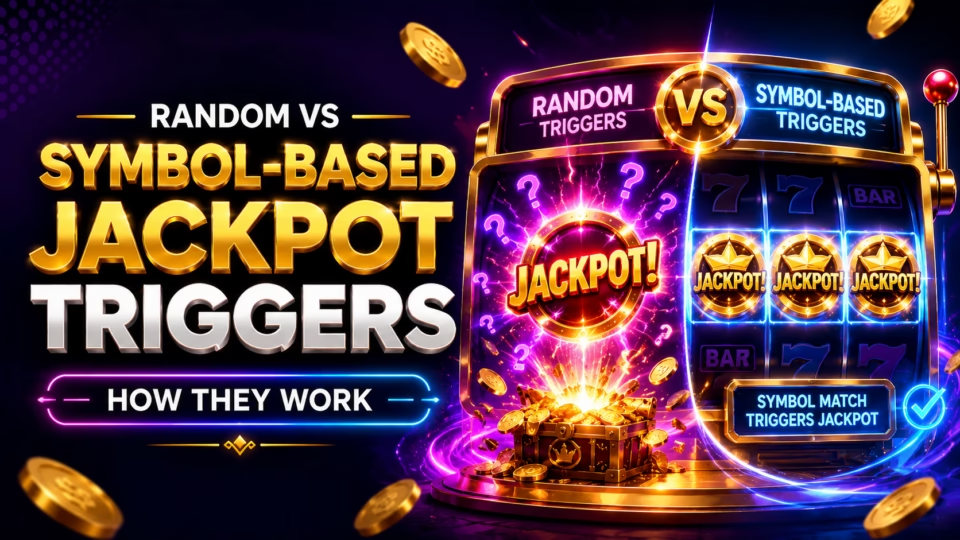
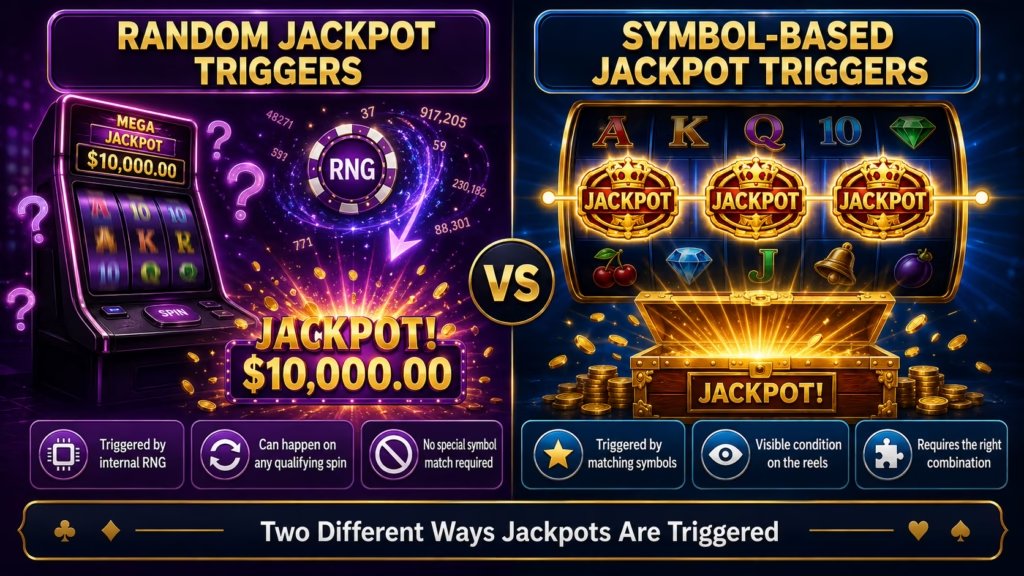
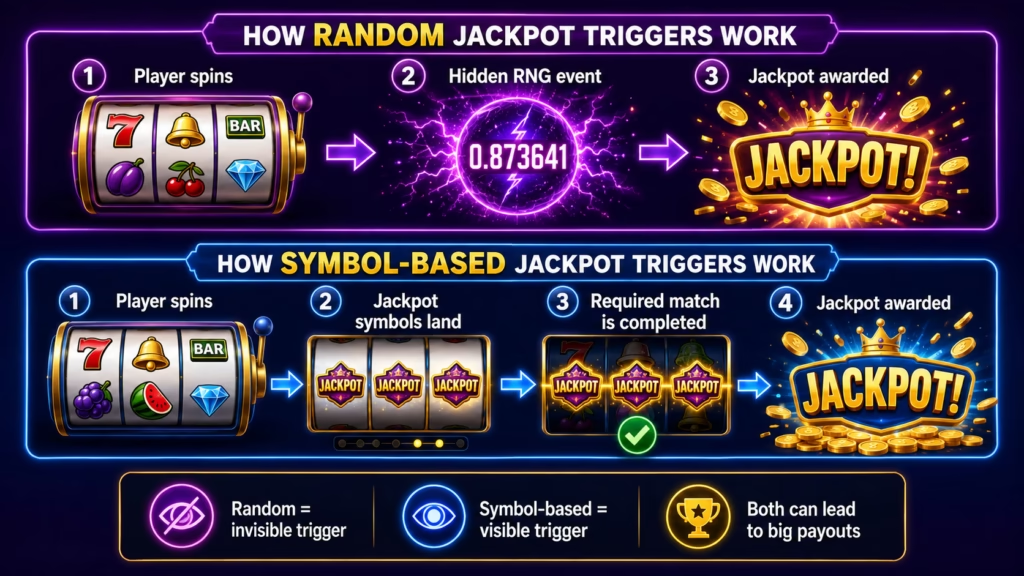
A random jackpot trigger awards or activates a jackpot through a separate random event, while a symbol-based jackpot trigger requires a specific symbol, combination, or reel condition to appear. The main difference is what causes the jackpot event: an independent random selection or a visible result on the reels.
Both systems can be used for fixed or progressive jackpots, and neither gives players a reliable way to predict when the next jackpot will occur. The exact trigger rules depend on the individual game.
Key points:
- Random jackpots are usually triggered independently of the normal winning symbol combinations.
- Symbol-based jackpots require defined symbols or reel conditions.
- A random jackpot can sometimes activate after an ordinary-looking spin.
- A symbol-based jackpot gives players a visible trigger condition to watch for.
- Neither jackpot trigger type makes the next jackpot predictable.
Players who like transparent bonus mechanics may prefer symbol-based triggers because the requirement is visible. Players who enjoy unexpected jackpot events may find random triggers more appealing. In either case, the jackpot should be treated as an entertainment feature rather than a strategy for making money.
What Is a Random Jackpot Trigger?
A random jackpot trigger is a jackpot mechanism in which an eligible spin can activate a jackpot through a random event that is separate from the normal symbol combination shown on the reels.
For example, a player might complete a spin that produces no unusual jackpot symbols, yet the game can still initiate a jackpot sequence. The triggering decision is handled by the game’s underlying system rather than by a predetermined visible combination such as five jackpot symbols.
This does not mean every wager necessarily has identical jackpot eligibility. A game may impose conditions such as:
- minimum qualifying bet;
- specific game mode;
- eligible base-game spins;
- particular jackpot level requirements;
- casino or network-specific rules.
The exact conditions should therefore be checked in the game’s rules or paytable.
How Does a Random Jackpot Trigger Work?
A random jackpot normally involves two separate processes: determining the ordinary spin result and determining whether an eligible jackpot event occurs.
A simplified example looks like this:
1. The player starts an eligible spin.
2. The game’s RNG determines the relevant game outcomes.
3. The jackpot system checks whether its triggering condition has been met.
4. If the jackpot trigger occurs, the game awards the jackpot directly or starts a separate jackpot feature.
5. If it does not occur, the normal spin continues according to the game’s standard rules.
The precise technical implementation can differ between games. Players should not assume that every random jackpot uses exactly the same mathematical model.
Most importantly, previous spins do not tell a player that a random jackpot is “due.” A long period without a jackpot does not by itself prove that the next spin has a higher probability of triggering one.
What Is a Symbol-Based Jackpot Trigger?
A symbol-based jackpot trigger requires a specified symbol pattern, number of jackpot symbols, or other visible reel condition to occur before the jackpot is awarded or a jackpot feature begins.
A simple example would be a game requiring five special jackpot symbols on an active result. Another game might require special symbols to land on certain reels or collect enough jackpot-related symbols during a feature.
Unlike a random trigger, the trigger condition is connected directly to something the player can see in the game result.
Symbol-based jackpot conditions can include:
- a required number of jackpot symbols;
- special symbols on particular reels;
- jackpot symbols appearing on a defined payline;
- a full set of special symbols;
- collected jackpot symbols reaching a specified target;
- a qualifying symbol combination during bonus play.
The actual requirement varies by game and should always be verified in the official rules.
Random Jackpot vs Symbol-Based Jackpot
The most useful way to compare random jackpot vs symbol-based jackpot mechanics is to look at how the trigger is determined rather than at the size of the prize.
| Feature | Random Jackpot Trigger | Symbol-Based Jackpot Trigger |
| Main trigger | Separate random event | Defined symbol or reel condition |
| Visible before trigger | Usually no | Usually yes |
| Depends on jackpot symbols | Not necessarily | Usually |
| Can activate after ordinary-looking spin | Yes | Usually not |
| Predictable from previous spins | No | No |
| Eligibility conditions possible | Yes | Yes |
| Can be progressive | Yes | Yes |
| Can have multiple jackpot levels | Yes | Yes |
Neither format is automatically more generous. A game’s jackpot probability, jackpot contribution, RTP structure and prize values depend on its mathematical design rather than simply on whether the trigger is random or symbol-based.
Example of a Random Jackpot Trigger
Imagine a slot with a four-level progressive jackpot.
An eligible player makes a normal spin. The reels stop without forming a jackpot-specific combination, but the game suddenly opens a jackpot feature. The underlying jackpot system selected that spin as a qualifying event.
The player may then receive one of the available jackpot levels according to the game’s rules.
In this example, looking for particular symbols would not help predict the jackpot because the visible reel combination was not the direct trigger.
This is why random jackpots can sometimes feel more unexpected than symbol-based jackpots.
Example of a Symbol-Based Jackpot Trigger
Imagine another slot in which the Grand Jackpot requires five Grand symbols to appear during a bonus feature.
Four Grand symbols do not award the Grand Jackpot. The fifth required symbol must appear before the defined feature ends.
In this case, the trigger is transparent because the player can see the required symbols and understand what condition must be completed.
However, seeing four symbols does not mean the fifth symbol is guaranteed to arrive. Unless the rules specifically say otherwise, players should not assume that an almost-completed jackpot combination makes the remaining symbol certain.
Which Jackpot Trigger Type Is Easier to Understand?
Symbol-based jackpot triggers are generally easier to follow visually because players can see the symbols or conditions required for the jackpot.
A player may immediately understand a rule such as “land five jackpot symbols” without knowing anything about the underlying probability.
Random jackpots are less visually obvious. The player can understand that an eligible spin may trigger the jackpot, but there may be nothing on the reels that shows how close a spin was to winning it.
That difference affects presentation, not predictability. Visible jackpot symbols do not provide a reliable forecasting tool unless the game’s rules explicitly include some form of persistent collection or guaranteed progression.
Are Random Jackpots Completely Independent of the Reels?
A random jackpot can be independent of the visible reel combination, but that does not necessarily mean it is independent of every aspect of the game.
A random trigger may still be limited to qualifying wagers, eligible spins or specific modes. Some games can also use more complicated hybrid systems in which a random process and reel-based conditions interact.
For this reason, “random jackpot” should not automatically be interpreted as “every possible spin has exactly the same jackpot probability.”
The game’s paytable and rules are the correct place to verify eligibility.
Can a Jackpot Use Both Random and Symbol-Based Triggers?
Yes. A slot can combine multiple jackpot trigger types within the same game.
For example, one jackpot level could be awarded for collecting a specific group of symbols while another jackpot level is triggered randomly. A game could also use symbols to enter a jackpot feature and then use a random process to determine which prize is awarded.
Hybrid designs are important because labels such as “jackpot slot” do not tell you exactly how every jackpot level works.
Players should check each jackpot level separately rather than assuming Mini, Minor, Major and Grand prizes all use the same trigger mechanism.
Does Bet Size Affect Jackpot Triggers?
Bet size can affect jackpot eligibility or probability in some games, but it does not do so universally.
A jackpot slot may use one of several models. A minimum bet might be required for jackpot eligibility, higher stakes might alter the effective jackpot probability, or all eligible bets might participate under the same basic trigger rules.
There is therefore no safe general rule that betting more makes a jackpot “more likely.”
Before playing, check:
- whether all bet sizes qualify;
- whether maximum bet is required;
- whether jackpot probability changes with stake;
- whether all jackpot levels are available at every stake;
- whether different bet configurations have different RTP values.
Increasing a wager purely because a jackpot feels close is not a reliable strategy.
Do Random and Symbol-Based Jackpots Affect RTP Differently?
The trigger type alone does not determine RTP. RTP depends on the complete mathematical model of the game, including ordinary wins, bonus features and any jackpot contribution included in the theoretical return.
Two slots could use different jackpot triggers while having similar overall RTP values. Conversely, two symbol-based jackpot games can have substantially different mathematical profiles.
Progressive jackpots can make RTP particularly important to interpret correctly because part of the theoretical return may be associated with a rare jackpot prize.
RTP is a long-term statistical measure. It does not predict what one player will receive during a specific session.
Are Symbol-Based Jackpots More Likely to Hit When Symbols Almost Land?
No. Near-miss jackpot symbols do not prove that a jackpot is becoming more likely.
A player might repeatedly see two jackpot symbols when three are required or four symbols when five are required. Those visual results can create the impression that the jackpot is approaching, but the next result remains governed by the game’s underlying mechanics.
The exception is a feature explicitly designed around persistent progress. For example, if qualifying symbols remain collected between spins according to the rules, progress can genuinely matter to that feature.
Without such a rule, visual closeness should not be interpreted as evidence that a jackpot is due.
Is a Random Jackpot More Likely After a Long Dry Period?
A long period without a jackpot does not by itself mean a random jackpot must trigger soon.
This misunderstanding is related to the gambler’s fallacy, the belief that previous random outcomes force a different outcome to occur next.
If a jackpot system evaluates eligible events independently, a long sequence without a jackpot does not create a debt that the game must repay on the next spin.
There can be exceptions in games using explicitly disclosed mechanics such as guaranteed thresholds or persistent meters. Those features should be judged by their actual rules rather than by assumptions about random jackpots generally.
How to Check Which Jackpot Trigger a Game Uses
The fastest way to identify a jackpot trigger is to read the game’s help screen, paytable or jackpot rules.
Look for wording explaining exactly what activates each prize.
For a random jackpot, descriptions may indicate that a jackpot can be triggered randomly during eligible play. For a symbol-based jackpot, the rules should specify the required symbols, positions, collections or combinations.
Pay particular attention to:
1. Eligibility: Which spins and stakes qualify?
2. Trigger: What exactly starts or awards the jackpot?
3. Jackpot levels: Do different prizes use different triggers?
4. Progressive rules: Is the prize fixed or linked to a growing jackpot pool?
5. Bet requirements: Does stake size affect eligibility or probability?
6. Bonus restrictions: Can the jackpot trigger in both the base game and bonus features?
7. RTP information: Is the jackpot included in the stated theoretical return?
If the rules do not clearly answer these questions, do not assume the mechanic works like another slot with a similar appearance.
Which Jackpot Trigger Type Is Better?
Neither random nor symbol-based jackpot triggers are inherently better. The choice mainly depends on the type of game experience a player prefers.
Random jackpot triggers may suit players who:
- like unexpected bonus events;
- do not need a visible collection mechanic;
- prefer jackpots that can potentially appear during otherwise ordinary eligible play.
Symbol-based jackpot triggers may suit players who:
- want to understand the trigger visually;
- enjoy collecting or landing special symbols;
- prefer clearly defined bonus conditions.
The trigger mechanism should not be used as evidence that one game offers better value. RTP, volatility, jackpot probability, prize structure and betting requirements are separate characteristics.
Common Jackpot Trigger Myths
“A random jackpot is due after enough losing spins”
Not necessarily. Previous losses do not automatically make the next eligible spin more likely to trigger a random jackpot.
“Two jackpot symbols mean the third is getting closer”
Not necessarily. A near miss is not evidence that the required final symbol will appear soon unless the rules include persistent progression.
“Maximum bet always gives the best jackpot chance”
This depends entirely on the game. Some jackpots have stake-related conditions while others use different eligibility structures.
“Symbol-based jackpots are less random”
Symbol-based jackpots still rely on the game’s underlying random outcome generation. The player can see the required trigger, but seeing the requirement does not make the result controllable.
“Random jackpots cannot have visible jackpot symbols”
A game can display jackpot imagery or symbols even when a particular jackpot is triggered separately. Visual design alone does not define the underlying mechanism.
How This Information Was Reviewed
The comparison between random and symbol-based jackpot triggers is based on the functional distinction between an independent jackpot event and a jackpot activated through defined symbol or reel conditions.
Individual games can use different mathematical implementations, hybrid trigger systems, eligibility requirements and jackpot levels. For that reason, the exact paytable, help screen and game rules should be checked before drawing conclusions about a specific slot.
RTP, volatility, jackpot size and trigger type do not guarantee a particular result. Casino games involve financial risk, and jackpot slots should be treated as entertainment rather than a source of income. Set spending and time limits before playing and stop if gambling stops being enjoyable.
FAQ
What is the difference between a random jackpot and a symbol-based jackpot?
A random jackpot is triggered by a separate random event during eligible play, while a symbol-based jackpot requires specified symbols or reel conditions. Both mechanisms remain subject to the game’s underlying rules and random outcome generation.
What are the main jackpot trigger types?
The two common categories are random triggers and symbol-based triggers, although games can also use collection mechanics, bonus-feature triggers and hybrid systems. A single slot may use different trigger methods for different jackpot levels.
Can a random jackpot trigger on any spin?
A random jackpot may trigger on an eligible spin without requiring a specific visible combination, but not every spin is necessarily eligible. Minimum bets, game modes or other conditions can apply, so the rules should be checked.
Do jackpot symbols mean a jackpot is about to hit?
No. Seeing jackpot symbols or repeated near misses does not normally mean a jackpot is about to occur. Persistent progress matters only when the game rules explicitly state that symbols or other progress carry forward.
Are random jackpots easier to win than symbol-based jackpots?
Not necessarily. Trigger type alone does not reveal jackpot probability. A random-trigger game can have a rarer jackpot than a symbol-based game, or vice versa.
Can different jackpots in the same slot use different triggers?
Yes. A game can use a symbol requirement for one jackpot and a random trigger for another. Mini, Minor, Major and Grand prizes should therefore be checked individually in the game rules.
Does betting more increase the chance of triggering a jackpot?
It depends on the game. Some jackpot systems have stake-related eligibility or probability rules, while others do not. Never assume a larger wager improves jackpot chances unless the game’s rules explicitly say so.
Are symbol-based jackpots predictable?
No. A visible trigger makes the requirement easier to understand, but it does not make the next result predictable. The required symbols must still occur according to the game’s mechanics.
Does RTP tell me how often a jackpot will trigger?
No. RTP describes theoretical long-term return and does not directly tell you jackpot hit frequency. Two games with similar RTP values can distribute their returns very differently.
Can a jackpot be guaranteed after enough spins?
Only if the specific game explicitly contains a disclosed guaranteed threshold or similar mechanic. A standard random or symbol-based jackpot should not be assumed to become guaranteed simply because it has not appeared for a long time.
In short
Random jackpot vs symbol-based jackpot describes two different ways of activating a jackpot. Random jackpots can trigger through a separate random event during eligible play, while symbol-based jackpots require a defined visible reel condition. Neither system makes jackpots predictable or guarantees better odds. Check the game’s paytable for eligibility, bet requirements and the trigger rules for each jackpot level, and treat jackpot play as entertainment rather than a way to make money.