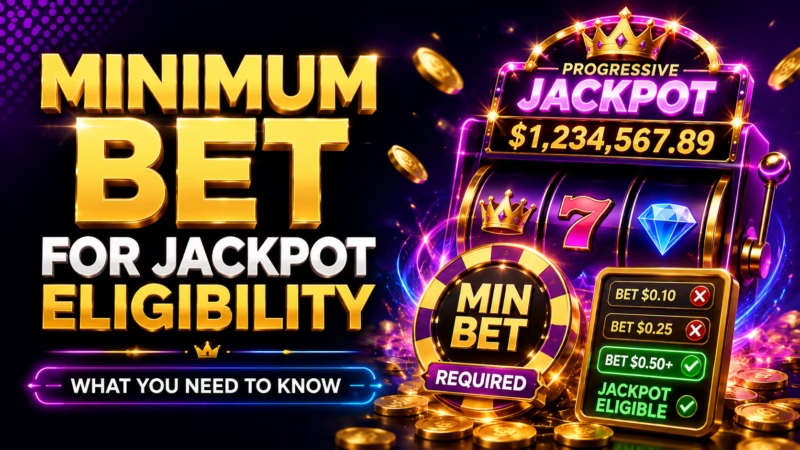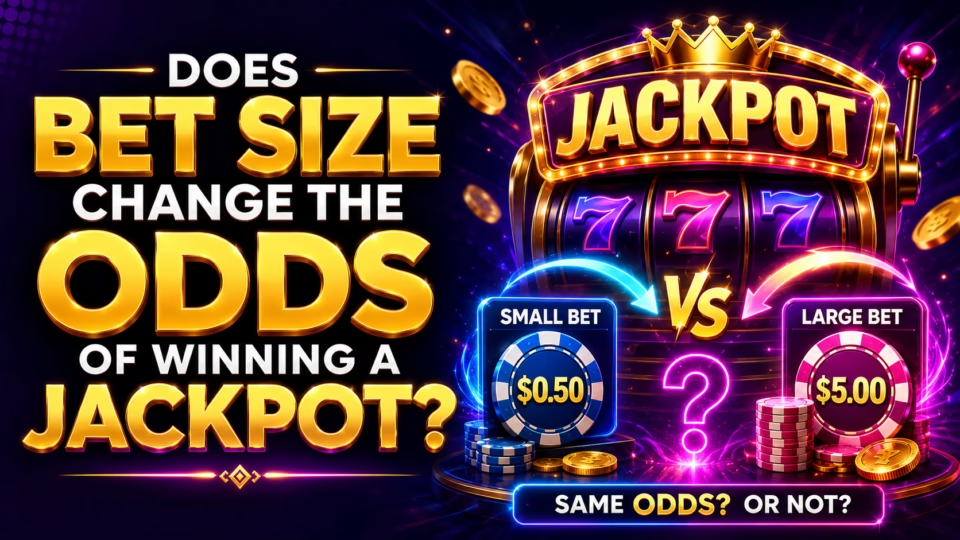
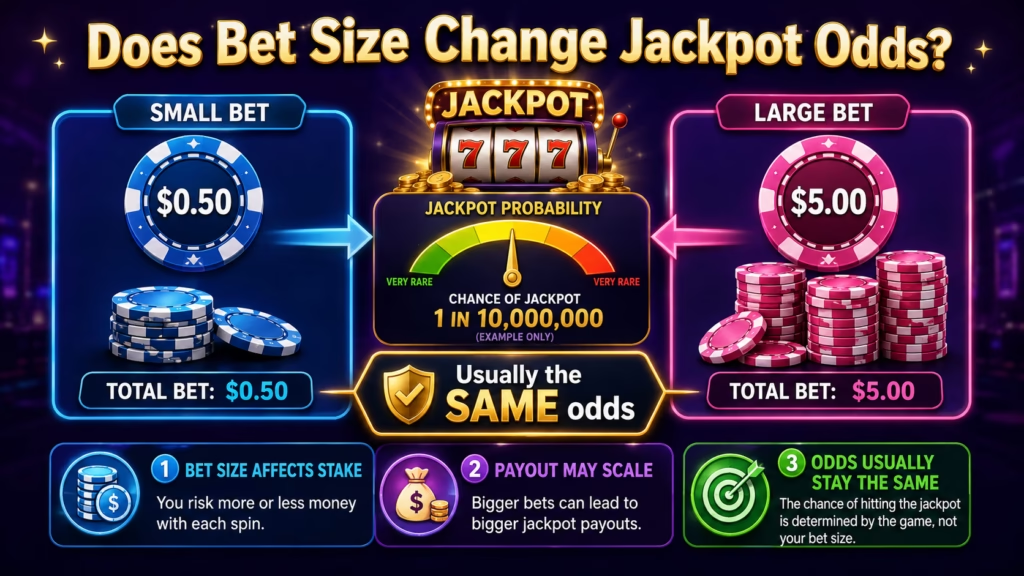
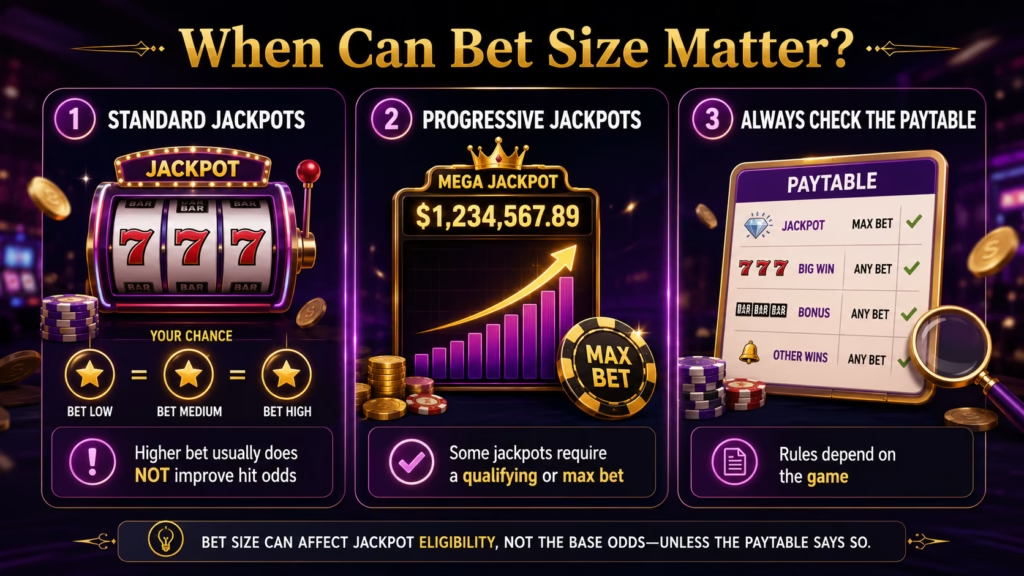
Bet size does not automatically change the odds of winning a jackpot. Whether betting more increases jackpot chances depends entirely on how the specific game calculates jackpot eligibility and probability. In some slots, every qualifying spin has the same jackpot chance regardless of wager. In others, a larger bet can provide more jackpot entries, increase the probability per spin, or be required to qualify for the top prize.
The safest rule is simple: never assume a larger wager improves jackpot odds unless the game rules or paytable explicitly say that it does.
Quick takeaways:
- A higher bet does not universally increase jackpot probability.
- Some progressive jackpots use wager-dependent probability or ticket systems.
- Some jackpots require a minimum or maximum qualifying bet.
- A larger bet may increase the jackpot payout without changing the chance of triggering it.
- Betting more increases the amount of money at risk, even when jackpot odds remain unchanged.
Players interested in progressive slots or jackpot features should therefore check the game’s official rules rather than judging the mechanic from the size of the displayed jackpot alone.
Does Bet Size Affect Jackpot Odds?
Bet size affects jackpot odds only when the game’s jackpot mechanism is designed to use wager size as part of its probability calculation. Casino games do not follow one universal jackpot formula, so two visually similar progressive slots can treat wagers very differently.
Consider three common systems:
- Every eligible spin has the same jackpot probability.
- Larger wagers receive more jackpot entries or greater trigger probability.
- A specific wager is required before the jackpot becomes available.
The difference matters because increasing a $1 spin to $5 can have completely different consequences depending on the system. In the first case, the player simply risks five times as much money for the same jackpot chance. In the second case, the chance may increase. In the third case, the larger wager may simply unlock eligibility.
The paytable, help screen, jackpot rules, or provider documentation should state how the feature works.
Does Betting More Increase Jackpot Chances?
Betting more can increase jackpot chances in some games, but it is not a general rule.
A jackpot system may allocate entries according to wager size. For example, imagine a hypothetical game where every $1 wager receives one jackpot entry:
- $1 bet = 1 entry
- $2 bet = 2 entries
- $5 bet = 5 entries
Under that specific model, increasing the wager produces more opportunities in the jackpot draw associated with that spin.
However, another game might assign exactly one jackpot opportunity to every eligible spin. A $0.50 spin and a $5 spin could therefore have identical jackpot probability.
The important point is that bet amount and jackpot probability are separate variables unless the game explicitly connects them.
Three Ways Jackpot Games Can Treat Bet Size
1. The Jackpot Chance Stays the Same at Every Eligible Bet
Some games give every qualifying spin the same probability of triggering the jackpot. Once the minimum qualifying conditions are met, increasing the wager does not provide additional jackpot chances.
For example, if a jackpot is available from bets of $0.50 upward, the jackpot probability might remain identical at:
- $0.50
- $1
- $2
- $5
In this type of game, increasing the wager solely because the jackpot looks attractive may provide no probability advantage.
Players with smaller entertainment budgets may prefer this structure because they can remain eligible without unnecessarily increasing their stake.
2. Jackpot Probability Increases With the Bet
Some jackpot systems connect wager size to jackpot probability. A larger wager may purchase more virtual entries or contribute proportionally more weight to a jackpot trigger.
A simplified example would be:
| Bet | Relative Jackpot Entries |
| $0.50 | 1 |
| $1.00 | 2 |
| $2.00 | 4 |
| $5.00 | 10 |
This example illustrates the mechanism only. Actual games can use completely different calculations.
Even when probability increases proportionally with the bet, that does not necessarily make the larger wager economically better. If the wager increases fivefold and the jackpot chance also increases fivefold, the player is paying five times as much for five times the exposure.
That is very different from receiving a mathematical advantage.
3. A Certain Bet Is Required to Qualify
Some jackpot games impose a qualifying wager.
A jackpot could require:
- a minimum total bet;
- all paylines to be active;
- a specific side bet;
- an additional jackpot contribution;
- or a maximum qualifying wager.
Under this system, betting below the threshold can mean the jackpot is completely unavailable.
Once the qualifying level is reached, however, additional wagering may or may not improve the odds.
This distinction is critical. Jackpot eligibility is not the same thing as jackpot probability.
Jackpot Eligibility vs Jackpot Probability
Jackpot eligibility determines whether your spin can win the jackpot at all. Jackpot probability determines how likely an eligible spin is to trigger the prize.
Suppose a progressive jackpot requires a minimum $1 wager.
A player betting $0.50 might have:
Jackpot eligibility: No
A player betting $1 might have:
Jackpot eligibility: Yes
A player betting $5 might also have:
Jackpot eligibility: Yes
That does not tell us whether the $5 spin has better odds than the $1 spin. The game could give both eligible wagers identical jackpot probability.
Players should therefore look for two separate pieces of information:
- What bet makes the jackpot available?
- Does probability change after eligibility is achieved?
Can a Larger Bet Increase the Jackpot Payout Instead?
Yes. Some games connect wager size to jackpot value rather than jackpot probability.
For example, the jackpot chance might remain constant while the amount awarded depends on the wager. A player betting at a higher level could qualify for a larger version of the prize.
A simplified structure could look like this:
- Low bet: 25% of displayed jackpot
- Medium bet: 50% of displayed jackpot
- Maximum qualifying bet: 100% of displayed jackpot
Other games might scale prizes through coin value, stake multipliers, or different jackpot tiers.
In such cases, saying that “you must bet more to win the jackpot” can be misleading. The player may already be able to trigger the jackpot at a smaller stake, but the resulting payout could differ.
The game rules should specify whether wager size affects probability, eligibility, payout size, or some combination of the three.
Do Progressive Jackpots Work Differently?
Progressive jackpots can use several different structures, so the relationship between bet size and jackpot odds must be checked game by game.
A progressive jackpot grows because qualifying wagers contribute to a prize pool or because the jackpot increases according to another predefined mechanism.
Standalone progressive jackpots
A standalone jackpot is linked to one game or machine. Its jackpot mechanics are defined within that individual game.
Local or casino-wide jackpots
Multiple games or machines within the same operator may feed into a shared jackpot.
Networked progressive jackpots
A networked jackpot can connect players across multiple casinos or games, creating much larger prize pools.
The size of the jackpot network does not automatically reveal how bet size affects probability. A multimillion-dollar progressive jackpot might use equal probability per eligible spin, weighted wager entries, or another system.
Does Maximum Bet Give You the Best Jackpot Odds?
Maximum bet does not automatically provide the best jackpot odds.
This belief partly comes from older casino machines and jackpot structures where maximum coin wagers were sometimes required for the largest prize. Modern online games use many different mechanics.
A maximum wager can have three possible effects:
- it may increase jackpot probability;
- it may unlock the full jackpot payout;
- it may provide no jackpot advantage beyond minimum eligibility.
Because these possibilities are fundamentally different, automatically choosing maximum bet is not a reliable jackpot strategy.
It also creates a straightforward financial problem. Higher stakes make the bankroll decline faster during losing sequences.
Example: Same Odds vs Bet-Weighted Odds
Game A: Equal Probability
Every eligible spin has a 1 in 1,000,000 jackpot probability.
A player betting $1 has:
1 in 1,000,000 per eligible spin
A player betting $5 also has:
1 in 1,000,000 per eligible spin
Betting five times more does nothing to improve jackpot probability.
Game B: Bet-Weighted Probability
Suppose another game assigns one jackpot entry for every $1 wager.
A $1 spin receives one entry, while a $5 spin receives five entries.
The $5 wager receives greater jackpot exposure per spin, but it also costs five times more.
This is why jackpot probability should never be evaluated without considering the price of each attempt.
More Money per Spin vs More Spins
Bet size also affects how many spins a fixed bankroll can support.
Suppose a player has a $100 entertainment budget.
At $1 per spin, the theoretical maximum is:
100 spins
At $5 per spin:
20 spins
If jackpot probability is identical at every eligible wager, making smaller bets allows more individual jackpot attempts from the same starting budget.
Even when larger wagers improve the chance per spin, the comparison becomes more complicated because fewer spins can be made.
There is no universal betting level that turns a random jackpot game into a positive or predictable strategy.
Does Bet Size Affect RTP?
Bet size and RTP are separate concepts.
RTP, or return to player, is the theoretical percentage of wagered money that a game is designed to return over a very large number of plays. RTP does not predict what will happen during one session.
Some games maintain the same theoretical RTP across wager levels. Others can have different configurations, jackpot contributions, bonus options, or game versions.
A higher wager therefore should not be assumed to produce better RTP.
Players should check the specific game’s paytable or information screen if RTP changes by configuration.
Jackpot Contribution Rates and Bet Size
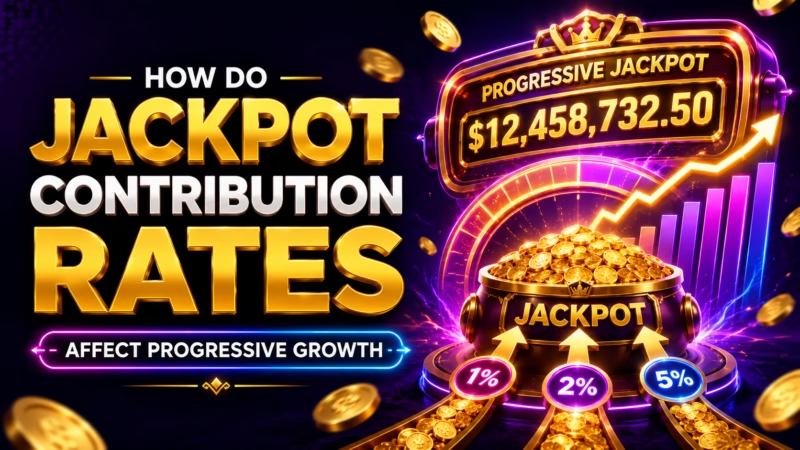
Progressive jackpots can be funded partly through a portion of qualifying wagers. A larger wager can therefore contribute a larger monetary amount to the jackpot pool.
However, contributing more money to the progressive pool does not automatically mean the individual player receives proportionally better odds.
For example, if 1% of every eligible wager contributes to a progressive jackpot:
- $1 bet contributes $0.01
- $5 bet contributes $0.05
The larger contribution tells us how the prize pool grows. It does not tell us how the jackpot winner is selected.
Contribution rate and trigger probability are separate mechanics unless the rules explicitly connect them.
Common Myths About Bet Size and Jackpots
“The casino rewards big bettors with jackpots”
Random casino games do not become more likely to award a jackpot simply because a player has previously spent more money unless the published jackpot mechanic specifically uses wager size.
Past losses do not make a future jackpot due.
“The jackpot is huge, so someone must win soon”
A large progressive jackpot does not mean a particular player’s next spin is more likely to win unless the game uses a probability system that changes with jackpot size.
Random outcomes do not become predictable because the displayed prize has grown.
“Maximum bet always unlocks the jackpot”
Some games require maximum stakes, but many do not. Eligibility conditions should be verified in the game rules.
“Increasing the bet after several losses improves the chance”
Changing wager size does not compensate for previous losing spins. Each random outcome is determined according to the game’s underlying rules.
How to Check Whether Bet Size Changes Jackpot Odds
Before increasing a wager for jackpot purposes, check the game information for:
1. Minimum qualifying bet: Find the lowest wager that activates the jackpot.
2. Maximum-bet requirements: Determine whether the top jackpot requires maximum stake.
3. Probability wording: Look for statements explaining whether jackpot probability increases with wager.
4. Prize scaling: Check whether larger bets change the payout amount rather than the trigger chance.
5. Jackpot contribution rules: Do not confuse contribution percentage with personal winning probability.
6. Jackpot tiers: Mini, Minor, Major and Grand jackpots may have different eligibility requirements.
7. Casino-specific terms: Game configurations and jackpot availability can vary by operator.
If these details are not clearly explained, do not assume that wagering more provides an advantage.
Should You Bet More to Chase a Jackpot?
Increasing the wager solely to chase a jackpot generally makes sense only if you understand exactly what the higher bet changes and are comfortable with the additional cost.
A higher stake may provide a mechanical benefit when the rules explicitly state that jackpot probability increases with bet size. Even then, the jackpot remains random and the additional probability must be considered alongside the increased wager.
For entertainment-focused play, bankroll limits are more controllable than jackpot outcomes. Decide your maximum spending limit before playing rather than increasing stakes because a progressive prize becomes more attractive.
Casino games should be treated as entertainment, not as a reliable method of making money.
How This Information Was Reviewed
The relationship between bet size and jackpot odds should be evaluated using four separate criteria: jackpot eligibility, trigger probability, payout scaling and wager cost.
Exact mechanics can differ between games, providers and casino configurations. The paytable, game rules and operator terms should therefore be treated as the authoritative sources for a specific jackpot.
RTP, volatility, jackpot size and previous outcomes do not guarantee what will happen on the next spin. Players should use fixed spending limits, avoid chasing losses and stop playing when gambling is no longer recreational.
FAQ
Does bet size affect jackpot odds?
Sometimes. Bet size affects jackpot odds only when the game’s rules connect wager size to jackpot probability. Other games give every eligible wager the same chance.
Does betting more increase jackpot chances?
Betting more can increase jackpot chances in games that use wager-weighted entries or probability. It provides no additional probability in games where every qualifying spin has equal jackpot odds.
Do you have to bet maximum to win a progressive jackpot?
Not always. Some progressive jackpots require a maximum or minimum qualifying wager, while others are available at multiple bet levels. Check the game’s official rules.
Can I win the full jackpot with a minimum bet?
It depends on the game. Some jackpots pay the full prize at any eligible wager, while others scale the payout according to bet size or require a specific stake for the top award.
Are jackpot odds better on higher denomination slots?
Not necessarily. Higher denomination does not automatically mean better jackpot probability. The relationship depends on the game’s mathematical rules and jackpot configuration.
Does increasing my bet after losing improve my jackpot chances?
No general rule makes previous losses improve the next jackpot outcome. Increasing the bet only changes the probability if the jackpot system specifically uses wager size as part of its trigger calculation.
Does a bigger progressive jackpot become easier to win?
Not necessarily. A larger jackpot balance can simply mean the prize has accumulated for longer. Unless the game uses a probability system that changes as the jackpot grows, the displayed amount does not indicate that a win is due.
Does a bigger bet increase RTP?
Not automatically. RTP is determined by the game’s mathematical configuration. Some games use the same RTP at every wager, while others may have different versions or features. Check the paytable for the specific game.
Is it better to make small bets and play more spins?
If jackpot probability is identical at every eligible wager, smaller bets can provide more individual spins from the same bankroll. This still does not guarantee a jackpot, and every outcome remains random.
How can I know whether a jackpot uses bet-weighted odds?
Check the paytable, help screen, jackpot rules or official game documentation. Look specifically for wording about qualifying stakes, probability increasing with bet size, jackpot entries or payout scaling.
Brief Conclusion
Bet size changes jackpot odds only when the specific game is designed that way. A larger wager may increase jackpot probability, unlock eligibility, increase the payout, or provide no jackpot advantage at all. Check the game’s rules before assuming that betting more gives you a better chance. Higher stakes always increase the money at risk, while jackpot outcomes remain random.